
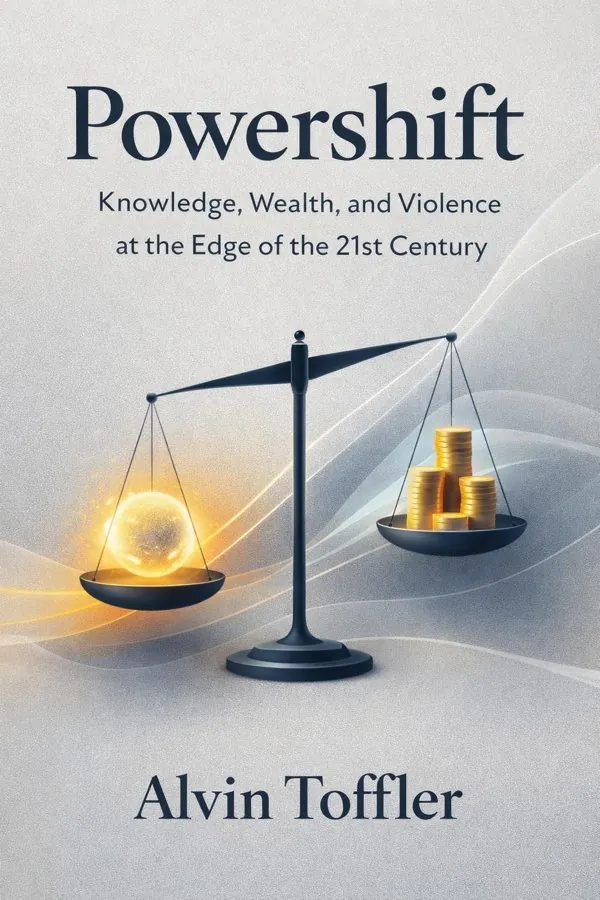
Powershift: Knowledge, Wealth, and Violence at the Edge of the 21st Century: Summary & Key Insights
 10 min5 chaptersAudio available
What Is Powershift: Knowledge, Wealth, and Violence at the Edge of the 21st Century About?
Powershift: Knowledge, Wealth, and Violence at the Edge of the 21st Century by Alvin Toffler is a future_trends book spanning 5 pages. Powershift explores how the balance of power in society is changing as knowledge becomes the most important source of influence, surpassing wealth and force. Alvin Toffler analyzes the transformation of global institutions, economies, and relationships as information technology reshapes the way power is created and exercised.
This FizzRead summary covers all 5 key chapters of Powershift: Knowledge, Wealth, and Violence at the Edge of the 21st Century in approximately 10 minutes, distilling the most important ideas, arguments, and takeaways from Alvin Toffler's work. Also available as an audio summary and Key Quotes Podcast.
Powershift: Knowledge, Wealth, and Violence at the Edge of the 21st Century
Powershift explores how the balance of power in society is changing as knowledge becomes the most important source of influence, surpassing wealth and force. Alvin Toffler analyzes the transformation of global institutions, economies, and relationships as information technology reshapes the way power is created and exercised.
Who Should Read Powershift: Knowledge, Wealth, and Violence at the Edge of the 21st Century?
This book is perfect for anyone interested in future_trends and looking to gain actionable insights in a short read. Whether you're a student, professional, or lifelong learner, the key ideas from Powershift: Knowledge, Wealth, and Violence at the Edge of the 21st Century by Alvin Toffler will help you think differently.
- ✓Readers who enjoy future_trends and want practical takeaways
- ✓Professionals looking to apply new ideas to their work and life
- ✓Anyone who wants the core insights of Powershift: Knowledge, Wealth, and Violence at the Edge of the 21st Century in just 10 minutes
Want the full summary?
Get instant access to this book summary and 100K+ more with Fizz Moment.
Get Free SummaryAvailable on App Store • Free to download
Key Chapters
Power has always been about control—the ability to make others do what you want, to shape outcomes, to influence futures. In the earliest human societies, power stemmed from physical strength and violence. The hunter with the sharpest weapon or the chief commanding loyal warriors ruled his tribe. Later, as agriculture arose, landowners accumulated power through wealth—control of resources, property, and labor. The entire structure of feudal Europe exemplified this: those who owned land produced food and thus controlled both survival and submission.
The industrial revolution introduced an entirely new configuration of power. Machines multiplied the productivity of human labor, and capital became king. Economic systems revolved around those who could marshal capital, invest in factories, and employ the emerging working class. Wealth generated authority, which in turn determined who controlled governments and social institutions.
Yet even throughout the industrial age, knowledge played an underappreciated role. The engineers, inventors, and managers who knew how machines functioned and markets behaved possessed a quiet yet rising form of influence. Over time, as production processes grew more complex, the need for specialized knowledge intensified. Bureaucratic hierarchies emerged to manage complexity, and information—about production rates, market demands, or financial performance—became an indispensable tool of control.
By the late twentieth century, the explosive growth of information technologies exposed a fundamental transformation: knowledge was no longer an accessory to wealth and force; it had become their foundation. Information could amplify or dismantle military power, accelerate or destroy corporate wealth, and democratize political voice. In this new era, power could be derived from knowing something others did not. Unlike land or money, knowledge could be shared without being divided, multiplied without limits. It was—and remains—the ultimate leverage.
This realization forces us to rethink history itself as a continual evolution of the sources of power: from violence to wealth to knowledge. And as each era takes shape, new elites emerge. In our time, the new elite are not merely those with money or weapons but those with insight, information networks, and the ability to convert knowledge into actionable influence.
In industrial economies, value was tied to tangible resources—iron, coal, oil, machinery. In the knowledge economy, value inheres in intangible assets: software, data, expertise, intellectual property. The transformation is immense. When information becomes the key production resource, the traditional equations of power dissolve.
In corporations, the powershift manifests most dramatically. The executive controlling information systems can wield more influence than the owner of the machines. Decision-making migrates from the factory floor to the data center. Managers who understand how to handle uncertainty and rapid information flow govern competitive advantage. The rise of information networks flattens hierarchy: the clerk connected to the right data stream can challenge the authority of supervisors steeped in outdated procedures. Business empires can rise or fall overnight not because of resource shortages, but because of gaps in knowledge management.
Even economic behavior changes character. Knowledge departs from the rules of scarcity that govern material goods. When knowledge is shared, everyone equipped with it gains power; yet if withheld or manipulated, it can enslave. This dual nature of information—its capacity to liberate or imprison—makes it the most strategic element of the modern age.
Wealth itself becomes knowledge-intensive. Financial markets depend on real-time data, predictive models, and computational instruments. Supply chains rely on information systems rather than simple logistics. Intangibles outperform tangibles. The more advanced an economy becomes, the more its power structure is dictated by who generates, processes, and applies knowledge.
But the powershift doesn’t stop in the economy. It transforms governance, culture, and individual identity. Nations once reliant on natural resources find themselves vulnerable unless they build technological and educational infrastructures. The affluent are those who command channels of communication and analysis. The poor are those denied access to information.
Thus, the emerging global divide is not just between rich and poor, East and West, or North and South—it is between the knowledgeable and the ignorant. Those who can learn faster, adapt quicker, and leverage data intelligently hold the future in their hands. The control of knowledge, not merely its possession, will determine who commands society’s critical systems.
+ 3 more chapters — available in the FizzRead app
All Chapters in Powershift: Knowledge, Wealth, and Violence at the Edge of the 21st Century
About the Author
Alvin Toffler (1928–2016) was an American writer and futurist known for his works discussing modern technologies and their social impacts. His notable books include Future Shock and The Third Wave, which examine the effects of rapid technological and societal change.
Get This Summary in Your Preferred Format
Read or listen to the Powershift: Knowledge, Wealth, and Violence at the Edge of the 21st Century summary by Alvin Toffler anytime, anywhere. FizzRead offers multiple formats so you can learn on your terms — all free.
Available formats: App · Audio · PDF · EPUB — All included free with FizzRead
Download Powershift: Knowledge, Wealth, and Violence at the Edge of the 21st Century PDF and EPUB Summary
Key Quotes from Powershift: Knowledge, Wealth, and Violence at the Edge of the 21st Century
“Power has always been about control—the ability to make others do what you want, to shape outcomes, to influence futures.”
“In industrial economies, value was tied to tangible resources—iron, coal, oil, machinery.”
Frequently Asked Questions about Powershift: Knowledge, Wealth, and Violence at the Edge of the 21st Century
Powershift: Knowledge, Wealth, and Violence at the Edge of the 21st Century by Alvin Toffler is a future_trends book that explores key ideas across 5 chapters. Powershift explores how the balance of power in society is changing as knowledge becomes the most important source of influence, surpassing wealth and force. Alvin Toffler analyzes the transformation of global institutions, economies, and relationships as information technology reshapes the way power is created and exercised.
More by Alvin Toffler
You Might Also Like
Futureproof: 9 Rules for Humans in the Age of Automation
Kevin Roose
10 min
The Third Wave
Alvin Toffler
10 min
2030: How Today's Biggest Trends Will Collide and Reshape the Future of Everything
Mauro F. Guillén
10 min
A Very Human Future: Enriching Humanity in a Digitized World
Rohit Talwar, Steve Wells, Alexandra Whittington
10 min
AI 2041: Ten Visions for Our Future
Kai-Fu Lee, Chen Qiufan
10 min
Abundance: The Future Is Better Than You Think
Peter H. Diamandis, Steven Kotler
10 minBrowse by Category
Ready to read Powershift: Knowledge, Wealth, and Violence at the Edge of the 21st Century?
Get the full summary and 100K+ more books with Fizz Moment.