
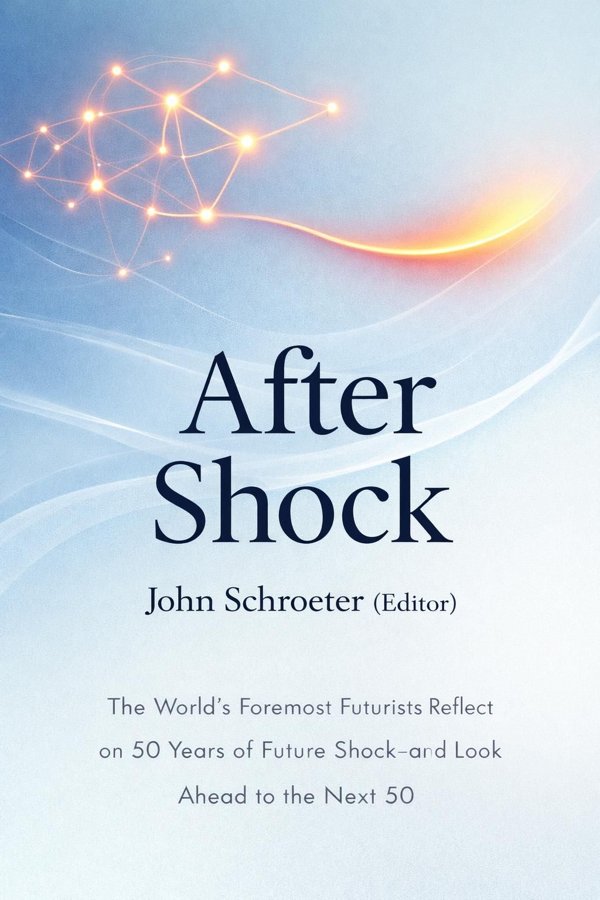
After Shock: The World's Foremost Futurists Reflect on 50 Years of Future Shock—and Look Ahead to the Next 50: Summary & Key Insights
 10 min6 chaptersAudio available
What Is After Shock: The World's Foremost Futurists Reflect on 50 Years of Future Shock—and Look Ahead to the Next 50 About?
After Shock: The World's Foremost Futurists Reflect on 50 Years of Future Shock—and Look Ahead to the Next 50 by John Schroeter (Editor) is a future_trends book spanning 6 pages. After Shock is a commemorative anthology marking the 50th anniversary of Alvin and Heidi Toffler’s seminal work, Future Shock. Edited by John Schroeter, the book gathers essays from leading futurists, technologists, and thought leaders who reflect on the Tofflers’ predictions and explore the accelerating pace of change shaping the next half-century. Contributors discuss topics such as artificial intelligence, climate change, social transformation, and the future of human identity in a rapidly evolving world.
This FizzRead summary covers all 6 key chapters of After Shock: The World's Foremost Futurists Reflect on 50 Years of Future Shock—and Look Ahead to the Next 50 in approximately 10 minutes, distilling the most important ideas, arguments, and takeaways from John Schroeter (Editor)'s work. Also available as an audio summary and Key Quotes Podcast.
After Shock: The World's Foremost Futurists Reflect on 50 Years of Future Shock—and Look Ahead to the Next 50
After Shock is a commemorative anthology marking the 50th anniversary of Alvin and Heidi Toffler’s seminal work, Future Shock. Edited by John Schroeter, the book gathers essays from leading futurists, technologists, and thought leaders who reflect on the Tofflers’ predictions and explore the accelerating pace of change shaping the next half-century. Contributors discuss topics such as artificial intelligence, climate change, social transformation, and the future of human identity in a rapidly evolving world.
Who Should Read After Shock: The World's Foremost Futurists Reflect on 50 Years of Future Shock—and Look Ahead to the Next 50?
This book is perfect for anyone interested in future_trends and looking to gain actionable insights in a short read. Whether you're a student, professional, or lifelong learner, the key ideas from After Shock: The World's Foremost Futurists Reflect on 50 Years of Future Shock—and Look Ahead to the Next 50 by John Schroeter (Editor) will help you think differently.
- ✓Readers who enjoy future_trends and want practical takeaways
- ✓Professionals looking to apply new ideas to their work and life
- ✓Anyone who wants the core insights of After Shock: The World's Foremost Futurists Reflect on 50 Years of Future Shock—and Look Ahead to the Next 50 in just 10 minutes
Want the full summary?
Get instant access to this book summary and 100K+ more with Fizz Moment.
Get Free SummaryAvailable on App Store • Free to download
Key Chapters
Half a century after Alvin and Heidi Toffler revealed the world’s growing unease with technological acceleration, their core thesis remains hauntingly relevant. *Future Shock* described a psychological condition born of too much change in too short a time—a collective and individual sense of overstimulation, of losing our stable patterns of identity, community, and belonging. In *After Shock*, our contributors revisit this idea not as nostalgic reflection but as current diagnosis. The very information overload that the Tofflers predicted has metastasized. Now, every second brings data, notifications, updates, and decisions, each demanding a slice of attention.
Reflecting from the Tofflers’ vantage, I find their insight prescient: when human adaptation lags behind innovation, society splinters into confusion. Yet the essays gathered here suggest something deeper—that the shock is not simply emotional but structural. Our institutions, built for linear change, falter under exponential conditions. Governance frameworks groan under the weight of digital democracy. Education models, designed for predictability, collapse in the face of lifelong flux. Every contributor, whether drawing on neuroscience, sociology, or technology, agrees the Tofflers’ concept of adaptive capacity is now civilization’s most vital skill.
Revisiting *Future Shock* thus invites us to ask not whether they were right, but how we respond when the future’s tempo has far surpassed their forecasts. Their call for a ‘future-oriented education,’ their plea for empathy amid transformation—these ideas are reborn across the anthology’s chapters as fundamental imperatives. Futurist Hazel Henderson reminds us that awareness itself can be a coping strategy; the ability to anticipate systemic consequences restores human agency. This realization connects directly to the book’s purpose: understanding that ‘shock’ can be transmuted into a catalyst for renewal when we learn to see change as material for creation, not chaos.
In the decades since *Future Shock*, technological growth has ceased to feel linear—it has become exponential. The contributors to *After Shock* explore this acceleration across disciplines, mapping the compound effects of digital interconnectivity, computational power, and demographic shifts. Futurist Gerd Leonhard notes how the data revolution redefines not only industry but identity: every click, every share, every streamed moment accelerates the fabric of our shared reality. The Tofflers foresaw rapid transitions between technologies; we now confront multiplicative transitions, where one innovation instantly seeds another.
From my editorial perspective, collecting these essays was itself an experience of acceleration. Each author approached the question of speed with different tools—some through mathematics, others through ethics—but all converged on a single observation: humanity is living at the intersection of machine velocity and biological limitation. This tension shapes everything—from economics to education, from personal psychology to global politics. As Kevin Kelly argues, when systems shift faster than our moral frameworks can adapt, we need new patterns of foresight that mirror technological flexibility.
What does acceleration mean for the ordinary person? Several contributors emphasize that the experience of change is not evenly distributed. For some, like software engineers immersed in perpetual beta, it feels energizing; for others, caught in industries swept aside by automation, it is destabilizing. The Tofflers believed the remedy lay in conscious adaptation; *After Shock* extends that principle to collective resilience. The ‘future shock’ of 1970 has evolved into the ‘future flux’ of today—an always-on state demanding agile cognition. Yet within that velocity lies opportunity. If we treat acceleration as medium, the future becomes a space not of panic but of innovation, a field where redesigning the way we learn and govern can harmonize with the speed itself.
+ 4 more chapters — available in the FizzRead app
All Chapters in After Shock: The World's Foremost Futurists Reflect on 50 Years of Future Shock—and Look Ahead to the Next 50
About the Author
John Schroeter is an American author, editor, and technology entrepreneur. He has worked extensively in publishing and innovation, serving as Executive Director of the World Future Society and editor of several works on emerging technologies and futurism.
Get This Summary in Your Preferred Format
Read or listen to the After Shock: The World's Foremost Futurists Reflect on 50 Years of Future Shock—and Look Ahead to the Next 50 summary by John Schroeter (Editor) anytime, anywhere. FizzRead offers multiple formats so you can learn on your terms — all free.
Available formats: App · Audio · PDF · EPUB — All included free with FizzRead
Download After Shock: The World's Foremost Futurists Reflect on 50 Years of Future Shock—and Look Ahead to the Next 50 PDF and EPUB Summary
Key Quotes from After Shock: The World's Foremost Futurists Reflect on 50 Years of Future Shock—and Look Ahead to the Next 50
“Half a century after Alvin and Heidi Toffler revealed the world’s growing unease with technological acceleration, their core thesis remains hauntingly relevant.”
“In the decades since *Future Shock*, technological growth has ceased to feel linear—it has become exponential.”
Frequently Asked Questions about After Shock: The World's Foremost Futurists Reflect on 50 Years of Future Shock—and Look Ahead to the Next 50
After Shock: The World's Foremost Futurists Reflect on 50 Years of Future Shock—and Look Ahead to the Next 50 by John Schroeter (Editor) is a future_trends book that explores key ideas across 6 chapters. After Shock is a commemorative anthology marking the 50th anniversary of Alvin and Heidi Toffler’s seminal work, Future Shock. Edited by John Schroeter, the book gathers essays from leading futurists, technologists, and thought leaders who reflect on the Tofflers’ predictions and explore the accelerating pace of change shaping the next half-century. Contributors discuss topics such as artificial intelligence, climate change, social transformation, and the future of human identity in a rapidly evolving world.
You Might Also Like
Futureproof: 9 Rules for Humans in the Age of Automation
Kevin Roose
10 min
The Third Wave
Alvin Toffler
10 min
2030: How Today's Biggest Trends Will Collide and Reshape the Future of Everything
Mauro F. Guillén
10 min
A Very Human Future: Enriching Humanity in a Digitized World
Rohit Talwar, Steve Wells, Alexandra Whittington
10 min
AI 2041: Ten Visions for Our Future
Kai-Fu Lee, Chen Qiufan
10 min
Abundance: The Future Is Better Than You Think
Peter H. Diamandis, Steven Kotler
10 minFeatured In
Browse by Category
Ready to read After Shock: The World's Foremost Futurists Reflect on 50 Years of Future Shock—and Look Ahead to the Next 50?
Get the full summary and 100K+ more books with Fizz Moment.