
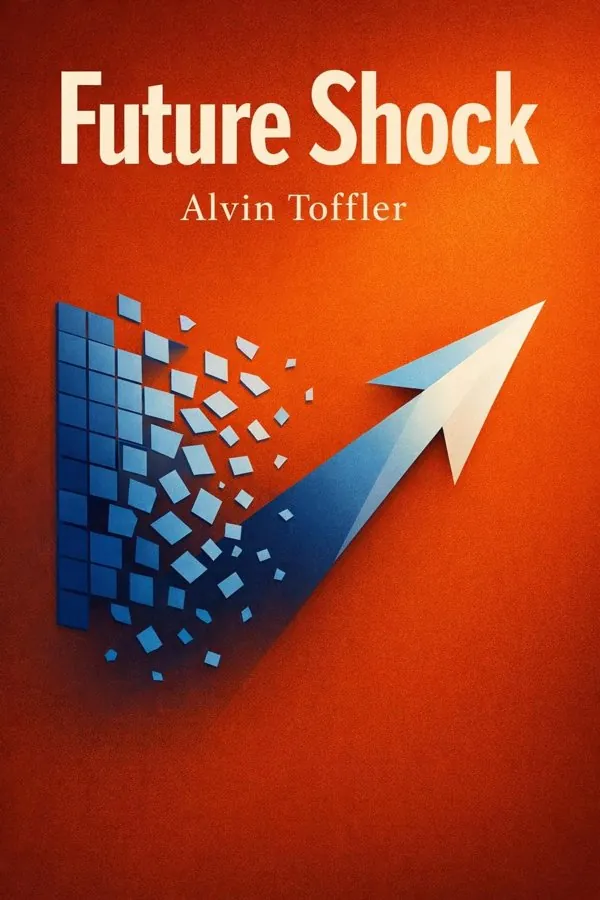
Future Shock: Summary & Key Insights
 10 min7 chaptersAudio available
What Is Future Shock About?
Future Shock by Alvin Toffler is a future_trends book spanning 7 pages. Future Shock es un libro de no ficción escrito por Alvin Toffler y publicado por primera vez en 1970. Explora el impacto psicológico y social de la aceleración del cambio tecnológico y cultural, argumentando que la humanidad enfrenta una sobrecarga de información y una rápida obsolescencia de valores y estructuras sociales. Toffler acuñó el término 'shock del futuro' para describir la desorientación y el estrés que resultan de vivir en una sociedad en constante transformación.
This FizzRead summary covers all 7 key chapters of Future Shock in approximately 10 minutes, distilling the most important ideas, arguments, and takeaways from Alvin Toffler's work. Also available as an audio summary and Key Quotes Podcast.
Future Shock
Future Shock es un libro de no ficción escrito por Alvin Toffler y publicado por primera vez en 1970. Explora el impacto psicológico y social de la aceleración del cambio tecnológico y cultural, argumentando que la humanidad enfrenta una sobrecarga de información y una rápida obsolescencia de valores y estructuras sociales. Toffler acuñó el término 'shock del futuro' para describir la desorientación y el estrés que resultan de vivir en una sociedad en constante transformación.
Who Should Read Future Shock?
This book is perfect for anyone interested in future_trends and looking to gain actionable insights in a short read. Whether you're a student, professional, or lifelong learner, the key ideas from Future Shock by Alvin Toffler will help you think differently.
- ✓Readers who enjoy future_trends and want practical takeaways
- ✓Professionals looking to apply new ideas to their work and life
- ✓Anyone who wants the core insights of Future Shock in just 10 minutes
Want the full summary?
Get instant access to this book summary and 100K+ more with Fizz Moment.
Get Free SummaryAvailable on App Store • Free to download
Key Chapters
At the heart of *Future Shock* lies a recognition of the exponential acceleration of change. For millions of years, human progress followed a slow, linear rhythm. In contrast, modern society experiences innovation bursts that compress centuries' worth of transformation into just decades. The industrial revolution initiated this process; automation, computerization, and information technology intensified it. Today, every scientific discovery generates a chain reaction of further discoveries, and each new invention radically redefines the landscape of human experience.
This rapid turnover challenges individuals and institutions alike. People once expected their jobs, communities, and beliefs to remain relatively stable throughout life. Now, even large corporations must reinvent themselves every few years, and individuals must learn new skills repeatedly. This constant adaptation produces tremendous psychological tension. The depth of change is not merely quantitative—it alters the very pattern of human existence.
To understand acceleration, imagine three waves of history: the agricultural, industrial, and super-industrial. The first was measured by generations; the second, by decades; the third, by years. In the super-industrial society, transformation occurs so swiftly that social structures can scarcely catch up. This mismatch creates chaos, uncertainty, and, ultimately, the syndrome I call ‘future shock.’ I urge readers to see that coping with this pace requires more than endurance—it demands anticipation. We must develop the capacity to foresee change and respond proactively, rather than reactively.
Future shock expresses itself most clearly through transience—the impermanence that pervades relationships, jobs, and possessions. In one generation, we have moved from a society that valued durability to one that thrives on instant replacement. We change homes, careers, partners, and even identities with unprecedented frequency. Materially, this appears as the throwaway product cycle; psychologically, it manifests as a restless sense of unreliability.
When permanence disappears, the individual loses the continuity that once sustained meaning. In the traditional world, people knew who they were partly because of stable surroundings. But the modern individual must reconstruct identity continuously. We live amid temporary arrangements—short-term employment, disposable goods, transient neighborhoods—all reinforcing an unstable sense of self.
This instability is not merely an economic product; it is a psychological pattern. Toffler describes how habitual change forces adaptability but exacts emotional tolls. People who cannot cope experience anxiety, loneliness, and alienation. Yet transience also contains a paradoxical blessing. It liberates us from rigid structures, enabling growth and reinvention. The challenge, I insist, is to build psychic anchors—to cultivate values and purposes that endure even as material conditions shift. This internal continuity is the only antidote to external impermanence.
+ 5 more chapters — available in the FizzRead app
All Chapters in Future Shock
About the Author
Alvin Toffler (1928–2016) fue un escritor y futurista estadounidense conocido por sus obras sobre la revolución digital, la comunicación y el cambio social. Su trabajo influyó en la comprensión moderna de la tecnología y la sociedad, y su trilogía 'Future Shock', 'The Third Wave' y 'Powershift' se considera fundamental en el pensamiento futurista.
Get This Summary in Your Preferred Format
Read or listen to the Future Shock summary by Alvin Toffler anytime, anywhere. FizzRead offers multiple formats so you can learn on your terms — all free.
Available formats: App · Audio · PDF · EPUB — All included free with FizzRead
Download Future Shock PDF and EPUB Summary
Key Quotes from Future Shock
“At the heart of *Future Shock* lies a recognition of the exponential acceleration of change.”
“Future shock expresses itself most clearly through transience—the impermanence that pervades relationships, jobs, and possessions.”
Frequently Asked Questions about Future Shock
Future Shock by Alvin Toffler is a future_trends book that explores key ideas across 7 chapters. Future Shock es un libro de no ficción escrito por Alvin Toffler y publicado por primera vez en 1970. Explora el impacto psicológico y social de la aceleración del cambio tecnológico y cultural, argumentando que la humanidad enfrenta una sobrecarga de información y una rápida obsolescencia de valores y estructuras sociales. Toffler acuñó el término 'shock del futuro' para describir la desorientación y el estrés que resultan de vivir en una sociedad en constante transformación.
More by Alvin Toffler
You Might Also Like
Futureproof: 9 Rules for Humans in the Age of Automation
Kevin Roose
10 min
The Third Wave
Alvin Toffler
10 min
2030: How Today's Biggest Trends Will Collide and Reshape the Future of Everything
Mauro F. Guillén
10 min
A Very Human Future: Enriching Humanity in a Digitized World
Rohit Talwar, Steve Wells, Alexandra Whittington
10 min
AI 2041: Ten Visions for Our Future
Kai-Fu Lee, Chen Qiufan
10 min
Abundance: The Future Is Better Than You Think
Peter H. Diamandis, Steven Kotler
10 minBrowse by Category
Ready to read Future Shock?
Get the full summary and 100K+ more books with Fizz Moment.