
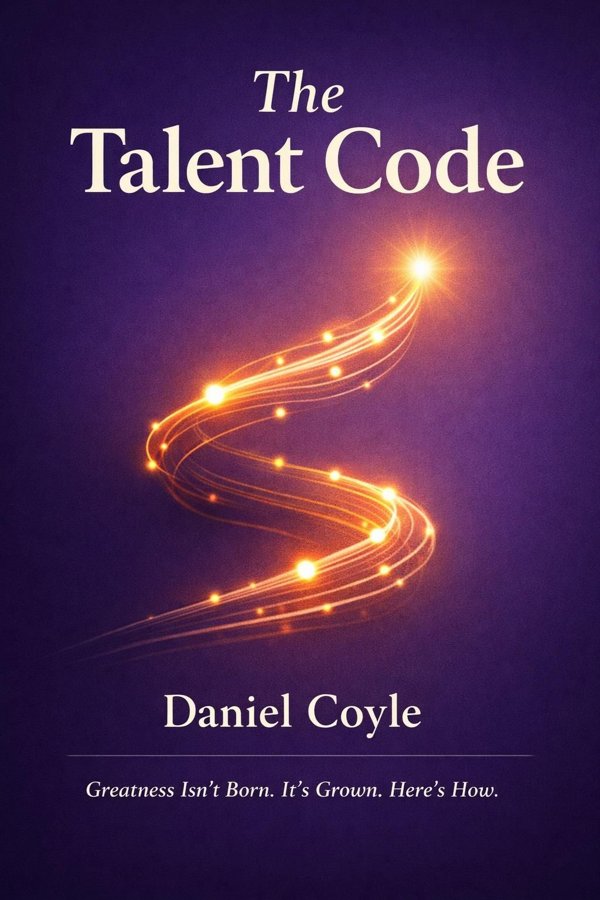
The Talent Code: Greatness Isn't Born. It's Grown. Here's How.: Summary & Key Insights
by Daniel Coyle
 10 min10 chaptersAudio available
What Is The Talent Code: Greatness Isn't Born. It's Grown. Here's How. About?
The Talent Code: Greatness Isn't Born. It's Grown. Here's How. by Daniel Coyle is a education book spanning 10 pages. The Talent Code explores how talent is developed through deep practice, ignition, and master coaching. Daniel Coyle investigates the neurological basis of skill acquisition, showing how myelin growth in the brain enhances performance. Through examples from sports, music, and education, the book reveals that greatness is not innate but cultivated through deliberate effort and the right environment.
This FizzRead summary covers all 10 key chapters of The Talent Code: Greatness Isn't Born. It's Grown. Here's How. in approximately 10 minutes, distilling the most important ideas, arguments, and takeaways from Daniel Coyle's work. Also available as an audio summary and Key Quotes Podcast.
The Talent Code: Greatness Isn't Born. It's Grown. Here's How.
The Talent Code explores how talent is developed through deep practice, ignition, and master coaching. Daniel Coyle investigates the neurological basis of skill acquisition, showing how myelin growth in the brain enhances performance. Through examples from sports, music, and education, the book reveals that greatness is not innate but cultivated through deliberate effort and the right environment.
Who Should Read The Talent Code: Greatness Isn't Born. It's Grown. Here's How.?
This book is perfect for anyone interested in education and looking to gain actionable insights in a short read. Whether you're a student, professional, or lifelong learner, the key ideas from The Talent Code: Greatness Isn't Born. It's Grown. Here's How. by Daniel Coyle will help you think differently.
- ✓Readers who enjoy education and want practical takeaways
- ✓Professionals looking to apply new ideas to their work and life
- ✓Anyone who wants the core insights of The Talent Code: Greatness Isn't Born. It's Grown. Here's How. in just 10 minutes
Want the full summary?
Get instant access to this book summary and 100K+ more with Fizz Moment.
Get Free SummaryAvailable on App Store • Free to download
Key Chapters
Every act of skill — playing a note on the violin, making a fluid tennis forehand, articulating a precise sentence — begins as a signal traveling through a neural circuit. These circuits grow stronger when wrapped in myelin, the biological insulation that allows impulses to travel more swiftly and precisely. Understanding this process changes the entire conversation about talent.
Through research with neuroscientists like Dr. Douglas Fields and Dr. R. Douglas Shadlen, I came to learn that myelin functions as nature’s ultimate amplifier. Each time you practice a skill correctly, you fire that circuit, and the body responds by wrapping another layer of myelin around those fibers. Over time, layers accumulate, thickening the insulation, and therefore strengthening that skill pathway. When you see a master effortlessly performing their craft, you are watching the outcome of miles of myelin built through thousands of deeply engaged repetitions.
This means that talent is physical — not mystical. The brain isn’t passively gifted; it is actively engineered by experience. Every mistake, every correction, every moment of effort actually reshapes the wiring of who you are. The secret is not exposure but intensity and accuracy of firing. That’s why shallow practice — casual repetition without focus — contributes far less than deep, effortful struggle. Modern neuroscience reveals that greatness does not flow from genes alone, but from the continual construction of neural insulation, built one microsecond of attention at a time.
The realization that myelin growth drives skill allows us to redefine learning itself. It’s not memorization, not repetition, but circuit-building. If you can focus your effort where it matters most — on your edges, on the parts where you fail and then succeed — you are engaging in the biological process that literally grows talent inside you. And once you see skill as something built through myelin development, you see that talent truly can be grown.
Deep practice is the engine of the Talent Code’s system. It looks deceptively simple but is biologically and psychologically profound. It is the type of practice that feels difficult, uncomfortable, and filled with mistakes — and precisely because of that, it builds myelin and engrains mastery.
In deep practice, the key is not mindless repetition, but *targeted struggle*. You deliberately work inside the zone just beyond your comfort, where failure happens frequently but meaningfully. Think of how children learn language — haltingly, imperfectly, but driven by endless correction and feedback. That same pattern defines every skill learning process. You slow down, you break down a move or sequence, and you attend to errors with heightened focus.
At the Russian tennis academy Spartak, young players train not by continuous full games but by breaking movements into tiny, corrected chunks. At the Meadowmount School of Music in New York, violinists spend hours practicing at half-speed, cultivating microscopic improvements. These environments reinforce the same universal truth — talent isn't the ability to do something perfectly, but the resilience to refine imperfection until it becomes precision.
Physiologically, each moment of deep practice forces your neural circuits to fire with intensity and precision. As you repeat, the myelin layers understanding around those circuits. It is in those uncomfortable repetitions that true skill is physically wired.
When you change your relationship to mistakes — seeing them as treasurable signals rather than humiliations — you unlock the central mechanic of talent growth. Deep practice teaches patience and courage: it is the art of embracing failure as feedback. Every master I spoke to — coaches, mentors, champions — understood this instinctively. They didn’t chase smoothness; they chased correction. Talent, in truth, is built in the place where you are most challenged.
+ 8 more chapters — available in the FizzRead app
All Chapters in The Talent Code: Greatness Isn't Born. It's Grown. Here's How.
About the Author
Daniel Coyle is an American author and journalist known for his works on performance, learning, and organizational culture. He has written several bestselling books including The Culture Code and The Little Book of Talent. Coyle has contributed to publications such as Sports Illustrated and The New York Times.
Get This Summary in Your Preferred Format
Read or listen to the The Talent Code: Greatness Isn't Born. It's Grown. Here's How. summary by Daniel Coyle anytime, anywhere. FizzRead offers multiple formats so you can learn on your terms — all free.
Available formats: App · Audio · PDF · EPUB — All included free with FizzRead
Download The Talent Code: Greatness Isn't Born. It's Grown. Here's How. PDF and EPUB Summary
Key Quotes from The Talent Code: Greatness Isn't Born. It's Grown. Here's How.
“Every act of skill — playing a note on the violin, making a fluid tennis forehand, articulating a precise sentence — begins as a signal traveling through a neural circuit.”
“Deep practice is the engine of the Talent Code’s system.”
Frequently Asked Questions about The Talent Code: Greatness Isn't Born. It's Grown. Here's How.
The Talent Code: Greatness Isn't Born. It's Grown. Here's How. by Daniel Coyle is a education book that explores key ideas across 10 chapters. The Talent Code explores how talent is developed through deep practice, ignition, and master coaching. Daniel Coyle investigates the neurological basis of skill acquisition, showing how myelin growth in the brain enhances performance. Through examples from sports, music, and education, the book reveals that greatness is not innate but cultivated through deliberate effort and the right environment.
More by Daniel Coyle
You Might Also Like

Bedtime Biography: Florence Nightingale
Isabel Thomas
10 min
Introduction To Museum Studies
Howard H. Hoyt
10 min
A Mind for Numbers: How to Excel at Math and Science (Even If You Flunked Algebra)
Barbara Oakley
10 min
AI for Educators: Learning Strategies, Teacher Empowerment, and the Future of Education
Matt Miller
10 min
Animation For Beginners
Morr Meroz
10 min
Artificial Intelligence for Learning
Donald Clark
10 minBrowse by Category
Ready to read The Talent Code: Greatness Isn't Born. It's Grown. Here's How.?
Get the full summary and 100K+ more books with Fizz Moment.