
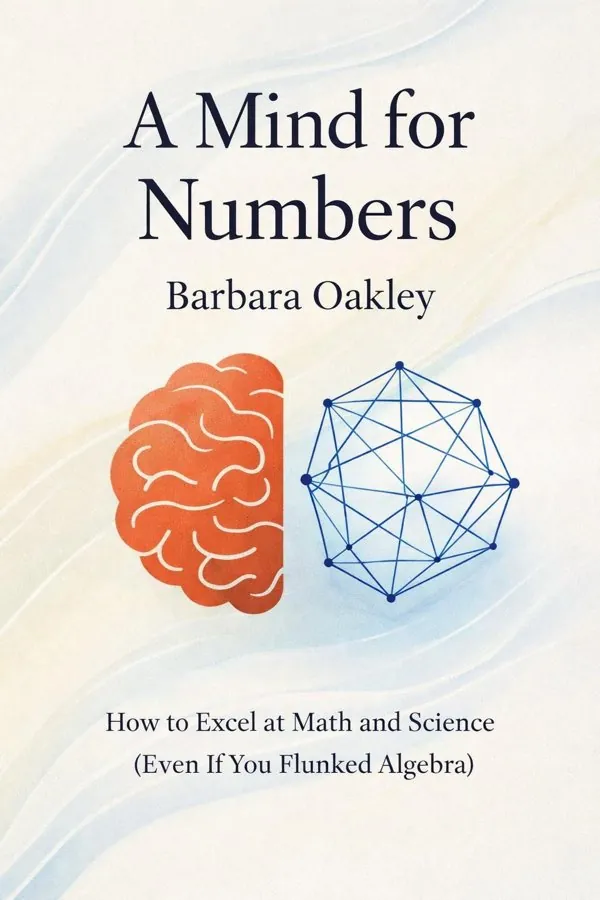
A Mind for Numbers: How to Excel at Math and Science (Even If You Flunked Algebra): Summary & Key Insights
 10 min11 chaptersAudio available
What Is A Mind for Numbers: How to Excel at Math and Science (Even If You Flunked Algebra) About?
A Mind for Numbers: How to Excel at Math and Science (Even If You Flunked Algebra) by Barbara Oakley is a education book spanning 11 pages. In this book, Barbara Oakley explores how anyone can improve their ability to learn and master complex subjects like math and science. Drawing on neuroscience and cognitive psychology, she provides practical strategies for overcoming mental blocks, enhancing memory, and developing effective problem-solving habits. The book serves as a companion to her popular Coursera course 'Learning How to Learn.'
This FizzRead summary covers all 11 key chapters of A Mind for Numbers: How to Excel at Math and Science (Even If You Flunked Algebra) in approximately 10 minutes, distilling the most important ideas, arguments, and takeaways from Barbara Oakley's work. Also available as an audio summary and Key Quotes Podcast.
A Mind for Numbers: How to Excel at Math and Science (Even If You Flunked Algebra)
In this book, Barbara Oakley explores how anyone can improve their ability to learn and master complex subjects like math and science. Drawing on neuroscience and cognitive psychology, she provides practical strategies for overcoming mental blocks, enhancing memory, and developing effective problem-solving habits. The book serves as a companion to her popular Coursera course 'Learning How to Learn.'
Who Should Read A Mind for Numbers: How to Excel at Math and Science (Even If You Flunked Algebra)?
This book is perfect for anyone interested in education and looking to gain actionable insights in a short read. Whether you're a student, professional, or lifelong learner, the key ideas from A Mind for Numbers: How to Excel at Math and Science (Even If You Flunked Algebra) by Barbara Oakley will help you think differently.
- ✓Readers who enjoy education and want practical takeaways
- ✓Professionals looking to apply new ideas to their work and life
- ✓Anyone who wants the core insights of A Mind for Numbers: How to Excel at Math and Science (Even If You Flunked Algebra) in just 10 minutes
Want the full summary?
Get instant access to this book summary and 100K+ more with Fizz Moment.
Get Free SummaryAvailable on App Store • Free to download
Key Chapters
We often think learning is about intense concentration—hitting the books hard, drilling through problems until something clicks. That’s only half the picture. Our brains operate in two distinct modes: focused and diffuse.
The focused mode is active concentration—what happens when you’re solving a problem or deeply engaged in analytical thinking. The diffuse mode is more relaxed, creative, and open-ended—it’s what activates when you take a walk, shower, or drift into daydreams. These modes complement each other. Focus builds precision; diffusion provides insight.
When I began studying complex subjects, I realized that the diffuse mode was my secret ally. It’s during relaxed periods that your brain connects dots—forming those sudden flashes of understanding that make learning feel magical. Scientific studies show that when your attention shifts away from a specific task, neural networks reorganize and form wider connections. So alternating between focused effort and diffuse relaxation isn’t avoidance—it’s efficient.
You can apply this directly: after struggling with a problem, step away. Let your mind wander. That’s your diffuse mode working, unconsciously linking concepts from different parts of your brain. This interplay explains why breakthroughs often occur after rest, not in the heat of concentration.
Once you grasp that balance, you’ll study smarter, not longer. Effective learning relies on giving both modes time to operate naturally—like breathing in and out. In focus you build the bricks; in diffusion you see the design.
Learning doesn’t happen in a flood of information. It occurs in chunks—discrete, interconnected pieces of knowledge that our brains compress into compact, usable patterns. When you practice a concept until it becomes familiar, your neurons form links that represent that idea as a unit. That’s chunking.
In mathematics, for example, mastering algebra means forming chunks around symbols and operations so that manipulating equations feels intuitive. At first, each step may feel awkward, but with deliberate repetition and understanding—not memorization—you build automaticity. Neuroscience reveals that chunking frees your working memory by grouping related elements into a single cognitive unit.
To build chunks effectively, you must first focus. Understanding precedes automation. Then, through spaced practice, the brain strengthens those pathways. It’s like building muscle: consistent effort reorganizes the neural circuitry.
When I teach this, I emphasize that chunking is not passive. It’s active synthesis—you practice until you can recall and apply the chunk without strain. And each chunk connects to others, forming a lattice of understanding. This web becomes the foundation for tackling advanced problems, because the brain can now manipulate larger ideas without being overwhelmed.
Chunking is your gateway to mastery. It turns scattered facts into meaningful structures, transforming frustration into fluency.
+ 9 more chapters — available in the FizzRead app
All Chapters in A Mind for Numbers: How to Excel at Math and Science (Even If You Flunked Algebra)
About the Author
Barbara Oakley, Ph.D., is a professor of engineering at Oakland University and an instructor of the Coursera course 'Learning How to Learn.' Her research focuses on the complex relationship between neuroscience and social behavior. She is known for her work in learning science and educational innovation.
Get This Summary in Your Preferred Format
Read or listen to the A Mind for Numbers: How to Excel at Math and Science (Even If You Flunked Algebra) summary by Barbara Oakley anytime, anywhere. FizzRead offers multiple formats so you can learn on your terms — all free.
Available formats: App · Audio · PDF · EPUB — All included free with FizzRead
Download A Mind for Numbers: How to Excel at Math and Science (Even If You Flunked Algebra) PDF and EPUB Summary
Key Quotes from A Mind for Numbers: How to Excel at Math and Science (Even If You Flunked Algebra)
“We often think learning is about intense concentration—hitting the books hard, drilling through problems until something clicks.”
“Learning doesn’t happen in a flood of information.”
Frequently Asked Questions about A Mind for Numbers: How to Excel at Math and Science (Even If You Flunked Algebra)
A Mind for Numbers: How to Excel at Math and Science (Even If You Flunked Algebra) by Barbara Oakley is a education book that explores key ideas across 11 chapters. In this book, Barbara Oakley explores how anyone can improve their ability to learn and master complex subjects like math and science. Drawing on neuroscience and cognitive psychology, she provides practical strategies for overcoming mental blocks, enhancing memory, and developing effective problem-solving habits. The book serves as a companion to her popular Coursera course 'Learning How to Learn.'
More by Barbara Oakley
You Might Also Like

Bedtime Biography: Florence Nightingale
Isabel Thomas
10 min
Introduction To Museum Studies
Howard H. Hoyt
10 min
AI for Educators: Learning Strategies, Teacher Empowerment, and the Future of Education
Matt Miller
10 min
Animation For Beginners
Morr Meroz
10 min
Artificial Intelligence for Learning
Donald Clark
10 min
Artists' Resumes and Portfolios: Various Practical Guides
A. Robin
10 minFeatured In
Browse by Category
Ready to read A Mind for Numbers: How to Excel at Math and Science (Even If You Flunked Algebra)?
Get the full summary and 100K+ more books with Fizz Moment.