
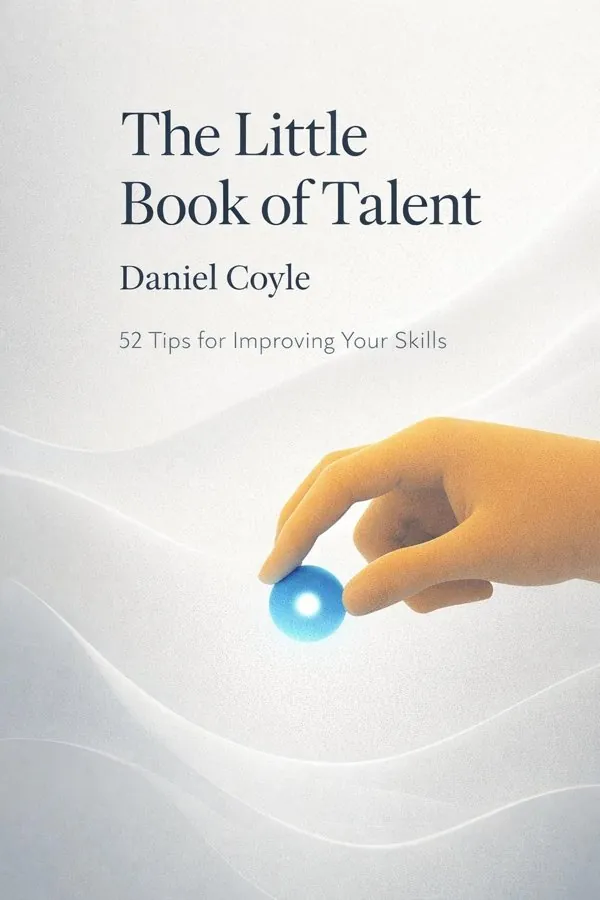
The Little Book of Talent: 52 Tips for Improving Your Skills: Summary & Key Insights
by Daniel Coyle
 10 min9 chaptersAudio available
Key Takeaways from The Little Book of Talent: 52 Tips for Improving Your Skills
Improvement begins where comfort ends.
Mastery is rarely built all at once; it is assembled piece by piece.
Going slower can be the quickest path to improvement.
Skill does not grow on discipline alone; it also needs fuel.
The right coach does more than give advice; they change the speed of your growth.
What Is The Little Book of Talent: 52 Tips for Improving Your Skills About?
The Little Book of Talent: 52 Tips for Improving Your Skills by Daniel Coyle is a education book spanning 8 pages. The Little Book of Talent is a practical handbook for anyone who wants to get better at something that matters. In just 52 short tips, Daniel Coyle turns the science of skill-building into clear, usable advice for athletes, musicians, students, teachers, leaders, and lifelong learners. Rather than treating talent as a mysterious gift, the book argues that high performance grows from specific behaviors: practicing deeply, staying motivated, seeking excellent coaching, and repeating the right actions until they become automatic. That message matters because most people underestimate how much progress depends not on raw ability, but on how they train. Coyle writes with unusual authority. As the bestselling author of The Talent Code and a journalist who has studied elite training environments around the world, he draws on neuroscience, observation, and coaching wisdom to show how skills are really built. His focus is not on grand theory for its own sake, but on practical methods that work in real life. The result is a compact, highly actionable guide that helps readers practice smarter, persist longer, and improve with greater confidence in any field.
This FizzRead summary covers all 9 key chapters of The Little Book of Talent: 52 Tips for Improving Your Skills in approximately 10 minutes, distilling the most important ideas, arguments, and takeaways from Daniel Coyle's work. Also available as an audio summary and Key Quotes Podcast.
The Little Book of Talent: 52 Tips for Improving Your Skills
The Little Book of Talent is a practical handbook for anyone who wants to get better at something that matters. In just 52 short tips, Daniel Coyle turns the science of skill-building into clear, usable advice for athletes, musicians, students, teachers, leaders, and lifelong learners. Rather than treating talent as a mysterious gift, the book argues that high performance grows from specific behaviors: practicing deeply, staying motivated, seeking excellent coaching, and repeating the right actions until they become automatic. That message matters because most people underestimate how much progress depends not on raw ability, but on how they train.
Coyle writes with unusual authority. As the bestselling author of The Talent Code and a journalist who has studied elite training environments around the world, he draws on neuroscience, observation, and coaching wisdom to show how skills are really built. His focus is not on grand theory for its own sake, but on practical methods that work in real life. The result is a compact, highly actionable guide that helps readers practice smarter, persist longer, and improve with greater confidence in any field.
Who Should Read The Little Book of Talent: 52 Tips for Improving Your Skills?
This book is perfect for anyone interested in education and looking to gain actionable insights in a short read. Whether you're a student, professional, or lifelong learner, the key ideas from The Little Book of Talent: 52 Tips for Improving Your Skills by Daniel Coyle will help you think differently.
- ✓Readers who enjoy education and want practical takeaways
- ✓Professionals looking to apply new ideas to their work and life
- ✓Anyone who wants the core insights of The Little Book of Talent: 52 Tips for Improving Your Skills in just 10 minutes
Want the full summary?
Get instant access to this book summary and 100K+ more with Fizz Moment.
Get Free SummaryAvailable on App Store • Free to download
Key Chapters
Improvement begins where comfort ends. One of Daniel Coyle’s central insights is that talent grows through what he calls deep practice: a focused kind of training in which you operate at the edge of your current ability, make mistakes, notice them, and correct them. This process is not smooth or glamorous. It feels awkward, slow, and mentally demanding. Yet that very struggle is what strengthens skill.
Coyle connects this idea to the brain’s ability to build and reinforce neural circuits. Each time you perform a movement, solve a problem, or speak a phrase correctly after correcting an error, you strengthen the pathway that supports that skill. In other words, mistakes are not evidence of failure; they are the raw material of improvement. The best learners spend less time performing what they already know and more time grappling with what they cannot yet do consistently.
This has powerful implications. A basketball player should not simply shoot easy free throws for an hour; they should isolate weak mechanics and repeat difficult variations with intense attention. A language learner should not only reread familiar words; they should practice speaking challenging phrases and fixing pronunciation in real time. A student preparing for exams should test recall under pressure rather than passively review notes.
Deep practice is effective because it combines challenge, feedback, and correction. It transforms effort into adaptation. If your practice feels effortless all the time, you may be maintaining skill rather than building it.
Actionable takeaway: Spend at least part of every practice session working just beyond your comfort zone, where errors are frequent enough to teach you but not so overwhelming that you shut down.
Mastery is rarely built all at once; it is assembled piece by piece. Coyle emphasizes that every advanced skill, no matter how impressive it appears from the outside, can be broken into smaller chunks. These chunks are manageable units of action that can be practiced, refined, and recombined until they become fluent.
This approach matters because complexity often discourages learners. A beginner pianist sees an entire piece and feels overwhelmed. A new public speaker thinks about timing, content, tone, confidence, body language, and audience engagement all at once. But expert coaches know that progress accelerates when learners isolate one component at a time. They focus on the opening bars, the first transition, the first paragraph, the grip, the foot placement, or the initial move.
Chunking also improves concentration. Instead of vaguely trying to "get better," you work on something concrete and measurable. A soccer player might isolate first touch. A writer might practice only openings. A programmer might focus on debugging one class of error. By narrowing attention, learners reduce noise and increase precision.
Importantly, chunking is not just for beginners. Advanced performers also use it to repair weaknesses and upgrade technique. They identify where a larger performance breaks down, strip it apart, and train the component that is limiting the whole.
Once chunks improve, they must be reconnected into the full skill. That integration is crucial, but it works best after the pieces are strengthened individually.
Actionable takeaway: Identify the skill you want to improve, divide it into its smallest meaningful parts, and devote focused sessions to the weakest chunk before rebuilding the complete performance.
Going slower can be the quickest path to improvement. One of the most counterintuitive lessons in The Little Book of Talent is that slowing down helps learners perform with greater accuracy, awareness, and control. When practice happens too quickly, mistakes blur together. When it slows down, hidden details become visible.
Coyle shows that top performers often train at reduced speed because it allows them to notice technique. A golfer can feel the sequence of a swing. A violinist can hear intonation and bow pressure. A speaker can observe pacing and emphasis. Slowness creates a microscope for skill. It reveals where tension appears, where timing slips, and where coordination breaks down.
This principle is especially useful when learning new patterns. If you rush early repetitions, you risk encoding flawed habits. But if you move slowly enough to execute correctly, you give the brain a clean model to reinforce. That does not mean all practice should remain slow forever. Speed matters too. But speed should be layered on top of accurate movement and understanding, not substituted for them.
A practical example: if you are learning a presentation, rehearse difficult sections half-speed and exaggerate pauses. If you are studying math, solve problems slowly enough to explain each step aloud. If you are training in sports, perform technical drills with deliberate control before increasing intensity.
Slow practice also lowers anxiety. It gives learners room to think, adjust, and reset. In that sense, it is not merely a mechanical technique but a psychological one.
Actionable takeaway: Take the hardest part of your skill and practice it at 50 to 70 percent speed until you can perform it cleanly, then gradually increase tempo without sacrificing form.
Skill does not grow on discipline alone; it also needs fuel. Coyle uses the idea of ignition to describe the emotional spark that transforms casual interest into determined effort. Ignition is the moment when a person begins to believe, often viscerally, that a skill matters and that improvement is possible for someone like them.
This spark often comes from identity and exposure. A child sees a great player who shares their background and thinks, "That could be me." A professional hears a compelling vision of what mastery would make possible and decides to pursue excellence seriously. Motivation deepens when people connect a skill to belonging, purpose, aspiration, or personal meaning.
Coyle suggests that successful learning environments deliberately create ignition. They expose learners to vivid role models, challenging standards, and a culture that expects growth. Motivation is not treated as a mysterious force that appears or disappears; it is cultivated through signals, stories, and goals.
In everyday life, this means your environment matters. If you want to improve, surround yourself with examples of high performance. Watch experts up close. Read biographies. Join communities where effort is normal. Define why the skill matters to you specifically. Vague ambitions fade quickly, but emotionally charged goals endure.
Ignition also works best when paired with small wins. Inspiration opens the door, but visible progress keeps people moving. That is why goals should be meaningful yet broken into reachable steps.
Actionable takeaway: Strengthen your motivation by identifying a clear personal reason to improve, choosing a role model who makes the goal feel real, and placing daily reminders of that purpose in your practice environment.
The right coach does more than give advice; they change the speed of your growth. Coyle argues that great coaching is one of the most powerful multipliers of talent because it helps learners see what they cannot yet see for themselves. A master coach spots errors quickly, targets the right correction, and creates a practice environment where challenge feels productive rather than discouraging.
What makes this kind of coaching effective is not charisma alone. It is precision. Excellent coaches break skills into components, give timely feedback, and know when to push and when to simplify. They are deeply attentive. They observe body language, timing, emotional state, and recurring mistakes. They also communicate belief. Their message is often some version of: this is hard, but you can do it, and here is the next step.
This idea applies beyond formal coaching. A teacher, manager, mentor, editor, or training partner can play the same role. The crucial factor is quality of feedback. Generic praise like "good job" may feel nice, but it rarely improves performance. Specific guidance such as "your argument weakens in the third paragraph" or "your left foot lands too early" gives the learner something usable.
Coyle also suggests that learners should become active participants in coaching. Ask questions. Seek correction. Invite discomfort. The best students do not merely receive input; they mine it.
Even self-coaching can improve when you adopt a coach’s mindset. Record yourself, compare to a model, identify a single correction, and repeat.
Actionable takeaway: Find a coach, mentor, or feedback source who can give precise corrections, then structure practice around one specific improvement point at a time instead of chasing general encouragement.
Excellence is less a dramatic event than a repeated pattern. Coyle emphasizes that high skill is sustained by habits: small, consistent routines that make quality practice more likely and wasted effort less likely. People often admire peak performances, but those moments are usually the visible result of invisible systems built over time.
Habits matter because motivation fluctuates. On some days you will feel energized; on others, distracted or tired. Good routines reduce the need to constantly negotiate with yourself. If you always practice at a set time, use the same preparation ritual, or begin with the same warm-up drill, you lower friction. You make starting easier, and starting is often the hardest part.
Habits also shape attention. A musician who always tunes, breathes, and visualizes before playing enters a focused state faster. A writer who begins by reviewing yesterday’s final paragraph avoids blank-page hesitation. An athlete who logs each session builds accountability and pattern awareness. Small structures compound.
Coyle’s broader point is that mastery depends not only on what you do during intense effort, but on the environment surrounding that effort. Sleep, recovery, scheduling, and cue-based routines all influence whether deep practice happens consistently.
This perspective is especially valuable for professionals and students who feel they lack time. You may not control every hour, but you can often control triggers, rituals, and practice defaults. A stable system can carry you forward when willpower dips.
Actionable takeaway: Design one repeatable practice ritual—same time, same place, same opening routine—and follow it for two weeks so that improvement depends less on mood and more on structure.
Plateaus are not proof that growth has stopped; they are often signs that your current method has stopped challenging you. Coyle treats stagnation as a practical problem, not a personal verdict. When progress slows, the answer is usually not more of the same, but a smarter form of difficulty.
A plateau often appears when a skill has become partially automated. You can perform it well enough to get by, but not with enough deliberate attention to improve further. At that point, learners need to introduce friction again. That might mean narrowing focus to a weaker subskill, increasing performance pressure, changing context, or seeking sharper feedback.
For example, a tennis player stuck at the same level might stop playing only full matches and instead train return-of-serve patterns under targeted constraints. A speaker who sounds competent but flat might isolate vocal variety and rehearse with recordings. A student whose grades have stalled might switch from rereading to retrieval practice and timed problem sets.
Coyle’s ideas suggest that plateaus are best overcome through diagnosis. Where exactly is the bottleneck? Is it technique, attention, motivation, recovery, or feedback quality? Once identified, the learner can make practice specific again.
There is also an emotional lesson here. Plateaus can trigger frustration, but frustration is useful when interpreted correctly. It signals that you are near the edge of adaptation. The key is to stay engaged without drifting into mindless repetition.
Actionable takeaway: When progress stalls, do not simply practice longer; identify one weak link in your process, create a more demanding drill for that point, and measure whether it improves over the next week.
A skill is not fully learned until it works under pressure. Coyle makes clear that isolated drills matter, but they are only part of the journey. To perform well in real situations, learners must eventually integrate separate components and practice under conditions that resemble actual use.
This distinction explains why some people look excellent in rehearsal yet struggle in competition, conversation, exams, or live performance. They have built pieces of the skill, but not the ability to access them fluidly under realistic constraints. Real performance includes timing, emotion, distraction, uncertainty, and consequence. Training should account for that.
Integration means combining chunks into whole sequences and then stress-testing them. A musician should not only perfect passages, but play complete runs without stopping. A job candidate should not just prepare answers, but simulate interviews with interruptions and follow-up questions. A basketball player should move from shooting drills to game-like decision-making under fatigue.
Coyle’s practical wisdom is to bridge the gap gradually. Start with small chunks. Link them into larger units. Then add speed, pressure, and unpredictability. This progression prevents overwhelm while still preparing the learner for real demands.
It is equally important to review performance afterward. What held up? What broke down? What felt automatic, and what required too much thought? Reflection turns performance into the next cycle of deep practice.
Actionable takeaway: Before calling a skill "learned," rehearse it in conditions that mimic reality—time limits, distractions, audience, fatigue, or uncertainty—then use the results to choose your next practice focus.
People often imagine mastery as the result of breakthrough moments, but Coyle’s broader message is more grounded: improvement usually comes from many small corrections stacked over time. The myth of sudden talent is appealing because it is dramatic, but the truth is more encouraging. You do not need a miracle. You need repeated, accurate adjustment.
This idea reframes progress in a healthier way. Instead of asking whether you have become great yet, ask whether you are slightly better than yesterday at a meaningful component of the skill. Those tiny gains may feel insignificant in isolation, yet they compound rapidly. In technical fields, sports, arts, and academics alike, consistency often beats intensity.
A singer improves by correcting one phrase, then one breath, then one vowel shape. A manager improves by refining one listening habit, then one meeting behavior, then one feedback pattern. A student improves by reviewing one missed concept each day instead of waiting for a heroic last-minute effort. Such progress is modest but durable.
This principle also protects against discouragement. If success depends on giant leaps, most learners will quit. If success depends on steady micro-improvements, almost anyone can continue. Coyle’s tips repeatedly point toward this mindset: narrow the target, correct the error, repeat with attention.
The practical challenge is noticing small wins. Tracking matters. Notes, recordings, checklists, and brief reflections help learners see momentum that would otherwise remain invisible.
Actionable takeaway: End each practice session by writing down one specific thing you improved and one next correction to make, so progress becomes a visible chain of small, cumulative gains.
All Chapters in The Little Book of Talent: 52 Tips for Improving Your Skills
About the Author
Daniel Coyle is an American author, journalist, and speaker best known for exploring how talent, skill, and high-performing cultures are developed. He gained wide recognition through books such as The Talent Code, The Little Book of Talent, and The Culture Code, all of which examine the hidden processes behind excellence in individuals and groups. Coyle’s work blends reporting, behavioral science, neuroscience, and practical observation from elite training environments around the world. In addition to writing books, he has contributed to major publications including The New York Times Magazine and Sports Illustrated. His clear, accessible style has made him a trusted voice for coaches, educators, business leaders, and readers interested in personal growth. Across his work, Coyle consistently challenges the myth of fixed talent and shows how improvement can be intentionally built.
Get This Summary in Your Preferred Format
Read or listen to the The Little Book of Talent: 52 Tips for Improving Your Skills summary by Daniel Coyle anytime, anywhere. FizzRead offers multiple formats so you can learn on your terms — all free.
Available formats: App · Audio · PDF · EPUB — All included free with FizzRead
Download The Little Book of Talent: 52 Tips for Improving Your Skills PDF and EPUB Summary
Key Quotes from The Little Book of Talent: 52 Tips for Improving Your Skills
“Mastery is rarely built all at once; it is assembled piece by piece.”
“Going slower can be the quickest path to improvement.”
“Skill does not grow on discipline alone; it also needs fuel.”
“The right coach does more than give advice; they change the speed of your growth.”
“Excellence is less a dramatic event than a repeated pattern.”
Frequently Asked Questions about The Little Book of Talent: 52 Tips for Improving Your Skills
The Little Book of Talent: 52 Tips for Improving Your Skills by Daniel Coyle is a education book that explores key ideas across 9 chapters. The Little Book of Talent is a practical handbook for anyone who wants to get better at something that matters. In just 52 short tips, Daniel Coyle turns the science of skill-building into clear, usable advice for athletes, musicians, students, teachers, leaders, and lifelong learners. Rather than treating talent as a mysterious gift, the book argues that high performance grows from specific behaviors: practicing deeply, staying motivated, seeking excellent coaching, and repeating the right actions until they become automatic. That message matters because most people underestimate how much progress depends not on raw ability, but on how they train. Coyle writes with unusual authority. As the bestselling author of The Talent Code and a journalist who has studied elite training environments around the world, he draws on neuroscience, observation, and coaching wisdom to show how skills are really built. His focus is not on grand theory for its own sake, but on practical methods that work in real life. The result is a compact, highly actionable guide that helps readers practice smarter, persist longer, and improve with greater confidence in any field.
More by Daniel Coyle


You Might Also Like

Bedtime Biography: Florence Nightingale
Isabel Thomas
10 min
Introduction To Museum Studies
Howard H. Hoyt
10 min
A Mind for Numbers: How to Excel at Math and Science (Even If You Flunked Algebra)
Barbara Oakley
10 min
AI for Educators: Learning Strategies, Teacher Empowerment, and the Future of Education
Matt Miller
10 min
Animation For Beginners
Morr Meroz
10 min
Artificial Intelligence for Learning
Donald Clark
10 minBrowse by Category
Ready to read The Little Book of Talent: 52 Tips for Improving Your Skills?
Get the full summary and 100K+ more books with Fizz Moment.