
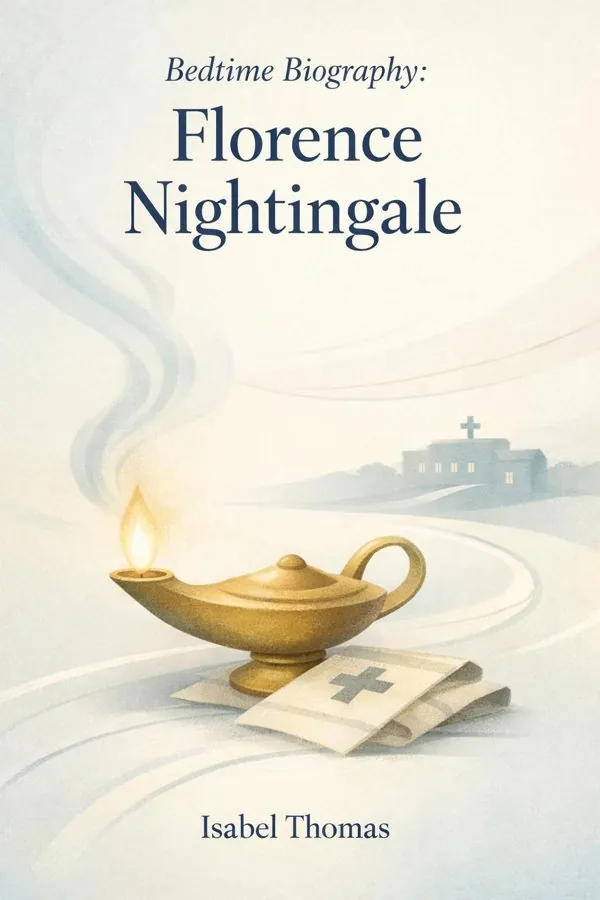
Bedtime Biography: Florence Nightingale: Summary & Key Insights
 10 min9 chaptersAudio available
Key Takeaways from Bedtime Biography: Florence Nightingale
Every remarkable life starts not with fame, but with curiosity.
Feeling sorry for others is easy; standing beside them when society disapproves is much harder.
Caregiving changes lives most when it is treated as a discipline, not just a good intention.
History is often changed by details people ignore.
Facts become powerful when they help people see what they would rather ignore.
What Is Bedtime Biography: Florence Nightingale About?
Bedtime Biography: Florence Nightingale by Isabel Thomas is a education book. Bedtime Biography: Florence Nightingale by Isabel Thomas is an inviting, beautifully accessible introduction to one of history’s most influential women. Written for young readers but rich enough to interest parents, teachers, and curious adults, the book tells the story of Florence Nightingale’s life from her unusual childhood to her groundbreaking work as a nurse, reformer, and statistician. Rather than presenting Florence as a distant legend, the book shows her as a determined person who asked difficult questions, challenged unfair systems, and used both compassion and evidence to improve lives. What makes this biography especially valuable is its balance of warmth and accuracy. It highlights Florence’s kindness and courage while also explaining the larger social problems she confronted, including poor hospital conditions, limited roles for women, and preventable disease. Isabel Thomas is known for making complex historical and scientific ideas clear for children, and that skill is on full display here. This book matters because it helps readers see that real change often begins with noticing what is wrong, caring enough to act, and working patiently to make things better.
This FizzRead summary covers all 9 key chapters of Bedtime Biography: Florence Nightingale in approximately 10 minutes, distilling the most important ideas, arguments, and takeaways from Isabel Thomas's work. Also available as an audio summary and Key Quotes Podcast.
Bedtime Biography: Florence Nightingale
Bedtime Biography: Florence Nightingale by Isabel Thomas is an inviting, beautifully accessible introduction to one of history’s most influential women. Written for young readers but rich enough to interest parents, teachers, and curious adults, the book tells the story of Florence Nightingale’s life from her unusual childhood to her groundbreaking work as a nurse, reformer, and statistician. Rather than presenting Florence as a distant legend, the book shows her as a determined person who asked difficult questions, challenged unfair systems, and used both compassion and evidence to improve lives.
What makes this biography especially valuable is its balance of warmth and accuracy. It highlights Florence’s kindness and courage while also explaining the larger social problems she confronted, including poor hospital conditions, limited roles for women, and preventable disease. Isabel Thomas is known for making complex historical and scientific ideas clear for children, and that skill is on full display here. This book matters because it helps readers see that real change often begins with noticing what is wrong, caring enough to act, and working patiently to make things better.
Who Should Read Bedtime Biography: Florence Nightingale?
This book is perfect for anyone interested in education and looking to gain actionable insights in a short read. Whether you're a student, professional, or lifelong learner, the key ideas from Bedtime Biography: Florence Nightingale by Isabel Thomas will help you think differently.
- ✓Readers who enjoy education and want practical takeaways
- ✓Professionals looking to apply new ideas to their work and life
- ✓Anyone who wants the core insights of Bedtime Biography: Florence Nightingale in just 10 minutes
Want the full summary?
Get instant access to this book summary and 100K+ more with Fizz Moment.
Get Free SummaryAvailable on App Store • Free to download
Key Chapters
Every remarkable life starts not with fame, but with curiosity. One of the most powerful ideas in Bedtime Biography: Florence Nightingale is that Florence’s achievements did not appear suddenly on the battlefields of Crimea; they began much earlier, in a child who observed the world carefully and wondered why things were the way they were. Isabel Thomas presents Florence as a thoughtful girl growing up in a wealthy family, expected to follow a conventional path. Yet Florence was not satisfied by comfort or custom alone. She wanted purpose. She read widely, studied seriously, and asked difficult questions about poverty, sickness, and duty.
This matters because children often imagine heroes as people who are simply born extraordinary. The book gently corrects that idea. Florence became influential because she paid attention, learned constantly, and refused to ignore suffering. Her early interest in helping others, combined with discipline and education, gave shape to the work she would later do. Even at a young age, she showed that compassion becomes more powerful when paired with knowledge.
For modern readers, this idea has practical value. A child who asks why some people lack access to clean water, why schools differ, or why public health matters is already thinking like a problem solver. Parents and teachers can use Florence’s story to encourage questioning instead of passive acceptance. Curiosity can lead to research, empathy, and eventually action.
A useful application is to invite children to choose one problem they notice in daily life and learn more about it. That could be litter in a park, loneliness at school, or waste at home. Florence’s life reminds us that questions are not a distraction from learning; they are often the beginning of meaningful work.
Actionable takeaway: Treat curiosity as a strength, and turn one sincere question about the world into a small act of learning or service.
Feeling sorry for others is easy; standing beside them when society disapproves is much harder. A central lesson in this biography is that Florence Nightingale’s compassion mattered because she had the courage to act on it. In her time, nursing was not respected as a proper profession for upper-class women. Florence’s family had expectations for her future, and those expectations did not include hospital work. Yet she believed caring for the sick was her calling, and she persisted despite resistance.
Isabel Thomas helps readers understand that courage is not always loud or dramatic. Sometimes it looks like continuing to prepare for a difficult goal when others misunderstand you. Florence studied nursing methods, visited hospitals, and learned how care could be improved long before she became famous. Her bravery was practical: she chose commitment over comfort. That makes her story especially relevant for young readers, because it shows that courage can be expressed through steady determination.
This concept applies beyond medicine. A student who defends a classmate, admits a mistake, or pursues an unusual interest despite peer pressure is practicing the same kind of moral courage. The book invites readers to see bravery not only in emergencies but in choices made day after day. Florence did not simply care about suffering; she accepted the personal cost of trying to reduce it.
Adults can use this idea to discuss values with children. What matters enough to work for, even when it is inconvenient? What does it mean to stand by an important belief respectfully and persistently? Florence’s life offers a model: convictions should be tested through preparation, discipline, and service.
Actionable takeaway: Choose one value you believe in—kindness, fairness, honesty, service—and practice it this week in a situation where it would be easier to stay silent.
Caregiving changes lives most when it is treated as a discipline, not just a good intention. Bedtime Biography: Florence Nightingale emphasizes that Florence helped transform nursing into respected professional work. Before reforms like hers, hospitals were often dirty, disorganized, and dangerous. Many people assumed that nursing required only sympathy. Florence understood that effective care also required training, observation, routines, cleanliness, and responsibility.
This is one of the book’s most important educational contributions. Young readers learn that helping others is not only about being nice; it also involves developing skills. Florence’s work showed that careful attention to food, hygiene, fresh air, sanitation, and record-keeping could save lives. In telling this story simply and clearly, Isabel Thomas introduces children to a deeper truth: professions that support human well-being depend on both heart and knowledge.
That lesson can be applied in many settings. Teachers do more than care; they learn methods. Firefighters do more than want to help; they train. Scientists do more than wonder; they test ideas. Florence Nightingale’s example helps children value expertise and preparation. It also broadens their understanding of nursing as a field combining science, discipline, and compassion.
For classrooms and families, this idea can spark discussion about what makes a profession trustworthy. What training is needed? What habits matter? Why do procedures exist? Children may begin to see that excellence often comes from routine tasks done well, not just heroic moments. Florence’s reforms were powerful precisely because she improved the basics that others overlooked.
Actionable takeaway: The next time you want to help someone, ask not only “How can I be kind?” but also “What skill or knowledge would make my help more effective?”
History is often changed by details people ignore. One of the clearest ideas in the book is that Florence Nightingale noticed how everyday conditions—cleanliness, ventilation, water, food, and organization—directly affected whether people recovered or died. During the Crimean War, she encountered hospitals where wounded soldiers suffered not only from injuries but also from filth, overcrowding, and disease. Her insight was profound in its simplicity: healing depends on environment.
Isabel Thomas presents this in a child-friendly way without losing its seriousness. Florence did not rely on vague hope. She examined what patients needed around them and worked to improve those conditions. This helps readers understand public health at an early age. Health is not only about medicine after people become ill; it is also about preventing illness through better surroundings and systems.
This idea remains highly practical. Families see it in handwashing, clean kitchens, fresh air, and adequate sleep. Schools see it in hygiene routines and safe spaces. Communities see it in sanitation, clean water, vaccination systems, and healthy housing. Florence’s work teaches that caring for people includes caring for the spaces they live and heal in.
The broader lesson is that small improvements can have enormous consequences. Making sure a room is aired out, surfaces are cleaned, or records are organized may seem ordinary, but ordinary actions often create the foundation for safety. Children can learn that invisible causes matter, and that prevention is a powerful form of care.
Actionable takeaway: Pick one environment you use every day—your room, classroom, or kitchen—and improve one health-related condition in it, such as cleanliness, airflow, organization, or access to water.
Facts become powerful when they help people see what they would rather ignore. A standout theme in Florence Nightingale’s story is that she did not rely only on personal testimony to argue for reform; she used numbers. She collected information about illness and death, organized it, and presented it in ways that leaders could not easily dismiss. This made her not only a compassionate caregiver but also an early champion of evidence-based change.
For young readers, this is an exciting and often surprising part of the biography. Florence was not just “the lady with the lamp.” She was also a thinker who understood that data can reveal patterns hidden inside chaos. If more soldiers were dying from preventable disease than from battle wounds, then policy had to change. Isabel Thomas introduces this idea accessibly, helping children connect mathematics, observation, and social responsibility.
This lesson applies strongly today. Students can gather data about recycling habits, reading time, playground use, or food waste, then use that information to improve their school. Communities use statistics to address traffic safety, pollution, or public health. Florence’s example shows that numbers are not cold or impersonal when used well; they can be instruments of care, fairness, and accountability.
The key is that evidence strengthens advocacy. Complaints may be ignored, but clear patterns supported by observation can influence decision-makers. Florence combined empathy with proof, making her arguments harder to deny. That combination remains one of the most effective ways to solve problems.
Actionable takeaway: If something around you seems unfair or inefficient, start by observing it carefully and collecting simple evidence before proposing a solution.
True leadership is often tested where fear, exhaustion, and confusion are greatest. In Bedtime Biography: Florence Nightingale, Florence’s work during the Crimean War illustrates that leadership is not merely holding authority; it is organizing care when others are overwhelmed. Faced with overcrowded hospitals, limited supplies, and widespread suffering, she did not wait for ideal conditions. She assessed needs, set standards, coordinated work, and kept the focus on patients.
The book offers children a practical image of leadership rooted in responsibility rather than status. Florence became influential because she was dependable under pressure. She made decisions, improved systems, and inspired trust. Her famous night rounds with a lamp symbolize compassion, but they also reflect something deeper: presence. She showed up consistently where she was needed most.
This lesson can be translated into everyday life. A child can lead by helping organize a group project, calming disagreement, or noticing who has been left out. A teacher leads by creating order that allows students to thrive. A parent leads by setting routines that support health and safety. In each case, leadership involves clarity, steadiness, and service.
Florence’s example also corrects the idea that leaders must be loud or charismatic. She led through preparation, standards, persistence, and visible care. That is an important message for quieter readers who may not see themselves in conventional heroic roles. Leadership can look like competence, reliability, and commitment to the common good.
Actionable takeaway: In your next group situation, lead by improving one practical thing—organization, communication, fairness, or care for others—instead of trying merely to be in charge.
The most important work is not always the most visible. Many people know Florence Nightingale for her service during war, but this biography also points readers toward what came afterward: the reforms, writing, planning, and institution-building that extended her influence far beyond one historic moment. Her legacy was not created only by brave action in a crisis; it was secured by the patient work of changing systems.
This is a valuable insight because children often encounter history as a series of dramatic scenes. Isabel Thomas helps them see that real progress often depends on what happens next. Florence used her experience and evidence to advocate for better hospitals, better sanitation, and better training. In other words, she turned emergency lessons into durable improvements. That is how social change becomes more than a single inspiring story.
The practical lesson is relevant in school, home, and community life. Solving a problem once is useful; creating a process that prevents the problem from returning is better. Cleaning up a mess matters, but establishing a routine to keep the space clean matters more. Helping one person is meaningful, but improving the system that affects many people multiplies the benefit.
Florence’s postwar work teaches perseverance. Recognition can fade, but structures endure. Readers learn that if they care about a cause, they should think not only about immediate relief but also about long-term design. What rules, habits, or resources would improve things permanently?
Actionable takeaway: After fixing a small problem this week, ask yourself one follow-up question: “What system or routine would stop this problem from happening again?”
Progress often begins when someone refuses to accept the limits placed on them. A major theme of Florence Nightingale’s life is that she challenged the narrow expectations for women in her era. As a woman from a privileged background, she was expected to live a socially approved life, not pursue demanding public work in nursing, administration, and reform. By choosing differently, she expanded what many people believed women could do.
Isabel Thomas conveys this idea with clarity and care, helping young readers understand that historical barriers were real, yet not immovable. Florence did not simply succeed personally; she altered public perceptions. She demonstrated that women could lead, study, manage institutions, influence policy, and contribute intellectually to national life. That makes this biography not only a story about medicine but also about gender, opportunity, and social change.
This lesson remains important. Even today, people may be steered toward roles based on assumptions about gender, class, or personality. Florence’s story encourages readers to examine those assumptions critically. It suggests that talent and calling should matter more than outdated rules. For children especially, this can be empowering. They are invited to imagine futures based on purpose and capability rather than restriction.
In practical terms, adults can use the book to discuss stereotypes in careers and leadership. Why are some jobs seen as “for” certain people? What happens when someone challenges that idea? Florence’s life shows that one person’s refusal to conform can open doors for many others.
Actionable takeaway: Notice one stereotype about what certain people “should” do, and challenge it by learning about someone who succeeded outside that expectation.
Children’s books do their best work when they turn admiration into possibility. Bedtime Biography: Florence Nightingale is designed to be calm, engaging, and approachable, yet its gentleness does not weaken its message. Instead, it makes serious history available to young minds. By telling Florence’s story in an illustrated, age-appropriate way, Isabel Thomas helps children connect emotionally with a historical figure while also learning about service, health, discipline, and reform.
This format matters. A bedtime biography is not only about transmitting facts; it is about shaping imagination. When children encounter stories of real people who used their abilities to help others, they begin to think of history as something made by human choices. Florence becomes more than a statue or a name in a textbook. She becomes an example of what focused kindness can achieve.
The book’s educational value also lies in its tone. It avoids overwhelming young readers while still respecting their ability to understand injustice and improvement. That balance makes it useful for family reading, classroom introduction, and independent exploration. It can open conversations about hospitals, war, hygiene, gender roles, or how one person can influence society.
Most importantly, the book suggests that inspiration should lead somewhere. Admiring Florence is a start, but the better response is to imitate her habits in small ways: noticing needs, preparing carefully, helping consistently, and thinking beyond oneself. Stories become formative when they point toward action.
Actionable takeaway: After reading about a historical figure you admire, choose one specific habit from their life and practice it in your own daily routine.
All Chapters in Bedtime Biography: Florence Nightingale
About the Author
Isabel Thomas is an award-winning British children’s author who specializes in nonfiction books about science, history, and the natural world. Before becoming a full-time writer, she studied human sciences at the University of Oxford and worked in science communication, experiences that helped shape her clear and engaging style. Thomas is widely respected for her ability to explain complex ideas in ways that are accurate, lively, and accessible for young readers. Her books often encourage curiosity, critical thinking, and a sense of wonder about the world. In works like Bedtime Biography: Florence Nightingale, she combines careful research with storytelling that makes important historical figures feel vivid and relevant. Her writing is popular with families, teachers, and librarians seeking thoughtful, informative children’s nonfiction.
Get This Summary in Your Preferred Format
Read or listen to the Bedtime Biography: Florence Nightingale summary by Isabel Thomas anytime, anywhere. FizzRead offers multiple formats so you can learn on your terms — all free.
Available formats: App · Audio · PDF · EPUB — All included free with FizzRead
Download Bedtime Biography: Florence Nightingale PDF and EPUB Summary
Key Quotes from Bedtime Biography: Florence Nightingale
“Every remarkable life starts not with fame, but with curiosity.”
“Feeling sorry for others is easy; standing beside them when society disapproves is much harder.”
“Caregiving changes lives most when it is treated as a discipline, not just a good intention.”
“History is often changed by details people ignore.”
“Facts become powerful when they help people see what they would rather ignore.”
Frequently Asked Questions about Bedtime Biography: Florence Nightingale
Bedtime Biography: Florence Nightingale by Isabel Thomas is a education book that explores key ideas across 9 chapters. Bedtime Biography: Florence Nightingale by Isabel Thomas is an inviting, beautifully accessible introduction to one of history’s most influential women. Written for young readers but rich enough to interest parents, teachers, and curious adults, the book tells the story of Florence Nightingale’s life from her unusual childhood to her groundbreaking work as a nurse, reformer, and statistician. Rather than presenting Florence as a distant legend, the book shows her as a determined person who asked difficult questions, challenged unfair systems, and used both compassion and evidence to improve lives. What makes this biography especially valuable is its balance of warmth and accuracy. It highlights Florence’s kindness and courage while also explaining the larger social problems she confronted, including poor hospital conditions, limited roles for women, and preventable disease. Isabel Thomas is known for making complex historical and scientific ideas clear for children, and that skill is on full display here. This book matters because it helps readers see that real change often begins with noticing what is wrong, caring enough to act, and working patiently to make things better.
More by Isabel Thomas

You Might Also Like

Introduction To Museum Studies
Howard H. Hoyt
10 min
A Mind for Numbers: How to Excel at Math and Science (Even If You Flunked Algebra)
Barbara Oakley
10 min
AI for Educators: Learning Strategies, Teacher Empowerment, and the Future of Education
Matt Miller
10 min
Animation For Beginners
Morr Meroz
10 min
Artificial Intelligence for Learning
Donald Clark
10 min
Artists' Resumes and Portfolios: Various Practical Guides
A. Robin
10 minFeatured In
Browse by Category
Ready to read Bedtime Biography: Florence Nightingale?
Get the full summary and 100K+ more books with Fizz Moment.