
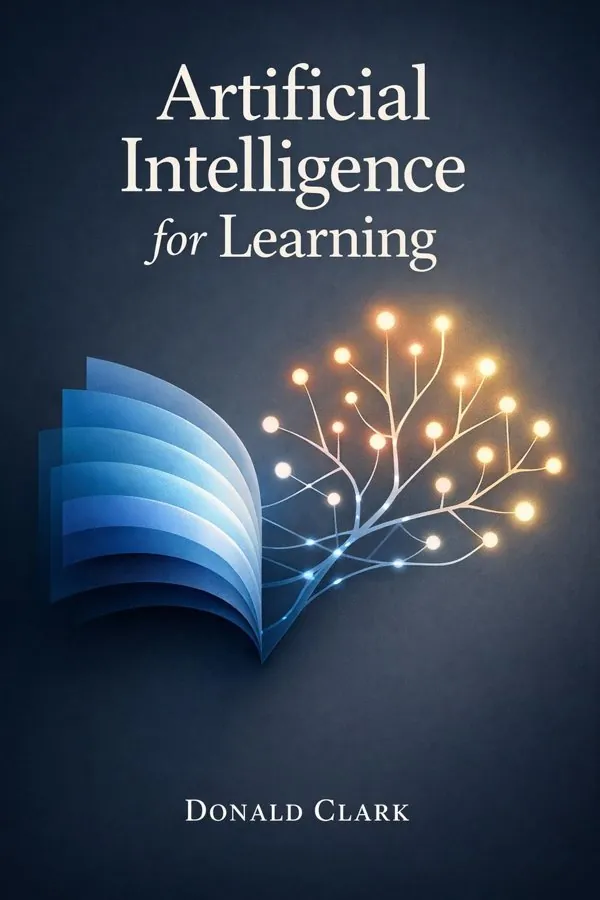
Artificial Intelligence for Learning: Summary & Key Insights
by Donald Clark
 10 min9 chaptersAudio available
Key Takeaways from Artificial Intelligence for Learning
Revolutions in learning rarely arrive all at once; they emerge by building on what came before.
The most powerful use of AI in learning may be its ability to treat learners as individuals rather than averages.
Much of education runs on invisible labor: writing materials, building quizzes, grading submissions, tagging content, and updating outdated modules.
One of education’s oldest problems is that learners often need help at the exact moment no teacher is available.
Education generates more data than ever, but data alone does not improve learning.
What Is Artificial Intelligence for Learning About?
Artificial Intelligence for Learning by Donald Clark is a education book spanning 8 pages. Artificial intelligence is no longer a futuristic idea hovering at the edge of education. It is already changing how people learn, how teachers teach, and how organizations train at scale. In Artificial Intelligence for Learning, Donald Clark offers a grounded, practical guide to this shift, showing how AI can personalize learning journeys, automate repetitive tasks, improve assessment, and generate deeper insight into learner behavior. Rather than treating AI as magic, Clark examines what it can actually do, where it works well, and where caution is essential. What makes this book especially valuable is Clark’s authority. He is not simply commenting on trends from the sidelines. As a long-time learning technology entrepreneur, writer, and speaker, he has spent decades observing how digital tools move from hype to implementation. That experience gives the book a rare balance of enthusiasm and realism. Clark argues that AI should not replace human educators but strengthen their ability to design better learning experiences. For teachers, instructional designers, HR leaders, and anyone curious about the future of education, this book provides a sharp, accessible map of one of the most important transformations in modern learning.
This FizzRead summary covers all 9 key chapters of Artificial Intelligence for Learning in approximately 10 minutes, distilling the most important ideas, arguments, and takeaways from Donald Clark's work. Also available as an audio summary and Key Quotes Podcast.
Artificial Intelligence for Learning
Artificial intelligence is no longer a futuristic idea hovering at the edge of education. It is already changing how people learn, how teachers teach, and how organizations train at scale. In Artificial Intelligence for Learning, Donald Clark offers a grounded, practical guide to this shift, showing how AI can personalize learning journeys, automate repetitive tasks, improve assessment, and generate deeper insight into learner behavior. Rather than treating AI as magic, Clark examines what it can actually do, where it works well, and where caution is essential.
What makes this book especially valuable is Clark’s authority. He is not simply commenting on trends from the sidelines. As a long-time learning technology entrepreneur, writer, and speaker, he has spent decades observing how digital tools move from hype to implementation. That experience gives the book a rare balance of enthusiasm and realism. Clark argues that AI should not replace human educators but strengthen their ability to design better learning experiences. For teachers, instructional designers, HR leaders, and anyone curious about the future of education, this book provides a sharp, accessible map of one of the most important transformations in modern learning.
Who Should Read Artificial Intelligence for Learning?
This book is perfect for anyone interested in education and looking to gain actionable insights in a short read. Whether you're a student, professional, or lifelong learner, the key ideas from Artificial Intelligence for Learning by Donald Clark will help you think differently.
- ✓Readers who enjoy education and want practical takeaways
- ✓Professionals looking to apply new ideas to their work and life
- ✓Anyone who wants the core insights of Artificial Intelligence for Learning in just 10 minutes
Want the full summary?
Get instant access to this book summary and 100K+ more with Fizz Moment.
Get Free SummaryAvailable on App Store • Free to download
Key Chapters
Revolutions in learning rarely arrive all at once; they emerge by building on what came before. Donald Clark begins by placing AI within the longer history of educational technology, showing that today’s intelligent systems did not appear from nowhere. Earlier waves of e-learning digitized content, moved courses online, and made learning more accessible across distance and time. Learning management systems organized delivery, while multimedia and mobile tools made learning richer and more flexible. But much of this digital learning remained static: everyone often received the same materials in the same order, regardless of prior knowledge or performance.
AI changes that pattern by making systems more responsive. Instead of simply delivering content, AI-driven platforms can analyze learner behavior, identify patterns, and adjust what comes next. This shift matters because education has long struggled with a core tension: how to provide individualized support at scale. Traditional classrooms and corporate training programs often cannot tailor instruction deeply enough for every learner. AI promises a partial solution by moving from content distribution to intelligent adaptation.
Clark’s historical framing is important because it discourages naive hype. Many technologies have been sold as educational breakthroughs, yet not all delivered lasting value. By tracing the path from programmed learning to online courses to adaptive systems, he reminds readers that AI should be judged by outcomes, not novelty. A university that once uploaded lecture slides can now use AI to recommend resources based on student weaknesses. A company that relied on annual compliance modules can create dynamic practice paths that respond to employee performance.
The actionable takeaway is simple: do not adopt AI as a trendy add-on. First identify the limitations of your current learning approach, then ask where intelligence, adaptation, and automation could genuinely improve the learner experience.
The most powerful use of AI in learning may be its ability to treat learners as individuals rather than averages. Clark argues that personalization is not a luxury feature but a practical response to the reality that people differ in readiness, pace, confidence, motivation, and goals. In traditional systems, instruction is often standardized because tailoring is expensive and difficult. AI allows educators and organizations to move closer to individualized learning without requiring a human tutor for every student.
Adaptive systems can adjust the sequence, difficulty, and type of content based on performance data. A learner struggling with algebra might receive more foundational explanations, worked examples, and targeted practice, while a faster learner moves to more complex problems. In workplace training, a new manager may receive coaching scenarios on feedback and delegation, while an experienced leader skips basics and focuses on strategic decision-making. Personalization can also improve engagement by recommending content formats that suit context, such as short refreshers for busy employees or deeper simulations for high-stakes skills.
Clark is careful not to reduce learning to a machine-only optimization problem. Personalization must serve genuine understanding, not just efficiency. Poorly designed systems can overfit to short-term behaviors or reinforce narrow paths. Learners still need challenge, surprise, and opportunities to encounter ideas they would not choose themselves. The goal is not to let software simply please the learner, but to guide them intelligently.
Used well, AI personalization can reduce frustration, prevent boredom, and improve mastery. It can also free educators from one-size-fits-all delivery so they can focus on mentoring and support. The actionable takeaway: map where your learners currently get stuck, then use AI to create flexible pathways that adapt to need while still preserving clear learning goals.
Much of education runs on invisible labor: writing materials, building quizzes, grading submissions, tagging content, and updating outdated modules. Clark highlights automation as one of AI’s most immediate and practical benefits because it targets this heavy operational burden. When repetitive tasks are reduced, educators and learning teams gain time for higher-value work such as coaching, curriculum design, and feedback.
AI can assist with content creation in several ways. It can generate first drafts of learning objectives, summaries, quiz items, case studies, and practice questions. It can convert a long policy document into microlearning segments or turn a webinar transcript into searchable study notes. In corporate settings, this is especially useful when training must be produced quickly across many topics. AI also supports assessment by automatically scoring objective items, analyzing short responses, identifying common errors, and even suggesting feedback. This can dramatically shorten turnaround times for learners.
Still, Clark does not present automation as a reason to lower standards. Automatically generated content can be shallow, inaccurate, or misaligned with the intended level of difficulty. Automated grading may misread nuance, especially in complex writing or creative work. That is why human review remains essential. AI is strongest as an amplifier of expert effort, not a substitute for sound pedagogy.
The practical value becomes clear in examples. A university instructor might use AI to create a bank of low-stakes practice questions from lecture notes, then refine them for accuracy. A learning and development team might upload product manuals and ask AI to draft onboarding modules, reducing production time from weeks to days. The actionable takeaway: use AI first on repetitive, high-volume tasks where speed matters, but put clear quality checks in place before learners ever see the output.
One of education’s oldest problems is that learners often need help at the exact moment no teacher is available. Clark sees intelligent tutoring systems as a meaningful response to this gap. These systems provide guidance, hints, explanations, and practice in ways that imitate some functions of a human tutor. They do not replace expert teachers, but they can extend support across time, location, and scale.
An intelligent tutor can diagnose where a learner is going wrong, offer step-by-step feedback, and adapt prompts based on prior attempts. In mathematics, it may identify a recurring procedural error and provide targeted correction. In language learning, it may suggest grammar improvements or pronunciation practice. In workplace training, it can simulate customer conversations, technical troubleshooting, or managerial coaching, allowing learners to practice safely before applying skills in real situations.
The significance of this goes beyond convenience. Timely feedback is one of the strongest drivers of learning, yet it is often delayed or inconsistent in large classes and busy organizations. Intelligent tutoring systems can create more continuous support loops. They also encourage active learning by letting people try, fail, and try again. Instead of passively consuming content, learners interact with material and receive immediate response.
Clark also implies an important limitation: tutoring systems are only as good as the models, data, and design behind them. They can help with structured domains and common misconceptions, but they may struggle with ambiguity, emotional complexity, or broader judgment. Human educators remain essential for motivation, interpretation, and deeper developmental support.
A practical example is a nursing student using an AI tutor to rehearse clinical decision sequences before attending lab sessions, or a sales trainee practicing objection handling with an AI coach between workshops. The actionable takeaway: deploy intelligent tutoring where learners need frequent practice and feedback, especially in areas where teacher time is limited but structured guidance can make a major difference.
Education generates more data than ever, but data alone does not improve learning. Its value comes from interpretation and action. Clark argues that AI-powered learning analytics can help educators and organizations move from passive reporting to meaningful insight. Instead of merely tracking completion rates or test scores, AI can identify patterns that suggest confusion, disengagement, risk of dropout, or readiness for progression.
This matters because many learning problems emerge gradually and remain invisible until they become serious. A student may stop watching videos halfway through, repeatedly miss questions on one concept, or log in less frequently each week. An employee in mandatory training may click through modules quickly without demonstrating understanding. AI can detect these signals early and alert instructors, managers, or support staff to intervene.
Analytics can also improve design. If many learners fail after a certain lesson, the problem may lie not in the learners but in the instruction. If one interactive exercise produces strong retention while another is ignored, teams can refine the course based on evidence rather than guesswork. In higher education, predictive models may identify students at risk and trigger tutoring or advising. In corporate learning, analytics can link training patterns to job performance, compliance rates, or certification success.
Yet Clark’s approach warns against data fetishism. Metrics can be misleading when detached from context. High activity does not always mean deep learning, and predictive systems can stigmatize learners if labels are used carelessly. Data should support judgment, not replace it.
A useful application might be a school dashboard that highlights students needing support before exams, or a company system that recommends refresher training after performance errors on the job. The actionable takeaway: choose a small set of learner behaviors and outcomes that truly matter, then use AI analytics to trigger timely support and continuous course improvement.
The more powerful AI becomes in education, the more dangerous careless implementation becomes. Clark makes ethics central rather than optional, arguing that any system influencing learning opportunities, assessment, or progression must be examined for fairness, transparency, privacy, and accountability. AI can help learners flourish, but it can also reproduce bias, misuse personal data, and make opaque decisions that affect real lives.
Bias can enter at many points: the data used to train systems, the assumptions embedded in algorithms, or the institutional practices surrounding deployment. A predictive model might incorrectly classify certain students as high risk because historical data reflects past inequalities. An automated scoring tool might undervalue language patterns common among particular groups. A recommendation engine might narrow what learners see, reducing rather than expanding opportunity.
Privacy is equally important. AI systems often rely on detailed learner data, including behavior logs, performance records, and possibly biometric or conversational information. Without strong governance, institutions may collect too much, store it insecurely, or use it for purposes learners never meaningfully consented to. Clark’s broader message is that educational trust is fragile. Once learners feel surveilled or unfairly judged, the value of the system declines.
The role of educators therefore becomes more important, not less. Teachers, designers, and leaders must question outputs, explain decisions, and advocate for learner interests. Ethical adoption requires audit trails, human oversight, and a clear understanding of what the technology should and should not do.
For example, a school using AI writing support should disclose how student data is processed and ensure final grading still involves human judgment. A company deploying predictive learning tools should test for disparate impact across employee groups. The actionable takeaway: before scaling any AI system, create explicit policies for fairness, transparency, privacy, and human review.
A common fear around AI in education is that teachers will become less necessary. Clark pushes back against that idea by reframing the educator’s role. As AI handles more routine delivery, search, and feedback tasks, human educators become more valuable in the areas machines handle poorly: motivation, social learning, judgment, care, ethical oversight, and instructional design. The profession does not disappear; it changes.
This shift matters because too much discussion about educational technology focuses on replacement instead of augmentation. AI can generate examples, answer common questions, and track learner progress, but it cannot fully understand the emotional and cultural reality of a classroom or the developmental needs of a struggling learner. A teacher notices confidence, confusion, resistance, curiosity, and interpersonal dynamics in ways that remain difficult to encode. In corporate settings, experienced facilitators help learners connect training to organizational context, identity, and performance expectations.
Clark suggests that educators increasingly need new capabilities. They must evaluate AI-generated content, interpret analytics, design adaptive experiences, and spot when systems are producing misleading outputs. They also need to teach learners how to use AI responsibly, much as digital literacy became essential in earlier eras. The educator becomes part subject expert, part learning architect, part ethical gatekeeper.
Consider a teacher who uses AI to produce differentiated reading materials, then spends saved time on discussion and individual support. Or a learning designer who relies on AI to draft scenario branches but personally shapes the narrative, difficulty, and feedback to align with real-world practice. In both cases, human expertise becomes more strategic.
The actionable takeaway: do not frame AI adoption as a staffing shortcut. Invest in helping educators build skills in prompting, reviewing, designing, and governing AI so they can use it to deepen, not dilute, the learning experience.
Some of the most practical and rapid applications of AI in learning are happening not in schools but in workplaces. Clark pays serious attention to corporate learning because organizations face intense pressure to train people quickly, consistently, and at scale. New hires need onboarding, teams need upskilling, regulated industries require compliance, and business conditions change fast. AI fits this environment because it can accelerate content production, personalize pathways, and support performance in the flow of work.
In companies, AI can recommend training based on role, prior performance, career aspirations, or project needs. It can identify skill gaps by combining learning data with operational metrics. It can generate job aids, simulations, practice conversations, and searchable knowledge support. For customer-facing roles, AI can simulate realistic interactions. For technical roles, it can guide troubleshooting or reinforce standard procedures. This creates a tighter connection between learning and performance, which is one of Clark’s recurring priorities.
Corporate settings also reveal the commercial reality of AI adoption: organizations are willing to invest when learning solutions save time, reduce risk, and produce measurable results. A global business can standardize onboarding while still personalizing content by region or role. A healthcare provider can use AI refreshers to keep staff updated on changing procedures. A sales organization can practice negotiation scenarios with AI coaches between live workshops.
But Clark’s broader point remains: utility must come before excitement. Many companies buy platforms with impressive AI claims but weak instructional value. Without clear use cases, integration, and evaluation, tools become expensive noise.
The actionable takeaway: if you work in learning and development, start with business-critical problems such as onboarding speed, compliance accuracy, or skill gap remediation, then test whether AI can improve measurable outcomes in those areas before expanding further.
The future of AI in learning will not be shaped by technology alone; it will be shaped by the questions educators and institutions choose to ask. Clark’s forward-looking argument is neither utopian nor fearful. He suggests that AI will continue to become more conversational, multimodal, predictive, and embedded in everyday learning environments. Systems may generate content in real time, support immersive simulations, translate across languages, and act as always-available study companions. But progress will only matter if it improves actual learning.
This future requires experimentation, yet not blind experimentation. Schools, universities, and organizations must learn through pilots, evidence gathering, and iterative design. They need to test where AI adds value and where it does not. In some cases, the best outcome may be minor efficiency gains. In others, AI may open entirely new forms of practice, support, and access. For example, learners with disabilities may benefit from more responsive interfaces, transcription, summarization, or personalized scaffolding. Global teams may gain from translation and culturally adaptable content.
At the same time, Clark encourages skepticism toward grand claims. Faster generation is not the same as better instruction. More data is not the same as more understanding. More personalization is not automatically more wisdom. The future belongs to institutions that can distinguish between impressive demos and durable educational improvement.
An effective strategy might involve small pilots with clear success measures, such as improved completion, better retention, lower support burden, or stronger on-the-job performance. Teams can then refine, govern, and scale what works. The actionable takeaway: approach AI as an ongoing design discipline. Experiment boldly, evaluate rigorously, and keep human learning goals at the center of every technological decision.
All Chapters in Artificial Intelligence for Learning
About the Author
Donald Clark is a British entrepreneur, author, blogger, and public speaker specializing in learning technology, online education, and workplace training. With more than three decades of experience in the field, he has been an influential voice in the evolution of e-learning and digital learning design. Clark is known for translating complex technological developments into practical insights for educators, instructional designers, and business leaders. His work often focuses on how innovation can improve learning outcomes, increase access, and make training more effective at scale. Because he has observed multiple waves of educational technology firsthand, he brings both enthusiasm and healthy skepticism to new developments. In Artificial Intelligence for Learning, that experience allows him to present AI as a powerful tool for transformation while also emphasizing ethics, evidence, and the continuing importance of human educators.
Get This Summary in Your Preferred Format
Read or listen to the Artificial Intelligence for Learning summary by Donald Clark anytime, anywhere. FizzRead offers multiple formats so you can learn on your terms — all free.
Available formats: App · Audio · PDF · EPUB — All included free with FizzRead
Download Artificial Intelligence for Learning PDF and EPUB Summary
Key Quotes from Artificial Intelligence for Learning
“Revolutions in learning rarely arrive all at once; they emerge by building on what came before.”
“The most powerful use of AI in learning may be its ability to treat learners as individuals rather than averages.”
“Much of education runs on invisible labor: writing materials, building quizzes, grading submissions, tagging content, and updating outdated modules.”
“One of education’s oldest problems is that learners often need help at the exact moment no teacher is available.”
“Education generates more data than ever, but data alone does not improve learning.”
Frequently Asked Questions about Artificial Intelligence for Learning
Artificial Intelligence for Learning by Donald Clark is a education book that explores key ideas across 9 chapters. Artificial intelligence is no longer a futuristic idea hovering at the edge of education. It is already changing how people learn, how teachers teach, and how organizations train at scale. In Artificial Intelligence for Learning, Donald Clark offers a grounded, practical guide to this shift, showing how AI can personalize learning journeys, automate repetitive tasks, improve assessment, and generate deeper insight into learner behavior. Rather than treating AI as magic, Clark examines what it can actually do, where it works well, and where caution is essential. What makes this book especially valuable is Clark’s authority. He is not simply commenting on trends from the sidelines. As a long-time learning technology entrepreneur, writer, and speaker, he has spent decades observing how digital tools move from hype to implementation. That experience gives the book a rare balance of enthusiasm and realism. Clark argues that AI should not replace human educators but strengthen their ability to design better learning experiences. For teachers, instructional designers, HR leaders, and anyone curious about the future of education, this book provides a sharp, accessible map of one of the most important transformations in modern learning.
You Might Also Like

Bedtime Biography: Florence Nightingale
Isabel Thomas
10 min
Introduction To Museum Studies
Howard H. Hoyt
10 min
A Mind for Numbers: How to Excel at Math and Science (Even If You Flunked Algebra)
Barbara Oakley
10 min
AI for Educators: Learning Strategies, Teacher Empowerment, and the Future of Education
Matt Miller
10 min
Animation For Beginners
Morr Meroz
10 min
Artists' Resumes and Portfolios: Various Practical Guides
A. Robin
10 minFeatured In
Browse by Category
Ready to read Artificial Intelligence for Learning?
Get the full summary and 100K+ more books with Fizz Moment.