
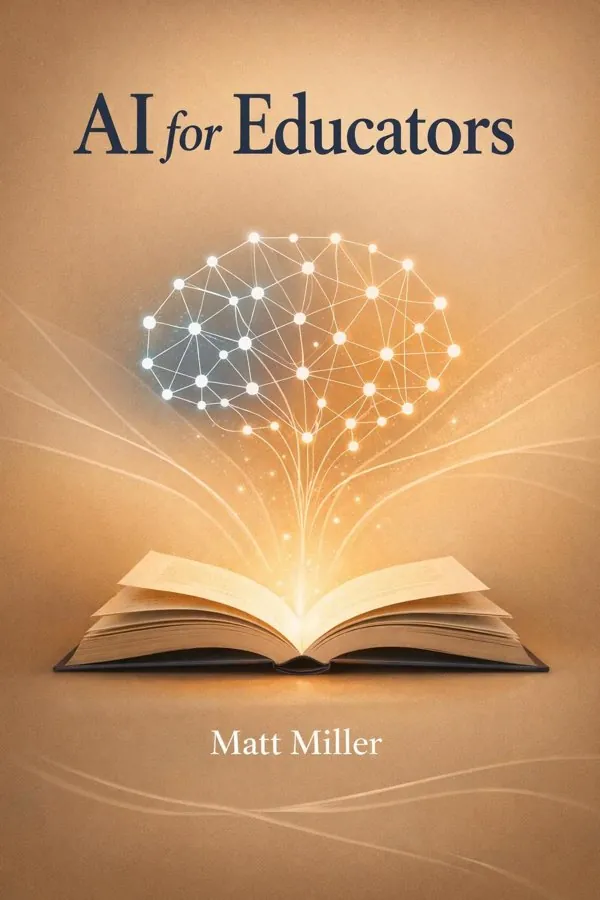
AI for Educators: Learning Strategies, Teacher Empowerment, and the Future of Education: Summary & Key Insights
by Matt Miller
 10 min5 chaptersAudio available
What Is AI for Educators: Learning Strategies, Teacher Empowerment, and the Future of Education About?
AI for Educators: Learning Strategies, Teacher Empowerment, and the Future of Education by Matt Miller is a education book spanning 5 pages. AI for Educators explores how artificial intelligence can transform teaching and learning. Matt Miller provides practical guidance for teachers to integrate AI tools into their classrooms, enhance creativity, and personalize learning experiences. The book emphasizes ethical use, critical thinking, and the evolving role of educators in an AI-driven world.
This FizzRead summary covers all 5 key chapters of AI for Educators: Learning Strategies, Teacher Empowerment, and the Future of Education in approximately 10 minutes, distilling the most important ideas, arguments, and takeaways from Matt Miller's work. Also available as an audio summary and Key Quotes Podcast.
AI for Educators: Learning Strategies, Teacher Empowerment, and the Future of Education
AI for Educators explores how artificial intelligence can transform teaching and learning. Matt Miller provides practical guidance for teachers to integrate AI tools into their classrooms, enhance creativity, and personalize learning experiences. The book emphasizes ethical use, critical thinking, and the evolving role of educators in an AI-driven world.
Who Should Read AI for Educators: Learning Strategies, Teacher Empowerment, and the Future of Education?
This book is perfect for anyone interested in education and looking to gain actionable insights in a short read. Whether you're a student, professional, or lifelong learner, the key ideas from AI for Educators: Learning Strategies, Teacher Empowerment, and the Future of Education by Matt Miller will help you think differently.
- ✓Readers who enjoy education and want practical takeaways
- ✓Professionals looking to apply new ideas to their work and life
- ✓Anyone who wants the core insights of AI for Educators: Learning Strategies, Teacher Empowerment, and the Future of Education in just 10 minutes
Want the full summary?
Get instant access to this book summary and 100K+ more with Fizz Moment.
Get Free SummaryAvailable on App Store • Free to download
Key Chapters
Artificial intelligence is, at its core, a set of systems that learn patterns and act upon them. But what matters most for educators is not the mathematics under the hood—it’s the mindset that comes with it. I often tell teachers that AI begins with curiosity: how might machines think, and how might they help us think better ourselves? Concepts like machine learning and natural language processing may sound abstract, yet they’re already woven into tools we use every day—search engines, voice assistants, recommendation systems. Understanding these fundamentals empowers educators to shape the way AI enters learning spaces intentionally.
When I introduce AI to educators, I emphasize that it doesn’t require coding skills or deep technical expertise. What’s needed is a willingness to experiment, reflect, and ask questions about how automation can serve students. A machine learning algorithm that recognizes handwriting, for example, can help digitize and analyze student work. Natural language processing, used in chatbots or generators, can create prompts or feedback instantly, freeing the teacher to focus on deeper interactions. The promise of AI lies in this partnership: we design the learning; AI helps us deliver it more personally and efficiently.
In teaching contexts, understanding the basic principles of AI opens new pathways for creativity. Once a teacher realizes that machine learning models predict patterns based on data, it becomes clear why high-quality input matters—and why ethics must be integral. From the start, I remind educators that AI reflects the people who build and train it. Knowing this, we teach our students not merely to use technology, but to question it, ensuring that every AI-assisted classroom remains grounded in human judgment and empathy.
One of the most practical spaces where AI starts paying dividends is lesson planning. Educators often spend countless hours designing activities that meet curriculum goals while engaging diverse learners. With AI-driven platforms, that process can become faster and more creative. When I first experimented with generative text tools, I realized that they could suggest writing prompts, create sample dialogues, and outline differentiated content—all within minutes. Yet the breakthrough wasn’t speed—it was inspiration. AI gave me starting points that sparked new ideas I’d never considered.
In assessment, the transformation is equally powerful. Automated grading systems can handle repetitive evaluation tasks, allowing teachers to devote more energy to interpretive feedback—the part that makes learning personal. AI tools can examine patterns across student responses, identifying misconceptions and helping teachers intervene sooner. Imagine a language model generating instant, formative feedback or helping craft rubrics customized to individual assignments. The goal isn’t to let machines grade for us; it’s to enable teachers to spend their energy where it matters most.
I’ve seen classrooms where AI serves as a creative collaborator rather than a replacement. Teachers feed in learning objectives, and AI tools produce scaffolding for advanced learners and support for struggling students. For example, AI can propose alternative explanations, vocabulary reinforcements, or visual aids. What once took hours can now be iterated in minutes, freeing teachers to refine and personalize. Teachers who initially felt intimidated by AI ultimately discover that it amplifies their artistry—turning lesson design into a dynamic process fueled by exploration rather than obligation.
+ 3 more chapters — available in the FizzRead app
All Chapters in AI for Educators: Learning Strategies, Teacher Empowerment, and the Future of Education
About the Author
Matt Miller is an educator, speaker, and author known for his work on technology integration in education. He is the creator of the Ditch That Textbook movement, which encourages innovative and flexible teaching practices.
Get This Summary in Your Preferred Format
Read or listen to the AI for Educators: Learning Strategies, Teacher Empowerment, and the Future of Education summary by Matt Miller anytime, anywhere. FizzRead offers multiple formats so you can learn on your terms — all free.
Available formats: App · Audio · PDF · EPUB — All included free with FizzRead
Download AI for Educators: Learning Strategies, Teacher Empowerment, and the Future of Education PDF and EPUB Summary
Key Quotes from AI for Educators: Learning Strategies, Teacher Empowerment, and the Future of Education
“Artificial intelligence is, at its core, a set of systems that learn patterns and act upon them.”
“One of the most practical spaces where AI starts paying dividends is lesson planning.”
Frequently Asked Questions about AI for Educators: Learning Strategies, Teacher Empowerment, and the Future of Education
AI for Educators: Learning Strategies, Teacher Empowerment, and the Future of Education by Matt Miller is a education book that explores key ideas across 5 chapters. AI for Educators explores how artificial intelligence can transform teaching and learning. Matt Miller provides practical guidance for teachers to integrate AI tools into their classrooms, enhance creativity, and personalize learning experiences. The book emphasizes ethical use, critical thinking, and the evolving role of educators in an AI-driven world.
You Might Also Like

Bedtime Biography: Florence Nightingale
Isabel Thomas
10 min
Introduction To Museum Studies
Howard H. Hoyt
10 min
A Mind for Numbers: How to Excel at Math and Science (Even If You Flunked Algebra)
Barbara Oakley
10 min
Animation For Beginners
Morr Meroz
10 min
Artificial Intelligence for Learning
Donald Clark
10 min
Artists' Resumes and Portfolios: Various Practical Guides
A. Robin
10 minFeatured In
Browse by Category
Ready to read AI for Educators: Learning Strategies, Teacher Empowerment, and the Future of Education?
Get the full summary and 100K+ more books with Fizz Moment.