
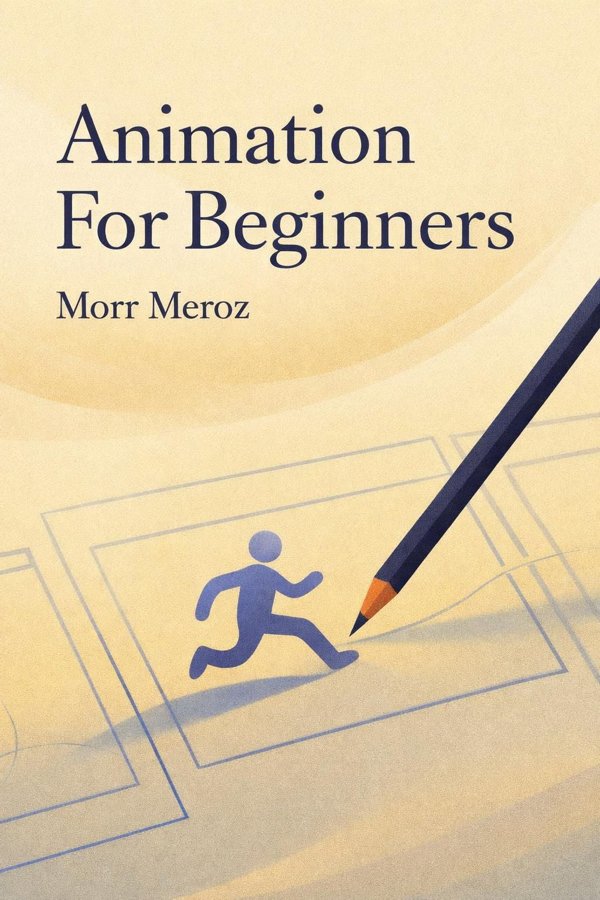
Animation For Beginners: Summary & Key Insights
by Morr Meroz
 10 min9 chaptersAudio available
Key Takeaways from Animation For Beginners
Animation begins with a paradox: you create life by arranging lifeless images.
A weak story cannot be rescued by polished animation.
A scene becomes real the moment you can see its sequence.
An audience remembers who a character is long before it remembers how perfectly the character was rendered.
Backgrounds are never just backgrounds.
What Is Animation For Beginners About?
Animation For Beginners by Morr Meroz is a education book spanning 9 pages. Animation For Beginners is a clear, encouraging introduction to the craft of turning ideas into moving stories. Rather than treating animation as a mysterious technical skill reserved for experts, Morr Meroz breaks it down into learnable stages: finding a story, designing characters, planning scenes, understanding motion, and completing a project from first sketch to final render. The book shows that good animation does not begin with expensive software or flashy effects. It begins with observation, storytelling, and deliberate choices about how movement communicates emotion and meaning. What makes this book especially valuable is its practical perspective. Meroz, founder of Bloop Animation, writes from real industry experience while keeping the material accessible for newcomers. He explains both the creative side of animation and the production mindset needed to finish work consistently. For aspiring animators, filmmakers, students, and self-taught artists, this book matters because it replaces overwhelm with structure. It helps readers see animation not as a single skill, but as a complete process that can be learned step by step. The result is a beginner-friendly roadmap into one of the most expressive visual mediums.
This FizzRead summary covers all 9 key chapters of Animation For Beginners in approximately 10 minutes, distilling the most important ideas, arguments, and takeaways from Morr Meroz's work. Also available as an audio summary and Key Quotes Podcast.
Animation For Beginners
Animation For Beginners is a clear, encouraging introduction to the craft of turning ideas into moving stories. Rather than treating animation as a mysterious technical skill reserved for experts, Morr Meroz breaks it down into learnable stages: finding a story, designing characters, planning scenes, understanding motion, and completing a project from first sketch to final render. The book shows that good animation does not begin with expensive software or flashy effects. It begins with observation, storytelling, and deliberate choices about how movement communicates emotion and meaning.
What makes this book especially valuable is its practical perspective. Meroz, founder of Bloop Animation, writes from real industry experience while keeping the material accessible for newcomers. He explains both the creative side of animation and the production mindset needed to finish work consistently. For aspiring animators, filmmakers, students, and self-taught artists, this book matters because it replaces overwhelm with structure. It helps readers see animation not as a single skill, but as a complete process that can be learned step by step. The result is a beginner-friendly roadmap into one of the most expressive visual mediums.
Who Should Read Animation For Beginners?
This book is perfect for anyone interested in education and looking to gain actionable insights in a short read. Whether you're a student, professional, or lifelong learner, the key ideas from Animation For Beginners by Morr Meroz will help you think differently.
- ✓Readers who enjoy education and want practical takeaways
- ✓Professionals looking to apply new ideas to their work and life
- ✓Anyone who wants the core insights of Animation For Beginners in just 10 minutes
Want the full summary?
Get instant access to this book summary and 100K+ more with Fizz Moment.
Get Free SummaryAvailable on App Store • Free to download
Key Chapters
Animation begins with a paradox: you create life by arranging lifeless images. That insight sits at the center of Morr Meroz’s approach. He frames animation not simply as drawing, software use, or technical trickery, but as a storytelling medium built from deliberate motion. Whether the work is hand-drawn, stop-motion, 2D digital, or 3D, the core challenge is always the same: how do you make the viewer believe that movement has intention, emotion, and meaning?
This perspective matters because many beginners focus too early on tools. They compare software, chase visual effects, or worry about professional hardware before understanding what animation actually does. Meroz redirects attention toward communication. A bouncing ball can express weight, mood, and personality. A pause before a character speaks can create tension. A camera move can shift emotional focus. In animation, movement is never neutral; every change in timing, spacing, and pose tells the audience something.
Thinking this way also helps beginners avoid intimidation. You do not need to master every style at once. You need to understand the medium’s purpose. For example, a simple stick-figure scene can feel more alive than a beautifully rendered model if the movement is believable and the action serves the story. The audience responds first to clarity and emotion, not technical complexity alone.
Meroz’s broader lesson is that animation is a language. The animator learns to speak through rhythm, shape, staging, and action. Once you understand that, every exercise becomes meaningful, from bouncing balls to dialogue shots.
Actionable takeaway: Before opening any animation software, describe in one sentence what emotion or idea your scene should communicate, then animate only what supports that goal.
A weak story cannot be rescued by polished animation. That is one of the book’s most important messages. Meroz emphasizes that every successful animated project starts with a clear dramatic idea: someone wants something, faces obstacles, and changes through action. Beginners often assume animation begins with drawing characters or building scenes, but story is what gives those elements purpose.
The book encourages readers to start small. Instead of inventing an epic fantasy world with dozens of characters, Meroz suggests focusing on a simple premise. A child trying to hide a broken toy. A dog determined to reach food on a table. A lonely robot searching for connection. These small stories are easier to animate because they rely on a single emotional line and a manageable sequence of actions. Simplicity is not a limitation; it is a discipline that helps beginners finish work.
Meroz also shows that good story development includes visual thinking. Animation is not literature with moving illustrations. It is a form where actions reveal character. Rather than writing long conversations, beginners should ask: what can be shown instead of explained? A character’s hesitation, posture, or repeated failed attempt can communicate more than a page of dialogue.
In practice, this means testing story ideas early. Create a one-paragraph synopsis. Identify the main conflict. Clarify the beginning, middle, and end. If the emotional arc is fuzzy on paper, it will become even weaker in animation, where every shot requires time and labor.
Actionable takeaway: Write a story premise in three sentences: who the character is, what they want, and what stands in their way. If that core is compelling, the animation has a solid foundation.
A scene becomes real the moment you can see its sequence. That is why storyboarding is such a powerful stage in the animation process. Meroz presents storyboards as the bridge between abstract story and actual production. They force creators to decide where the camera is, what the audience sees, how action unfolds, and which moments matter most.
For beginners, storyboards are invaluable because they make mistakes cheap. It is far easier to redraw a panel than to reanimate a finished shot. Through rough drawings, arrows, notes, and shot choices, you can test pacing, staging, and clarity before committing to detailed work. Meroz treats storyboarding not as an optional professional extra, but as a thinking tool. Even simple thumbnails can reveal continuity problems, confusing action, or missing emotional beats.
He then extends this logic into animatics, which combine storyboard panels with temporary timing and sound. Animatics let beginners feel the rhythm of a film before full production begins. A joke may land too slowly. A dramatic pause may be too short. A camera cut may feel abrupt. These issues are much easier to fix at the animatic stage than after weeks of animation.
Consider a short chase scene. On paper, the idea might seem exciting. In storyboards, you may notice repetitive framing. In an animatic, you may realize the sequence lacks escalation. The planning process reveals what pure imagination often hides.
The deeper lesson is that visual planning sharpens storytelling. You discover not just what happens, but how it should be seen.
Actionable takeaway: For your next idea, draw 10 to 20 rough storyboard panels and turn them into a timed animatic before animating anything in detail.
An audience remembers who a character is long before it remembers how perfectly the character was rendered. Meroz stresses that character design is not mainly about decoration. It is about making personality visible. Shape, silhouette, posture, proportions, expression, and movement style all work together to tell viewers what kind of being they are watching.
This is especially important for beginners, who often overdesign. They add intricate costumes, textures, and accessories without first asking what the character needs to communicate. A nervous character might have hunched shoulders, quick glances, and compact shapes. A confident character might stand with open posture, strong angles, and steady movement. Design becomes stronger when it emerges from behavior and role rather than surface complexity.
Meroz’s practical philosophy is to think in terms of clarity and function. Can the character be recognized in silhouette? Does the design support animation, or is it so complicated that every frame becomes exhausting? Does the visual style match the story’s tone? A cheerful children’s short may benefit from bold, simple forms, while a darker film may call for more angular tension.
He also points out that personality is reinforced through consistency. A character’s expressions, gestures, and reactions should feel like variations of the same inner identity. This does not mean they become predictable; it means their actions make sense. Even exaggeration works best when rooted in a coherent emotional core.
A beginner creating a short film about a stubborn inventor, for example, might design oversized glasses, a forward-leaning pose, and energetic hand motions to support that personality.
Actionable takeaway: Create one character sheet using only silhouette, posture, and three key expressions before adding costume details or color.
Backgrounds are never just backgrounds. In animation, environments shape mood, direct attention, and influence how characters move. Meroz encourages beginners to think of world-building not as decorative scene-filling, but as an extension of storytelling. A location should reveal information, create atmosphere, and support the action taking place within it.
A cluttered workshop suggests obsession and invention. A wide empty street can evoke loneliness or suspense. A cramped kitchen can make a comedic scene feel more chaotic as characters bump into objects and each other. Environment design affects not only how a film looks, but how scenes function. Doors, stairs, tables, windows, lighting sources, and spatial depth all influence blocking and timing.
For beginners, the key is balance. Overly detailed backgrounds can distract from the main action and dramatically increase production time. Meroz advises simplifying environments so they serve the story efficiently. That may mean emphasizing only the props and architectural features that matter. If a character must hide behind a couch, the couch needs strong visual clarity. If the emotional focus is on isolation, extra decorative clutter may weaken the image.
He also highlights consistency in style and perspective. Characters and environments should feel as though they belong to the same world. A highly stylized character placed in an unrelated realistic space can create an unintended disconnect unless that contrast is a deliberate artistic choice.
In practical terms, environment design works best when tied directly to scene purpose. Ask what the setting must communicate and what actions it needs to enable.
Actionable takeaway: For each scene, list three environmental elements that affect the story or movement, and design those first before adding any nonessential detail.
Movement feels alive when it obeys patterns the eye can trust. Meroz introduces the classic principles of animation as the foundation for this trust. Timing, spacing, squash and stretch, anticipation, follow-through, arcs, staging, and exaggeration are not old-fashioned rules; they are practical tools for making motion readable and expressive.
For beginners, these principles explain why some actions feel convincing and others look stiff. A ball that falls at a constant speed may seem artificial because gravity creates acceleration. A character who jumps without anticipation feels mechanical because real bodies prepare before major action. Hair or clothing that stops instantly after movement ignores inertia, making the shot feel dead. The principles teach animators how motion behaves and how audiences perceive it.
Meroz likely emphasizes learning these concepts through simple exercises rather than complicated scenes. A bouncing ball teaches timing and spacing. A pendulum demonstrates arcs and overlap. A sack of flour test introduces weight and flexibility. These exercises may seem basic, but they develop the animator’s eye far more effectively than jumping straight into ambitious character acting.
Importantly, the principles are not about realism alone. They are about clarity and emotional impact. Exaggeration, for example, can make a comedic reaction funnier or a dramatic moment more intense, as long as it remains consistent with the scene. The animator is not copying life mechanically; they are interpreting it.
Mastery begins when beginners stop asking, “How do I move this object?” and start asking, “What should this movement feel like?”
Actionable takeaway: Practice one simple motion study each day, such as a bouncing ball or head turn, and analyze it specifically through timing, spacing, anticipation, and follow-through.
Creative energy is common; finishing projects is rare. Meroz addresses this gap by teaching animation as a pipeline rather than a burst of inspiration. A production pipeline breaks a project into stages such as concept, script, storyboard, animatic, design, layout, animation, cleanup, sound, rendering, and final edit. This structure is what turns ideas into completed films.
For beginners, the pipeline is liberating because it reduces chaos. Without it, you may redesign characters halfway through animation, rewrite scenes after rendering, or discover too late that the story does not work. The pipeline creates order, helping artists solve problems at the right moment. Story problems belong early. Technical polishing belongs later. When stages are respected, the process becomes more efficient and less emotionally exhausting.
Meroz also implicitly teaches project management. Scope matters. A 30-second finished short with strong planning is more valuable than an unfinished five-minute epic. File organization matters. Naming conventions, folder structure, and version control may sound boring, but they prevent disasters. Deadlines matter too, even self-imposed ones, because endless revision can become a form of avoidance.
This production mindset is especially useful for solo creators, who must play multiple roles at once. By separating tasks, you can focus more effectively. One day is for script changes. Another is for rough animation. Another is for sound cleanup. This reduces mental switching and protects momentum.
The larger lesson is professional discipline. Animation is art, but it is also workflow.
Actionable takeaway: Build a simple production checklist for your next project, assign each stage a deadline, and do not move forward until the current stage is clear enough to support the next.
An animation can look impressive and still feel empty until sound gives it presence. Meroz highlights post-production as a major storytelling stage, not a final afterthought. Voice, music, ambience, and sound effects dramatically shape how movement is understood. A silent footstep, a mistimed line reading, or a flat soundscape can weaken an otherwise strong visual sequence.
For beginners, this is a crucial lesson because many underestimate how much sound affects emotion and clarity. Consider a simple shot of a character opening a door. With creaking hinges, distant thunder, and hesitant breathing, it becomes suspenseful. With bright music and a cheerful knock-like sound, it becomes comic. The image may remain identical, but the audience’s interpretation changes completely.
Meroz also points to synchronization. Dialogue animation depends on believable timing and lip sync, but beyond the mouth, the whole body should support speech. Sound encourages better visual choices. Similarly, effects and music should support the scene rather than overwhelm it. Beginners sometimes use nonstop music to cover weak pacing, but stronger post-production means choosing audio that enhances the intended rhythm.
Even basic sound design can elevate student work. Room tone smooths cuts. Subtle ambience gives a setting depth. Footsteps, cloth movement, and object impacts create physicality. Clean editing makes the final film feel intentional and complete.
The broader message is that animation is audiovisual storytelling. The visual track provides one half of the illusion; sound makes the world breathe.
Actionable takeaway: When finishing a scene, add at least three sound layers—dialogue or key action, ambient environment, and supporting effects or music—and review how each one changes the scene’s emotional meaning.
Beginners often believe they need permission before they can call themselves animators. Meroz pushes against that mindset by emphasizing portfolios, practice, and career-building through completed work. In animation, your strongest introduction is not your ambition but your reel. Employers, collaborators, and clients want to see evidence that you can observe motion, solve visual problems, and finish a project.
This means quality and focus matter more than quantity. A short reel with a few strong exercises or scenes is better than a long reel filled with inconsistent work. If your strength is character acting, show scenes that demonstrate emotion, timing, and body mechanics. If you prefer design or storyboarding, present work that highlights staging, clarity, and visual storytelling. A portfolio should communicate what kind of animator you are becoming.
Meroz’s advice is particularly useful for self-taught artists. Personal projects, short exercises, and small films are not just practice; they are career assets. A one-minute film that shows clear storytelling, strong animation principles, and polished sound can teach more and impress more than months of unfinished experiments. Sharing work online, seeking critique, and revising based on feedback also become part of professional growth.
He likely encourages readers to build habits that support long-term development: studying from life, maintaining consistency, learning industry expectations, and developing patience. The animation field rewards persistence as much as talent.
The underlying lesson is empowering: careers are built incrementally. Each completed scene strengthens both your skills and your credibility.
Actionable takeaway: Select your three best finished pieces, refine their presentation, and assemble a focused starter portfolio that reflects the specific animation work you want to pursue.
All Chapters in Animation For Beginners
About the Author
Morr Meroz is an Israeli-born animator, filmmaker, and educator best known as the founder of Bloop Animation Studios. He has become a respected voice in animation education by creating accessible lessons, tutorials, and courses for aspiring animators and storytellers. His work focuses on demystifying the animation process, helping beginners understand everything from story development and design to motion principles and production workflow. Meroz combines hands-on industry knowledge with a teacher’s clarity, which has made his content especially valuable for self-taught artists and students entering the field. Through books, videos, and educational resources, he has built a reputation for turning a complex creative discipline into a structured, approachable learning journey.
Get This Summary in Your Preferred Format
Read or listen to the Animation For Beginners summary by Morr Meroz anytime, anywhere. FizzRead offers multiple formats so you can learn on your terms — all free.
Available formats: App · Audio · PDF · EPUB — All included free with FizzRead
Download Animation For Beginners PDF and EPUB Summary
Key Quotes from Animation For Beginners
“Animation begins with a paradox: you create life by arranging lifeless images.”
“A weak story cannot be rescued by polished animation.”
“A scene becomes real the moment you can see its sequence.”
“An audience remembers who a character is long before it remembers how perfectly the character was rendered.”
“In animation, environments shape mood, direct attention, and influence how characters move.”
Frequently Asked Questions about Animation For Beginners
Animation For Beginners by Morr Meroz is a education book that explores key ideas across 9 chapters. Animation For Beginners is a clear, encouraging introduction to the craft of turning ideas into moving stories. Rather than treating animation as a mysterious technical skill reserved for experts, Morr Meroz breaks it down into learnable stages: finding a story, designing characters, planning scenes, understanding motion, and completing a project from first sketch to final render. The book shows that good animation does not begin with expensive software or flashy effects. It begins with observation, storytelling, and deliberate choices about how movement communicates emotion and meaning. What makes this book especially valuable is its practical perspective. Meroz, founder of Bloop Animation, writes from real industry experience while keeping the material accessible for newcomers. He explains both the creative side of animation and the production mindset needed to finish work consistently. For aspiring animators, filmmakers, students, and self-taught artists, this book matters because it replaces overwhelm with structure. It helps readers see animation not as a single skill, but as a complete process that can be learned step by step. The result is a beginner-friendly roadmap into one of the most expressive visual mediums.
You Might Also Like

Bedtime Biography: Florence Nightingale
Isabel Thomas
10 min
Introduction To Museum Studies
Howard H. Hoyt
10 min
A Mind for Numbers: How to Excel at Math and Science (Even If You Flunked Algebra)
Barbara Oakley
10 min
AI for Educators: Learning Strategies, Teacher Empowerment, and the Future of Education
Matt Miller
10 min
Artificial Intelligence for Learning
Donald Clark
10 min
Artists' Resumes and Portfolios: Various Practical Guides
A. Robin
10 minFeatured In
Browse by Category
Ready to read Animation For Beginners?
Get the full summary and 100K+ more books with Fizz Moment.