
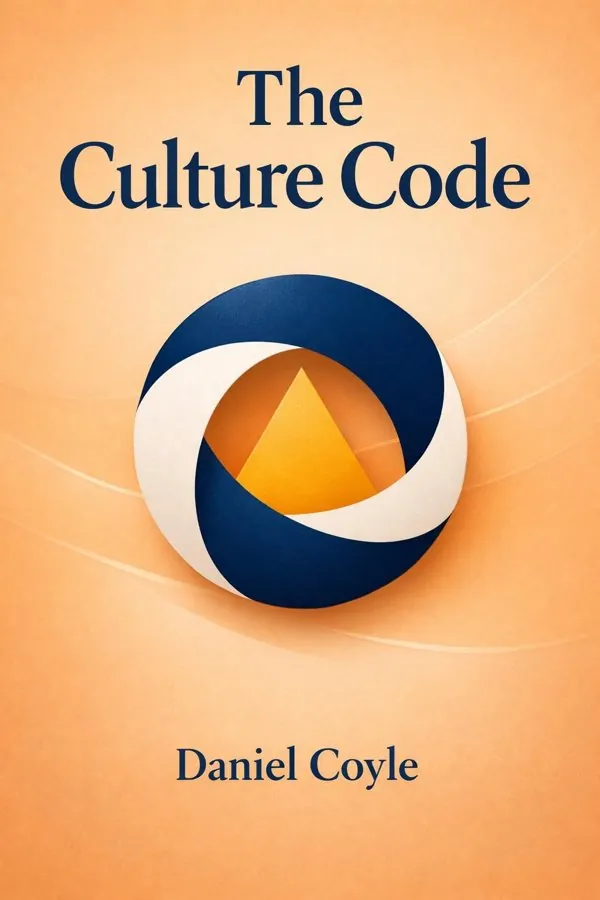
The Culture Code: Summary & Key Insights
by Daniel Coyle
 10 min9 chaptersAudio available
Key Takeaways from The Culture Code
Great cultures begin with a simple human need: the need to feel safe with one another.
Culture is not built in grand speeches; it is built in tiny signals that people exchange every day.
Strong cultures are not held together by displays of perfection.
Trust is not created by a single emotional moment.
A group can feel safe and trusting yet still drift if it lacks a clear sense of purpose.
What Is The Culture Code About?
The Culture Code by Daniel Coyle is a business book published in 2018 spanning 9 pages. What makes certain groups consistently outperform others, even when they do not seem to have more talent, money, or experience? In The Culture Code, Daniel Coyle argues that the answer lies in culture: the shared habits, signals, and behaviors that shape how people relate, trust, and work together. Drawing on visits to elite organizations such as Pixar, the San Antonio Spurs, Navy SEAL teams, and successful businesses, Coyle looks beneath the surface of high performance to uncover the patterns that make great groups thrive. The book matters because culture is often treated as a vague idea—something inspirational but hard to define. Coyle makes it concrete. He shows that strong cultures are not built through slogans or perks, but through repeatable actions that create safety, encourage vulnerability, and clarify purpose. These small moments determine whether people speak up, take risks, learn from failure, and commit to a shared mission. As a journalist and bestselling author focused on performance and teamwork, Coyle brings both storytelling skill and research-driven insight. The result is a practical guide for leaders, managers, coaches, and anyone who wants to build a stronger, more connected team.
This FizzRead summary covers all 9 key chapters of The Culture Code in approximately 10 minutes, distilling the most important ideas, arguments, and takeaways from Daniel Coyle's work. Also available as an audio summary and Key Quotes Podcast.
The Culture Code
What makes certain groups consistently outperform others, even when they do not seem to have more talent, money, or experience? In The Culture Code, Daniel Coyle argues that the answer lies in culture: the shared habits, signals, and behaviors that shape how people relate, trust, and work together. Drawing on visits to elite organizations such as Pixar, the San Antonio Spurs, Navy SEAL teams, and successful businesses, Coyle looks beneath the surface of high performance to uncover the patterns that make great groups thrive.
The book matters because culture is often treated as a vague idea—something inspirational but hard to define. Coyle makes it concrete. He shows that strong cultures are not built through slogans or perks, but through repeatable actions that create safety, encourage vulnerability, and clarify purpose. These small moments determine whether people speak up, take risks, learn from failure, and commit to a shared mission.
As a journalist and bestselling author focused on performance and teamwork, Coyle brings both storytelling skill and research-driven insight. The result is a practical guide for leaders, managers, coaches, and anyone who wants to build a stronger, more connected team.
Who Should Read The Culture Code?
This book is perfect for anyone interested in business and looking to gain actionable insights in a short read. Whether you're a student, professional, or lifelong learner, the key ideas from The Culture Code by Daniel Coyle will help you think differently.
- ✓Readers who enjoy business and want practical takeaways
- ✓Professionals looking to apply new ideas to their work and life
- ✓Anyone who wants the core insights of The Culture Code in just 10 minutes
Want the full summary?
Get instant access to this book summary and 100K+ more with Fizz Moment.
Get Free SummaryAvailable on App Store • Free to download
Key Chapters
Great cultures begin with a simple human need: the need to feel safe with one another. Before people can innovate, challenge ideas, or perform under pressure, they must first believe that they belong. Coyle shows that high-performing groups do not succeed because they are full of naturally confident people. They succeed because they create environments where individuals feel seen, respected, and protected enough to contribute honestly.
Safety in a group is not softness or comfort without standards. It is the shared sense that “we are connected,” “you matter here,” and “this is a place where I will not be ignored or punished for participating.” In low-safety cultures, people become guarded. They hold back ideas, avoid asking questions, and spend energy protecting themselves. In high-safety cultures, that energy is released into cooperation and problem-solving.
Coyle illustrates this through organizations where belonging cues are everywhere: close attention, active listening, warm eye contact, short energetic exchanges, and behaviors that reduce status barriers. These cues tell people that they are part of something larger and that their presence has value. Even small actions—learning names quickly, asking for input, acknowledging effort, and responding with curiosity instead of dismissal—can strengthen a group’s foundation.
In business settings, this may mean leaders creating regular moments for open discussion, making space for quieter team members, and responding constructively when concerns are raised. In families, schools, or community groups, it means showing consistent interest and reliability.
Actionable takeaway: Audit your daily interactions for belonging cues. Make eye contact, listen without interruption, invite participation, and consistently communicate, through words and behavior, that people are valued members of the group.
Culture is not built in grand speeches; it is built in tiny signals that people exchange every day. One of Coyle’s most powerful insights is that connection has a language, and much of that language is nonverbal. We often think trust is based on logic or formal agreements, but in practice people read the room through subtle cues: attention, timing, body posture, tone, and responsiveness.
These signals of connection tell us whether we are safe, whether we belong, and whether collaboration is worth the risk. A leader who looks distracted in a meeting, interrupts people, or reacts defensively may unintentionally create distance. By contrast, a leader who leans in, asks follow-up questions, and treats ideas with seriousness sends a message that encourages engagement.
Coyle emphasizes that high-performing groups are unusually good at sending these cues consistently. They do not leave inclusion to chance. Members make frequent, energetic exchanges. They show that they are listening. They coordinate turn-taking well. They create rhythms of attention that keep people connected. This is why some teams feel instantly cohesive while others feel fragmented, even if both are filled with capable people.
A practical example is the difference between a meeting where only a few voices dominate and one where participants are invited in, acknowledged, and built upon. The second environment generates more ownership and often better decisions because people feel psychologically present, not merely physically present.
Actionable takeaway: Improve your team’s connection signals by practicing visible listening. Maintain attention, reduce interruptions, reflect back what you heard, and make sure every conversation leaves the other person feeling recognized rather than overlooked.
Strong cultures are not held together by displays of perfection. They are strengthened when people feel able to admit uncertainty, weakness, and need. Coyle argues that vulnerability is not a side issue in group performance; it is one of the core mechanisms through which trust deepens. When team members acknowledge what they do not know or where they need help, they invite others into a more honest and collaborative relationship.
This idea can feel counterintuitive, especially in competitive workplaces where confidence is prized. Many people assume that revealing doubt lowers status. But in healthy groups, appropriate vulnerability actually increases credibility because it signals authenticity and commitment to collective success over ego protection. It says, in effect, “I trust this group enough to be real, and I care enough about our work to be honest.”
Coyle shows that great teams often normalize phrases like “I was wrong,” “I need help,” or “I missed something.” These are not signs of weakness. They are signs that members are working in a reality-based culture instead of a defensive one. Vulnerability also improves learning. If people can name mistakes early, the group can adjust quickly. If they hide them, small problems grow into major failures.
In practical terms, leaders play a decisive role here. When leaders admit errors, ask questions, and invite feedback, they lower the social cost of honesty. Teams then become faster at problem-solving because information moves more freely.
Actionable takeaway: Introduce vulnerability into your team’s routines. Model it first by admitting a mistake, asking for help, or inviting critique, and then reward honesty with curiosity and support rather than blame.
Trust is not created by a single emotional moment. It is built through repeated exchanges in which one person takes a risk and another responds constructively. Coyle calls these exchanges vulnerability loops. They are the basic unit of cooperation: one person signals openness or need, and the other answers with empathy, attention, or help. With each loop, trust grows a little stronger.
This matters because teams often assume trust should exist before difficult conversations happen. In reality, trust is often the result of those conversations. A colleague says, “I’m not sure this plan works,” and instead of being punished, they are heard. A manager says, “I need your expertise,” and the invitation creates mutual respect. A team reviews a failed project honestly, and rather than hunting for scapegoats, members focus on learning. These moments create a culture where candor becomes normal.
Coyle’s examples show that high-performing groups generate many vulnerability loops, especially in moments of stress or uncertainty. They do not avoid tension; they process it together. This makes them resilient because people know that difficulty will lead to collaboration, not isolation.
Organizations can intentionally create these loops through after-action reviews, feedback rituals, peer coaching, and meetings structured around questions instead of declarations. Even a simple practice of ending a project discussion with “What are we missing?” can encourage risk-sharing and better thinking.
Actionable takeaway: Build trust by designing repeated moments of safe honesty. Create rituals where people can admit errors, ask for support, and challenge assumptions, and make sure every act of openness is met with respect and useful response.
A group can feel safe and trusting yet still drift if it lacks a clear sense of purpose. Coyle’s third essential skill is establishing purpose: creating shared understanding about where the group is going, what matters most, and how each person contributes. Purpose turns connection into coordinated effort.
Importantly, purpose is not just a mission statement hanging on a wall. In strong cultures, purpose is taught, repeated, and embedded in daily behavior. People hear it in stories, see it in priorities, and feel it in decisions. It acts like a navigation system, helping teams choose what to do and what to ignore. Without it, groups become busy but not aligned.
Coyle explains that successful organizations overcommunicate priorities. They do not assume people understand the mission simply because it has been announced once. Instead, they use constant reminders, simple language, and clear behavioral standards. In a business, purpose might be tied to serving customers exceptionally well, building excellent products, or protecting long-term trust. In a hospital, it may center on patient safety. In a sports team, it may define how players practice, compete, and support one another.
Purpose also becomes more powerful when individuals can connect their own role to the larger mission. Employees work harder and with more care when they know why their work matters beyond immediate tasks.
Actionable takeaway: Clarify your team’s purpose in plain language and repeat it often. Then connect each major decision, routine, and responsibility back to that purpose so people can see how their daily actions support the whole.
People do not remember policy manuals; they remember stories. One of Coyle’s practical insights is that culture is transmitted through narratives and simple phrases that carry values from one moment to the next. Stories show people what the group truly honors, while catchphrases make those values easy to recall under pressure.
In effective cultures, stories are not random. They are selected and repeated because they demonstrate identity. A story about someone going the extra mile for a customer, admitting a costly mistake early, or supporting a teammate in a critical moment becomes more than an anecdote. It becomes a behavioral model. It tells everyone, “This is who we are around here.”
Catchphrases serve a similar function. They compress complex ideas into memorable cues that people can use in real time. A phrase like “strong opinions, loosely held” or “help first” can shape how meetings, feedback, and decisions unfold. The best phrases are brief, concrete, and tied to actual practice rather than empty branding.
Leaders often underestimate how much informal storytelling influences a group. If the stories people tell are about politics, fear, and punishment, that becomes the culture. If the stories celebrate learning, commitment, and care, the culture shifts in that direction. This is especially important in growing organizations where new members learn norms by listening to what veterans repeat.
Actionable takeaway: Curate your culture’s stories deliberately. Share examples that embody your values, create a few useful catchphrases that reinforce desired behaviors, and repeat them until they become part of the group’s everyday language.
Culture may belong to the whole group, but leaders shape its emotional weather. Their behavior tells people what is safe, what is valued, and what will happen when things go wrong. Coyle makes clear that leadership is less about authority and more about signal-sending. Every reaction from a leader—especially under pressure—teaches the group something.
If leaders hoard information, avoid accountability, or punish bad news, people quickly become cautious and political. If leaders are consistent, attentive, and honest, the group becomes more open and adaptive. This is why leadership in The Culture Code is not about charisma. It is about creating conditions in which trust, candor, and purpose can thrive.
Coyle highlights leaders who are skilled at listening, asking questions, and making others feel ownership of the mission. They create space for disagreement without letting the group lose alignment. They are demanding, but their standards are tied to care and clarity rather than fear. They also model the cultural behaviors they want others to adopt. A leader who expects humility must practice humility. A leader who wants feedback must be willing to receive it.
This applies at every level, not just at the top. Team leads, department heads, teachers, coaches, and even informal influencers can reinforce or weaken culture through everyday actions. The key is understanding that people are always reading behavior more closely than rhetoric.
Actionable takeaway: Lead through consistency and example. In moments of stress, slow down your reactions, invite input, and demonstrate the exact behaviors—openness, accountability, respect, and focus—that you want your culture to reflect.
One reason The Culture Code resonates so widely is that its lessons are not limited to elite organizations. Coyle translates his insights into practical behaviors that any team can use, whether in a startup, classroom, nonprofit, sports club, or family business. Culture is not built by rare grand initiatives; it is shaped by everyday habits.
For example, teams can begin meetings with quick check-ins that increase presence and connection. Managers can reduce unnecessary hierarchy by asking junior employees for perspective before sharing their own opinions. Project reviews can focus on learning by asking what worked, what failed, and what to improve next time. Hiring and onboarding can be designed to teach not just tasks but also values and expected behaviors.
Another practical application is conflict handling. In weak cultures, disagreement often becomes personal or gets suppressed entirely. In strong cultures, disagreement is framed as a shared effort to solve problems. Teams can use simple rules such as criticizing ideas rather than people, summarizing opposing views fairly, and ending debates with clear commitments.
Coyle also encourages physical and procedural design choices that support interaction: shared spaces, regular feedback rhythms, and rituals that create belonging. These tools may seem small, but repeated over time they shape how a group feels and functions.
The larger point is empowering: culture is not mysterious. It can be built intentionally through repeated practices that increase safety, honesty, and alignment.
Actionable takeaway: Choose three culture-building habits you can start this week—such as better meeting turn-taking, regular feedback sessions, or more explicit recognition—and practice them consistently until they become normal.
A strong culture is not something you create once and then keep forever. It is a living system that must be maintained, renewed, and protected as the group grows and changes. Coyle emphasizes that sustaining culture requires vigilance because success itself can create new risks: complacency, bureaucracy, ego, and dilution of values.
As teams expand, informal norms that once spread naturally may no longer be enough. New members arrive without shared history. Leaders become more distant from the front lines. Subgroups form, and communication becomes less direct. Without deliberate reinforcement, the original culture can weaken. That is why healthy organizations keep retelling core stories, revisiting standards, and creating rituals that reconnect people to the mission.
Sustaining culture also means handling setbacks well. Every group will face conflict, turnover, failure, or external pressure. These moments become cultural tests. If leaders respond by hiding problems or blaming individuals, trust erodes. If they respond with honesty, learning, and renewed clarity, the culture often emerges stronger.
Coyle’s framework suggests that long-term culture depends on repetition. Safety cues must continue. Vulnerability must remain acceptable. Purpose must stay visible. This is especially important during transitions such as rapid hiring, leadership changes, mergers, or remote work shifts.
In practical terms, organizations can protect culture through intentional onboarding, regular reflection, clear decision principles, and visible leadership behaviors that remain stable even as strategy evolves.
Actionable takeaway: Treat culture as an ongoing practice, not a one-time achievement. Build recurring rituals to reinforce safety, vulnerability, and purpose, and review them regularly to ensure your values survive growth, stress, and change.
All Chapters in The Culture Code
About the Author
Daniel Coyle is an American author, journalist, and speaker known for exploring the science and practice of high performance. He has written several bestselling books, including The Talent Code, The Little Book of Talent, and The Culture Code, all of which examine how people and groups develop excellence. Coyle’s work blends reporting, behavioral science, and storytelling, often drawing on examples from sports, business, education, and the military. He has contributed to major publications such as The New York Times Magazine and Sports Illustrated, and he is widely recognized for making complex ideas accessible and practical. In The Culture Code, Coyle applies his investigative approach to one of the most important topics in modern work: how successful groups create trust, alignment, and lasting collaboration.
Get This Summary in Your Preferred Format
Read or listen to the The Culture Code summary by Daniel Coyle anytime, anywhere. FizzRead offers multiple formats so you can learn on your terms — all free.
Available formats: App · Audio · PDF · EPUB — All included free with FizzRead
Download The Culture Code PDF and EPUB Summary
Key Quotes from The Culture Code
“Great cultures begin with a simple human need: the need to feel safe with one another.”
“Culture is not built in grand speeches; it is built in tiny signals that people exchange every day.”
“Strong cultures are not held together by displays of perfection.”
“Trust is not created by a single emotional moment.”
“A group can feel safe and trusting yet still drift if it lacks a clear sense of purpose.”
Frequently Asked Questions about The Culture Code
The Culture Code by Daniel Coyle is a business book that explores key ideas across 9 chapters. What makes certain groups consistently outperform others, even when they do not seem to have more talent, money, or experience? In The Culture Code, Daniel Coyle argues that the answer lies in culture: the shared habits, signals, and behaviors that shape how people relate, trust, and work together. Drawing on visits to elite organizations such as Pixar, the San Antonio Spurs, Navy SEAL teams, and successful businesses, Coyle looks beneath the surface of high performance to uncover the patterns that make great groups thrive. The book matters because culture is often treated as a vague idea—something inspirational but hard to define. Coyle makes it concrete. He shows that strong cultures are not built through slogans or perks, but through repeatable actions that create safety, encourage vulnerability, and clarify purpose. These small moments determine whether people speak up, take risks, learn from failure, and commit to a shared mission. As a journalist and bestselling author focused on performance and teamwork, Coyle brings both storytelling skill and research-driven insight. The result is a practical guide for leaders, managers, coaches, and anyone who wants to build a stronger, more connected team.
More by Daniel Coyle

You Might Also Like






Featured In
Browse by Category
Ready to read The Culture Code?
Get the full summary and 100K+ more books with Fizz Moment.