
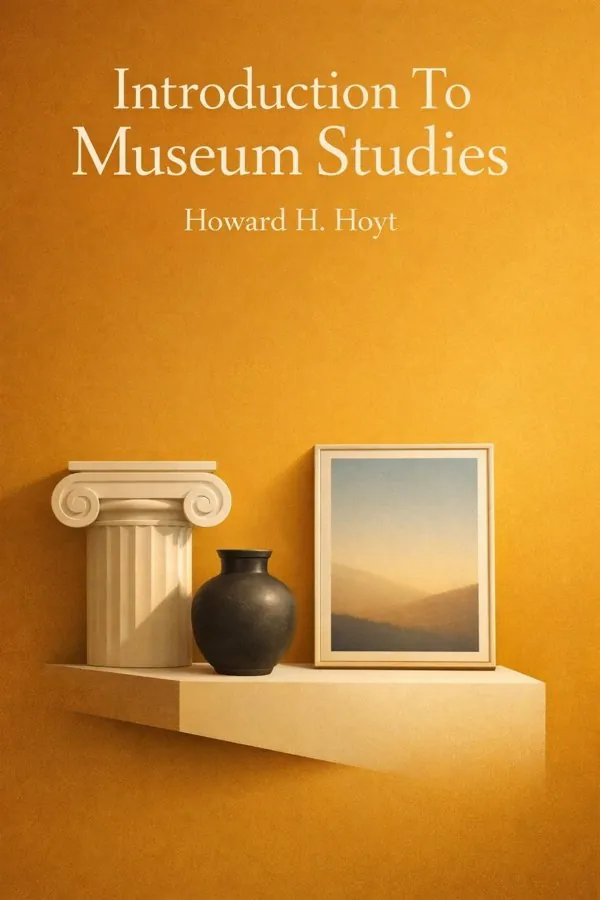
Introduction To Museum Studies: Summary & Key Insights
 10 min8 chaptersAudio available
Key Takeaways from Introduction To Museum Studies
Every museum tells a story, even when it claims to simply present facts.
An object becomes meaningful in a museum not because it is old or rare, but because it has been collected with purpose.
To preserve an object is not merely to keep it from breaking; it is to manage the conditions that allow it to endure meaningfully over time.
A strong exhibition does more than display objects; it transforms information into an experience people can understand, remember, and discuss.
A museum fulfills its purpose not when it stores knowledge, but when it helps people engage with that knowledge.
What Is Introduction To Museum Studies About?
Introduction To Museum Studies by Howard H. Hoyt is a education book. Museums are often seen as quiet buildings filled with old objects, but Howard H. Hoyt’s Introduction To Museum Studies reveals that they are far more than storage places for the past. They are educational institutions, cultural interpreters, civic spaces, and custodians of collective memory. This book serves as a foundational guide to understanding how museums function, why they matter, and what responsibilities they carry in modern society. Hoyt introduces readers to the essential principles behind collecting, preserving, researching, exhibiting, and interpreting objects, while also examining the ethical and institutional questions that shape museum work. What makes the book especially valuable is its balance between theory and practice: it helps readers see both the intellectual purpose of museums and the practical systems that keep them running. Whether you are a student, educator, museum professional, or simply curious about cultural institutions, this text offers a clear framework for understanding the field. Hoyt’s approach is authoritative, structured, and accessible, making the book a strong entry point into the interdisciplinary world of museum studies.
This FizzRead summary covers all 8 key chapters of Introduction To Museum Studies in approximately 10 minutes, distilling the most important ideas, arguments, and takeaways from Howard H. Hoyt's work. Also available as an audio summary and Key Quotes Podcast.
Introduction To Museum Studies
Museums are often seen as quiet buildings filled with old objects, but Howard H. Hoyt’s Introduction To Museum Studies reveals that they are far more than storage places for the past. They are educational institutions, cultural interpreters, civic spaces, and custodians of collective memory. This book serves as a foundational guide to understanding how museums function, why they matter, and what responsibilities they carry in modern society. Hoyt introduces readers to the essential principles behind collecting, preserving, researching, exhibiting, and interpreting objects, while also examining the ethical and institutional questions that shape museum work. What makes the book especially valuable is its balance between theory and practice: it helps readers see both the intellectual purpose of museums and the practical systems that keep them running. Whether you are a student, educator, museum professional, or simply curious about cultural institutions, this text offers a clear framework for understanding the field. Hoyt’s approach is authoritative, structured, and accessible, making the book a strong entry point into the interdisciplinary world of museum studies.
Who Should Read Introduction To Museum Studies?
This book is perfect for anyone interested in education and looking to gain actionable insights in a short read. Whether you're a student, professional, or lifelong learner, the key ideas from Introduction To Museum Studies by Howard H. Hoyt will help you think differently.
- ✓Readers who enjoy education and want practical takeaways
- ✓Professionals looking to apply new ideas to their work and life
- ✓Anyone who wants the core insights of Introduction To Museum Studies in just 10 minutes
Want the full summary?
Get instant access to this book summary and 100K+ more with Fizz Moment.
Get Free SummaryAvailable on App Store • Free to download
Key Chapters
Every museum tells a story, even when it claims to simply present facts. One of the central insights in Introduction To Museum Studies is that museums are not neutral containers of objects; they actively shape how the public understands history, science, art, and culture. The choice of what to collect, what to display, what to label, and what to omit influences how visitors interpret the world. Hoyt emphasizes that museums are educational institutions with enormous interpretive power, and this power brings responsibility.
A museum exhibition about immigration, for example, can either present migration as a human story of resilience and exchange or reduce it to statistics and policy timelines. A natural history museum can reinforce wonder and ecological awareness, or it can unintentionally present nature as static and disconnected from current environmental crises. Hoyt encourages readers to understand that museum work involves decisions about voice, framing, and audience. That means museum professionals must constantly ask: Whose perspective is being represented? What assumptions are embedded in the display? What social effect might this exhibit have?
This idea also helps explain why museums matter in civic life. They do not simply preserve heritage; they participate in public conversation. They can challenge myths, broaden understanding, and create empathy across communities. For teachers, this means museum visits can become lessons in critical thinking, not just observation. For museum professionals, it means interpretation must be thoughtful and transparent.
The practical application is straightforward: when visiting or designing an exhibition, ask what story is being told, who benefits from that story, and what alternative perspectives might also deserve attention. The actionable takeaway is to treat every museum display as an argument, not just an arrangement of objects.
An object becomes meaningful in a museum not because it is old or rare, but because it has been collected with purpose. Hoyt makes clear that collections are the foundation of museum work, yet collecting is far more demanding than acquiring interesting things. Museums must define the scope of their collections, establish standards for acquisition, document provenance, and ensure that each object can be properly cared for and interpreted over time. Without discipline, collecting becomes accumulation, and accumulation without purpose quickly creates institutional confusion.
This principle is especially important because every acquisition carries long-term responsibilities. A museum that accepts a textile, fossil, painting, or tool is also committing to storage, conservation, cataloging, research, and potential exhibition. Hoyt shows that effective collections management depends on policies that align with mission. A local history museum, for instance, should not accept every donated object from the community if those items do not support its interpretive focus. A science museum should consider whether a specimen adds educational or research value before bringing it into the collection.
Hoyt’s discussion also highlights documentation as a core professional practice. Without accurate records, an artifact loses much of its scholarly and educational usefulness. Information about origin, ownership, condition, cultural context, and acquisition method protects both the object and the institution. In today’s terms, this includes digital catalog systems and accessible metadata.
For students and emerging museum workers, the lesson is that stewardship begins long before an object goes on display. The actionable takeaway is to evaluate collections not by size or prestige, but by relevance, documentation quality, and the institution’s capacity to care for them responsibly.
To preserve an object is not merely to keep it from breaking; it is to manage the conditions that allow it to endure meaningfully over time. Hoyt stresses that preservation is one of the museum’s most important obligations, and it requires active planning rather than passive storage. Light, humidity, temperature, pests, handling, pollution, and even poor labeling can gradually damage collections. Preservation therefore combines scientific knowledge, institutional discipline, and ethical judgment.
This idea changes how readers think about museum work. Visitors often see only polished galleries, but behind the scenes are controlled storage spaces, conservation labs, environmental monitoring systems, and handling protocols. A manuscript may require low light and limited display time. A wooden artifact may crack if humidity fluctuates. A costume may need custom supports to avoid strain on fragile seams. Hoyt emphasizes that preservation is not only technical but strategic: museums must decide how to balance access and protection. An item displayed too often may deteriorate; an item never seen may fail to fulfill the museum’s public mission.
In practical terms, preservation also applies beyond large institutions. Small museums, school collections, and community heritage centers can improve care through basic measures such as clean storage, stable environmental conditions, careful object handling, and routine condition checks. Staff training matters just as much as expensive equipment.
Hoyt’s broader point is that preservation protects both material culture and the knowledge attached to it. Once damage occurs, historical evidence may be permanently lost. The actionable takeaway is to see preservation as a daily institutional habit: build systems, train people, and make every access decision with long-term care in mind.
A strong exhibition does more than display objects; it transforms information into an experience people can understand, remember, and discuss. Hoyt presents exhibitions as one of the museum’s most visible and influential tools, where scholarship meets design, education, and public engagement. Objects alone rarely communicate fully on their own. They need context, structure, and interpretation to become meaningful for diverse audiences.
This is why exhibition planning is both intellectual and practical. Curators and educators must identify a clear theme, define learning goals, select supporting objects, write accessible labels, and arrange the space in a way that guides the visitor’s attention. For example, an exhibit on industrialization might combine machinery, photographs, worker testimonies, maps, and interactive elements to show not only technological change but also its human consequences. Hoyt suggests that successful exhibits create coherence: visitors should leave with a central idea, not a scattered impression.
He also underscores the importance of audience awareness. Specialists may appreciate dense historical detail, but general visitors often need concise interpretation, visual clarity, and strong narrative links. Good exhibition design respects different levels of prior knowledge without oversimplifying the subject. This can include layered labels, multimedia interpretation, participatory stations, or family-oriented activities.
The lesson extends to classrooms, cultural programming, and digital exhibits: communication improves when information is organized around experience rather than mere presentation. The actionable takeaway is to design every exhibition around one essential question or message, then ensure that every object, label, and visual element helps visitors answer it.
A museum fulfills its purpose not when it stores knowledge, but when it helps people engage with that knowledge. Hoyt places education at the heart of museum studies, arguing that museums are uniquely positioned to support learning through direct encounters with objects, ideas, and environments. Unlike textbooks, museums can connect abstract concepts to tangible evidence. Unlike formal classrooms, they often encourage self-directed, exploratory learning. This combination gives museums unusual educational power.
Hoyt’s approach broadens the definition of museum education. It includes guided tours, school programs, family learning, public lectures, hands-on activities, interpretive texts, outreach initiatives, and community collaborations. A history museum might use everyday artifacts to make social change feel immediate. An art museum might teach visual literacy by encouraging visitors to compare techniques and symbolism. A science museum might foster curiosity through interactive experiments and real specimens. In each case, the museum acts as a bridge between specialized knowledge and public understanding.
The book also implies that education should not be an afterthought added once exhibitions are complete. Instead, educational goals should shape planning from the start. If an institution wants visitors to understand cultural diversity, scientific method, or local heritage, those outcomes should guide collecting, interpretation, staffing, and programming. Museums also need to consider accessibility, age differences, and varied learning styles.
For educators, the practical implication is that museum resources can deepen curriculum and spark inquiry-based learning. For museums, the challenge is to create encounters that are accurate, engaging, and inclusive. The actionable takeaway is to ask of every program or exhibit: What should visitors think, feel, or do differently after this experience?
Trust is one of a museum’s most valuable assets, and once damaged, it is difficult to rebuild. Hoyt highlights ethics as a defining element of museum practice, reminding readers that museums operate under public trust. They care for objects that often carry cultural, historical, spiritual, or scientific importance, and they must do so with integrity. Ethical questions arise in acquisitions, deaccessioning, provenance research, conservation, interpretation, donor influence, and community representation.
One major ethical concern involves ownership and rightful custody. Museums must ask whether an object was acquired legally, transparently, and respectfully. Artifacts taken during colonial expansion, sacred objects removed from communities, or items with incomplete provenance demand careful scrutiny. Hoyt’s framework encourages institutions to move beyond narrow legality and consider moral accountability. Ethical museum work may involve consultation, repatriation, or revised interpretation.
Another dimension of ethics concerns honesty in public communication. Exhibits should not exaggerate certainty, hide contested histories, or privilege institutional authority over evidence. Museums must also avoid allowing financial pressures or prestige goals to distort curatorial judgment. A donor’s preferences should not override scholarship or community sensitivity.
In practice, ethics should be embedded in policy, staff training, and decision-making structures. Even small institutions need clear guidelines on collecting, conflict of interest, and cultural respect. The broader lesson is that museum professionalism is not measured only by expertise, but by moral seriousness. The actionable takeaway is to treat every museum decision as a test of public trust: ask not just what can be done, but what should be done.
A museum’s vision succeeds only when supported by strong organization. Hoyt makes the practical case that museums are not sustained by collections and ideals alone; they also require planning, governance, staffing, budgeting, and policy. This administrative side of museum work may seem less glamorous than curation or exhibition design, but it is what allows the institution to function responsibly and consistently over time.
Mission is the starting point. Hoyt shows that a museum must define why it exists, whom it serves, and what priorities guide its decisions. From that mission flow collection policies, program choices, staffing needs, fundraising strategies, and evaluation methods. Without a clear mission, museums risk overstretching themselves, accepting unsuitable donations, or offering disconnected programs. Governance also matters: boards and leadership teams must support long-term stewardship rather than short-term visibility.
Practical planning includes financial management, legal compliance, facility care, risk assessment, and personnel development. A museum may dream of major exhibitions, but if it lacks conservation capacity, educational staffing, or sustainable funding, those ambitions may undermine the institution. Hoyt’s perspective helps readers understand that good administration is itself a form of stewardship.
This insight applies even to small organizations. A local museum can improve dramatically by clarifying roles, setting priorities, documenting procedures, and reviewing whether resources match goals. For students considering museum careers, the lesson is that administration is not separate from mission; it protects mission.
The actionable takeaway is to evaluate any museum initiative by asking whether it aligns with institutional purpose, available resources, and long-term sustainability before moving forward.
A museum that speaks only to itself gradually loses its public purpose. Hoyt underscores that museums must remain relevant to the communities they serve, not merely preserve objects in isolation from contemporary life. Relevance does not mean abandoning scholarship or turning every exhibit into entertainment. It means connecting collections, interpretation, and programs to the needs, questions, and identities of real audiences.
This idea has several practical dimensions. Museums can build relevance by collaborating with local groups, inviting community voices into exhibition development, addressing current social concerns, and creating programs that respond to public interests. A local history museum might work with immigrant communities to document changing neighborhood identities. A natural history museum might use its collections to discuss climate change and biodiversity loss. An art museum might create programming that helps visitors relate historical works to present-day themes such as labor, gender, or memory.
Hoyt’s perspective suggests that relevance is also a matter of access. If museum language is too specialized, admission barriers are too high, or visitors do not see themselves represented, the institution becomes distant. Community trust grows when museums listen, adapt, and acknowledge that expertise can exist outside formal professional structures.
Importantly, relevance does not require chasing trends. Instead, it requires meaningful connection between institutional resources and public life. When museums become places where people see their histories, questions, and futures reflected, they become essential civic institutions rather than optional cultural attractions.
The actionable takeaway is to measure success not only by attendance or prestige, but by whether the museum creates genuine connection, inclusion, and value for the communities it claims to serve.
All Chapters in Introduction To Museum Studies
About the Author
Howard H. Hoyt is recognized as a writer and educator associated with introductory scholarship in museum studies. His work focuses on explaining how museums function as institutions of preservation, interpretation, research, and public education. In Introduction To Museum Studies, Hoyt brings together key ideas from curation, collections management, exhibition planning, ethics, and museum administration, making the field accessible to students and general readers. He is best known for presenting museum work in a clear, organized way that highlights both its intellectual foundations and its practical demands. Rather than treating museums only as cultural symbols, Hoyt emphasizes the systems and responsibilities that sustain them. His contribution is especially valuable for readers seeking a broad and thoughtful starting point for understanding museums as professional, educational, and civic institutions.
Get This Summary in Your Preferred Format
Read or listen to the Introduction To Museum Studies summary by Howard H. Hoyt anytime, anywhere. FizzRead offers multiple formats so you can learn on your terms — all free.
Available formats: App · Audio · PDF · EPUB — All included free with FizzRead
Download Introduction To Museum Studies PDF and EPUB Summary
Key Quotes from Introduction To Museum Studies
“Every museum tells a story, even when it claims to simply present facts.”
“An object becomes meaningful in a museum not because it is old or rare, but because it has been collected with purpose.”
“To preserve an object is not merely to keep it from breaking; it is to manage the conditions that allow it to endure meaningfully over time.”
“A strong exhibition does more than display objects; it transforms information into an experience people can understand, remember, and discuss.”
“A museum fulfills its purpose not when it stores knowledge, but when it helps people engage with that knowledge.”
Frequently Asked Questions about Introduction To Museum Studies
Introduction To Museum Studies by Howard H. Hoyt is a education book that explores key ideas across 8 chapters. Museums are often seen as quiet buildings filled with old objects, but Howard H. Hoyt’s Introduction To Museum Studies reveals that they are far more than storage places for the past. They are educational institutions, cultural interpreters, civic spaces, and custodians of collective memory. This book serves as a foundational guide to understanding how museums function, why they matter, and what responsibilities they carry in modern society. Hoyt introduces readers to the essential principles behind collecting, preserving, researching, exhibiting, and interpreting objects, while also examining the ethical and institutional questions that shape museum work. What makes the book especially valuable is its balance between theory and practice: it helps readers see both the intellectual purpose of museums and the practical systems that keep them running. Whether you are a student, educator, museum professional, or simply curious about cultural institutions, this text offers a clear framework for understanding the field. Hoyt’s approach is authoritative, structured, and accessible, making the book a strong entry point into the interdisciplinary world of museum studies.
You Might Also Like
Bedtime Biography: Florence Nightingale
Isabel Thomas
10 min
A Mind for Numbers: How to Excel at Math and Science (Even If You Flunked Algebra)
Barbara Oakley
10 min
AI for Educators: Learning Strategies, Teacher Empowerment, and the Future of Education
Matt Miller
10 min
Animation For Beginners
Morr Meroz
10 min
Artificial Intelligence for Learning
Donald Clark
10 min
Artists' Resumes and Portfolios: Various Practical Guides
A. Robin
10 minBrowse by Category
Ready to read Introduction To Museum Studies?
Get the full summary and 100K+ more books with Fizz Moment.