
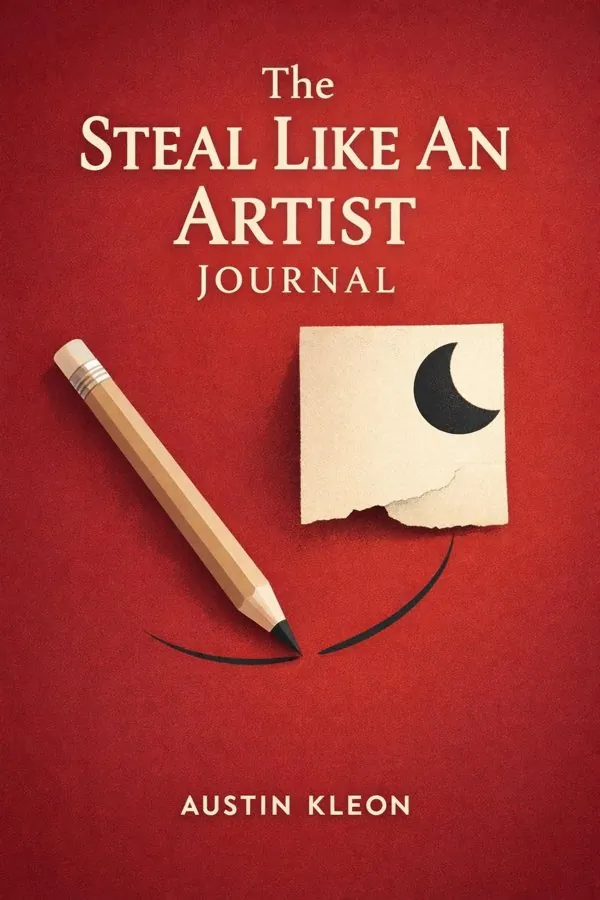
The Steal Like An Artist Journal: A Notebook for Creative Kleptomaniacs: Summary & Key Insights
by Austin Kleon
 10 min10 chaptersAudio available
Key Takeaways from The Steal Like An Artist Journal: A Notebook for Creative Kleptomaniacs
Originality is often misunderstood as making something from nothing, but creative work rarely happens that way.
Inspiration feels glamorous, but routine does the real work.
Most people look for inspiration only when they feel empty, but creative people learn to gather material all the time.
A blank page can feel intimidating because it seems to demand pure invention.
Creative growth is not just about making more things.
What Is The Steal Like An Artist Journal: A Notebook for Creative Kleptomaniacs About?
The Steal Like An Artist Journal: A Notebook for Creative Kleptomaniacs by Austin Kleon is a creativity book spanning 10 pages. The Steal Like An Artist Journal: A Notebook for Creative Kleptomaniacs is not a conventional book you simply read and put away. It is a working space, a creative laboratory, and a playful companion to Austin Kleon’s bestselling manifesto on creativity. Built around prompts, lists, sketches, and reflection exercises, the journal helps readers turn the ideas of Steal Like an Artist into daily practice. Instead of asking you to wait for inspiration, it invites you to collect influences, examine your habits, experiment with ideas, and make something from what moves you. What makes this journal valuable is its direct challenge to one of creativity’s most damaging myths: that originality means creating in isolation. Kleon argues that all creative work grows out of what came before. The goal is not to copy, but to notice, absorb, remix, and transform. As a writer and artist known for making creativity feel practical rather than mystical, Kleon brings unusual authority to this subject. His work has helped millions of readers see that artistic development is less about genius and more about curiosity, discipline, and attention. This journal turns that philosophy into action.
This FizzRead summary covers all 10 key chapters of The Steal Like An Artist Journal: A Notebook for Creative Kleptomaniacs in approximately 10 minutes, distilling the most important ideas, arguments, and takeaways from Austin Kleon's work. Also available as an audio summary and Key Quotes Podcast.
The Steal Like An Artist Journal: A Notebook for Creative Kleptomaniacs
The Steal Like An Artist Journal: A Notebook for Creative Kleptomaniacs is not a conventional book you simply read and put away. It is a working space, a creative laboratory, and a playful companion to Austin Kleon’s bestselling manifesto on creativity. Built around prompts, lists, sketches, and reflection exercises, the journal helps readers turn the ideas of Steal Like an Artist into daily practice. Instead of asking you to wait for inspiration, it invites you to collect influences, examine your habits, experiment with ideas, and make something from what moves you.
What makes this journal valuable is its direct challenge to one of creativity’s most damaging myths: that originality means creating in isolation. Kleon argues that all creative work grows out of what came before. The goal is not to copy, but to notice, absorb, remix, and transform. As a writer and artist known for making creativity feel practical rather than mystical, Kleon brings unusual authority to this subject. His work has helped millions of readers see that artistic development is less about genius and more about curiosity, discipline, and attention. This journal turns that philosophy into action.
Who Should Read The Steal Like An Artist Journal: A Notebook for Creative Kleptomaniacs?
This book is perfect for anyone interested in creativity and looking to gain actionable insights in a short read. Whether you're a student, professional, or lifelong learner, the key ideas from The Steal Like An Artist Journal: A Notebook for Creative Kleptomaniacs by Austin Kleon will help you think differently.
- ✓Readers who enjoy creativity and want practical takeaways
- ✓Professionals looking to apply new ideas to their work and life
- ✓Anyone who wants the core insights of The Steal Like An Artist Journal: A Notebook for Creative Kleptomaniacs in just 10 minutes
Want the full summary?
Get instant access to this book summary and 100K+ more with Fizz Moment.
Get Free SummaryAvailable on App Store • Free to download
Key Chapters
Originality is often misunderstood as making something from nothing, but creative work rarely happens that way. Austin Kleon’s central idea is that every artist learns by borrowing, collecting, and responding to the work of others. In this journal, “stealing” is not presented as plagiarism or lazy imitation. It is framed as a respectful act of study: noticing what resonates, asking why it works, and using those discoveries to develop your own voice.
The journal encourages readers to build what Kleon elsewhere calls a “genealogy of ideas.” Instead of pretending your influences do not exist, you map them. Which writers, musicians, designers, filmmakers, teachers, or ordinary experiences have shaped your taste? What patterns connect them? When you identify your influences clearly, you stop feeling guilty about having inspirations and start becoming more intentional about them.
This matters because many people get stuck before they even begin. They assume that if an idea has echoes of something else, it must not be valid. Kleon rejects that fear. The point is not to reproduce another person’s work but to absorb techniques, perspectives, structures, and energy, then transform them through your own experiences. A songwriter may borrow the emotional honesty of one artist, the rhythm of another, and the storytelling instincts of a third. A designer may collect visual references and combine them into something newly functional and personal.
The journal’s prompts make this process visible. You are asked to list influences, gather fragments, and track what you return to repeatedly. That practice turns influence into education rather than insecurity. Actionable takeaway: create an “inspiration inventory” of ten creators or works you love, then write one sentence about what each has taught you and how you might translate that lesson into your own medium.
Inspiration feels glamorous, but routine does the real work. One of the journal’s most practical lessons is that creativity is not a rare event reserved for your most brilliant moods. It is a habit that deepens through repetition. By offering spaces for notes, lists, sketches, observations, and experiments, the journal quietly trains you to show up regularly instead of waiting for a perfect idea.
This is a powerful shift because many people treat creativity like weather. If they feel energized, they create. If they feel uncertain, they stop. Kleon’s approach is different. He treats artistic practice more like gardening than lightning. You prepare the soil, return often, and trust that steady attention produces results over time. The journal supports this by making creative work small and manageable. You do not need a masterpiece today. You need a page, a thought, a collage, a sentence, a question.
Daily practice also lowers the emotional stakes. When creativity becomes a routine, each attempt matters less on its own, which makes experimentation easier. A writer can draft bad paragraphs without panic. An illustrator can test styles without expecting every sketch to become portfolio material. A teacher, entrepreneur, or student can use the journal to capture ideas from everyday life rather than assuming creativity belongs only to artists.
The deeper insight is that consistency creates identity. You become creative not by claiming the label, but by repeatedly doing creative things. The journal gives structure to that process. Over days and weeks, you begin to see recurring themes, stronger instincts, and more confidence. Actionable takeaway: set a daily ten-minute creative appointment with yourself and use the journal during that time, even if all you do is collect one idea, sketch one image, or write one paragraph.
Most people look for inspiration only when they feel empty, but creative people learn to gather material all the time. A major theme in this journal is the disciplined collection of inputs: images, phrases, memories, overheard lines, textures, headlines, colors, questions, and moments of surprise. Kleon treats inspiration as something you actively curate rather than passively receive.
This matters because the quality of your output is deeply connected to the richness of your input. If you consume only what is obvious, trendy, or algorithmically fed to you, your work may become thin and predictable. But if you train yourself to notice the world carefully, your creative reservoir becomes more varied and personal. The journal acts as a holding place for these fragments. It becomes a compost pile where scraps slowly turn into fertile material.
Practical applications are everywhere. A writer might note a strange sentence heard on the subway. A marketer could collect unusual headlines and campaign ideas. A photographer may save thoughts about shadows, gestures, and places worth revisiting. A product designer might sketch interfaces or packaging details that solve a problem elegantly. None of these fragments is complete on its own, but together they become raw material for future work.
The journal’s prompts help you sharpen observation. They encourage you to keep your eyes open and to trust small fascinations. What repeatedly catches your attention? What tiny details refuse to leave your mind? Those are clues to your taste, and taste is one of the foundations of original work.
Actionable takeaway: start an “idea bank” in your journal with three sections: things I noticed, things I loved, and things I do not yet understand. Add at least one item to each section every week.
A blank page can feel intimidating because it seems to demand pure invention. Kleon’s journal offers a more realistic and liberating model: create by combining, reframing, and transforming existing materials. Remix is not a shortcut around creativity; it is often the method through which creativity actually happens.
When you remix, you move from admiration to authorship. You begin by asking what can be reassembled. Could a poem borrow the structure of a recipe? Could a business presentation be told like a story? Could a painting combine folk motifs with digital aesthetics? Could a classroom lesson use the pacing of a game? Newness often comes not from unprecedented content but from unexpected combinations.
The journal encourages this kind of cross-pollination. By storing fragments from different sources and inviting playful exercises, it makes experimentation feel accessible. One of its hidden lessons is that your unique voice emerges through selection. Two people can study the same influences, but the way they combine them will differ because their experiences, values, obsessions, and constraints differ. That is why transformation matters more than imitation.
This idea is especially useful for anyone stuck in comparison. If you only compare your beginning to someone else’s polished result, you may freeze. But if you view creativity as recombination, you gain a process. A podcaster might borrow the intimacy of personal essays and the structure of investigative journalism. A fashion designer might fuse historical silhouettes with modern materials. A founder might adapt an idea from hospitality into software onboarding.
The journal helps you test these combinations without pressure. It gives you room to play, and play is often where originality begins. Actionable takeaway: choose two unrelated influences you love and create one page in the journal exploring how they could be combined into a project, product, or piece of art.
Creative growth is not just about making more things. It is also about understanding how you work, what repeatedly attracts you, and where you tend to sabotage yourself. The journal’s reflective prompts are designed to help readers notice these patterns. That self-awareness can be as valuable as technical skill because it helps you work with your tendencies instead of constantly fighting them.
Reflection matters because creativity is emotional as well as intellectual. Some people generate ideas easily but struggle to finish. Others are disciplined but overly critical. Some thrive in solitude, while others need conversation and feedback. The journal becomes a mirror that shows you your habits over time. Which exercises energize you? Which subjects keep recurring? When do you feel most open and imaginative? What kinds of fear appear when you try something new?
This process is not about turning creativity into self-obsession. It is about identifying the conditions that support your best work. For example, you may discover that you think clearly by hand rather than on a screen, that walking produces better ideas than sitting still, or that your strongest work grows from personal memories rather than abstract concepts. These insights make your practice more effective.
Reflection also reveals your taste. Taste is not merely preference; it is the pattern of what compels you. If your journal repeatedly fills with architecture, old maps, dialogue, family stories, or monochrome sketches, that repetition is meaningful. It points toward themes you may want to explore more deeply.
Kleon’s larger message is that creativity becomes sustainable when it is tied to attention rather than performance. The journal allows you to study your own creative life with curiosity. Actionable takeaway: once a week, review your recent journal pages and answer three questions: what excited me, what drained me, and what keeps recurring?
Freedom sounds ideal, but too much openness often leads to paralysis. One of the most practical lessons in the journal is that limitations are not the enemy of creativity; they are often the spark. Constraints narrow the field, force decisions, and push you toward inventive solutions you might never discover in unlimited conditions.
Kleon’s prompts embrace this principle by inviting you to work within boundaries: a page, a list, a shape, a small exercise, a simple instruction. These constraints reduce overwhelm and turn abstract ambition into something workable. Instead of asking, “What should I create?” you ask, “What can I do within these conditions?” That shift makes action easier.
Examples are easy to find across creative disciplines. A writer may draft a story using only dialogue. A musician may compose with just three chords. A designer may build a poster using one typeface and two colors. A social media creator might make a series using only smartphone photos. A startup team may solve a problem with no additional budget. In each case, the limit creates focus. It removes options and reveals ingenuity.
This idea is especially useful for people who believe they need more time, tools, money, or expertise before starting. The journal gently counters that belief. Begin with what you have. Work small. Give yourself playful restrictions. By doing so, you convert scarcity into structure.
More importantly, constraints help define style. Repeated choices within limits create recognizable patterns. What begins as restriction can become signature. The journal trains you to see boundaries as invitations rather than obstacles.
Actionable takeaway: choose one creative limitation for your next session, such as ten minutes, one page, one color, or one source of inspiration, and use it to complete a small piece rather than planning a larger one.
Creativity is often romanticized as solitary genius, but most good work grows in conversation with others. This journal reinforces the idea that making is social, even when the act itself is private. We learn from influences, peers, mentors, audiences, and collaborators. By capturing ideas and testing them in a notebook, you prepare yourself to participate more openly in that wider exchange.
Kleon’s broader philosophy has always emphasized generosity and connection. In the context of the journal, that means recognizing that creative development is accelerated when work leaves your head and enters relationships. Collaboration can take many forms: asking a friend for feedback, swapping references, creating alongside others, joining a class, or sharing fragments before they are finished. Even the simple act of discussing what interests you can sharpen your thinking.
The practical benefit is perspective. Alone, you may repeat your own assumptions. With others, you encounter new interpretations and possibilities. A writer may discover that a reader is drawn to a part they almost cut. A designer might realize a concept is stronger when simplified. A musician may find that a collaborator introduces a rhythm they would never invent alone. In workplaces, teams often produce more useful ideas when individuals bring well-developed notes, references, and sketches to the table. The journal helps you arrive with something concrete.
Sharing also builds courage. The more often you show unfinished work, the less power perfectionism has over you. That does not mean broadcasting everything. It means using connection strategically to keep momentum alive.
Actionable takeaway: choose one page or idea from your journal this week and share it with one trusted person, asking a specific question such as “What stands out?” or “What would you explore further?”
Creative blocks feel like a sign that something is wrong, but often they simply mean that the process has stalled. Kleon’s journal treats blockage not as a deep personal failure but as a normal phase of making. The remedy is usually not grand inspiration. It is motion: small actions that reengage attention and reduce the pressure to perform.
The journal is especially useful here because it lowers the threshold for beginning again. When a project feels too big, a prompt gives you an entry point. When your standards become suffocating, a quick list or sketch loosens them. When your mind feels empty, the pages remind you that collecting, noticing, and rearranging are also creative acts.
There are many forms of creative blockage. Sometimes you are overthinking. Sometimes you are undernourished and need new inputs. Sometimes you are tired and need rest. Sometimes you are afraid the work will not be good enough. The journal helps you diagnose these states by showing you where your momentum has broken. Have you stopped observing? Stopped playing? Stopped finishing? Stopped trusting small steps?
Practical responses might include copying a passage by hand to study rhythm, making a list of ideas without judging them, revisiting old notes, changing environments, or setting a ridiculously small task. A visual artist may create ten thumbnail sketches rather than one final piece. A founder may jot down bad solutions on purpose to unlock a better one. A student may summarize a concept in doodles instead of formal prose.
The key insight is that block is often solved by reducing intensity. You do not think your way out of it so much as work your way through it. Actionable takeaway: when you feel stuck, open the journal and complete a five-minute exercise with one rule only: no judging until the timer ends.
Many creative insights are lost not because they were weak, but because they were never captured. One of the journal’s quiet but profound contributions is its emphasis on documentation. By recording ideas, fragments, sketches, influences, and experiments, you create a visible trail of your development. That record becomes both practical and motivational.
Documentation matters because creative progress is rarely linear. On difficult days, it can feel like nothing is happening. But when you can flip back through pages and see lists, notes, drafts, references, and half-formed concepts accumulating, you realize that growth is underway. The journal becomes evidence that your creative life exists even when finished products are scarce.
This archive is also useful strategically. Ideas dismissed today may become central later. An image clipped months ago might solve a current problem. A phrase scribbled in passing might become the title of an essay, a song lyric, or a campaign. Professionals in every field benefit from this. Writers maintain notebooks of themes and sentences. Designers save visual solutions. Entrepreneurs document customer observations and product possibilities. Teachers keep lesson fragments and metaphors that can be reused in new contexts.
Kleon’s philosophy suggests that creativity is cumulative. The more faithfully you save what interests you, the more material you have to work with later. Documentation also trains your attention. It says: this mattered enough to keep. That act of noticing is itself a creative skill.
Over time, the journal becomes not just a notebook but a personal archive of taste and effort. It shows who you were becoming while you were busy making. Actionable takeaway: end each week by saving three things in your journal: one idea, one influence, and one experiment, then write a sentence about why each might matter later.
Big creative ambitions are inspiring, but they can also become an excuse for postponement. The journal repeatedly points readers toward a healthier balance: hold a long-term vision while working in small, concrete steps. This is one of Kleon’s most useful contributions to creative thinking. A meaningful body of work is not built through occasional heroic effort. It emerges through many modest acts sustained over time.
Long-term vision matters because it gives direction. You are not just filling pages randomly; you are shaping a sensibility, a portfolio, a practice, or a life. But vision becomes effective only when it is tied to immediate action. The journal creates that bridge. Each prompt, note, and experiment is small enough to complete, yet together they form a durable record of where you are headed.
This approach relieves a common pressure: the need to know everything in advance. You do not need a full master plan for your creative identity. You need curiosity, continuity, and a place to gather your discoveries. A novelist may begin with scenes and voices before understanding the whole book. A visual artist may fill notebooks with motifs before a clear series emerges. A consultant or entrepreneur may collect recurring problems until a business idea takes shape. The future is often visible only in hindsight.
The journal supports patience. It reminds you that your job is not to force instant clarity but to remain productively engaged. Small pages lead to larger patterns. Repeated attention becomes direction. Over time, the notebook shows not just what you made but what kind of maker you are becoming.
Actionable takeaway: write one long-term creative goal at the front of your journal, then beneath it list the smallest repeatable action you can take this week to move toward it.
All Chapters in The Steal Like An Artist Journal: A Notebook for Creative Kleptomaniacs
About the Author
Austin Kleon is an American writer and artist whose work focuses on creativity, productivity, and the realities of making art in the modern world. He became widely known through his bestselling books Steal Like an Artist, Show Your Work!, and Keep Going, all of which translate big creative ideas into practical, accessible advice. Kleon’s style blends writing, visual thinking, and a strong belief that creativity is built through habits, influences, and experimentation rather than sudden genius. His work resonates with artists, students, entrepreneurs, and professionals because it treats creativity as something ordinary people can practice every day. Through books, talks, and essays, he has helped a broad audience rethink originality, share their work more openly, and build sustainable creative lives.
Get This Summary in Your Preferred Format
Read or listen to the The Steal Like An Artist Journal: A Notebook for Creative Kleptomaniacs summary by Austin Kleon anytime, anywhere. FizzRead offers multiple formats so you can learn on your terms — all free.
Available formats: App · Audio · PDF · EPUB — All included free with FizzRead
Download The Steal Like An Artist Journal: A Notebook for Creative Kleptomaniacs PDF and EPUB Summary
Key Quotes from The Steal Like An Artist Journal: A Notebook for Creative Kleptomaniacs
“Originality is often misunderstood as making something from nothing, but creative work rarely happens that way.”
“Inspiration feels glamorous, but routine does the real work.”
“Most people look for inspiration only when they feel empty, but creative people learn to gather material all the time.”
“A blank page can feel intimidating because it seems to demand pure invention.”
“Creative growth is not just about making more things.”
Frequently Asked Questions about The Steal Like An Artist Journal: A Notebook for Creative Kleptomaniacs
The Steal Like An Artist Journal: A Notebook for Creative Kleptomaniacs by Austin Kleon is a creativity book that explores key ideas across 10 chapters. The Steal Like An Artist Journal: A Notebook for Creative Kleptomaniacs is not a conventional book you simply read and put away. It is a working space, a creative laboratory, and a playful companion to Austin Kleon’s bestselling manifesto on creativity. Built around prompts, lists, sketches, and reflection exercises, the journal helps readers turn the ideas of Steal Like an Artist into daily practice. Instead of asking you to wait for inspiration, it invites you to collect influences, examine your habits, experiment with ideas, and make something from what moves you. What makes this journal valuable is its direct challenge to one of creativity’s most damaging myths: that originality means creating in isolation. Kleon argues that all creative work grows out of what came before. The goal is not to copy, but to notice, absorb, remix, and transform. As a writer and artist known for making creativity feel practical rather than mystical, Kleon brings unusual authority to this subject. His work has helped millions of readers see that artistic development is less about genius and more about curiosity, discipline, and attention. This journal turns that philosophy into action.
More by Austin Kleon
Show Your Work!
Austin Kleon
10 min
Steal Like An Artist: 10 Things Nobody Told You About Being Creative
Austin Kleon
10 minShow Your Work!: 10 Ways to Share Your Creativity and Get Discovered
Austin Kleon
10 min
Keep Going: 10 Ways to Stay Creative in Good Times and Bad
Austin Kleon
10 minYou Might Also Like
Dimensions Of Creativity
Margaret A. Boden
10 min
How to Fly a Horse: The Secret History of Creation, Invention, and Discovery
Kevin Ashton
10 min
Imagine: How Creativity Works
Jonah Lehrer
10 min
The Accidental Creative: How to Be Brilliant at a Moment's Notice
Todd Henry
10 min
The Origins of Creativity
Edward O. Wilson
10 min
Wired to Create: Unraveling the Mysteries of the Creative Mind
Scott Barry Kaufman, Carolyn Gregoire
10 minBrowse by Category
Ready to read The Steal Like An Artist Journal: A Notebook for Creative Kleptomaniacs?
Get the full summary and 100K+ more books with Fizz Moment.