
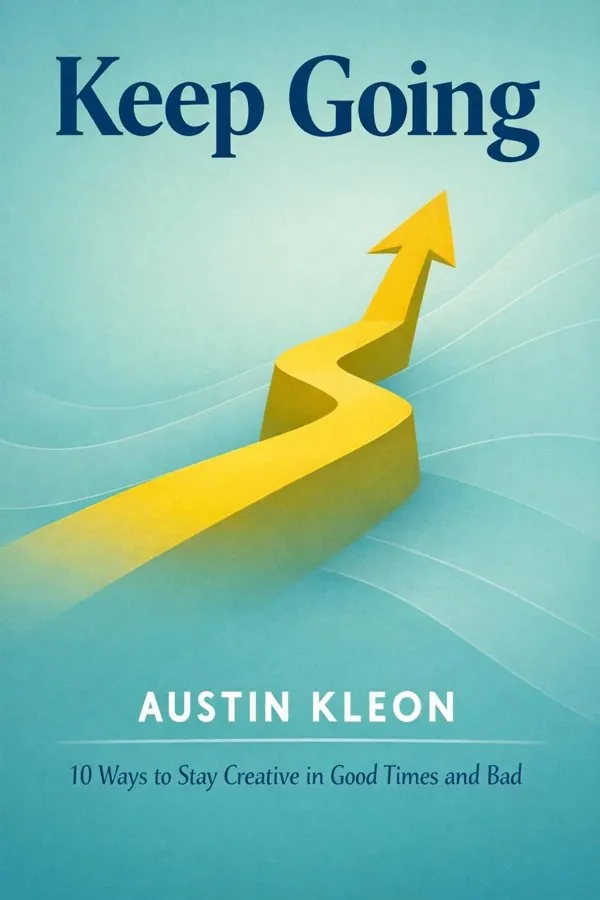
Keep Going: 10 Ways to Stay Creative in Good Times and Bad: Summary & Key Insights
by Austin Kleon
 10 min10 chaptersAudio available
Key Takeaways from Keep Going: 10 Ways to Stay Creative in Good Times and Bad
Creativity rarely survives when it depends on motivation alone.
Burnout often disguises itself as ambition.
Your past is not dead material; it is creative fuel.
In an always-connected world, solitude has become both harder to find and more necessary than ever.
Curiosity is often more reliable than inspiration.
What Is Keep Going: 10 Ways to Stay Creative in Good Times and Bad About?
Keep Going: 10 Ways to Stay Creative in Good Times and Bad by Austin Kleon is a creativity book spanning 10 pages. Keep Going by Austin Kleon is a practical, encouraging guide for anyone trying to make meaningful work in a distracting, uncertain world. Rather than treating creativity as a rare gift or a burst of inspiration, Kleon presents it as a daily practice—something sustained through habits, perspective, community, and resilience. The book is built around ten simple principles that help artists, writers, entrepreneurs, and knowledge workers continue creating whether life feels stable or chaotic. What makes this book especially valuable is its tone: honest without being gloomy, motivating without being simplistic. Kleon acknowledges burnout, bad news, self-doubt, family responsibilities, and the emotional strain of modern life, then offers grounded ways to keep moving forward. His advice is not about becoming famous or endlessly productive. It is about protecting your energy, staying curious, and building a creative life that can last. Austin Kleon brings unusual authority to this topic. As the bestselling author of Steal Like an Artist and Show Your Work!, he has become one of the most trusted modern voices on creativity, known for turning big artistic questions into memorable, actionable ideas.
This FizzRead summary covers all 10 key chapters of Keep Going: 10 Ways to Stay Creative in Good Times and Bad in approximately 10 minutes, distilling the most important ideas, arguments, and takeaways from Austin Kleon's work. Also available as an audio summary and Key Quotes Podcast.
Keep Going: 10 Ways to Stay Creative in Good Times and Bad
Keep Going by Austin Kleon is a practical, encouraging guide for anyone trying to make meaningful work in a distracting, uncertain world. Rather than treating creativity as a rare gift or a burst of inspiration, Kleon presents it as a daily practice—something sustained through habits, perspective, community, and resilience. The book is built around ten simple principles that help artists, writers, entrepreneurs, and knowledge workers continue creating whether life feels stable or chaotic.
What makes this book especially valuable is its tone: honest without being gloomy, motivating without being simplistic. Kleon acknowledges burnout, bad news, self-doubt, family responsibilities, and the emotional strain of modern life, then offers grounded ways to keep moving forward. His advice is not about becoming famous or endlessly productive. It is about protecting your energy, staying curious, and building a creative life that can last.
Austin Kleon brings unusual authority to this topic. As the bestselling author of Steal Like an Artist and Show Your Work!, he has become one of the most trusted modern voices on creativity, known for turning big artistic questions into memorable, actionable ideas.
Who Should Read Keep Going: 10 Ways to Stay Creative in Good Times and Bad?
This book is perfect for anyone interested in creativity and looking to gain actionable insights in a short read. Whether you're a student, professional, or lifelong learner, the key ideas from Keep Going: 10 Ways to Stay Creative in Good Times and Bad by Austin Kleon will help you think differently.
- ✓Readers who enjoy creativity and want practical takeaways
- ✓Professionals looking to apply new ideas to their work and life
- ✓Anyone who wants the core insights of Keep Going: 10 Ways to Stay Creative in Good Times and Bad in just 10 minutes
Want the full summary?
Get instant access to this book summary and 100K+ more with Fizz Moment.
Get Free SummaryAvailable on App Store • Free to download
Key Chapters
Creativity rarely survives when it depends on motivation alone. One of Kleon’s central insights is that the people who keep making things are usually not the ones with the most talent, but the ones who develop the habit of showing up. Daily practice matters because it lowers the emotional stakes. When you create every day, you stop expecting each session to produce brilliance. Some days you make progress, some days you simply maintain momentum, but either way you remain connected to the work.
This idea is powerful because inconsistency creates friction. If you only write when inspired, paint when energized, or compose when life feels calm, you train yourself to wait for ideal conditions that almost never arrive. A daily act—a paragraph, a sketch, a photograph, a melody, a note in a journal—keeps the creative muscle warm. Small efforts accumulate into a body of work before you fully notice what is happening.
Kleon’s approach also helps reduce perfectionism. A person who aims to create something small today is more likely to begin than someone who demands a masterpiece. Daily repetition builds confidence because it proves that creativity is not a mysterious event; it is a relationship sustained through attention.
A practical way to apply this is to define a minimum daily creative unit: write 100 words, draw for 10 minutes, record one idea, or revise one page. Keep the bar low enough that you can do it even on hard days. Actionable takeaway: choose one tiny creative task and commit to doing it every day for the next 30 days.
Burnout often disguises itself as ambition. Kleon argues that creativity is less about heroic bursts of effort and more about finding a rhythm your life can actually support. Many people assume that serious work requires constant pushing, but nonstop intensity usually leads to exhaustion, resentment, and creative numbness. Sustainable output comes from cycles: work and rest, focus and play, solitude and connection.
A rhythm is deeply personal. Some people think clearly in the morning, others at night. Some need long stretches of uninterrupted time, while others thrive in short sessions between responsibilities. The point is not to copy someone else’s routine but to observe your own energy honestly. When do you have the most clarity? What habits drain you? What conditions help you begin?
Kleon encourages readers to build ordinary structures that protect the work: regular hours, walks, rituals, boundaries around media, or designated spaces for making things. Rhythm matters especially during unstable periods. When the outside world feels chaotic, routines become anchors. They do not remove uncertainty, but they give you a pattern to return to.
This principle also suggests that rest is part of the process, not a break from it. The best long-term creators are often those who learn when to stop for the day and return tomorrow.
Try tracking your energy and output for one week. Notice when you produce your best work and when resistance is highest. Then redesign your schedule around those patterns instead of fighting them. Actionable takeaway: create a simple weekly creative rhythm that includes both dedicated work time and deliberate recovery time.
Your past is not dead material; it is creative fuel. Kleon warns against the impulse to constantly reinvent yourself by discarding old interests, abandoned projects, or earlier identities. Many people believe growth means leaving previous versions of themselves behind. But in creative life, old obsessions often become the raw material for new work. The strange hobby from childhood, the half-finished manuscript, the notebook of odd ideas, the music you loved before anyone approved of it—these can all become sources of originality.
Revisiting your past helps you recover what was once meaningful before taste, status, or practicality narrowed your vision. Children often make things naturally because they are fascinated, not strategic. Adults can lose that instinct by focusing too much on outcomes. Looking backward can reconnect you to what genuinely absorbs your attention.
This principle also applies to archives. Saving journals, sketches, drafts, photos, voice notes, clippings, and unfinished experiments gives you a reservoir to draw from later. What seemed useless at one stage may become essential at another. An old drawing style might inspire a new visual language. Notes from years ago might become an essay, talk, or business idea.
Instead of asking, “How do I become someone new?” Kleon invites a better question: “What parts of myself have I neglected that still want expression?” Creative maturity is often integration, not replacement.
A practical exercise is to revisit your old notebooks, folders, bookmarks, playlists, and childhood favorites. Circle recurring themes and unexplored fascinations. Actionable takeaway: rescue one forgotten idea, project, or interest from your past and bring it back into your creative life this week.
In an always-connected world, solitude has become both harder to find and more necessary than ever. Kleon makes the case that creative work needs private space—mental and physical—where your own thoughts can emerge before they are shaped by the noise of the crowd. Solitude is not the same as loneliness. It is chosen aloneness, a condition that allows reflection, experimentation, and honest attention.
Without solitude, we become overly reactive. We check feeds, compare ourselves, absorb opinions, and let the emotional weather of the internet determine our internal state. This constant exposure fragments concentration and makes it difficult to hear our own creative instincts. Solitude restores that inner signal.
Kleon does not suggest withdrawing from the world permanently. Instead, he recommends regularly stepping away from inputs so that outputs become possible. Going for walks without your phone, sitting quietly with a notebook, working offline for an hour, or spending time in nature can help reset your mind. Solitude creates the conditions for deeper observation, and observation is often the beginning of original work.
This idea is especially useful for people who feel blocked. Often the problem is not a lack of ideas but a lack of silence. When every moment is filled, nothing has time to develop. Solitude gives thoughts room to ripen.
You can build this habit gradually. Start with short periods of uninterrupted quiet rather than dramatic retreats. Protecting 20 minutes of device-free reflection each day can make a meaningful difference. Actionable takeaway: schedule one recurring period of solitude each day or week and treat it as essential creative maintenance.
Curiosity is often more reliable than inspiration. Kleon encourages readers to remain interested in the world, especially in small, ordinary things. Creativity does not always begin with grand ideas; it often starts when you notice something overlooked, ask a better question, or follow a strange fascination longer than other people would. Curiosity keeps the mind alive because it turns passive living into active exploration.
When people feel creatively stuck, they often assume they need a breakthrough. But what they may need instead is input—new observations, conversations, books, places, textures, disciplines, or routines. Curiosity widens perception. It makes you more likely to connect distant ideas and discover unexpected material for your work.
Kleon’s vision of curiosity is grounded rather than glamorous. Read widely. Collect interesting fragments. Visit a museum. Learn a manual skill. Pay attention to your neighborhood. Ask children questions. Notice what repeatedly captures your attention. The goal is not to consume endlessly, but to stay mentally porous.
Curiosity also protects against cynicism. It is difficult to remain fully closed off when you are genuinely interested in how things work and why people make what they make. A curious person has reasons to continue.
One practical method is to keep a “wonder list” or idea file. Write down questions, images, phrases, problems, and odd facts that intrigue you. Over time, these notes become a personal compost pile from which new projects emerge. Actionable takeaway: begin a daily curiosity log and record at least three interesting things you noticed, learned, or wondered about each day.
One of the fastest ways to drain creative energy is to obsess over everything outside your influence. Kleon emphasizes that the world will always offer reasons to feel overwhelmed: politics, markets, trends, algorithms, public opinion, other people’s success, and unpredictable crises. If you let your attention be captured entirely by these forces, you may end up emotionally exhausted before you make anything at all.
The discipline, then, is to keep returning to what is actually in your hands. You may not control whether people notice your work, but you control whether you make it. You may not control external chaos, but you control your routines, your inputs, your effort, your craft, and your willingness to continue. This shift is not denial. It is a practical strategy for preserving agency.
Kleon’s advice is especially relevant during bad news cycles. Being informed matters, but overconsumption of distressing information can become paralyzing. At some point, doomscrolling stops being awareness and starts becoming surrender. Creative people need to set limits so they can remain useful, awake, and capable of contribution.
A helpful application is to sort current concerns into two lists: what you can influence directly and what you cannot. Then devote your best energy to the first list. Write the essay, finish the design, call a friend, practice your skill, improve your workspace, or make the thing only you can make.
Actionable takeaway: when you feel overwhelmed, pause and ask, “What is one meaningful action I can take today?” Then do that before returning to everything outside your control.
Creative work may happen in solitude, but a creative life rarely survives in isolation. Kleon argues that we need people—not large audiences necessarily, but a circle of encouragement, honesty, and shared energy. Community helps sustain momentum because it reminds you that making things is a human activity, not a private battle for perfection. Good company can challenge you, comfort you, and keep you connected to purpose.
This does not mean surrounding yourself with people who flatter you. The most useful creative communities combine warmth with truth. They offer feedback, perspective, and companionship without turning everything into competition. Sometimes support comes from peers at your level; sometimes from mentors, collaborators, or friends who simply respect your commitment and make space for it.
Kleon also highlights the importance of being the kind of person who contributes to a community. Share resources, celebrate others, recommend work you admire, write encouraging notes, attend events, and participate generously. Creative ecosystems become stronger when people stop treating every interaction as self-promotion.
Community is especially valuable during difficult periods. When your confidence drops, borrowed belief can carry you for a while. A conversation, workshop, reading group, or accountability partner can reconnect you to the fact that struggle is normal and temporary.
If you do not currently have a creative circle, start small. Join one class, one local group, one online forum with substance, or one recurring conversation with a fellow maker. Actionable takeaway: identify one person or group that could strengthen your creative life and make a concrete move to connect with them this week.
A culture obsessed with productivity often treats rest as laziness, but Kleon insists that recovery is essential to long-term creativity. The mind does not produce well when it is chronically overstimulated, under-slept, emotionally frayed, or physically depleted. If you want your work to endure, your energy must endure too. That means rest is not a reward after the work; it is one of the conditions that makes the work possible.
Creative breakthroughs often happen away from the desk. Walks, naps, gardening, reading for pleasure, cooking, hobbies, and idle time can all refresh attention and unlock associations the conscious mind could not force. Rest creates mental spaciousness. It also helps prevent the common trap of overidentifying with output. If every waking hour is organized around producing, your sense of self becomes fragile and your work can start to feel joyless.
Kleon encourages rhythms that include seasons of recovery. This may mean stopping before total exhaustion, taking real days off, protecting sleep, or maintaining life-giving routines unrelated to your professional identity. For some people, family life, exercise, spiritual practice, or manual chores provide grounding that protects creativity from becoming abstract and consuming.
An important distinction here is that rest should actually restore you. Endless passive scrolling may feel like a break, but it often leaves you more scattered. Better forms of rest tend to be embodied, calming, and finite.
Actionable takeaway: choose one restorative practice—such as a walk, screen-free evening, nap, hobby, or full day off—and schedule it into your week as seriously as you schedule work.
A creative life is unstable by nature. Interests evolve, careers shift, tools change, audiences move on, and personal circumstances can transform overnight. Kleon’s point is not to resist all this change, but to learn how to move with it without abandoning your core values. Flexibility matters because rigid expectations often create unnecessary suffering. If you insist that creativity must happen in one specific place, format, or season of life, you make it easier for disruption to stop you entirely.
At the same time, adaptation does not mean chasing every trend or reinventing yourself for approval. The challenge is to distinguish between your essence and your methods. Your essence may be your curiosity, humor, visual style, themes, or way of seeing. Your methods—the tools, platforms, schedules, and business models—can evolve.
Kleon encourages a mindset of experimentation. Try new formats. Adjust to different life stages. Accept smaller windows of time if that is what a season allows. Let projects change shape. A person who can scale creative practice up or down without quitting altogether is far more resilient than someone who only works under ideal conditions.
This perspective is especially helpful when plans collapse. Rather than asking, “How do I get back to exactly how things were?” ask, “What does creativity look like now?” That question opens possibility instead of nostalgia.
Actionable takeaway: identify one current change in your life and redesign your creative practice to fit it, even in a reduced or altered form, rather than waiting for the old conditions to return.
The deepest message of the book is deceptively simple: keep going. Not blindly, not mechanically, and not at the cost of your health or humanity, but with steady faith in the value of continuing. Kleon believes a creative life is built less by dramatic turning points than by persistence across ordinary days. Success can distract you just as much as failure can. Good times may tempt you into complacency; bad times may tempt you into quitting. In both cases, the answer is the same: return to the work.
Keeping going does not mean forcing constant output. It means staying in relationship with your practice. Sometimes that looks like making a lot. Sometimes it looks like maintaining a tiny habit through grief, parenting, illness, uncertainty, or transition. The goal is continuity, not intensity.
This principle is powerful because it reframes creativity as endurance with meaning. Over time, your work becomes a record of attention, survival, and devotion. You may not control how quickly progress appears, but you can control whether the thread breaks. Every return strengthens identity: you become someone who keeps making things.
Kleon’s optimism is grounded in this repeated return. Art and creative work matter not because they solve everything, but because they help us remain alive to life. They give shape to experience, connection to others, and dignity to our days.
Actionable takeaway: decide now what “keeping going” will mean in your current season—one page, one sketch, one weekly session—and protect that practice no matter what kind of week you are having.
All Chapters in Keep Going: 10 Ways to Stay Creative in Good Times and Bad
About the Author
Austin Kleon is an American writer and artist whose work focuses on creativity, artistic practice, and making meaningful work in the digital age. He is the bestselling author of Steal Like an Artist, Show Your Work!, and Keep Going, books that have become modern favorites among writers, designers, entrepreneurs, and creators of all kinds. Known for his clear language, visual style, and memorable principles, Kleon has built a reputation for turning abstract creative challenges into practical, everyday habits. His work often blends text, collage, drawing, and reflection, making his books both accessible and visually distinctive. Through his writing, talks, and ongoing artistic practice, he encourages people to stay curious, protect their attention, and develop creative lives that are sustainable over the long term.
Get This Summary in Your Preferred Format
Read or listen to the Keep Going: 10 Ways to Stay Creative in Good Times and Bad summary by Austin Kleon anytime, anywhere. FizzRead offers multiple formats so you can learn on your terms — all free.
Available formats: App · Audio · PDF · EPUB — All included free with FizzRead
Download Keep Going: 10 Ways to Stay Creative in Good Times and Bad PDF and EPUB Summary
Key Quotes from Keep Going: 10 Ways to Stay Creative in Good Times and Bad
“Creativity rarely survives when it depends on motivation alone.”
“Burnout often disguises itself as ambition.”
“Your past is not dead material; it is creative fuel.”
“In an always-connected world, solitude has become both harder to find and more necessary than ever.”
“Curiosity is often more reliable than inspiration.”
Frequently Asked Questions about Keep Going: 10 Ways to Stay Creative in Good Times and Bad
Keep Going: 10 Ways to Stay Creative in Good Times and Bad by Austin Kleon is a creativity book that explores key ideas across 10 chapters. Keep Going by Austin Kleon is a practical, encouraging guide for anyone trying to make meaningful work in a distracting, uncertain world. Rather than treating creativity as a rare gift or a burst of inspiration, Kleon presents it as a daily practice—something sustained through habits, perspective, community, and resilience. The book is built around ten simple principles that help artists, writers, entrepreneurs, and knowledge workers continue creating whether life feels stable or chaotic. What makes this book especially valuable is its tone: honest without being gloomy, motivating without being simplistic. Kleon acknowledges burnout, bad news, self-doubt, family responsibilities, and the emotional strain of modern life, then offers grounded ways to keep moving forward. His advice is not about becoming famous or endlessly productive. It is about protecting your energy, staying curious, and building a creative life that can last. Austin Kleon brings unusual authority to this topic. As the bestselling author of Steal Like an Artist and Show Your Work!, he has become one of the most trusted modern voices on creativity, known for turning big artistic questions into memorable, actionable ideas.
More by Austin Kleon
Show Your Work!
Austin Kleon
10 min
Steal Like An Artist: 10 Things Nobody Told You About Being Creative
Austin Kleon
10 minShow Your Work!: 10 Ways to Share Your Creativity and Get Discovered
Austin Kleon
10 min
The Steal Like An Artist Journal: A Notebook for Creative Kleptomaniacs
Austin Kleon
10 minYou Might Also Like
Dimensions Of Creativity
Margaret A. Boden
10 min
How to Fly a Horse: The Secret History of Creation, Invention, and Discovery
Kevin Ashton
10 min
Imagine: How Creativity Works
Jonah Lehrer
10 min
The Accidental Creative: How to Be Brilliant at a Moment's Notice
Todd Henry
10 min
The Origins of Creativity
Edward O. Wilson
10 min
Wired to Create: Unraveling the Mysteries of the Creative Mind
Scott Barry Kaufman, Carolyn Gregoire
10 minBrowse by Category
Ready to read Keep Going: 10 Ways to Stay Creative in Good Times and Bad?
Get the full summary and 100K+ more books with Fizz Moment.