
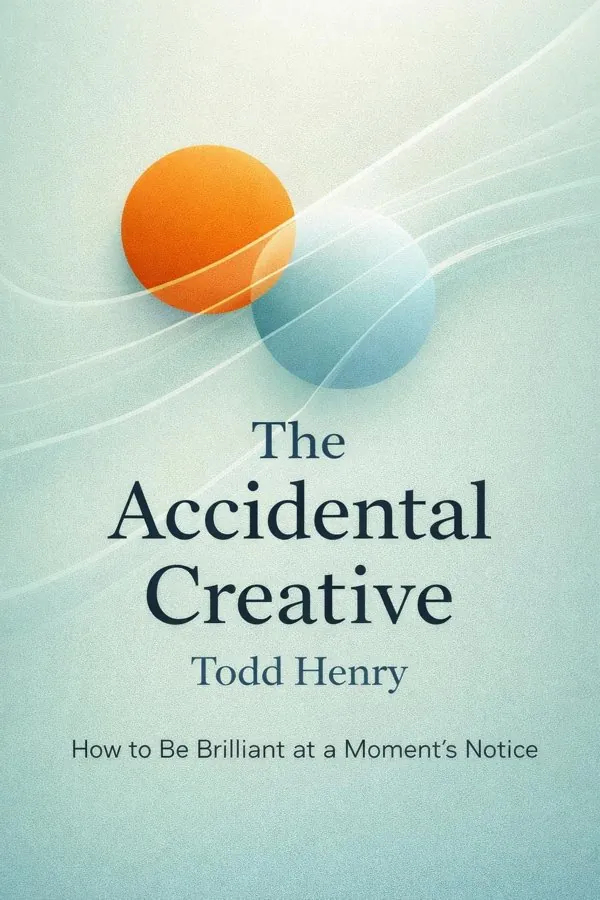
The Accidental Creative: How to Be Brilliant at a Moment's Notice: Summary & Key Insights
by Todd Henry
 10 min9 chaptersAudio available
Key Takeaways from The Accidental Creative: How to Be Brilliant at a Moment's Notice
The most surprising truth about creative work is that freedom alone does not produce brilliance.
A creative life falls apart when everything feels equally urgent.
Brilliance at a moment’s notice is usually the visible result of invisible habits.
Creative professionals often feel tension when their current methods no longer match the demands of their work.
A crowded mind struggles to produce clear ideas.
What Is The Accidental Creative: How to Be Brilliant at a Moment's Notice About?
The Accidental Creative: How to Be Brilliant at a Moment's Notice by Todd Henry is a creativity book. Many people assume creativity arrives like lightning: unpredictable, dramatic, and impossible to control. Todd Henry argues the opposite. In The Accidental Creative, he shows that brilliant ideas are rarely accidents at all. They are usually the result of disciplined habits, clear boundaries, healthy rhythms, and a system that allows creative people to perform under pressure. This book is especially relevant for anyone who must generate ideas on demand rather than waiting for inspiration to strike: marketers, designers, writers, entrepreneurs, leaders, and knowledge workers of all kinds. Henry writes from deep experience helping teams and organizations operate creatively in the real world, where deadlines are fixed, clients are demanding, and energy is limited. His central insight is powerful: if your job requires creativity, then you cannot treat it like a hobby. You need practices that protect your focus, sharpen your thinking, and prevent burnout. The Accidental Creative matters because it replaces romantic myths about inspiration with a practical framework for sustainable brilliance. It is a field guide for doing your best work consistently, even when the pressure is on and the moment demands something exceptional.
This FizzRead summary covers all 9 key chapters of The Accidental Creative: How to Be Brilliant at a Moment's Notice in approximately 10 minutes, distilling the most important ideas, arguments, and takeaways from Todd Henry's work. Also available as an audio summary and Key Quotes Podcast.
The Accidental Creative: How to Be Brilliant at a Moment's Notice
Many people assume creativity arrives like lightning: unpredictable, dramatic, and impossible to control. Todd Henry argues the opposite. In The Accidental Creative, he shows that brilliant ideas are rarely accidents at all. They are usually the result of disciplined habits, clear boundaries, healthy rhythms, and a system that allows creative people to perform under pressure. This book is especially relevant for anyone who must generate ideas on demand rather than waiting for inspiration to strike: marketers, designers, writers, entrepreneurs, leaders, and knowledge workers of all kinds.
Henry writes from deep experience helping teams and organizations operate creatively in the real world, where deadlines are fixed, clients are demanding, and energy is limited. His central insight is powerful: if your job requires creativity, then you cannot treat it like a hobby. You need practices that protect your focus, sharpen your thinking, and prevent burnout. The Accidental Creative matters because it replaces romantic myths about inspiration with a practical framework for sustainable brilliance. It is a field guide for doing your best work consistently, even when the pressure is on and the moment demands something exceptional.
Who Should Read The Accidental Creative: How to Be Brilliant at a Moment's Notice?
This book is perfect for anyone interested in creativity and looking to gain actionable insights in a short read. Whether you're a student, professional, or lifelong learner, the key ideas from The Accidental Creative: How to Be Brilliant at a Moment's Notice by Todd Henry will help you think differently.
- ✓Readers who enjoy creativity and want practical takeaways
- ✓Professionals looking to apply new ideas to their work and life
- ✓Anyone who wants the core insights of The Accidental Creative: How to Be Brilliant at a Moment's Notice in just 10 minutes
Want the full summary?
Get instant access to this book summary and 100K+ more with Fizz Moment.
Get Free SummaryAvailable on App Store • Free to download
Key Chapters
The most surprising truth about creative work is that freedom alone does not produce brilliance. Many people imagine artists, innovators, and idea-makers doing their best work in total spontaneity, but Todd Henry argues that chaos is often the enemy of consistent output. When your work depends on insight, strategy, originality, or problem-solving, you need reliable systems that support your mind before the big moment arrives. Great ideas often emerge from disciplined preparation, not random bursts of inspiration.
Henry’s point is especially important for professionals who create under deadlines. If you are a copywriter with a campaign due Friday, a team leader who needs fresh solutions in a meeting, or a product designer expected to solve user problems quickly, you cannot wait for a perfect mood. Structure gives you a repeatable environment where ideas can surface. This includes planning your week, protecting time for deep thinking, reducing unnecessary decisions, and creating rituals that signal your brain it is time to work.
Think of elite athletes. They do not perform well by improvising every aspect of training. They rely on routines, practice, recovery, and strategy so that when game time arrives, they can respond fluidly. Creative professionals need the same approach. A calendar, a notebook, a review habit, and defined work blocks may seem unglamorous, but they build the foundation for original thinking.
The practical application is simple: stop treating creativity as a lucky event. Build patterns that make high-quality work more likely. Schedule ideation time, keep a list of active problems, review your priorities daily, and set conditions that reduce mental clutter. Actionable takeaway: create one recurring weekly ritual dedicated to planning, focus, and idea generation so your creativity has a dependable structure to grow within.
A creative life falls apart when everything feels equally urgent. Henry emphasizes that creative professionals need boundaries, or what he describes as edges, to preserve energy and attention. Without clear limits, work expands into every corner of life, distractions multiply, and the mind becomes too scattered to produce meaningful insight. The problem is not always a lack of talent; often it is a lack of defined commitments and constraints.
Edges can take many forms. They may include a specific start and stop time for work, a rule for when email is checked, a decision about which projects fit your strengths, or a limit on client access. These boundaries are not restrictive in a negative sense. They are liberating because they protect what matters most. When you know where your attention belongs, you are less likely to surrender it to reactive tasks.
For example, a creative director who allows constant interruptions may feel busy all day but end with little strategic progress. By establishing two uninterrupted hours each morning for concept development, that person begins to reclaim their best thinking time. A freelancer who says yes to every project may soon become exhausted and mediocre. By defining a niche and declining poor-fit work, they improve both quality and satisfaction.
Henry’s message is that boundaries are a creative asset. They help you conserve finite cognitive resources for the work only you can do. In a world that rewards availability, this can feel uncomfortable. Yet the most effective creatives understand that saying no is often part of saying yes to excellence.
Actionable takeaway: identify one boundary that would immediately improve your creative focus, such as no meetings before 10 a.m. or checking email only three times a day, and enforce it consistently for the next two weeks.
Brilliance at a moment’s notice is usually the visible result of invisible habits. Henry argues that what you repeatedly do determines what you are able to deliver when pressure rises. If your days are reactive, distracted, and overloaded, your creative output will likely reflect that disorder. But if your practices are intentional, your mind becomes more agile, observant, and ready.
The book highlights several recurring practices that support long-term creative effectiveness. These include staying aware of emerging ideas, managing relationships well, investing in learning, and making space for reflection. The point is not to create a rigid life but to build consistent rhythms that keep your mind engaged and resourced. Just as physical fitness depends on repeated training rather than occasional effort, creative capacity grows through repeated discipline.
Consider a strategist who keeps a daily idea log, reads widely outside their industry, and reviews lessons from each major project. Over time, they develop a rich internal library of patterns and possibilities. When a client presents a difficult challenge, that strategist is more likely to connect the dots quickly. Compare this with someone who jumps from urgent task to urgent task, never capturing insights or exploring new inputs. They may work hard, but they are less prepared for moments requiring originality.
Henry’s framework invites readers to examine the hidden routines behind their visible work. Are you filling your mind with useful material? Are you noticing themes in your projects? Are you building habits that increase clarity rather than confusion? Small actions repeated over time create disproportionate results.
Actionable takeaway: choose three daily or weekly practices that support your creativity, such as journaling ideas, reading for 20 minutes, or conducting a Friday review, and track them for one month.
Creative professionals often feel tension when their current methods no longer match the demands of their work. Henry calls attention to this inner friction, or dissonance, as an important signal rather than something to ignore. Dissonance appears when you sense that your energy is fading, your ideas feel stale, your schedule is misaligned, or your values are being compromised. Instead of pushing through blindly, Henry suggests that these moments can expose where change is necessary.
This concept matters because many people normalize dysfunction. They assume stress, rushed output, endless meetings, and emotional exhaustion are simply part of creative work. But recurring frustration usually points to a mismatch somewhere in the system. Perhaps you are carrying too many responsibilities. Perhaps you have outgrown your current process. Perhaps you are not getting enough solitude to think, or maybe you are disconnected from why the work matters.
For example, a team member who dreads every brainstorming session may not be uncreative. They may be operating in an environment where ideas are judged too quickly. A writer who constantly misses deadlines may not lack discipline; they may be working from an unrealistic schedule that leaves no room for incubation. Dissonance is useful because it helps diagnose the real issue.
Henry encourages readers to pay attention to patterns of resistance, irritation, and fatigue. These are clues about systems, relationships, or habits that need adjustment. Growth begins when you stop blaming yourself vaguely and start identifying the actual source of tension.
Actionable takeaway: when you feel recurring frustration in your creative work, ask three questions: What specifically feels off? What pattern keeps repeating? What one change could reduce this friction? Write the answers down and test one adjustment this week.
A crowded mind struggles to produce clear ideas. Henry warns that creative professionals are constantly exposed to inputs competing for attention: messages, trends, meetings, requests, social media, industry chatter, and endless content. While some input is necessary for learning and inspiration, too much of it can drown out your own thinking. If you consume constantly but never process deeply, your mind becomes reactive instead of inventive.
The challenge is not merely information overload. It is the absence of filtering. Creative work requires both input and synthesis. You need to gather sparks from the world, but also create conditions where those sparks can combine into something meaningful. That means choosing what enters your attention and when. It may involve limiting notifications, scheduling focused work away from devices, or being selective about meetings and media.
Imagine a product manager who starts each day with email, Slack, news, analytics dashboards, and internal requests. By 10 a.m., their attention is fragmented. Even if they sit down later to think strategically, their mind remains scattered. In contrast, someone who spends the first 90 minutes defining priorities, reviewing a core problem, and working without interruption is far more likely to produce useful insight. The same person can consume information later, but on purpose rather than by default.
Henry’s broader argument is that attention is one of the most valuable resources in creative work. If you do not manage stimuli, someone else will manage it for you. The result is shallow thinking, copied ideas, and chronic mental fatigue.
Actionable takeaway: perform an attention audit for one week. Note which inputs energize your thinking and which fragment it, then eliminate or reduce one major source of unnecessary distraction immediately.
It is tempting to see creativity as a solitary act, but Henry makes clear that relationships are central to sustained brilliance. The quality of your interactions shapes the quality of your ideas, motivation, and execution. Creative work rarely happens in a vacuum. Whether you lead a team, serve clients, or collaborate with peers, your ability to build trust and exchange insight can dramatically improve outcomes.
Strong relationships do several things. They expose you to new perspectives, challenge your assumptions, provide honest feedback, and offer support during demanding periods. They also create accountability. When you are connected to thoughtful people who care about good work, you are less likely to drift into complacency. On the other hand, poor relationships drain energy, trigger defensiveness, and make collaboration harder than it needs to be.
A practical example is the difference between working with a colleague who asks sharp, respectful questions and one who offers vague criticism late in the process. The first relationship sharpens your thinking. The second creates friction and uncertainty. Likewise, having a trusted peer outside your organization can help you process stuck projects, spot blind spots, and regain perspective.
Henry encourages intentional relationship-building as part of professional practice, not as an optional extra. This may mean investing time in mentoring, creating regular check-ins with collaborators, or surrounding yourself with people whose standards and curiosity elevate your own. Creative success is not only about what happens in your head; it is also about the environment of challenge and encouragement around you.
Actionable takeaway: identify two relationships that could significantly improve your creative work, and schedule one meaningful conversation this week focused on feedback, problem-solving, or mutual support.
One of Henry’s most refreshing ideas is that passion is overrated when it is treated as the foundation of creative productivity. Passion can energize you, but it is inconsistent. If you rely on feeling inspired before doing meaningful work, your output will rise and fall with your emotions. Professionals cannot afford that volatility. They need commitment, discipline, and clarity about their responsibilities even on uninspired days.
This does not mean passion is unimportant. It means passion is not enough. A designer may love design, a founder may care deeply about their mission, and a writer may feel called to create. Yet each will still face mundane tasks, difficult revisions, interpersonal conflict, and fatigue. The difference between amateurs and professionals is often the willingness to continue working skillfully when excitement fades.
Henry’s argument is liberating because it removes guilt from normal fluctuations in motivation. You do not need to feel electrified every day to be creative. You need systems that keep you moving. For instance, a writer who writes at the same time every morning builds momentum regardless of mood. A leader who reviews strategic priorities each Monday avoids being hijacked by temporary emotional states.
This approach also protects against burnout. Chasing intensity all the time can become exhausting. Sustainable creativity is steadier. It relies on rhythm, preparation, and trust in process. Over time, disciplined action often rekindles passion because progress itself is motivating.
Actionable takeaway: choose one important creative responsibility you usually approach emotionally, and replace mood-based engagement with a fixed routine, such as a set work time, a checklist, or a deadline-based workflow.
Many talented people do not fail because they lack ideas. They fail because they ignore rhythm. Henry stresses that creative work requires cycles of focus, rest, input, and output. Without a healthy rhythm, even highly capable professionals become depleted. Burnout does not only reduce energy; it also lowers originality, patience, and judgment. The result is often mediocrity disguised as hard work.
Rhythm means understanding that your mind has limits. You cannot produce your best thinking nonstop. High performance depends on alternating intense effort with recovery and reflection. This may include planning demanding work for your peak hours, taking breaks before mental fatigue distorts your judgment, or building sabbath moments into a crowded week where your mind can reset.
A common example is the worker who treats every task as urgent and remains plugged in from morning to night. Initially, this can feel productive. But over time, the quality of thought declines, small problems feel overwhelming, and creativity becomes derivative. By contrast, someone who works deeply for defined periods, steps away, captures insights, and sleeps well often produces more valuable work in less time.
Henry encourages readers to think like long-term performers rather than short-term responders. Sustainable excellence is not created by constant acceleration. It comes from respecting the rhythms that keep your mind sharp and your perspective fresh. Rest is not laziness; it is part of the creative process.
Actionable takeaway: redesign one part of your weekly schedule around energy rather than obligation. Place your most demanding creative work in your best mental window and add a non-negotiable recovery block to protect long-term performance.
When someone delivers a remarkable idea in a meeting or finds an elegant solution under pressure, it may look spontaneous. Henry argues that such moments are usually earned long before they occur. Brilliance at a moment’s notice is the cumulative effect of preparation, observation, discipline, and readiness. The visible flash depends on invisible groundwork.
This idea ties the entire book together. The accidental creative is not really accidental. The person who seems naturally inventive has often spent years sharpening instincts, collecting insights, reflecting on patterns, and protecting the conditions that allow quick synthesis. They have learned how to recognize weak signals, ask better questions, and stay mentally available when opportunity appears.
For example, a consultant who solves a client’s problem in ten minutes may be drawing on months of reading, dozens of past conversations, and a habit of recording ideas. A team leader who reframes a conflict creatively may have developed emotional discipline, listening skills, and reflective practice over many years. The moment of brilliance is real, but it rests on prior investment.
Henry’s message is deeply practical: prepare for future demands before they become urgent. Fill your well. Develop your craft. Organize your environment. Notice what repeatedly triggers insight. Treat every day as training for the moments that matter. This mindset transforms creativity from a mysterious gift into a professional responsibility.
Actionable takeaway: start a personal creativity system today: keep one place for ideas, review it weekly, note patterns from your work, and intentionally prepare for the kinds of high-stakes moments your role regularly requires.
All Chapters in The Accidental Creative: How to Be Brilliant at a Moment's Notice
About the Author
Todd Henry is an author, speaker, consultant, and advisor known for his work on creativity, productivity, leadership, and meaningful work. He has spent much of his career helping organizations and teams develop practices that lead to stronger ideas and more sustainable performance. Rather than treating creativity as a mysterious talent, Henry focuses on the systems and disciplines that allow professionals to do brilliant work under pressure. He is the author of several influential books on creative process and leadership, and his ideas have resonated with entrepreneurs, executives, artists, and knowledge workers alike. Through his writing and speaking, Henry has built a reputation for translating big creative challenges into practical strategies that people can apply in everyday professional life.
Get This Summary in Your Preferred Format
Read or listen to the The Accidental Creative: How to Be Brilliant at a Moment's Notice summary by Todd Henry anytime, anywhere. FizzRead offers multiple formats so you can learn on your terms — all free.
Available formats: App · Audio · PDF · EPUB — All included free with FizzRead
Download The Accidental Creative: How to Be Brilliant at a Moment's Notice PDF and EPUB Summary
Key Quotes from The Accidental Creative: How to Be Brilliant at a Moment's Notice
“The most surprising truth about creative work is that freedom alone does not produce brilliance.”
“A creative life falls apart when everything feels equally urgent.”
“Brilliance at a moment’s notice is usually the visible result of invisible habits.”
“Creative professionals often feel tension when their current methods no longer match the demands of their work.”
“A crowded mind struggles to produce clear ideas.”
Frequently Asked Questions about The Accidental Creative: How to Be Brilliant at a Moment's Notice
The Accidental Creative: How to Be Brilliant at a Moment's Notice by Todd Henry is a creativity book that explores key ideas across 9 chapters. Many people assume creativity arrives like lightning: unpredictable, dramatic, and impossible to control. Todd Henry argues the opposite. In The Accidental Creative, he shows that brilliant ideas are rarely accidents at all. They are usually the result of disciplined habits, clear boundaries, healthy rhythms, and a system that allows creative people to perform under pressure. This book is especially relevant for anyone who must generate ideas on demand rather than waiting for inspiration to strike: marketers, designers, writers, entrepreneurs, leaders, and knowledge workers of all kinds. Henry writes from deep experience helping teams and organizations operate creatively in the real world, where deadlines are fixed, clients are demanding, and energy is limited. His central insight is powerful: if your job requires creativity, then you cannot treat it like a hobby. You need practices that protect your focus, sharpen your thinking, and prevent burnout. The Accidental Creative matters because it replaces romantic myths about inspiration with a practical framework for sustainable brilliance. It is a field guide for doing your best work consistently, even when the pressure is on and the moment demands something exceptional.
More by Todd Henry
You Might Also Like
Dimensions Of Creativity
Margaret A. Boden
10 min
How to Fly a Horse: The Secret History of Creation, Invention, and Discovery
Kevin Ashton
10 min
Imagine: How Creativity Works
Jonah Lehrer
10 min
The Origins of Creativity
Edward O. Wilson
10 min
Wired to Create: Unraveling the Mysteries of the Creative Mind
Scott Barry Kaufman, Carolyn Gregoire
10 min
A More Beautiful Question: The Power of Inquiry to Spark Breakthrough Ideas
Warren Berger
10 minBrowse by Category
Ready to read The Accidental Creative: How to Be Brilliant at a Moment's Notice?
Get the full summary and 100K+ more books with Fizz Moment.