
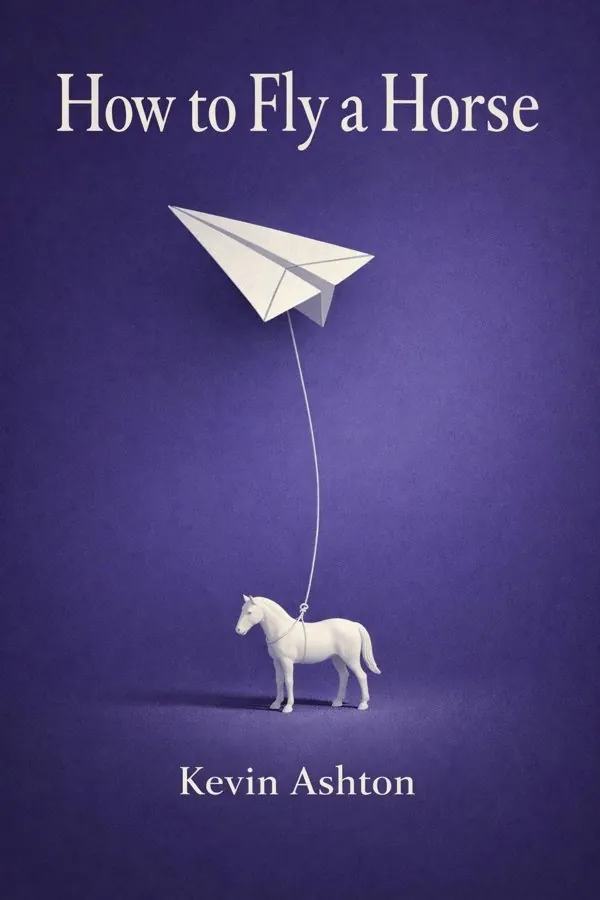
How to Fly a Horse: The Secret History of Creation, Invention, and Discovery: Summary & Key Insights
by Kevin Ashton
 10 min8 chaptersAudio available
Key Takeaways from How to Fly a Horse: The Secret History of Creation, Invention, and Discovery
The most dangerous myth about creativity is that great ideas appear in a flash.
We love stories about solitary masterminds, but Ashton shows that invention is rarely a solo act.
One reason people avoid creating is that they fear getting it wrong.
Creativity often begins not with imagination alone but with attention.
Natural ability may help, but Ashton argues that persistence is usually more decisive than raw talent.
What Is How to Fly a Horse: The Secret History of Creation, Invention, and Discovery About?
How to Fly a Horse: The Secret History of Creation, Invention, and Discovery by Kevin Ashton is a creativity book. How do new ideas actually come into the world? In How to Fly a Horse, Kevin Ashton challenges one of our most comforting myths: that creativity belongs to rare geniuses touched by inspiration. Instead, he argues that creation is ordinary, human, and built through effort, persistence, and trial and error. Drawing on stories from inventors, scientists, artists, entrepreneurs, and explorers, Ashton shows that breakthroughs usually emerge not from lightning bolts of brilliance but from hard work, collaboration, mistakes, and repeated experimentation. The book matters because the myth of genius can be paralyzing. If we believe innovation is reserved for exceptional people, most of us will never seriously attempt to create. Ashton dismantles that belief and replaces it with a more empowering truth: creativity is a process available to anyone willing to observe closely, work consistently, and keep going despite uncertainty. As a technology pioneer best known for coining the term “Internet of Things,” Ashton brings both practical experience and a deep interest in how invention really happens. The result is an engaging, myth-busting exploration of creativity that makes innovation feel less mysterious and far more achievable.
This FizzRead summary covers all 8 key chapters of How to Fly a Horse: The Secret History of Creation, Invention, and Discovery in approximately 10 minutes, distilling the most important ideas, arguments, and takeaways from Kevin Ashton's work. Also available as an audio summary and Key Quotes Podcast.
How to Fly a Horse: The Secret History of Creation, Invention, and Discovery
How do new ideas actually come into the world? In How to Fly a Horse, Kevin Ashton challenges one of our most comforting myths: that creativity belongs to rare geniuses touched by inspiration. Instead, he argues that creation is ordinary, human, and built through effort, persistence, and trial and error. Drawing on stories from inventors, scientists, artists, entrepreneurs, and explorers, Ashton shows that breakthroughs usually emerge not from lightning bolts of brilliance but from hard work, collaboration, mistakes, and repeated experimentation.
The book matters because the myth of genius can be paralyzing. If we believe innovation is reserved for exceptional people, most of us will never seriously attempt to create. Ashton dismantles that belief and replaces it with a more empowering truth: creativity is a process available to anyone willing to observe closely, work consistently, and keep going despite uncertainty. As a technology pioneer best known for coining the term “Internet of Things,” Ashton brings both practical experience and a deep interest in how invention really happens. The result is an engaging, myth-busting exploration of creativity that makes innovation feel less mysterious and far more achievable.
Who Should Read How to Fly a Horse: The Secret History of Creation, Invention, and Discovery?
This book is perfect for anyone interested in creativity and looking to gain actionable insights in a short read. Whether you're a student, professional, or lifelong learner, the key ideas from How to Fly a Horse: The Secret History of Creation, Invention, and Discovery by Kevin Ashton will help you think differently.
- ✓Readers who enjoy creativity and want practical takeaways
- ✓Professionals looking to apply new ideas to their work and life
- ✓Anyone who wants the core insights of How to Fly a Horse: The Secret History of Creation, Invention, and Discovery in just 10 minutes
Want the full summary?
Get instant access to this book summary and 100K+ more with Fizz Moment.
Get Free SummaryAvailable on App Store • Free to download
Key Chapters
The most dangerous myth about creativity is that great ideas appear in a flash. Ashton argues that this belief flatters genius but misleads everyone else. In reality, most meaningful creation comes from work: patient observation, repeated attempts, revisions, and persistence through failure. Inspiration may play a role, but it is rarely the engine. The engine is labor.
This idea matters because the myth of magic discourages effort. If people think invention depends on rare talent, they are more likely to wait for perfect ideas instead of building imperfect ones. Ashton uses historical examples to show that celebrated breakthroughs often had long, messy backstories. Inventors tested many versions, artists produced volumes of drafts, and scientists followed dead ends before finding useful answers. What looks effortless from a distance was usually difficult up close.
In practical terms, this changes how we approach our own work. A writer should expect ugly first drafts. A founder should expect weak early prototypes. A manager trying to improve a team process should expect several experiments before one sticks. Instead of reading friction as a sign of inadequacy, we can read it as evidence that creation is underway.
This perspective also encourages discipline over mood. You do not need to feel brilliant to make progress. You need to show up, pay attention, and continue. Daily effort compounds into insight. Small improvements accumulate into breakthroughs.
Actionable takeaway: Replace the question “Am I creative enough?” with “Am I willing to do the work?” Then create a regular practice, however small, that turns creativity from a fantasy into a habit.
We love stories about solitary masterminds, but Ashton shows that invention is rarely a solo act. Even when one person receives the credit, creative advances usually depend on shared knowledge, prior discoveries, collaborators, competitors, critics, tools, and culture. The lone genius narrative is emotionally satisfying, yet historically incomplete.
Why does this matter? Because it changes both how we understand success and how we design environments for innovation. If breakthroughs are social, then access to ideas, feedback, and networks matters enormously. A scientist draws from previous experiments. An entrepreneur responds to customer behavior. An artist absorbs influences from teachers, peers, and traditions. Creation happens within systems, not outside them.
This has practical value for anyone trying to do original work. Instead of trying to protect your identity as the smartest person in the room, you should focus on building rich connections with people and information. Feedback speeds improvement. Collaboration expands possibility. Diverse viewpoints expose blind spots. Even disagreement can sharpen a weak concept into a strong one.
Ashton’s broader point is not that individuals do not matter. They do. But individuals create using materials provided by the world around them. Seeing this reality can reduce ego and increase effectiveness. It also makes creativity feel more accessible. You do not need to be an isolated genius. You need curiosity, openness, and a willingness to learn from others.
Actionable takeaway: Audit your creative ecosystem. Identify three people, communities, or sources of feedback that can strengthen your work, and deliberately bring them into your process rather than trying to invent alone.
One reason people avoid creating is that they fear getting it wrong. Ashton reframes failure not as the opposite of creativity but as one of its raw materials. New things are uncertain by definition, so attempts will often miss the mark. Failure is not evidence that creation is impossible; it is evidence that you are testing something real.
This insight is easy to admire and hard to live. In schools and workplaces, people are often rewarded for correctness and punished for mistakes. That can make experimentation feel risky. But invention requires variation. If every step is guaranteed to succeed, then nothing truly new is being attempted. Ashton points to the repeated setbacks behind famous achievements to show that progress often emerges through error, revision, and persistence.
In everyday life, this means treating failed attempts as information. A product launch that falls flat can reveal what customers do not value. A presentation that confuses an audience can expose where your message breaks down. A painting that does not work can teach composition better than a theory book. The question is not whether you failed, but whether you learned enough from the failure to improve the next iteration.
This mindset can be operationalized. Run small tests. Keep costs low in early experiments. Review what happened without self-punishment. Record lessons before emotion erases them. Over time, you build resilience and intelligence simultaneously.
Actionable takeaway: After every unsuccessful attempt, write down three things: what you expected, what actually happened, and what you will change next. Turn disappointment into a repeatable learning loop.
Creativity often begins not with imagination alone but with attention. Ashton emphasizes that discovery depends on noticing details, contradictions, needs, and patterns that other people overlook. The world constantly offers clues, but only attentive minds turn those clues into ideas.
This is a powerful correction to the belief that creativity is mostly internal. We tend to picture inventors as generating novelty from pure thought. Ashton suggests instead that they are often excellent observers. They see friction in ordinary experiences, gaps in accepted explanations, or possibilities hidden inside familiar objects. Observation turns the everyday into raw material for invention.
Practically, this means creative improvement can start anywhere. A teacher notices students losing focus at the same point in every lesson and redesigns the class structure. A software designer watches users struggle with a feature and simplifies the interface. A parent observes a recurring household problem and invents a better routine or tool. Better seeing leads to better making.
Good observation also requires humility. If you assume you already understand everything, you stop noticing. Curiosity widens perception. So does direct contact with reality. Instead of relying only on reports or assumptions, creators often get close to the actual problem: they watch, listen, test, and ask questions.
In a noisy world, deliberate attention is a competitive advantage. Insight often lives in the obvious things everyone sees but nobody examines carefully. The more closely you study human behavior, systems, and problems, the more opportunities you uncover.
Actionable takeaway: Spend one week keeping a “friction journal.” Write down daily annoyances, repeated questions, inefficiencies, and surprising behaviors. Review the list for patterns that could become your next idea or improvement project.
Natural ability may help, but Ashton argues that persistence is usually more decisive than raw talent. Many people begin with promise; far fewer continue long enough to produce something meaningful. The creators we remember are often not the ones who started best, but the ones who stayed with the problem.
This matters because talent is unevenly distributed, but persistence is trainable. If creativity depended mainly on innate gifts, there would be little most people could do. Ashton offers a more democratic view: progress comes from sustained effort over time. The person who keeps refining, learning, and trying often overtakes the person who relies on early strengths.
In practice, persistence is not just stubbornness. It includes adapting methods, managing energy, and continuing despite boredom, criticism, and slow progress. A researcher may spend years pursuing a difficult question. A musician practices fundamentals long after the excitement of beginning fades. A business owner survives setbacks by adjusting the model instead of abandoning the mission.
This idea also helps explain why many good intentions never become real work. The middle of any project is less glamorous than the start. There is confusion, repetition, and frustration. Ashton’s argument invites us to normalize that stage rather than misinterpret it as a sign we chose the wrong path.
If you want to create consistently, build systems that support endurance: routines, milestones, peer accountability, and rest. Persistence thrives when motivation is not your only fuel.
Actionable takeaway: Choose one creative goal and commit to a minimum period of steady effort, such as 30 days or 12 weeks. Measure consistency, not brilliance, and let momentum strengthen your capability.
People often assume creativity requires total freedom, but Ashton shows that limits can actually sharpen invention. Constraints force choices, expose priorities, and push creators to use available resources more intelligently. Boundaries do not always restrict creativity; they often give it form.
Consider how this works in real life. A startup with little funding has to focus on the few features customers truly need. A poet writing within a strict form must find originality inside rules. An engineer dealing with physical limits must solve problems elegantly rather than extravagantly. Constraints filter fantasy into execution.
This insight is useful because many people wait for ideal conditions before they begin. They want more time, more money, better tools, a larger team, or complete certainty. Ashton’s view suggests the opposite: the conditions you have right now may help you create by forcing clarity. Scarcity can produce focus. Deadlines can trigger decisions. Technical limits can spark unusual solutions.
Of course, not all constraints are helpful. Some are crushing or arbitrary. But within reasonable bounds, constraints can make projects more concrete and manageable. The key is to treat them as design inputs rather than excuses.
This can be especially effective in teams. Instead of discussing endless possibilities, define clear parameters: budget, timeline, audience, purpose, and success criteria. Creativity improves when the challenge is specific enough to engage problem-solving.
Actionable takeaway: For your next project, set three deliberate constraints, such as a time limit, word limit, budget cap, or tool restriction. Use those boundaries to force decisions and uncover more inventive solutions.
Starting is exciting, but Ashton makes clear that real creation happens through revision. First attempts are rarely final forms. Whether in science, art, technology, or business, meaningful work is shaped through repeated improvement. The draft, prototype, experiment, and trial version are not detours from the process; they are the process.
This is an important lesson because our culture often celebrates launches more than iterations. We admire the finished book, product, or performance and overlook the many changes behind it. That distortion makes revision feel like a sign something went wrong, when in fact revision is what makes things good.
For individuals, this means lowering the emotional stakes of version one. A rough beginning is not embarrassing if it is understood as a platform for learning. A speech gets stronger after rehearsal and feedback. A business offer improves after customer objections reveal weak points. A design becomes intuitive after users expose where they get lost.
Revision also encourages better standards. If you believe your first pass must be perfect, you may either procrastinate or publish too early out of frustration. But if you expect multiple iterations, you can separate generating from refining. One mode produces possibilities; the other improves quality.
Teams can institutionalize this by building review cycles into workflows. Instead of hiding incomplete work, share it at appropriate moments, collect reactions, and improve systematically. Progress becomes visible and less emotionally charged.
Actionable takeaway: Stop judging your first version as if it were the final one. Build at least two revision rounds into every important project, and define what you want to improve in each round.
Perhaps Ashton’s most empowering claim is that creativity is not a rare gift possessed by a special few. It is a human capacity distributed far more widely than our myths suggest. People create when they solve problems, adapt tools, tell stories, test possibilities, and improve what already exists. Originality is not limited to famous inventors or artists.
This matters because labels shape behavior. When people say “I’m not creative,” they often mean “I don’t paint, write novels, or start companies.” Ashton broadens the definition. A nurse who redesigns a workflow, a mechanic who improvises a repair, a student who finds a better way to learn, or a parent who invents a bedtime routine is engaging in creative work. Innovation lives in ordinary life.
Recognizing this has practical consequences. It increases participation. Teams become more inventive when creativity is expected from everyone, not outsourced to a designated department. Schools become healthier when children learn that making, trying, and questioning matter more than appearing gifted. Individuals become bolder when they stop treating creativity as an identity test.
This view does not deny differences in skill or accomplishment. Some people become exceptional creators. But Ashton argues that exceptional output grows from common human capacities exercised deeply and persistently. The starting point is much more universal than we imagine.
Once creativity is seen as normal human behavior, the challenge shifts. The question is no longer who is allowed to create. The question is how to build habits, environments, and beliefs that let creation happen more often.
Actionable takeaway: Redefine creativity in your own life. List five ways you already solve problems or improve things, then choose one area where you can become more deliberate about creating rather than merely consuming.
All Chapters in How to Fly a Horse: The Secret History of Creation, Invention, and Discovery
About the Author
Kevin Ashton is a British technology entrepreneur, author, and innovation expert best known for coining the term “Internet of Things.” He has held leadership roles in technology and startup companies and has worked at the intersection of business, invention, and digital transformation for decades. Ashton is also recognized for his ability to explain complex ideas in practical, human terms, especially around creativity, discovery, and how new products and systems emerge. In How to Fly a Horse, he combines historical research with firsthand experience in innovation to challenge popular myths about genius and inspiration. His work is valued for making creativity feel less mysterious and more attainable, helping readers see invention as a process rooted in persistence, observation, and effort rather than rare talent.
Get This Summary in Your Preferred Format
Read or listen to the How to Fly a Horse: The Secret History of Creation, Invention, and Discovery summary by Kevin Ashton anytime, anywhere. FizzRead offers multiple formats so you can learn on your terms — all free.
Available formats: App · Audio · PDF · EPUB — All included free with FizzRead
Download How to Fly a Horse: The Secret History of Creation, Invention, and Discovery PDF and EPUB Summary
Key Quotes from How to Fly a Horse: The Secret History of Creation, Invention, and Discovery
“The most dangerous myth about creativity is that great ideas appear in a flash.”
“We love stories about solitary masterminds, but Ashton shows that invention is rarely a solo act.”
“One reason people avoid creating is that they fear getting it wrong.”
“Creativity often begins not with imagination alone but with attention.”
“Natural ability may help, but Ashton argues that persistence is usually more decisive than raw talent.”
Frequently Asked Questions about How to Fly a Horse: The Secret History of Creation, Invention, and Discovery
How to Fly a Horse: The Secret History of Creation, Invention, and Discovery by Kevin Ashton is a creativity book that explores key ideas across 8 chapters. How do new ideas actually come into the world? In How to Fly a Horse, Kevin Ashton challenges one of our most comforting myths: that creativity belongs to rare geniuses touched by inspiration. Instead, he argues that creation is ordinary, human, and built through effort, persistence, and trial and error. Drawing on stories from inventors, scientists, artists, entrepreneurs, and explorers, Ashton shows that breakthroughs usually emerge not from lightning bolts of brilliance but from hard work, collaboration, mistakes, and repeated experimentation. The book matters because the myth of genius can be paralyzing. If we believe innovation is reserved for exceptional people, most of us will never seriously attempt to create. Ashton dismantles that belief and replaces it with a more empowering truth: creativity is a process available to anyone willing to observe closely, work consistently, and keep going despite uncertainty. As a technology pioneer best known for coining the term “Internet of Things,” Ashton brings both practical experience and a deep interest in how invention really happens. The result is an engaging, myth-busting exploration of creativity that makes innovation feel less mysterious and far more achievable.
You Might Also Like
Dimensions Of Creativity
Margaret A. Boden
10 min
Imagine: How Creativity Works
Jonah Lehrer
10 min
The Accidental Creative: How to Be Brilliant at a Moment's Notice
Todd Henry
10 min
The Origins of Creativity
Edward O. Wilson
10 min
Wired to Create: Unraveling the Mysteries of the Creative Mind
Scott Barry Kaufman, Carolyn Gregoire
10 min
A More Beautiful Question: The Power of Inquiry to Spark Breakthrough Ideas
Warren Berger
10 minBrowse by Category
Ready to read How to Fly a Horse: The Secret History of Creation, Invention, and Discovery?
Get the full summary and 100K+ more books with Fizz Moment.