
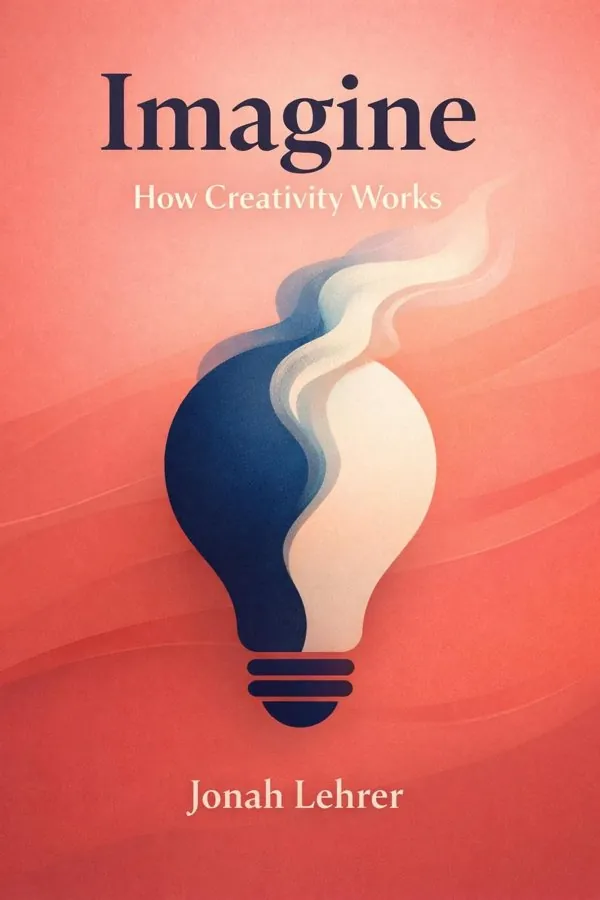
Imagine: How Creativity Works: Summary & Key Insights
by Jonah Lehrer
 10 min9 chaptersAudio available
Key Takeaways from Imagine: How Creativity Works
The most powerful insight in the book is that creativity is rarely a lightning strike from nowhere.
Many breakthroughs happen only after the mind stops trying so hard.
A surprising truth about creativity is that feeling stuck is often a sign of progress.
Creativity does not happen in a vacuum.
One of the book’s strongest themes is that creativity becomes more powerful when different people, perspectives, and experiences collide.
What Is Imagine: How Creativity Works About?
Imagine: How Creativity Works by Jonah Lehrer is a creativity book. Creativity often looks mysterious from the outside. A hit song appears fully formed, a scientific breakthrough seems to arrive in a flash, and a brilliant business idea can feel like pure magic. In Imagine: How Creativity Works, Jonah Lehrer argues that creativity is not magic at all. It is a process with patterns, habits, environments, and mental states that can be studied and improved. Drawing on neuroscience, psychology, history, and storytelling, Lehrer explores how ideas emerge in the mind, why some people and teams generate more original thinking than others, and what conditions help innovation flourish. What makes the book especially compelling is its range. Lehrer moves from Bob Dylan’s songwriting to the design culture at 3M, from brain science to urban innovation, showing that creativity is both deeply personal and profoundly social. He presents creativity not as a gift reserved for geniuses, but as a skill shaped by attention, persistence, mood, collaboration, and environment. For readers who want to think better, solve problems more imaginatively, or build more innovative teams, Imagine offers a practical and fascinating guide to how new ideas actually happen.
This FizzRead summary covers all 9 key chapters of Imagine: How Creativity Works in approximately 10 minutes, distilling the most important ideas, arguments, and takeaways from Jonah Lehrer's work. Also available as an audio summary and Key Quotes Podcast.
Imagine: How Creativity Works
Creativity often looks mysterious from the outside. A hit song appears fully formed, a scientific breakthrough seems to arrive in a flash, and a brilliant business idea can feel like pure magic. In Imagine: How Creativity Works, Jonah Lehrer argues that creativity is not magic at all. It is a process with patterns, habits, environments, and mental states that can be studied and improved. Drawing on neuroscience, psychology, history, and storytelling, Lehrer explores how ideas emerge in the mind, why some people and teams generate more original thinking than others, and what conditions help innovation flourish.
What makes the book especially compelling is its range. Lehrer moves from Bob Dylan’s songwriting to the design culture at 3M, from brain science to urban innovation, showing that creativity is both deeply personal and profoundly social. He presents creativity not as a gift reserved for geniuses, but as a skill shaped by attention, persistence, mood, collaboration, and environment. For readers who want to think better, solve problems more imaginatively, or build more innovative teams, Imagine offers a practical and fascinating guide to how new ideas actually happen.
Who Should Read Imagine: How Creativity Works?
This book is perfect for anyone interested in creativity and looking to gain actionable insights in a short read. Whether you're a student, professional, or lifelong learner, the key ideas from Imagine: How Creativity Works by Jonah Lehrer will help you think differently.
- ✓Readers who enjoy creativity and want practical takeaways
- ✓Professionals looking to apply new ideas to their work and life
- ✓Anyone who wants the core insights of Imagine: How Creativity Works in just 10 minutes
Want the full summary?
Get instant access to this book summary and 100K+ more with Fizz Moment.
Get Free SummaryAvailable on App Store • Free to download
Key Chapters
The most powerful insight in the book is that creativity is rarely a lightning strike from nowhere. Although breakthroughs can feel sudden, they usually emerge from a longer process of preparation, struggle, and revision. Lehrer challenges the romantic myth that original ideas belong only to rare geniuses with mysterious gifts. Instead, he shows that creative work tends to follow recognizable patterns, whether in art, science, business, or everyday problem-solving.
A new idea often begins with deep immersion in a problem. People gather facts, practice skills, hit obstacles, and spend time wrestling with questions they cannot yet answer. This effort matters because the mind needs raw material before it can make fresh combinations. The breakthrough may arrive unexpectedly, but it usually rests on long periods of conscious and unconscious work.
This has practical implications. If you believe creativity is magic, then you wait passively for inspiration. If you understand it as a process, you can build habits that support it. A designer can collect references, sketch broadly, and leave room for revision. A student can study intensely, step away, and return with fresh perspective. A manager can create workflows that include experimentation instead of demanding immediate perfection.
Lehrer’s broader point is reassuring: creative success is less about being born special and more about learning how to move through uncertainty. Originality often looks messy before it looks brilliant. The people who create important work are not necessarily those with the fewest doubts, but those willing to stay engaged long enough for a better idea to emerge.
Actionable takeaway: Stop waiting for inspiration to feel effortless. Choose one problem that matters to you, gather material on it deeply, and commit to working through several imperfect drafts before judging your creativity.
Many breakthroughs happen only after the mind stops trying so hard. One of Lehrer’s most memorable themes is that creativity depends on two very different mental modes: focused attention and relaxed wandering. Concentration helps you define the problem, learn the details, and push your thinking to its limits. But when the obvious solutions fail, the brain often needs distance. In those quieter moments, it can reorganize information in surprising ways.
This is why insights so often arrive in the shower, during a walk, while driving, or in the brief pause after intense work. The brain’s associative networks keep processing even when conscious effort eases. When you are too locked into one line of thought, you can become trapped by habit. Relaxation gives hidden connections a chance to surface.
The practical lesson is not that focus is unimportant. Without effort, there is nothing for the mind to incubate. But nonstop concentration can become counterproductive. Writers who stare at the same paragraph for hours may get less done than those who work hard, step away, and return later. Engineers facing a design problem may find a solution after taking a break rather than forcing one more meeting.
You can apply this by structuring your day around alternating states. Work deeply on a difficult challenge, then deliberately shift into low-pressure activity. Go for a walk without your phone. Take a shower after a demanding session. Do something repetitive and calm that lets your thoughts drift. These transitions help the brain move from analysis to recombination.
Actionable takeaway: The next time you are stuck, do not just work longer. Spend 45 to 90 minutes in focused effort, then take a genuine mental break and notice what new ideas appear when you stop forcing them.
A surprising truth about creativity is that feeling stuck is often a sign of progress. Lehrer explains that breakthrough moments are frequently preceded by frustration, confusion, and even failure. This happens because the mind must first exhaust familiar patterns before it can discover something genuinely new. If the first answer worked, there would be no need for creativity.
This idea matters because most people interpret frustration as evidence that they lack talent. They hit a wall and assume they are not creative enough. But the wall itself may be necessary. When your usual methods stop working, the brain is pushed to search beyond routine solutions. The discomfort signals that you are leaving the safe territory of habit.
Consider a songwriter who keeps producing predictable melodies, a founder whose business model no longer fits the market, or a scientist whose data refuses to match the theory. In each case, progress may depend on tolerating confusion long enough to rethink assumptions. That emotional resilience is a major part of creative achievement.
Lehrer also highlights the value of persistence without rigidity. You must stay with the problem, but not cling to one answer. Productive frustration means continuing the search while letting go of old frameworks. Teams can support this by normalizing dead ends, prototypes, and failed experiments rather than punishing every wrong turn.
For individuals, it helps to rename the experience. Instead of saying, “I’m failing,” say, “I’m in the middle of discovery.” This reframing reduces panic and keeps your mind open. The most dangerous moment is not confusion itself, but the urge to escape it too quickly with a mediocre solution.
Actionable takeaway: When you feel stuck on a meaningful problem, resist the temptation to quit or settle fast. Write down three assumptions you are making, then challenge each one to create space for a different kind of answer.
Creativity does not happen in a vacuum. Lehrer shows that the places where we live and work strongly influence the quality of our ideas. Noise levels, physical layout, freedom of movement, exposure to new experiences, and even the emotional tone of a room can either expand or shrink creative possibility. In other words, original thought is not just inside your head; it is also embedded in your surroundings.
Innovative environments tend to combine stimulation with freedom. They offer enough novelty to spark new associations, yet enough safety for people to take risks. A workplace where everyone fears embarrassment will produce cautious thinking, no matter how smart the employees are. By contrast, a space that encourages experimentation can generate more unusual and valuable ideas.
This applies on a personal scale too. If your routine is completely predictable, your brain receives fewer surprising inputs. New cafes, neighborhoods, books, conversations, and disciplines all provide material for fresh combinations. Even small changes can help: rearranging your workspace, using a notebook instead of a laptop, working near moderate ambient noise, or placing visual prompts nearby.
Lehrer’s broader argument is that creativity thrives when people encounter difference. Cities, diverse teams, and open exchanges matter because they expose us to perspectives we would not generate alone. Novelty is not a distraction from creativity; often it is the fuel.
The key is intentional design. If you want better thinking, shape your environment to support it. Build routines that include exploration, make your workspace inviting rather than sterile, and seek out people whose backgrounds differ from yours. Your surroundings can become a silent collaborator in the creative process.
Actionable takeaway: Audit your current environment and change one element this week, such as where you work, whom you brainstorm with, or what new input you expose yourself to, so your mind has more material to recombine.
One of the book’s strongest themes is that creativity becomes more powerful when different people, perspectives, and experiences collide. Lehrer argues that innovation often emerges not from isolated brilliance but from networks where ideas mix, clash, and evolve. Diversity is valuable not only because it is socially important, but because it improves thinking itself.
When everyone in a room shares the same assumptions, solutions tend to remain predictable. Diverse groups are more likely to question defaults, notice blind spots, and bring in unexpected analogies. A musician may borrow from technology, a scientist may learn from design, and a business team may discover new opportunities by listening to customers unlike themselves. These collisions of perspective help ideas become less obvious and more inventive.
At the same time, diversity can create friction. People with different backgrounds may communicate differently, disagree more, or struggle to reach quick consensus. Lehrer suggests that this tension is often productive. Smooth agreement can feel efficient, but it may also mean that no one is challenging the dominant view. Creative teams need enough trust to handle disagreement without shutting down.
In practice, this means leaders should not merely gather talented individuals and hope for innovation. They should create conditions where distinct viewpoints are actually heard. Invite contributions from quieter members. Mix departments. Reward constructive debate. Expose teams to customers, industries, and disciplines outside their usual bubble.
For individuals, the lesson is equally important. Read outside your field. Spend time with people whose work and lives differ from your own. Creative growth often begins when your familiar categories stop being sufficient.
Actionable takeaway: Deliberately add one new perspective to your current project, whether by consulting someone from another field, reading outside your expertise, or inviting dissent before finalizing a decision.
Brainstorming is not automatically creative. Lehrer explores the complicated reality of group innovation and shows that collaboration works best under specific conditions. Simply putting people in a room and asking for ideas can lead to conformity, shallow enthusiasm, or domination by the loudest voice. Productive collaboration requires a structure that balances freedom with focus.
One challenge in groups is social pressure. People often censor unusual ideas because they fear sounding foolish. Others may anchor the conversation too early, limiting what follows. In poorly designed sessions, quantity replaces quality and discussion becomes performance. The result is a meeting full of energy but little originality.
Effective collaboration usually combines solitary and collective work. Individuals first think independently, then bring ideas together for refinement. This preserves originality while allowing cross-pollination. The best teams also have psychological safety: members can disagree, challenge assumptions, and admit uncertainty without being punished. That honesty is essential for real innovation.
Lehrer’s examples suggest that creative organizations cultivate open communication across roles while protecting time for deep individual thought. A product team might let engineers, marketers, and designers contribute from different angles, but also allow each person to develop concepts alone before review. A classroom might encourage students to generate ideas privately before group discussion, leading to more varied contributions.
The lesson is not that collaboration is overrated. It is that collaboration must be designed. Good teams do not erase individuality; they amplify it through thoughtful exchange. The goal is not instant consensus, but a process that helps raw ideas become stronger through challenge and combination.
Actionable takeaway: In your next group session, have everyone generate ideas independently before discussion begins, then use the meeting to compare, challenge, and build rather than improvise everything out loud.
Creativity is not purely intellectual; it is emotional too. Lehrer shows that feelings such as curiosity, openness, frustration, excitement, and even certain kinds of melancholy can shape how the mind generates ideas. Our emotional state influences whether we think narrowly or expansively, whether we cling to routine or explore unfamiliar paths.
Positive moods often broaden attention. When people feel safe and engaged, they tend to notice more possibilities and make wider associations. That can help during idea generation, when the goal is to expand options. But not every creative task benefits from the same mood. Some forms of careful editing, error detection, or analytical refinement may require more critical focus. Creativity is not one emotion; it is a sequence of mental and emotional shifts.
This matters because many people treat mood as irrelevant or uncontrollable. In reality, small changes in energy and atmosphere can alter how effectively we think. A team under constant stress may become reactive and unimaginative. An artist who never protects time for rest may lose access to playful experimentation. Even physical factors like sleep, sunlight, music, and movement can influence mental flexibility.
Lehrer’s discussion encourages a more humane view of productivity. Better ideas do not always come from harsher pressure. Sometimes they emerge when people feel interested, supported, and mentally alive. Emotional management is therefore part of the creative toolkit.
You can use this insight by matching your work to your state. Do expansive tasks when you feel energized and open. Save editing and evaluation for periods of sharper critical focus. Build rituals that elevate curiosity, such as music, movement, or a short review of inspiring examples before you begin.
Actionable takeaway: Before starting creative work, spend five minutes improving your mental state with a simple ritual like walking, stretching, listening to music, or reviewing inspiring material, then choose a task that fits your mood.
A new idea is only the beginning. Lehrer emphasizes that creativity is not just about generating possibilities; it is also about refining them. The myth of inspiration often ignores the less glamorous work of revision, selection, and discipline. Yet many great works become great precisely because someone was willing to cut, reshape, and improve what first appeared.
Raw creativity can produce abundance, but abundance alone is not value. A novelist may write dozens of pages that need compression. An entrepreneur may have ten product ideas but only one with real market fit. A scientist may imagine several explanations, then test them rigorously. Without editing, creativity becomes noise.
This is where discipline matters. Creative people must develop standards, not only imagination. They need the patience to revisit a draft, the honesty to reject weak ideas, and the humility to accept feedback. Lehrer suggests that originality is often the result of a cycle: generate widely, evaluate carefully, revise repeatedly. The best creators do not protect every idea equally; they shape and sacrifice in order to strengthen what matters.
For teams, this means separating phases. If critique enters too early, originality shrinks. But if critique never arrives, projects remain vague or inflated. Effective innovators know when to open the floodgates and when to narrow the field.
For individuals, a useful practice is to treat first ideas as material, not final answers. That mindset reduces attachment and makes revision easier. Creativity becomes less about proving your brilliance and more about building something excellent.
Actionable takeaway: After your next brainstorming session, choose the three strongest ideas and evaluate them using clear criteria such as usefulness, originality, and feasibility, then revise one of them with ruthless focus.
Perhaps the most encouraging lesson in Imagine is that creativity can be nurtured by design. Lehrer does not promise a formula for genius, but he does show that individuals and organizations can reliably improve the conditions under which good ideas emerge. Innovation is not fully controllable, yet it is far from random.
Creative cultures tend to share several traits: they value curiosity, tolerate failure, promote diverse interaction, and allow time for both deep work and incubation. They do not treat every minute as measurable output. Instead, they understand that exploration, wandering, and experimentation are part of the work. This can be seen in companies that give employees room to pursue side ideas, schools that encourage open-ended projects, or leaders who reward questioning rather than blind agreement.
On a personal level, cultivating creativity means building systems rather than relying on mood. Keep an idea capture habit. Schedule uninterrupted work. Seek novelty regularly. Alternate collaboration with solitude. Reflect on your best insights and identify the conditions that produced them. Over time, this turns creativity from a vague aspiration into a repeatable practice.
Lehrer’s larger contribution is practical optimism. You do not need to become someone else to become more creative. You need to understand how your mind works and shape your habits accordingly. Original thinking grows when intention meets environment, effort, and openness.
This mindset is especially useful in a world that increasingly rewards adaptability. Whether you are solving a business problem, making art, teaching, or redesigning your life, creativity is no longer optional. It is a core human capacity that can be strengthened.
Actionable takeaway: Create a simple weekly creativity system with time for deep work, one session of idea review, one source of new input, and one deliberate break for incubation, then track which conditions produce your best ideas.
All Chapters in Imagine: How Creativity Works
About the Author
Jonah Lehrer is an American author and journalist known for writing about neuroscience, psychology, decision-making, and creativity for a broad audience. He studied neuroscience at Columbia University and later built a reputation as a science writer who could explain complex research through clear storytelling and vivid examples. Lehrer contributed to major publications and became especially well known for books that examined how the mind works in real life, including topics such as innovation, emotion, and human judgment. In Imagine: How Creativity Works, he brings together science, business, music, and history to explore where new ideas come from. His work has attracted readers interested in making cognitive science practical, accessible, and relevant to everyday thinking and performance.
Get This Summary in Your Preferred Format
Read or listen to the Imagine: How Creativity Works summary by Jonah Lehrer anytime, anywhere. FizzRead offers multiple formats so you can learn on your terms — all free.
Available formats: App · Audio · PDF · EPUB — All included free with FizzRead
Download Imagine: How Creativity Works PDF and EPUB Summary
Key Quotes from Imagine: How Creativity Works
“The most powerful insight in the book is that creativity is rarely a lightning strike from nowhere.”
“Many breakthroughs happen only after the mind stops trying so hard.”
“A surprising truth about creativity is that feeling stuck is often a sign of progress.”
“Lehrer shows that the places where we live and work strongly influence the quality of our ideas.”
“One of the book’s strongest themes is that creativity becomes more powerful when different people, perspectives, and experiences collide.”
Frequently Asked Questions about Imagine: How Creativity Works
Imagine: How Creativity Works by Jonah Lehrer is a creativity book that explores key ideas across 9 chapters. Creativity often looks mysterious from the outside. A hit song appears fully formed, a scientific breakthrough seems to arrive in a flash, and a brilliant business idea can feel like pure magic. In Imagine: How Creativity Works, Jonah Lehrer argues that creativity is not magic at all. It is a process with patterns, habits, environments, and mental states that can be studied and improved. Drawing on neuroscience, psychology, history, and storytelling, Lehrer explores how ideas emerge in the mind, why some people and teams generate more original thinking than others, and what conditions help innovation flourish. What makes the book especially compelling is its range. Lehrer moves from Bob Dylan’s songwriting to the design culture at 3M, from brain science to urban innovation, showing that creativity is both deeply personal and profoundly social. He presents creativity not as a gift reserved for geniuses, but as a skill shaped by attention, persistence, mood, collaboration, and environment. For readers who want to think better, solve problems more imaginatively, or build more innovative teams, Imagine offers a practical and fascinating guide to how new ideas actually happen.
More by Jonah Lehrer
You Might Also Like
Dimensions Of Creativity
Margaret A. Boden
10 min
How to Fly a Horse: The Secret History of Creation, Invention, and Discovery
Kevin Ashton
10 min
The Accidental Creative: How to Be Brilliant at a Moment's Notice
Todd Henry
10 min
The Origins of Creativity
Edward O. Wilson
10 min
Wired to Create: Unraveling the Mysteries of the Creative Mind
Scott Barry Kaufman, Carolyn Gregoire
10 min
A More Beautiful Question: The Power of Inquiry to Spark Breakthrough Ideas
Warren Berger
10 minBrowse by Category
Ready to read Imagine: How Creativity Works?
Get the full summary and 100K+ more books with Fizz Moment.