
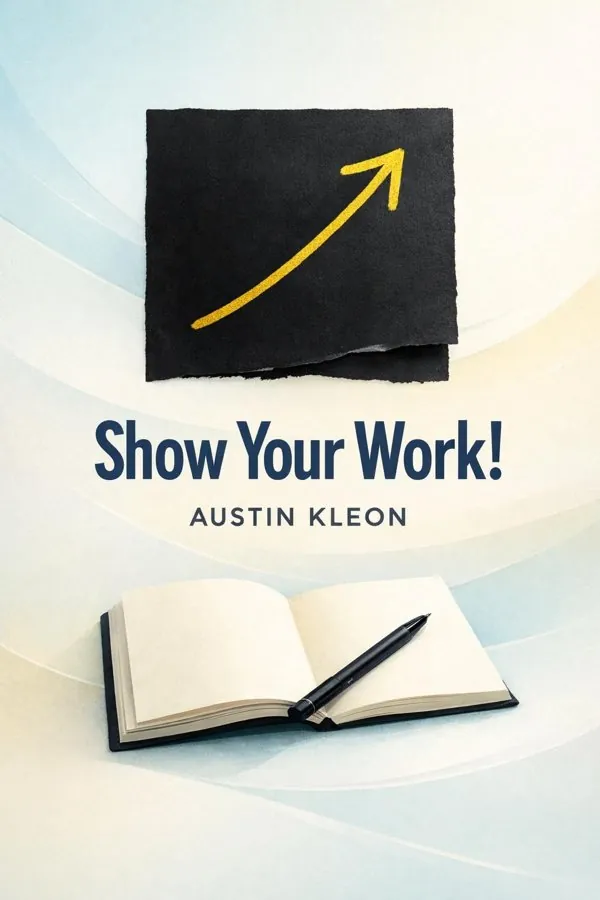
Show Your Work!: 10 Ways to Share Your Creativity and Get Discovered: Summary & Key Insights
by Austin Kleon
 10 min10 chaptersAudio available
Key Takeaways from Show Your Work!: 10 Ways to Share Your Creativity and Get Discovered
We often romanticize creativity as the domain of rare geniuses, but that myth keeps too many people silent.
Finished work can impress people, but process is what draws them in.
Big breakthroughs are exciting, but small consistent signals are what keep you visible.
Your originality is often revealed by what you pay attention to.
People remember stories more easily than explanations.
What Is Show Your Work!: 10 Ways to Share Your Creativity and Get Discovered About?
Show Your Work!: 10 Ways to Share Your Creativity and Get Discovered by Austin Kleon is a creativity book spanning 10 pages. Show Your Work! is a practical, energizing guide to one of the biggest challenges creative people face: not making the work, but getting it seen. In this short illustrated book, Austin Kleon argues that in the digital age, success is no longer reserved for mysterious geniuses or loud self-promoters. Instead, the people who get discovered are often those who generously share their process, ideas, influences, experiments, and lessons as they create. Rather than waiting until everything is perfect, Kleon encourages artists, writers, designers, entrepreneurs, and knowledge workers to let others witness the journey in real time. What makes the book so useful is its tone and its practicality. Kleon does not ask readers to become marketers or internet celebrities. He shows how small, consistent acts of sharing can build trust, attract the right audience, and create meaningful connections. Drawing on examples from art, writing, and online culture, he turns visibility into a daily creative habit. As the bestselling author of Steal Like an Artist, Kleon brings credibility, clarity, and lived experience to the topic, making this an essential book for anyone who wants to create openly and be found.
This FizzRead summary covers all 10 key chapters of Show Your Work!: 10 Ways to Share Your Creativity and Get Discovered in approximately 10 minutes, distilling the most important ideas, arguments, and takeaways from Austin Kleon's work. Also available as an audio summary and Key Quotes Podcast.
Show Your Work!: 10 Ways to Share Your Creativity and Get Discovered
Show Your Work! is a practical, energizing guide to one of the biggest challenges creative people face: not making the work, but getting it seen. In this short illustrated book, Austin Kleon argues that in the digital age, success is no longer reserved for mysterious geniuses or loud self-promoters. Instead, the people who get discovered are often those who generously share their process, ideas, influences, experiments, and lessons as they create. Rather than waiting until everything is perfect, Kleon encourages artists, writers, designers, entrepreneurs, and knowledge workers to let others witness the journey in real time.
What makes the book so useful is its tone and its practicality. Kleon does not ask readers to become marketers or internet celebrities. He shows how small, consistent acts of sharing can build trust, attract the right audience, and create meaningful connections. Drawing on examples from art, writing, and online culture, he turns visibility into a daily creative habit. As the bestselling author of Steal Like an Artist, Kleon brings credibility, clarity, and lived experience to the topic, making this an essential book for anyone who wants to create openly and be found.
Who Should Read Show Your Work!: 10 Ways to Share Your Creativity and Get Discovered?
This book is perfect for anyone interested in creativity and looking to gain actionable insights in a short read. Whether you're a student, professional, or lifelong learner, the key ideas from Show Your Work!: 10 Ways to Share Your Creativity and Get Discovered by Austin Kleon will help you think differently.
- ✓Readers who enjoy creativity and want practical takeaways
- ✓Professionals looking to apply new ideas to their work and life
- ✓Anyone who wants the core insights of Show Your Work!: 10 Ways to Share Your Creativity and Get Discovered in just 10 minutes
Want the full summary?
Get instant access to this book summary and 100K+ more with Fizz Moment.
Get Free SummaryAvailable on App Store • Free to download
Key Chapters
We often romanticize creativity as the domain of rare geniuses, but that myth keeps too many people silent. Austin Kleon’s first and most liberating point is that you do not need to be extraordinary before you begin sharing. You do not need mastery, fame, or a perfectly polished identity. What people respond to is not only brilliance, but curiosity, honesty, and visible effort.
Kleon challenges the image of the isolated creative hero and replaces it with something more realistic: creativity is social. Every artist learns from others, borrows from traditions, and develops through practice. When you admit that you are learning, experimenting, and figuring things out as you go, you become more relatable. Instead of pretending to have all the answers, you invite others into a process they can connect with.
This matters because many people avoid sharing until they feel qualified. A designer waits until her portfolio is flawless. A writer waits until he has a finished book. A musician hides rough recordings because they seem amateurish. But audiences often enjoy seeing the person behind the work. A sketch, a notebook page, a failed attempt, or a half-formed insight can create more connection than a polished final product with no human context.
The goal is not to act insecure or underplay your talent. It is to replace performance with participation. Share what you are learning, what you are trying, and what fascinates you. Document your growth instead of waiting for permission.
Actionable takeaway: Stop asking, “Am I good enough to share?” and start asking, “What can I share today that shows what I’m exploring?”
Big breakthroughs are exciting, but small consistent signals are what keep you visible. Kleon recommends sharing something small every day, not because frequency alone guarantees success, but because regular sharing creates momentum. It keeps you present in people’s minds, sharpens your own thinking, and lowers the emotional stakes of being seen.
Many creatives treat sharing as a major event. They vanish into their work, then resurface with a dramatic announcement. That approach can work occasionally, but it is exhausting and brittle. Daily sharing is a different philosophy. It might be a sentence from your journal, a photo of your workspace, a short lesson from a project, a link to something inspiring, or a progress update. The point is not to flood the internet with noise. The point is to create a sustainable rhythm of contribution.
This habit has several benefits. First, it trains you to notice what is shareable. Second, it gives others many entry points into your work. Third, it helps you get comfortable being imperfect in public. Over time, your archive becomes evidence of growth. You no longer depend on one perfect viral moment; you build discoverability through consistency.
Daily sharing also creates opportunities for serendipity. A small post can lead to a collaboration, a client inquiry, a speaking invitation, or a conversation with someone who shares your interests. These outcomes are often impossible to predict, which is why showing up regularly matters.
The challenge is to keep it manageable. Do not promise daily essays if you can only sustain short notes. Make the habit fit your life.
Actionable takeaway: Choose one simple format you can maintain for 30 days and share one useful or interesting thing each day.
Your originality is often revealed by what you pay attention to. Kleon encourages readers to open up their “cabinet of curiosities,” meaning the collection of influences, obsessions, references, and discoveries that feed their work. People are not only interested in what you make; they are interested in what shapes your taste.
This idea is powerful because it removes the pressure to constantly generate original content from scratch. If you are a filmmaker, you can share scenes you admire and explain why they work. If you are a product designer, you can collect examples of elegant packaging or interfaces. If you are a writer, you can post quotes, books, and article structures that inspire you. By doing this, you become a curator as well as a creator.
Curating your influences has two effects. First, it gives your audience a richer sense of your mind. They begin to understand your aesthetic and values. Second, it deepens your own practice. Explaining why something matters forces you to clarify your taste. Taste is not passive; it is a creative skill.
This does not mean copying thoughtlessly or reposting without attribution. Kleon’s broader philosophy always includes generosity and acknowledgment. Credit your sources. Point people toward the artists, thinkers, and teachers you admire. When you do, you contribute to a creative ecosystem rather than simply extracting from it.
A well-chosen recommendation can be as valuable as an original post because it saves others time and opens doors. It shows discernment. In many cases, people begin following creators because of what they consistently notice and highlight.
Actionable takeaway: Create a weekly habit of sharing three influences and briefly explain what each one teaches you.
People remember stories more easily than explanations. Kleon argues that if you want others to care about your work, you need to learn how to tell good stories about it. This does not mean inventing drama or building a fake personal brand. It means giving context so people can understand what you do, why you do it, and why it matters.
Many talented people struggle with visibility because they describe their work too vaguely or too technically. They assume the work should speak for itself. Sometimes it does, but often it needs framing. A simple narrative can transform how others perceive your projects. Instead of saying, “I make illustrations,” you might say, “I create playful illustrations that help complex scientific ideas feel accessible.” Instead of announcing, “I launched a newsletter,” you could explain the problem it solves, the audience it serves, and the personal curiosity that led you to start it.
Good stories usually include tension, process, and purpose. What challenge were you trying to solve? What surprised you? What did you learn? Why does this matter now? These elements make your work easier to share and discuss. They also help you stay connected to your own motivations.
Storytelling is especially important online, where attention is limited. A project with a clear narrative gives people a hook. It invites conversation rather than passive scrolling. This applies to bios, pitches, portfolio descriptions, social posts, and even casual conversations.
You do not need hype. You need clarity. When your story is honest and specific, the right people can immediately see how your work fits into their world.
Actionable takeaway: Write a short origin story for one of your projects using three parts: the problem, the process, and the purpose.
One of the fastest ways to become valuable is to share what you know while you are learning it. Kleon’s advice to “teach what you know” reframes expertise. You do not need to be the world’s leading authority to be helpful. If you are one step ahead of someone else, you can teach them something useful.
This mindset removes a common obstacle: the fear of not being expert enough. A beginner coder can document how she solved a bug. A freelance designer can explain how he priced his first project. A new gardener can share what worked in a small balcony setup. These insights may feel ordinary to the person sharing them, but they can be exactly what someone else needs.
Teaching clarifies your own understanding. When you explain a concept, method, or tool, you discover what you truly know and where your gaps remain. It also creates trust. Audiences appreciate creators who are generous with information rather than protective and opaque. Over time, teaching establishes you as a thoughtful practitioner.
There are many forms this can take: tutorials, checklists, annotated screenshots, behind-the-scenes breakdowns, reading lists, process notes, workshops, Q&As, or simple “here’s what I learned” posts. The best teaching is concrete. Instead of saying, “Be more productive,” show your exact writing routine. Instead of saying, “Lighting matters,” show before-and-after examples.
Importantly, teaching is not only a marketing tactic. It is a way of participating in a community. You are contributing to a chain of shared knowledge that likely helped you too.
Actionable takeaway: This week, turn one thing you recently learned into a short lesson that someone else could use immediately.
There is a fine line between sharing your work and constantly demanding attention. Kleon warns against turning into “human spam,” a person who only broadcasts self-promotion without offering context, value, or genuine engagement. People do not mind hearing about your work; they mind being treated like targets instead of participants.
The difference lies in intent and balance. Human spam says, “Look at me, buy this, click this, praise this,” over and over. Generous sharing says, “Here’s something interesting, useful, or meaningful from my work and the world around it.” One approach drains attention; the other earns trust.
In practice, this means mixing promotion with contribution. If you have a new book, article, print, or product, tell people about it. But also share the thinking behind it, the tools you used, the people who inspired it, the lessons it taught you, and resources related to it. Respond to others. Ask questions. Recommend great work that is not your own. Be part of a conversation, not just an interruption inside one.
This principle matters because audiences quickly sense desperation or manipulation. They are far more receptive to creators who appear interested in serving rather than extracting. Generosity also makes your presence more sustainable. Constant self-advertising is exhausting for both you and your followers.
A healthy online identity is not built by shouting the loudest. It is built through relevance, respect, and reciprocity. If people associate your presence with insight, encouragement, and discovery, they will pay attention when you do ask for support.
Actionable takeaway: Before posting about your work, ask, “What does this give the audience besides awareness that I exist?”
The moment you share your work publicly, you invite response, and not all of it will be kind. Kleon’s advice to “learn to take a punch” is a realistic reminder that visibility comes with vulnerability. If you want to be discovered, you must also be prepared to be misunderstood, ignored, or criticized.
This is not a reason to retreat. It is a reason to develop emotional resilience. Criticism is not all the same. Some feedback is useful and specific. Some is careless, cruel, or purely reactive. One of the most important skills a creative person can build is the ability to tell the difference. Productive criticism can sharpen your work. Random hostility should not control your direction.
Kleon encourages boundaries. You do not need to read every comment, answer every message, or argue with every detractor. In many cases, the healthiest response is no response. Protecting your energy is part of protecting your practice. At the same time, do not let fear of negative feedback stop you from sharing at all. Silence guarantees obscurity; exposure creates possibility.
It helps to anchor yourself in process rather than approval. If your identity depends entirely on praise, criticism will devastate you. But if you are committed to learning and making, then feedback becomes one signal among many, not a verdict on your worth.
Creators who last are not the ones who avoid all blows. They are the ones who absorb what is useful, discard what is not, and keep going.
Actionable takeaway: Create a personal rule for feedback: save helpful critique, ignore bad-faith attacks, and never let a stranger’s comment determine whether you continue.
Many creatives feel uneasy about money, as if earning from their work somehow contaminates it. Kleon pushes against this false purity. His chapter on “sell out” makes the case that supporting yourself is not a betrayal of art. If people value what you make, giving them ways to buy, subscribe, hire, or support you is reasonable and healthy.
The problem is not selling. The problem is losing your integrity for approval or short-term gain. Ethical selling begins with making something genuinely useful, moving, beautiful, or interesting. It continues by being clear about what you offer and how people can support it. A writer can sell books, courses, or memberships. An illustrator can offer prints, commissions, and workshops. A consultant can publish free insights while also offering paid services. These models do not cheapen the work; they can sustain it.
Kleon’s broader point is that generosity and commerce can coexist. You can share plenty for free and still ask for payment where appropriate. In fact, free sharing often helps people understand the value of your paid work. The key is alignment. Do not build offers that conflict with your values or audience. Do not make every interaction transactional. But do not hide the fact that creative work requires time, attention, and resources.
When money enters the picture thoughtfully, it can buy freedom: more time to practice, more tools to experiment with, and more ability to keep contributing. Sustainability matters because a creative life is a long game.
Actionable takeaway: Make one clear, respectful path for people to support your work, whether through a product, service, subscription, or donation.
Many people begin creative work with intensity, then disappear when progress slows or attention fades. Kleon’s final message, “stick around,” may be the most important of all. Getting discovered is rarely a single moment. It is often the result of showing up over years, continuing to make things, and allowing your body of work to accumulate.
Longevity gives your work depth. Early efforts may be uneven, but they teach you what interests you most. Repetition reveals patterns. Patterns become voice. Voice attracts a real audience. None of this happens if you quit whenever results are delayed. In that sense, perseverance is not separate from creativity; it is part of it.
Sticking around also means evolving publicly. Your interests will change. Your tools will improve. Your audience may shift. That is normal. The goal is not to preserve a fixed identity forever. The goal is to remain active enough that your work can grow in full view. People often enjoy following long arcs of development more than isolated flashes of talent.
Practically, this requires patience and systems. Build routines you can sustain. Protect time for making. Take breaks when needed, but do not confuse rest with abandonment. Measure progress not only by metrics such as followers or sales, but by the quality and consistency of your output.
The internet rewards novelty, but meaningful creative careers are built on endurance. If you keep making, keep sharing, and keep learning, your chances of being found rise dramatically over time.
Actionable takeaway: Design a creative routine you can still imagine doing a year from now, then commit to it more than to quick attention.
All Chapters in Show Your Work!: 10 Ways to Share Your Creativity and Get Discovered
About the Author
Austin Kleon is an American writer and artist whose work focuses on creativity, productivity, and artistic identity in the modern world. He is best known for his bestselling books Steal Like an Artist, Show Your Work!, and Keep Going, which have helped millions of readers rethink how they create, share, and sustain meaningful work. Kleon’s style blends concise writing, visual design, and practical wisdom, making complex creative ideas easy to understand and apply. Before becoming a full-time author, he worked in libraries and as a web designer, experiences that shaped his interest in ideas, influence, and communication. Through his books, talks, and essays, Kleon has become a trusted voice for artists, writers, entrepreneurs, and anyone trying to build a more open, generous, and resilient creative life.
Get This Summary in Your Preferred Format
Read or listen to the Show Your Work!: 10 Ways to Share Your Creativity and Get Discovered summary by Austin Kleon anytime, anywhere. FizzRead offers multiple formats so you can learn on your terms — all free.
Available formats: App · Audio · PDF · EPUB — All included free with FizzRead
Download Show Your Work!: 10 Ways to Share Your Creativity and Get Discovered PDF and EPUB Summary
Key Quotes from Show Your Work!: 10 Ways to Share Your Creativity and Get Discovered
“We often romanticize creativity as the domain of rare geniuses, but that myth keeps too many people silent.”
“Finished work can impress people, but process is what draws them in.”
“Big breakthroughs are exciting, but small consistent signals are what keep you visible.”
“Your originality is often revealed by what you pay attention to.”
“People remember stories more easily than explanations.”
Frequently Asked Questions about Show Your Work!: 10 Ways to Share Your Creativity and Get Discovered
Show Your Work!: 10 Ways to Share Your Creativity and Get Discovered by Austin Kleon is a creativity book that explores key ideas across 10 chapters. Show Your Work! is a practical, energizing guide to one of the biggest challenges creative people face: not making the work, but getting it seen. In this short illustrated book, Austin Kleon argues that in the digital age, success is no longer reserved for mysterious geniuses or loud self-promoters. Instead, the people who get discovered are often those who generously share their process, ideas, influences, experiments, and lessons as they create. Rather than waiting until everything is perfect, Kleon encourages artists, writers, designers, entrepreneurs, and knowledge workers to let others witness the journey in real time. What makes the book so useful is its tone and its practicality. Kleon does not ask readers to become marketers or internet celebrities. He shows how small, consistent acts of sharing can build trust, attract the right audience, and create meaningful connections. Drawing on examples from art, writing, and online culture, he turns visibility into a daily creative habit. As the bestselling author of Steal Like an Artist, Kleon brings credibility, clarity, and lived experience to the topic, making this an essential book for anyone who wants to create openly and be found.
More by Austin Kleon
Show Your Work!
Austin Kleon
10 min
Steal Like An Artist: 10 Things Nobody Told You About Being Creative
Austin Kleon
10 min
Keep Going: 10 Ways to Stay Creative in Good Times and Bad
Austin Kleon
10 min
The Steal Like An Artist Journal: A Notebook for Creative Kleptomaniacs
Austin Kleon
10 minYou Might Also Like
Dimensions Of Creativity
Margaret A. Boden
10 min
How to Fly a Horse: The Secret History of Creation, Invention, and Discovery
Kevin Ashton
10 min
Imagine: How Creativity Works
Jonah Lehrer
10 min
The Accidental Creative: How to Be Brilliant at a Moment's Notice
Todd Henry
10 min
The Origins of Creativity
Edward O. Wilson
10 min
Wired to Create: Unraveling the Mysteries of the Creative Mind
Scott Barry Kaufman, Carolyn Gregoire
10 minBrowse by Category
Ready to read Show Your Work!: 10 Ways to Share Your Creativity and Get Discovered?
Get the full summary and 100K+ more books with Fizz Moment.