
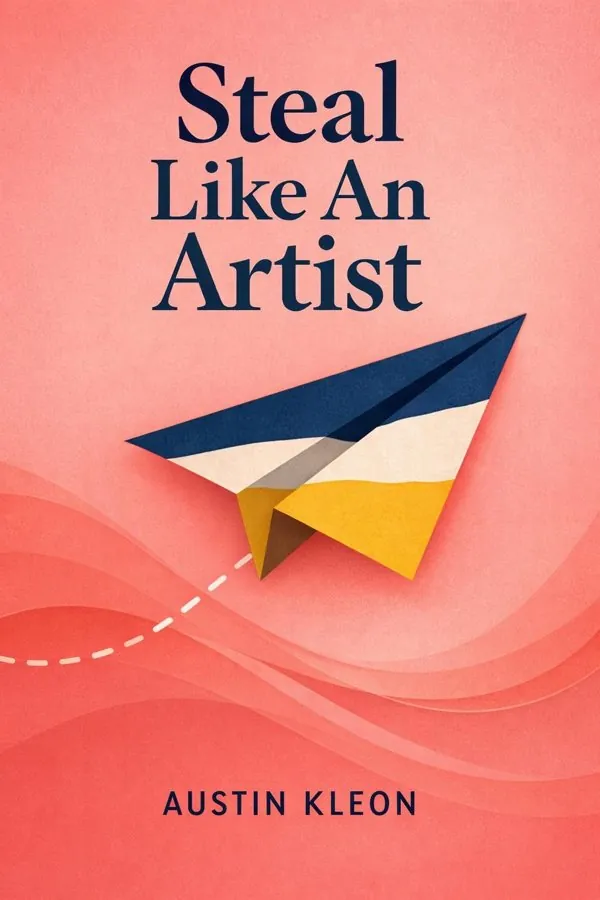
Steal Like An Artist: 10 Things Nobody Told You About Being Creative: Summary & Key Insights
by Austin Kleon
 10 min10 chaptersAudio available
Key Takeaways from Steal Like An Artist: 10 Things Nobody Told You About Being Creative
The fear of influence often blocks creativity more effectively than a lack of talent.
Many people believe they must discover who they are before they can begin creating.
One of the clearest paths to meaningful work is to create the thing you wish someone else had already made.
In a world dominated by screens, Kleon argues for the power of physical making.
Not everything valuable begins as your main job.
What Is Steal Like An Artist: 10 Things Nobody Told You About Being Creative About?
Steal Like An Artist: 10 Things Nobody Told You About Being Creative by Austin Kleon is a creativity book spanning 10 pages. Steal Like An Artist is a short, sharp, and highly practical manifesto about creativity in the modern world. In this book, Austin Kleon argues that originality is not about inventing from nothing. Instead, it comes from collecting influences, studying what moves you, and transforming existing ideas into something personal and fresh. That message matters because many people never begin creative work at all: they are intimidated by the pressure to be completely original, perfectly confident, or fully formed before they start. Kleon dismantles those myths and replaces them with a more generous, realistic model of artistic growth. What makes the book so effective is its clarity. Kleon writes like a working artist rather than an abstract theorist, offering concise principles that apply not only to painters and writers, but also to designers, entrepreneurs, students, and anyone trying to make meaningful work. Drawing on examples from art, literature, music, and everyday life, he shows that creativity is a habit built through curiosity, discipline, experimentation, and sharing. The result is an encouraging guide for people who want to create more bravely, more consistently, and with less fear.
This FizzRead summary covers all 10 key chapters of Steal Like An Artist: 10 Things Nobody Told You About Being Creative in approximately 10 minutes, distilling the most important ideas, arguments, and takeaways from Austin Kleon's work. Also available as an audio summary and Key Quotes Podcast.
Steal Like An Artist: 10 Things Nobody Told You About Being Creative
Steal Like An Artist is a short, sharp, and highly practical manifesto about creativity in the modern world. In this book, Austin Kleon argues that originality is not about inventing from nothing. Instead, it comes from collecting influences, studying what moves you, and transforming existing ideas into something personal and fresh. That message matters because many people never begin creative work at all: they are intimidated by the pressure to be completely original, perfectly confident, or fully formed before they start. Kleon dismantles those myths and replaces them with a more generous, realistic model of artistic growth.
What makes the book so effective is its clarity. Kleon writes like a working artist rather than an abstract theorist, offering concise principles that apply not only to painters and writers, but also to designers, entrepreneurs, students, and anyone trying to make meaningful work. Drawing on examples from art, literature, music, and everyday life, he shows that creativity is a habit built through curiosity, discipline, experimentation, and sharing. The result is an encouraging guide for people who want to create more bravely, more consistently, and with less fear.
Who Should Read Steal Like An Artist: 10 Things Nobody Told You About Being Creative?
This book is perfect for anyone interested in creativity and looking to gain actionable insights in a short read. Whether you're a student, professional, or lifelong learner, the key ideas from Steal Like An Artist: 10 Things Nobody Told You About Being Creative by Austin Kleon will help you think differently.
- ✓Readers who enjoy creativity and want practical takeaways
- ✓Professionals looking to apply new ideas to their work and life
- ✓Anyone who wants the core insights of Steal Like An Artist: 10 Things Nobody Told You About Being Creative in just 10 minutes
Want the full summary?
Get instant access to this book summary and 100K+ more with Fizz Moment.
Get Free SummaryAvailable on App Store • Free to download
Key Chapters
The fear of influence often blocks creativity more effectively than a lack of talent. Kleon’s first and most famous idea is that all creative work builds on what came before. Nothing appears from a vacuum. Writers absorb other writers, musicians learn through songs they love, and designers borrow visual language from traditions, movements, and mentors. The point is not to copy blindly, but to study deeply and transform what resonates with you into something that carries your own perspective.
Kleon distinguishes productive borrowing from theft. A thief takes without understanding or acknowledgment. An artist studies the source, learns its structure, and remakes it through personality, context, and combination. If you admire a filmmaker’s pacing, a poet’s simplicity, and a designer’s use of white space, your job is not to imitate one person exactly. Your job is to build a family tree of influences and let them interact inside your work.
A useful practice is to keep a “swipe file” of ideas that spark something in you: lines, images, compositions, systems, even habits. Then ask why each one matters. What problem does it solve? What emotional effect does it create? This moves you from passive admiration to active learning.
The deeper lesson is liberating: you do not need to invent from zero to make work that matters. You need taste, attention, and the willingness to turn inspiration into contribution. Actionable takeaway: make a list of ten creators you love, study what each one does well, and combine those lessons into your next project.
Many people believe they must discover who they are before they can begin creating. Kleon flips that idea on its head. Identity is not a prerequisite for creative work; it is a result of it. You find your voice by using it. You learn what you care about by making things, noticing patterns, and following your own curiosity over time.
This is especially important for beginners, who often feel fraudulent because they do not yet sound original. Kleon’s advice is to embrace imitation as part of development. Children learn to speak by echoing others before forming their own style. Artists do something similar. Trying on influences is not a sign of inauthenticity; it is a stage of growth. Through repetition, experimentation, and reflection, imitation gradually becomes interpretation, then originality.
Consider a new writer who admires Joan Didion, James Baldwin, and contemporary newsletter authors. At first, their drafts may sound inconsistent or derivative. But through practice, they begin to notice what fits and what does not. Over time, their own rhythm emerges. The same is true for someone learning illustration, product design, teaching, or public speaking.
Waiting to feel certain usually leads to paralysis. Creative confidence comes after action, not before it. The process of making reveals your interests, strengths, and values more reliably than endless introspection.
Actionable takeaway: choose one small project you can start today, even if it feels imperfect, and treat it as an experiment in discovering your voice rather than a final statement about who you are.
One of the clearest paths to meaningful work is to create the thing you wish someone else had already made. Kleon’s advice to “write the book you want to read” extends far beyond writing. Build the product you wish you could buy. Start the newsletter you wish landed in your inbox. Teach the course you wish someone had offered when you were starting out.
This principle matters because it turns dissatisfaction into direction. Instead of wondering what the market wants in the abstract, you begin with a genuine need, curiosity, or frustration. That gives your work energy and specificity. People often respond most strongly to projects made from lived desire, because those projects solve real problems and speak in a real voice.
For example, if you are a manager who cannot find clear, humane advice on leading a remote team, you could create a short guide based on what you are learning. If you are a parent who wants better educational activities for children, you could design simple printable tools. If you are a musician tired of technical tutorials that ignore emotion, you could make lessons focused on expression.
The deeper value here is that your taste becomes an asset. What you long for is evidence of the standards and gaps you perceive. Rather than treating your preferences as trivial, use them as clues to what you might contribute.
Actionable takeaway: identify one resource, experience, or piece of art you wish existed, then outline a small version you can create for yourself and others within the next week.
In a world dominated by screens, Kleon argues for the power of physical making. Using your hands changes the quality of attention you bring to your work. When you sketch on paper, rearrange index cards, cut and paste, annotate books, or prototype with simple materials, you engage your mind differently than when you only click, scroll, and type. The body becomes part of the thinking process.
This matters because many creative breakthroughs happen through contact with materials. A designer may discover a better layout by moving printed elements around a table. A writer may find structure by sorting scenes on cards. A teacher may improve a lesson by sketching the flow by hand. Physical constraints can create clarity where digital abundance creates overwhelm.
Kleon is not anti-technology. His point is balance. Digital tools are powerful for editing, distributing, and scaling work. But if every stage of creation happens on a screen, ideas can remain too abstract and too polished too early. Handwork invites play, mess, and surprise. It also slows you down enough to notice what you are actually trying to say.
A practical system is to split your workspace in two: an analog zone for brainstorming and generating, and a digital zone for refining and publishing. This simple distinction can prevent endless tinkering and help you move from exploration to execution more deliberately.
Actionable takeaway: for your next project, do the first round of thinking away from the screen using paper, sticky notes, sketches, or physical prototypes before you move into digital production.
Not everything valuable begins as your main job. Kleon emphasizes that side projects and hobbies are not distractions from serious work; they are often where serious work begins. Because they carry less pressure, they create space for experimentation, play, and risk. They let you follow curiosity without demanding immediate proof of usefulness.
This is crucial for sustaining creativity over the long term. When all of your making is tied to performance, income, or public validation, creative life becomes brittle. Hobbies restore energy. Side projects reconnect you with intrinsic motivation. They also allow hidden interests to cross-pollinate. A photographer who gardens may develop a richer eye for pattern and seasonality. A programmer who writes poetry may become more sensitive to rhythm and language in product design.
Many careers are shaped by these seemingly peripheral pursuits. Newsletters become books. Weekend illustrations become client work. Casual experiments become entire businesses. Even when they do not turn into professional opportunities, hobbies strengthen resilience by reminding you that your worth is not reducible to productivity.
The key is to stop dismissing what captivates you just because it is not obviously strategic. Follow what pulls at your attention. Creative identity often grows at the edges, not the center. Side work also gives you a low-stakes environment to practice consistency.
Actionable takeaway: reserve one recurring block of time each week for a hobby or side project with no immediate career goal, and pay attention to what skills, ideas, or energy it feeds back into your main work.
For much of history, creative opportunity depended heavily on where you lived. Kleon argues that this is less true than ever. The internet allows artists, writers, makers, and thinkers to learn from one another, find audiences, and build communities across distance. Geography still matters, but it no longer has to dictate whether your work can circulate.
This is especially encouraging for people who feel isolated from major cultural centers. You do not need to live in New York, London, or Los Angeles to participate in a creative field. You can publish online, collaborate remotely, join niche communities, and study the work of people around the world. A designer in a small town can build an international client base. A poet can find readers through newsletters and social platforms. A teacher can share resources globally.
At the same time, Kleon’s point is not to abandon place entirely. Local life remains a rich source of material, perspective, and grounding. In fact, one of the best ways to stand out online is to bring a specific local sensibility to your work. The internet expands your reach; your lived environment deepens your voice.
The healthiest approach is hybrid: cultivate your immediate surroundings while using digital tools to connect, learn, and contribute beyond them. Community is now something you can actively construct rather than passively inherit.
Actionable takeaway: join one online community tied to your creative interests and also engage more intentionally with one local space, event, or group that can nourish your work from the ground up.
Creative success is not only about talent. It is also about reputation. Kleon’s reminder that “the world is a small town” highlights how interconnected creative fields really are. People remember how you behave: whether you are generous, whether you meet deadlines, whether you credit others, and whether you are pleasant to collaborate with. In many cases, these qualities matter as much as brilliance.
Being nice does not mean being fake, passive, or uncritical. It means treating others with respect, gratitude, and professionalism. It means answering messages clearly, acknowledging influence, paying people fairly when you can, and avoiding the ego games that poison communities. Since recommendations and relationships drive many opportunities, trust becomes a major creative asset.
This principle applies especially online, where the temptation to perform superiority can be strong. Public cynicism may attract attention, but it rarely builds durable goodwill. By contrast, thoughtful generosity compounds. People return to those who contribute constructively and make others feel seen.
Imagine two equally skilled freelancers. One is erratic, defensive, and careless with communication. The other is dependable, curious, and easy to work with. Over time, the second person usually wins more trust and more referrals. The same pattern holds in publishing, design, education, and entrepreneurship.
Actionable takeaway: choose three professional habits to strengthen immediately, such as responding on time, giving clear credit, and following through exactly as promised, then treat those habits as part of your creative practice.
Creativity often looks glamorous from the outside, but most meaningful work is built through ordinary routines. Kleon’s advice to “be boring” is really a defense of stability. If you want to make work consistently, you need habits, boundaries, and a life structure that protects your attention. Waiting for inspiration alone produces erratic results. Routine makes inspiration more likely to find you working.
This is particularly important in a culture that celebrates hustle, novelty, and constant stimulation. Deep work needs repetition. Writers need regular writing time. Artists need studio hours. Entrepreneurs need systems that reduce decision fatigue. Even a simple ritual, such as beginning each morning with reading and note-taking before checking messages, can dramatically improve output.
Boring does not mean lifeless. It means dependable. It means choosing sleep, schedules, budgets, and focused blocks over endless chaos. It also means recognizing that many creative problems are actually logistical problems. If your environment is always noisy, your calendar overloaded, and your energy depleted, creativity will struggle no matter how inspired you feel.
Kleon’s insight is that a stable life can support a daring imagination. The wilder your ideas, the more helpful it is to have repeatable structures around them. Discipline is not the enemy of creativity; it is often the container that allows it.
Actionable takeaway: design one simple weekly routine that protects your creative time, such as a recurring two-hour block for making work, and defend it as seriously as you would any important appointment.
When people think of creativity, they often think of adding more: more ideas, more features, more references, more effort. Kleon ends by emphasizing the opposite force. Creativity is also subtraction. Good work often emerges when you remove what is unnecessary so the essential can breathe. Editing, simplifying, and reducing are creative acts, not merely finishing tasks.
Subtraction matters because modern life overwhelms us with abundance. There are too many tools, too many channels, too many options, too much noise. Without restraint, projects become cluttered and diluted. A clear essay is usually better than an overexplained one. A simple design often outperforms a crowded one. A focused business message connects more strongly than a broad, vague one.
This principle applies at multiple levels. You can subtract words from a draft, steps from a process, possessions from a workspace, and obligations from a calendar. You can reduce inputs so you can hear your own thinking. You can choose fewer projects and go deeper. In each case, less can create more coherence, more energy, and more signal.
Subtraction also requires courage. It means cutting lines you like, saying no to opportunities, and accepting that not every idea belongs in the final version. But this discipline is often what transforms activity into art.
Actionable takeaway: review one current project and remove at least three nonessential elements, asking with each cut, “Does this strengthen the core idea or distract from it?”
All Chapters in Steal Like An Artist: 10 Things Nobody Told You About Being Creative
About the Author
Austin Kleon is an American author and artist known for making creativity feel accessible, practical, and alive. He gained broad recognition through his bestselling book Steal Like An Artist, which helped popularize the idea that creative work grows through influence, remixing, and steady practice rather than pure originality. His style blends concise writing, visual thinking, and an artist’s eye for process, making his ideas appealing to both creatives and general readers. Kleon has also written Show Your Work! and Keep Going, extending his exploration of how people make, share, and sustain meaningful work in a distracted world. Through his books, talks, newsletters, and art, he has become a widely trusted voice on creative habits, artistic identity, and the everyday discipline of making things.
Get This Summary in Your Preferred Format
Read or listen to the Steal Like An Artist: 10 Things Nobody Told You About Being Creative summary by Austin Kleon anytime, anywhere. FizzRead offers multiple formats so you can learn on your terms — all free.
Available formats: App · Audio · PDF · EPUB — All included free with FizzRead
Download Steal Like An Artist: 10 Things Nobody Told You About Being Creative PDF and EPUB Summary
Key Quotes from Steal Like An Artist: 10 Things Nobody Told You About Being Creative
“The fear of influence often blocks creativity more effectively than a lack of talent.”
“Many people believe they must discover who they are before they can begin creating.”
“One of the clearest paths to meaningful work is to create the thing you wish someone else had already made.”
“In a world dominated by screens, Kleon argues for the power of physical making.”
“Not everything valuable begins as your main job.”
Frequently Asked Questions about Steal Like An Artist: 10 Things Nobody Told You About Being Creative
Steal Like An Artist: 10 Things Nobody Told You About Being Creative by Austin Kleon is a creativity book that explores key ideas across 10 chapters. Steal Like An Artist is a short, sharp, and highly practical manifesto about creativity in the modern world. In this book, Austin Kleon argues that originality is not about inventing from nothing. Instead, it comes from collecting influences, studying what moves you, and transforming existing ideas into something personal and fresh. That message matters because many people never begin creative work at all: they are intimidated by the pressure to be completely original, perfectly confident, or fully formed before they start. Kleon dismantles those myths and replaces them with a more generous, realistic model of artistic growth. What makes the book so effective is its clarity. Kleon writes like a working artist rather than an abstract theorist, offering concise principles that apply not only to painters and writers, but also to designers, entrepreneurs, students, and anyone trying to make meaningful work. Drawing on examples from art, literature, music, and everyday life, he shows that creativity is a habit built through curiosity, discipline, experimentation, and sharing. The result is an encouraging guide for people who want to create more bravely, more consistently, and with less fear.
More by Austin Kleon
Show Your Work!
Austin Kleon
10 minShow Your Work!: 10 Ways to Share Your Creativity and Get Discovered
Austin Kleon
10 min
Keep Going: 10 Ways to Stay Creative in Good Times and Bad
Austin Kleon
10 min
The Steal Like An Artist Journal: A Notebook for Creative Kleptomaniacs
Austin Kleon
10 minYou Might Also Like
Dimensions Of Creativity
Margaret A. Boden
10 min
How to Fly a Horse: The Secret History of Creation, Invention, and Discovery
Kevin Ashton
10 min
Imagine: How Creativity Works
Jonah Lehrer
10 min
The Accidental Creative: How to Be Brilliant at a Moment's Notice
Todd Henry
10 min
The Origins of Creativity
Edward O. Wilson
10 min
Wired to Create: Unraveling the Mysteries of the Creative Mind
Scott Barry Kaufman, Carolyn Gregoire
10 minBrowse by Category
Ready to read Steal Like An Artist: 10 Things Nobody Told You About Being Creative?
Get the full summary and 100K+ more books with Fizz Moment.