
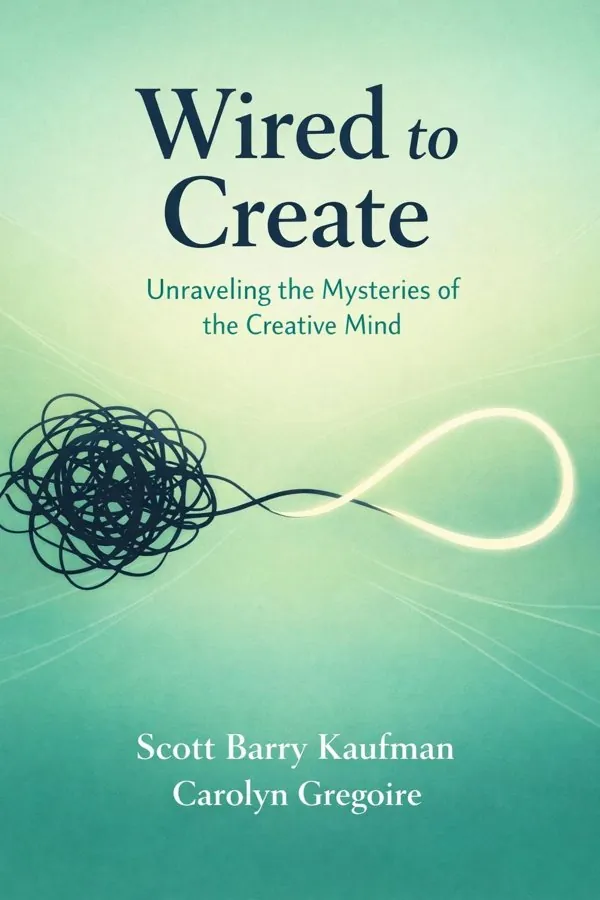
Wired to Create: Unraveling the Mysteries of the Creative Mind: Summary & Key Insights
by Scott Barry Kaufman, Carolyn Gregoire
 10 min9 chaptersAudio available
Key Takeaways from Wired to Create: Unraveling the Mysteries of the Creative Mind
The most damaging myth about creativity is that only a gifted few possess it.
Creative people often seem different not because they know more, but because they experience more.
Many people treat a wandering mind as a failure of discipline, but the book makes a compelling case that daydreaming can be a creative asset.
In a culture that celebrates constant collaboration and visibility, solitude can look unproductive.
What if the traits that make life feel intense also make creativity possible?
What Is Wired to Create: Unraveling the Mysteries of the Creative Mind About?
Wired to Create: Unraveling the Mysteries of the Creative Mind by Scott Barry Kaufman, Carolyn Gregoire is a creativity book. Creativity is often treated like a rare gift reserved for artists, inventors, or eccentric geniuses. In Wired to Create, psychologist Scott Barry Kaufman and journalist Carolyn Gregoire challenge that myth and show that creativity is a deeply human capacity—one that can be understood, developed, and expressed in many forms. Drawing from cutting-edge research in psychology, neuroscience, and the lives of highly creative people, the book explores what actually fuels original thinking. It looks at personality, mind-wandering, sensitivity, solitude, play, openness to experience, and even adversity as essential ingredients in the creative process. What makes this book especially valuable is its blend of scientific rigor and practical insight. Kaufman is a leading cognitive psychologist known for his work on intelligence, imagination, and human potential, while Gregoire brings a journalist’s gift for clear storytelling and relatable examples. Together, they unpack the hidden habits and mental states that support innovation in everyday life. Whether you are an artist, entrepreneur, student, manager, or simply someone who wants to think more deeply and live more imaginatively, Wired to Create offers a powerful, research-based guide to unlocking your creative mind.
This FizzRead summary covers all 9 key chapters of Wired to Create: Unraveling the Mysteries of the Creative Mind in approximately 10 minutes, distilling the most important ideas, arguments, and takeaways from Scott Barry Kaufman, Carolyn Gregoire's work. Also available as an audio summary and Key Quotes Podcast.
Wired to Create: Unraveling the Mysteries of the Creative Mind
Creativity is often treated like a rare gift reserved for artists, inventors, or eccentric geniuses. In Wired to Create, psychologist Scott Barry Kaufman and journalist Carolyn Gregoire challenge that myth and show that creativity is a deeply human capacity—one that can be understood, developed, and expressed in many forms. Drawing from cutting-edge research in psychology, neuroscience, and the lives of highly creative people, the book explores what actually fuels original thinking. It looks at personality, mind-wandering, sensitivity, solitude, play, openness to experience, and even adversity as essential ingredients in the creative process.
What makes this book especially valuable is its blend of scientific rigor and practical insight. Kaufman is a leading cognitive psychologist known for his work on intelligence, imagination, and human potential, while Gregoire brings a journalist’s gift for clear storytelling and relatable examples. Together, they unpack the hidden habits and mental states that support innovation in everyday life. Whether you are an artist, entrepreneur, student, manager, or simply someone who wants to think more deeply and live more imaginatively, Wired to Create offers a powerful, research-based guide to unlocking your creative mind.
Who Should Read Wired to Create: Unraveling the Mysteries of the Creative Mind?
This book is perfect for anyone interested in creativity and looking to gain actionable insights in a short read. Whether you're a student, professional, or lifelong learner, the key ideas from Wired to Create: Unraveling the Mysteries of the Creative Mind by Scott Barry Kaufman, Carolyn Gregoire will help you think differently.
- ✓Readers who enjoy creativity and want practical takeaways
- ✓Professionals looking to apply new ideas to their work and life
- ✓Anyone who wants the core insights of Wired to Create: Unraveling the Mysteries of the Creative Mind in just 10 minutes
Want the full summary?
Get instant access to this book summary and 100K+ more with Fizz Moment.
Get Free SummaryAvailable on App Store • Free to download
Key Chapters
The most damaging myth about creativity is that only a gifted few possess it. Wired to Create argues the opposite: creativity is not a mystical trait handed to a small elite, but a natural human capacity that appears wherever people combine curiosity, imagination, and persistence. This shift matters because when we define creativity too narrowly, we miss the countless ways it shows up in problem-solving, leadership, relationships, parenting, teaching, and personal growth.
Kaufman and Gregoire explain that creativity is not limited to producing famous paintings, bestselling novels, or groundbreaking inventions. It can mean seeing a new angle on an old problem, finding a more meaningful way to work, redesigning a daily routine, or connecting ideas across fields. In this sense, creative expression is less about status and more about engagement with life. Research in psychology supports the idea that many people have untapped creative potential, especially when they are given autonomy, encouragement, and room to explore.
This perspective is liberating. It means you do not need to wait for permission to be creative. A teacher designing a more engaging lesson, a team leader reshaping meetings, or a parent inventing a playful bedtime routine is already participating in the creative act. The real barrier is often not lack of talent, but fear, conformity, and the belief that originality belongs to someone else.
The authors encourage readers to broaden their definition of creativity and treat it as a daily practice rather than a rare performance. Actionable takeaway: identify one area of your ordinary life—work, home, learning, or relationships—and ask, “What would a more original approach look like here?” Then test one small change this week.
Creative people often seem different not because they know more, but because they experience more. One of the book’s central findings is that openness to experience is one of the strongest personality predictors of creativity. Openness includes curiosity, imagination, appreciation of beauty, intellectual exploration, and willingness to entertain the unfamiliar. People high in openness notice more, question more, and connect more, which gives them richer material for original thought.
The authors show that creativity begins long before a finished idea appears. It starts with how people move through the world. Someone who reads outside their field, listens carefully to different perspectives, pays attention to emotion, travels, experiments, or tolerates ambiguity is building a larger inner library. That library becomes the raw material for innovation. By contrast, rigid habits and overly narrow identities can limit what the mind has available to recombine.
Practical examples are everywhere. A product designer may improve her work by studying architecture, psychology, and music. A writer may unlock a story by visiting unfamiliar places and observing details others ignore. A manager may solve a stubborn team issue by borrowing ideas from sports coaching or theater rehearsal. Openness creates cross-pollination.
Importantly, openness is not the same as constant novelty-seeking for its own sake. It is a disciplined receptivity to life. You can cultivate it by reading broadly, talking to people outside your usual circle, keeping a notebook of surprising observations, or spending time with art and nature.
Actionable takeaway: create a weekly “openness ritual.” Spend one hour exploring something unrelated to your profession or routine, and write down three ideas that could transfer back into your own work or life.
Many people treat a wandering mind as a failure of discipline, but the book makes a compelling case that daydreaming can be a creative asset. Creative insight often emerges not when the mind is forcing an answer, but when it is allowed to drift, combine, and simulate possibilities in the background. This is one reason ideas appear in the shower, during a walk, or while staring out a window after giving up on a problem.
Kaufman and Gregoire connect this process to the brain’s default mode network, which becomes active during internally focused thought. This network helps with imagination, autobiographical reflection, mental simulation, and meaning-making. When balanced well, mind-wandering is not laziness. It is a way the brain explores alternatives beyond immediate demands. The creative mind needs both focus and freedom: deliberate effort to gather and shape ideas, and spacious reflection to let hidden connections emerge.
In practical terms, this means nonstop busyness can undermine originality. If every idle moment is filled with notifications, meetings, and reactive tasks, the brain gets less opportunity to incubate. A founder trying to solve a strategic challenge may benefit from taking a solo walk without a phone. A student writing a paper may gain insight by stepping away after doing focused research. An artist stuck on a project may need less pressure and more unstructured time.
The key is intentional use. Mind-wandering becomes useful when it follows preparation and is paired with later evaluation. Let the mind roam, but return to capture what it discovered.
Actionable takeaway: when working on a difficult question, schedule a 20-minute incubation break after focused effort. Walk, rest, or sit quietly without consuming media, then immediately note any associations or fresh ideas that arise.
In a culture that celebrates constant collaboration and visibility, solitude can look unproductive. Wired to Create argues that this is a serious misunderstanding. While collaboration has value, solitude is often where original thought is born. Creative work requires periods of withdrawal from noise, expectation, and social performance so that a person can hear subtler ideas and develop a stronger inner voice.
The authors distinguish loneliness from solitude. Loneliness is disconnection that hurts; solitude is chosen space that restores. Many creative people need time alone not because they dislike others, but because privacy supports concentration, reflection, and experimentation without immediate judgment. Solitude helps people notice their own thoughts instead of reacting to everyone else’s. It also allows for emotional processing, which can enrich the depth and authenticity of creative expression.
This has practical implications in modern work and education. Open offices, constant messaging, and packed calendars may increase contact but reduce deep thinking. A software developer may need uninterrupted blocks to solve a design problem. A writer may discover her best ideas before the world wakes up. A student may understand a subject more deeply by studying quietly before discussing it in a group. Even leaders make better decisions when they have time to reflect rather than respond instantly.
Choosing solitude is not antisocial; it is often a condition for meaningful contribution. The challenge is to protect it deliberately in environments that constantly compete for attention.
Actionable takeaway: carve out at least two distraction-free solitude sessions each week, even if only 30 to 60 minutes. Use them for thinking, writing, sketching, or reflecting without devices, and treat that time as essential creative work rather than optional downtime.
What if the traits that make life feel intense also make creativity possible? The book explores how heightened sensitivity—emotional depth, receptivity to beauty, strong reactions, and awareness of nuance—can become an important source of creative power. Many creative individuals experience the world vividly. They notice patterns others miss, feel contradictions more strongly, and are affected by atmosphere, language, and human complexity in ways that generate insight.
This sensitivity can be difficult. It may bring overthinking, vulnerability to criticism, or emotional turbulence. But Kaufman and Gregoire show that the same openness that increases sensitivity also expands the capacity for imagination and originality. Creative work often begins with being deeply moved, disturbed, or fascinated by something others pass by. The person who feels more may also perceive more.
The practical lesson is not to romanticize suffering, but to reinterpret sensitivity as information rather than weakness. A designer who feels overwhelmed by clutter may create more elegant systems. A poet who is deeply affected by memory may transform private emotion into language that resonates with others. A founder who is highly attuned to frustration may spot unmet user needs before competitors do.
To use sensitivity well, people need boundaries and self-understanding. Rest, emotional regulation, supportive relationships, and healthy routines can help sensitive individuals protect their energy while preserving their perceptiveness. Instead of numbing the trait, the goal is to channel it.
Actionable takeaway: notice one recurring emotional or sensory response you usually dismiss as “too much.” Ask what it is revealing about your values, perceptions, or unmet needs, and use that insight as the starting point for a creative project or practical improvement.
Creativity does not require pain, but many creative lives are shaped by struggle. The authors carefully explore the relationship between adversity and originality without turning hardship into a romantic ideal. Difficult experiences can disrupt assumptions, deepen self-knowledge, and push people to search for meaning. In some cases, creative expression becomes a way to process suffering, reclaim agency, and transform chaos into form.
The key idea is not that trauma automatically produces art or innovation. In fact, severe distress can just as easily impair functioning. What matters is how people integrate challenge. When individuals find ways to reflect on hardship, build resilience, and create meaning from it, adversity can expand perspective. It can make them more psychologically complex, more compassionate, and more willing to question conventional answers. Those qualities often support creativity.
Examples range from artists who turn grief into moving work to entrepreneurs who build companies inspired by personal frustration or exclusion. A person who struggled with learning differences may design better educational tools. Someone who experienced instability may develop unusual adaptability and problem-solving skills. The creative act can become a bridge between wound and wisdom.
The authors’ approach is humane: protect mental health first, and do not glorify suffering. Creativity is not a punishment for pain; it is one possible response to it. Reflection, therapy, journaling, conversation, and artistic practice can help convert raw experience into insight.
Actionable takeaway: think of one difficult experience that changed how you see the world. Write down what it taught you that comfort never could, and consider how that lesson could inform a project, service, story, or decision you make next.
Creativity flourishes when people care deeply and experiment freely. Wired to Create emphasizes that original work often grows from a combination of intrinsic motivation and play. Intrinsic motivation means doing something because it is meaningful, absorbing, or enjoyable—not merely for rewards or approval. Play adds curiosity, flexibility, and low-stakes exploration. Together, they create the conditions in which novel ideas can emerge and evolve.
This matters because many people try to force creativity through pressure alone. Deadlines and external incentives can help execution, but they rarely generate the deepest originality by themselves. Creative people tend to explore because they are genuinely interested. They follow odd questions, tinker with possibilities, and remain willing to look foolish while trying something new. That spirit of play lowers fear and increases experimentation.
In practice, this can look very different across fields. A scientist may play with unconventional hypotheses. A marketer may brainstorm absurd campaign ideas before refining them. A child learns through imaginative play, but adults also need spaces where not every effort must be efficient, polished, or profitable. Even serious breakthroughs often begin as playful exploration at the margins.
Passion, however, is not simply intense emotion. It also requires persistence. Sustainable creativity comes from returning to a subject long enough to build skill, tolerate frustration, and improve rough ideas. Play opens the door; commitment carries the work through.
Actionable takeaway: choose one meaningful project and reintroduce play into it. Set aside 30 minutes to explore without judging outcomes—generate wild options, sketch variations, test odd combinations—and only afterward decide which ideas deserve serious development.
One striking theme in the book is that creative people often contain opposites. They can be disciplined yet dreamy, introverted yet expressive, rebellious yet hardworking, playful yet serious. Rather than fitting neatly into one personality box, they move flexibly between different modes depending on what the work requires. This psychological complexity helps them generate and refine ideas that simpler habits might never produce.
Kaufman and Gregoire show that creativity is not just about freedom or just about control. It needs both. Divergent thinking allows a person to generate possibilities, while convergent thinking helps evaluate and shape them. Emotional sensitivity can inspire powerful ideas, while resilience helps survive rejection. Solitude may nurture insight, while collaboration can sharpen execution. The most creative people often learn to balance these tensions instead of choosing one side permanently.
This idea is useful because many of us limit ourselves with fixed self-descriptions: “I’m not disciplined,” “I’m not imaginative,” “I’m not a people person,” or “I’m too practical for creativity.” The creative process may require you to become more than one thing. A founder may need visionary imagination when setting direction and ruthless realism when budgeting. A novelist may need vulnerability while drafting and detachment while editing. Flexibility becomes a competitive advantage.
The goal is not to become inconsistent, but adaptive. When you can shift mental gears, you gain access to more of your own capacity.
Actionable takeaway: identify a creative challenge you face and ask which opposite quality it now requires. If you have been too loose, add structure. If you have been too rigid, add experimentation. Practice the mode you usually avoid.
Talent alone rarely determines whether creativity blooms. The environments people inhabit—families, schools, workplaces, cultures—can either suppress originality or make it safer and more likely. Wired to Create highlights how social context shapes creative expression by influencing risk-taking, autonomy, attention, and confidence. Even highly imaginative people may hide their ideas if they expect ridicule, constant interruption, or punishment for failure.
The authors challenge systems that reward compliance over curiosity. Standardized education, rigid corporate cultures, and hyper-efficient schedules often leave little room for experimentation. Yet creativity depends on conditions that look inefficient in the short term: reflection, exploration, tolerance for mistakes, and space for unusual ideas. A classroom that values questions over rote answers can awaken student originality. A company that allows employees time to pursue side ideas may discover innovations no meeting would have produced.
Supportive environments also provide emotional safety. People create more boldly when they know unfinished thoughts will not be mocked. This does not mean lowering standards. It means separating idea generation from harsh judgment, and criticism from contempt. Leaders, teachers, and parents play a powerful role here by rewarding initiative, modeling curiosity, and treating failure as information.
Even if you cannot control your whole environment, you can shape pockets of possibility. You can redesign your workspace, protect focused time, choose more encouraging collaborators, and create rituals that cue creative thinking.
Actionable takeaway: audit your environment for one week. Note what consistently energizes or shuts down your originality—people, spaces, habits, tools, timing—and make one concrete change that increases autonomy, safety, or uninterrupted exploration.
All Chapters in Wired to Create: Unraveling the Mysteries of the Creative Mind
About the Authors
Scott Barry Kaufman is a cognitive psychologist, author, and researcher widely known for his work on creativity, intelligence, imagination, and human potential. His writing often bridges rigorous scientific research with practical insights for a general audience. Carolyn Gregoire is a journalist and author who has written extensively about psychology, mental health, creativity, and well-being. She is known for translating complex ideas into engaging, accessible narratives. Together, Kaufman and Gregoire combine academic depth and strong storytelling in Wired to Create. Their collaboration brings both scientific authority and human warmth to the subject, making the book especially compelling for readers who want evidence-based insight into how the creative mind works.
Get This Summary in Your Preferred Format
Read or listen to the Wired to Create: Unraveling the Mysteries of the Creative Mind summary by Scott Barry Kaufman, Carolyn Gregoire anytime, anywhere. FizzRead offers multiple formats so you can learn on your terms — all free.
Available formats: App · Audio · PDF · EPUB — All included free with FizzRead
Download Wired to Create: Unraveling the Mysteries of the Creative Mind PDF and EPUB Summary
Key Quotes from Wired to Create: Unraveling the Mysteries of the Creative Mind
“The most damaging myth about creativity is that only a gifted few possess it.”
“Creative people often seem different not because they know more, but because they experience more.”
“Many people treat a wandering mind as a failure of discipline, but the book makes a compelling case that daydreaming can be a creative asset.”
“In a culture that celebrates constant collaboration and visibility, solitude can look unproductive.”
“What if the traits that make life feel intense also make creativity possible?”
Frequently Asked Questions about Wired to Create: Unraveling the Mysteries of the Creative Mind
Wired to Create: Unraveling the Mysteries of the Creative Mind by Scott Barry Kaufman, Carolyn Gregoire is a creativity book that explores key ideas across 9 chapters. Creativity is often treated like a rare gift reserved for artists, inventors, or eccentric geniuses. In Wired to Create, psychologist Scott Barry Kaufman and journalist Carolyn Gregoire challenge that myth and show that creativity is a deeply human capacity—one that can be understood, developed, and expressed in many forms. Drawing from cutting-edge research in psychology, neuroscience, and the lives of highly creative people, the book explores what actually fuels original thinking. It looks at personality, mind-wandering, sensitivity, solitude, play, openness to experience, and even adversity as essential ingredients in the creative process. What makes this book especially valuable is its blend of scientific rigor and practical insight. Kaufman is a leading cognitive psychologist known for his work on intelligence, imagination, and human potential, while Gregoire brings a journalist’s gift for clear storytelling and relatable examples. Together, they unpack the hidden habits and mental states that support innovation in everyday life. Whether you are an artist, entrepreneur, student, manager, or simply someone who wants to think more deeply and live more imaginatively, Wired to Create offers a powerful, research-based guide to unlocking your creative mind.
You Might Also Like
Dimensions Of Creativity
Margaret A. Boden
10 min
How to Fly a Horse: The Secret History of Creation, Invention, and Discovery
Kevin Ashton
10 min
Imagine: How Creativity Works
Jonah Lehrer
10 min
The Accidental Creative: How to Be Brilliant at a Moment's Notice
Todd Henry
10 min
The Origins of Creativity
Edward O. Wilson
10 min
A More Beautiful Question: The Power of Inquiry to Spark Breakthrough Ideas
Warren Berger
10 minBrowse by Category
Ready to read Wired to Create: Unraveling the Mysteries of the Creative Mind?
Get the full summary and 100K+ more books with Fizz Moment.