
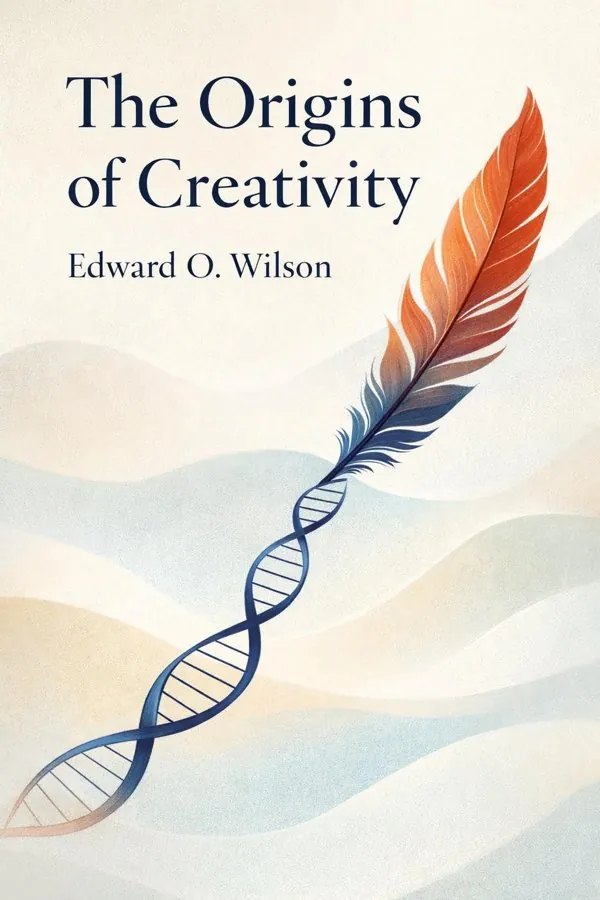
The Origins of Creativity: Summary & Key Insights
 10 min9 chaptersAudio available
Key Takeaways from The Origins of Creativity
A striking idea sits at the heart of Wilson’s argument: creativity did not appear as a decorative extra in human life, but as a functional adaptation shaped by evolution.
One of Wilson’s most compelling insights is that humans are not just toolmakers or rational thinkers; we are storytellers who build reality together.
Wilson has long championed the idea of “consilience,” the unity of knowledge, and The Origins of Creativity extends that vision into the question of art.
A powerful turning point in human history came when our ancestors developed the capacity for symbolic thought.
Perhaps the most extraordinary feature of human creativity is the ability to leave the present moment mentally and enter hypothetical worlds.
What Is The Origins of Creativity About?
The Origins of Creativity by Edward O. Wilson is a creativity book. What makes human beings uniquely creative, and why did art, storytelling, music, and symbolic thought emerge at all? In The Origins of Creativity, celebrated biologist Edward O. Wilson tackles these questions by drawing together evolutionary biology, anthropology, neuroscience, and the humanities. Rather than treating creativity as a mysterious gift detached from nature, Wilson argues that it is a product of human evolution: a survival-enhancing capacity rooted in social life, imagination, and the ability to build meaning together. The book matters because it bridges a divide that often separates science from art. Wilson shows that to understand creativity fully, we must see it not only as cultural expression but also as a biological achievement shaped over millennia. Few thinkers are better suited to make this case. A pioneering naturalist, two-time Pulitzer Prize winner, and one of the world’s most influential evolutionary thinkers, Wilson brings scientific rigor and philosophical breadth to the subject. The result is an intellectually rich exploration of why humans create, why culture matters, and how our species became capable of turning experience into beauty, narrative, and shared identity.
This FizzRead summary covers all 9 key chapters of The Origins of Creativity in approximately 10 minutes, distilling the most important ideas, arguments, and takeaways from Edward O. Wilson's work. Also available as an audio summary and Key Quotes Podcast.
The Origins of Creativity
What makes human beings uniquely creative, and why did art, storytelling, music, and symbolic thought emerge at all? In The Origins of Creativity, celebrated biologist Edward O. Wilson tackles these questions by drawing together evolutionary biology, anthropology, neuroscience, and the humanities. Rather than treating creativity as a mysterious gift detached from nature, Wilson argues that it is a product of human evolution: a survival-enhancing capacity rooted in social life, imagination, and the ability to build meaning together. The book matters because it bridges a divide that often separates science from art. Wilson shows that to understand creativity fully, we must see it not only as cultural expression but also as a biological achievement shaped over millennia. Few thinkers are better suited to make this case. A pioneering naturalist, two-time Pulitzer Prize winner, and one of the world’s most influential evolutionary thinkers, Wilson brings scientific rigor and philosophical breadth to the subject. The result is an intellectually rich exploration of why humans create, why culture matters, and how our species became capable of turning experience into beauty, narrative, and shared identity.
Who Should Read The Origins of Creativity?
This book is perfect for anyone interested in creativity and looking to gain actionable insights in a short read. Whether you're a student, professional, or lifelong learner, the key ideas from The Origins of Creativity by Edward O. Wilson will help you think differently.
- ✓Readers who enjoy creativity and want practical takeaways
- ✓Professionals looking to apply new ideas to their work and life
- ✓Anyone who wants the core insights of The Origins of Creativity in just 10 minutes
Want the full summary?
Get instant access to this book summary and 100K+ more with Fizz Moment.
Get Free SummaryAvailable on App Store • Free to download
Key Chapters
A striking idea sits at the heart of Wilson’s argument: creativity did not appear as a decorative extra in human life, but as a functional adaptation shaped by evolution. Human beings did not simply survive by being stronger or faster than other species. We survived by imagining possibilities, sharing stories, reading social cues, and inventing tools, symbols, and rituals that allowed groups to cooperate more effectively. In that sense, creativity is woven into the same evolutionary fabric as language, problem-solving, and social bonding.
Wilson invites readers to look at artistic expression not as something opposed to biology, but as an extension of it. Early humans who could picture alternative outcomes, dramatize danger, preserve memory through symbol, or inspire group cohesion through rhythm and ritual gained advantages. A painted cave wall, a myth retold around a fire, or a ceremonial dance may have strengthened identity and transmitted knowledge. These acts of creation helped communities remember what mattered and imagine what was possible.
This perspective changes how we think about modern creativity. Writing a poem, designing a product, developing a scientific model, or composing music all rely on the same evolved capacities: pattern recognition, emotional communication, and imaginative simulation. Creativity is not just for artists. It is a species-wide inheritance expressed differently across domains.
In practical terms, this means creativity grows when people are placed in environments that reward curiosity, experimentation, and collaboration. Schools, families, and organizations often suppress these evolutionary strengths by overvaluing conformity. Wilson’s view suggests the opposite approach: treat imaginative thought as natural, necessary, and deeply human.
Actionable takeaway: Build one daily habit that strengthens imaginative variation, such as sketching ideas, asking “what if?” questions, or exploring problems from multiple angles.
One of Wilson’s most compelling insights is that humans are not just toolmakers or rational thinkers; we are storytellers who build reality together. Storytelling is more than entertainment. It helps groups preserve values, transmit knowledge, coordinate behavior, and make sense of uncertainty. A tribe, nation, family, or institution can function only when its members share narratives about who they are, what matters, and how they should act.
Wilson frames this as part of our evolutionary success. Groups that could organize around compelling shared meanings likely had advantages over those that could not. Stories made memory portable. They carried warnings, identities, aspirations, and lessons across generations. Before formal science, law, or literature, stories helped human communities hold themselves together. Creativity, in this sense, became a social technology.
This idea remains powerfully relevant. Businesses use mission stories to align teams. Political movements rely on narratives of justice, decline, or hope. Families shape children through repeated stories about resilience, sacrifice, and belonging. Even individual identity depends on self-narration: people interpret their lives through stories that explain setbacks, purpose, and change.
Wilson’s point is not that all stories are equally true or beneficial. Shared narratives can unite, but they can also distort, exclude, or manipulate. That is why creativity must be paired with critical reflection. We need stories that enlarge understanding, not merely flatter our tribe.
If you want to apply this idea, look at the narratives guiding your work and relationships. What story does your team tell about success? What story do you tell yourself about failure? Revising a narrative can change behavior more effectively than issuing abstract rules.
Actionable takeaway: Write down one story shaping your life or organization, then ask whether it encourages growth, cooperation, and truth—or whether it needs to be rewritten.
Wilson has long championed the idea of “consilience,” the unity of knowledge, and The Origins of Creativity extends that vision into the question of art. He argues that the arts and sciences are not rival ways of knowing but complementary ones. Science explains mechanisms, patterns, and causes. Art explores meaning, emotion, experience, and subjective interpretation. Creativity flourishes most deeply when these domains enrich one another rather than remain isolated.
This is an important corrective to a common cultural split. Many people are taught to think in categories: analytical versus intuitive, scientific versus artistic, data-driven versus expressive. Wilson rejects that divide as historically narrow and intellectually limiting. The same species that studies ecosystems also writes symphonies; the same mind that seeks causal explanation also seeks beauty and moral significance. These are not contradictions. They are parallel expressions of human cognitive complexity.
Examples are everywhere. Architecture requires engineering and aesthetic imagination. Medicine benefits from biology, but also from empathy and narrative understanding. Environmental conservation succeeds not only through scientific evidence but through compelling imagery, storytelling, and public moral vision. Even technological innovation often begins with artistic forms of envisioning what does not yet exist.
For readers, this idea has practical force. It suggests that creative growth often happens at boundaries. A scientist can become more insightful by reading literature. A designer can improve by learning ecology. A writer can deepen by studying psychology or evolution. Cross-disciplinary curiosity expands the range of analogies and patterns available to the mind.
Wilson’s larger message is hopeful: human understanding becomes richer when we refuse to fragment it. Creativity is strengthened when precision and imagination work together.
Actionable takeaway: Pair your primary field with one unfamiliar discipline this month, and deliberately look for ideas, methods, or metaphors you can transfer between them.
A powerful turning point in human history came when our ancestors developed the capacity for symbolic thought. Wilson treats this ability as one of the key foundations of creativity. Symbols allow a thing to stand for something beyond itself: a mark can represent an animal, a sound can represent an object, a gesture can represent allegiance, and a myth can represent an entire worldview. Once humans could think symbolically, culture could accumulate, become more complex, and travel across generations.
This matters because symbolic thought transformed survival into civilization. Instead of reacting only to immediate stimuli, humans could encode meaning, imagine invisible forces, create rituals, establish social roles, and preserve memory in durable forms. Language, visual art, religion, law, and mathematics all depend on symbol systems. Creativity expanded not just because people had ideas, but because they could externalize and share those ideas in increasingly sophisticated ways.
Wilson’s evolutionary framing helps explain why symbols feel so potent even now. Logos shape consumer behavior. Flags evoke loyalty. Religious icons inspire devotion. Metaphors organize abstract thinking. Songs become vessels of identity. The human mind is built to respond to symbols because they condense emotion, memory, and shared significance.
In everyday life, symbolic thinking is a practical tool. Leaders who understand symbols communicate more effectively. Teachers who use images and analogies make concepts memorable. Creators who design meaningful symbols can move audiences beyond literal explanation. At the same time, Wilson’s perspective encourages caution: symbols can enlighten, but they can also manipulate if detached from truth.
To use this idea well, focus on clarity and resonance. Ask what symbols dominate your environment and whether they align with the values you want to live by.
Actionable takeaway: Choose one important message you want to communicate and express it through a clear symbol, image, or metaphor that others can instantly grasp and remember.
Perhaps the most extraordinary feature of human creativity is the ability to leave the present moment mentally and enter hypothetical worlds. Wilson sees imagination as a critical evolutionary advantage because it allows people to simulate outcomes before acting. We can rehearse danger, invent tools, picture futures, and empathize with experiences we have never directly lived. This capacity makes both planning and art possible.
In evolutionary terms, imagination improved survival by reducing costly trial and error. A hunter could envision the movement of prey. A group could imagine what might happen if another tribe approached. A craftsperson could mentally test a new tool design. Over time, that same mental flexibility supported myth, theater, fiction, scientific theory, and moral reflection. Human beings became creatures capable of living partly in possibility.
Wilson’s idea helps explain why imagination is central in so many modern settings. Entrepreneurs imagine products before they exist. Scientists form hypotheses about unseen mechanisms. Therapists help patients imagine new identities beyond trauma. Readers expand empathy by entering fictional minds. Children learn through pretend play, which trains social understanding and flexible thinking.
The challenge is that many institutions reward certainty over exploration. Imagination can seem inefficient, vague, or impractical. Wilson’s evolutionary perspective pushes back against that assumption. The ability to consider unrealized possibilities is one of the most practical abilities humans possess.
To cultivate imagination, people need both input and freedom: exposure to diverse ideas, and time to let the mind combine them. Constant distraction weakens this process. Reflection strengthens it. So does playful experimentation without immediate judgment.
Actionable takeaway: Set aside fifteen minutes each day to imagine alternative outcomes for a problem, deliberately generating options before deciding which one seems most realistic.
Wilson’s work is often at its best when it balances two truths at once: human beings are biological organisms shaped by evolution, and human culture is astonishingly flexible. In The Origins of Creativity, he does not argue that genes rigidly determine art, literature, or moral systems. Instead, he shows that biology creates predispositions, capacities, and constraints within which culture unfolds. Creativity emerges from this dynamic interaction.
This distinction is crucial. If biology were destiny, culture would be little more than programmed behavior. If biology were irrelevant, human universals would be difficult to explain. Wilson avoids both extremes. He suggests that the mind comes equipped with tendencies toward sociality, pattern recognition, emotional response, symbolism, and narrative formation. Different cultures then elaborate these tendencies in unique ways, producing diverse artistic traditions, beliefs, and institutions.
Consider music. Humans across cultures respond to rhythm and vocal expression, but musical forms vary enormously. Or think of storytelling: nearly every society uses narrative, but the specific myths, genres, and values differ. The same underlying capacities generate a vast range of cultural inventions. This is exactly why creativity is so important: it is how biology becomes history.
Practically speaking, this perspective encourages humility and openness. It reminds us that some features of human life are deeply rooted, so attempts to design systems that ignore emotion, ritual, status, or belonging often fail. But it also affirms that change is possible because culture is not fixed. Education, institutions, and artistic movements can redirect inherited tendencies toward better outcomes.
For creators, this means effective work often resonates because it speaks to universal human predispositions while expressing them in fresh cultural forms.
Actionable takeaway: When developing an idea, ask two questions: what basic human need or tendency does this tap into, and how can I express it in a distinctive, culturally meaningful way?
Wilson repeatedly returns to the importance of social groups in human evolution. Creativity, in his account, is not merely an individual spark appearing in isolation. It develops within small communities where cooperation, competition, imitation, teaching, and shared rituals shape the mind. Human beings evolved in groups small enough for close social monitoring yet rich enough in interaction to reward innovation and symbolic expression.
This matters because modern culture often romanticizes the lone genius. Wilson does not deny individual brilliance, but he places it inside a collective context. A creator needs language, tools, inherited forms, audiences, mentors, rivals, and collaborators. Even the most original work builds on social scaffolding. Early human groups likely rewarded individuals who could contribute memorable songs, persuasive stories, useful designs, or emotionally binding ceremonies. Creative ability benefited the group, and the group in turn nurtured the creator.
This framework applies strongly today. Research labs, writers’ rooms, design studios, classrooms, and startup teams often produce better ideas than isolated individuals because social exchange multiplies perspective. Constructive conflict can sharpen insight. Shared standards improve quality. Communities also preserve traditions that creators can either extend or challenge.
At the same time, group life has risks. Conformity pressure can punish originality. Tribal loyalty can narrow imagination. Wilson’s evolutionary lens helps explain both dynamics: humans are built for belonging, but creativity sometimes requires tension with the group. Healthy cultures therefore create spaces where experimentation is permitted without severing connection.
If you want more creativity, pay attention not only to personal habits but to social design. Who are you thinking with? What norms shape your work? Are dissent and novelty welcomed?
Actionable takeaway: Create or join a small recurring group where ideas can be tested, challenged, and improved in an atmosphere of trust and intellectual honesty.
Why do certain forms, sounds, and images feel beautiful? Wilson approaches beauty not as a purely mystical category, but as something connected to evolved human preferences and interpretive capacities. We are drawn to pattern, contrast, symmetry, rhythm, and emotionally resonant complexity. Yet beauty is never just mechanical. It matters because the human mind attaches meaning to form. Creativity becomes powerful when structure and significance reinforce each other.
From an evolutionary standpoint, sensitivity to pattern had practical value. Detecting regularities in faces, landscapes, animal movement, and environmental change improved survival. Over time, these perceptual biases could be recruited into art, music, and design. A rhythm that once coordinated movement becomes music. A sensitivity to visual balance becomes painting or architecture. An attentiveness to natural form becomes aesthetic pleasure.
But Wilson does not reduce art to biology alone. Cultural context shapes what counts as beautiful, refined, or moving. A landscape painting, a sacred chant, and a minimalist building may all appeal for different reasons, even while drawing on common psychological tendencies. Beauty therefore sits at the meeting point of nature and culture.
This has useful implications for creators and audiences. Good design often works because it aligns with human perception while carrying emotional or conceptual weight. A clear interface, an elegant sentence, a memorable melody, or a well-composed room feels satisfying not merely because it is efficient, but because it engages deep cognitive preferences.
To apply this idea, notice where pattern and meaning meet in your own work. Ask not only, “Does this function?” but also, “Does this invite attention, memory, and feeling?” Beauty is often a form of successful communication.
Actionable takeaway: Improve one piece of work by simplifying its structure, strengthening its patterns, and making sure every aesthetic choice supports the meaning you want others to experience.
Wilson’s exploration of creativity is not only about prehistoric origins; it also raises urgent questions about the future of our species. If creativity is one of humanity’s defining evolutionary strengths, then modern societies should protect and cultivate it rather than weaken it through distraction, fragmentation, and narrow specialization. Understanding where creativity comes from helps us see what conditions allow it to flourish.
Wilson’s broader worldview suggests that creativity is indispensable for addressing large-scale problems. Climate change, biodiversity loss, technological disruption, political polarization, and ethical dilemmas cannot be solved by technical knowledge alone. They require imagination, narrative, moral vision, and the ability to connect disciplines. In other words, the same capacities that once helped small groups survive now must operate at planetary scale.
This gives the book contemporary urgency. Education systems focused only on testing miss a central human power. Institutions that separate science from the humanities handicap themselves. Cultures that consume endless novelty without deep reflection may lose the patience creativity requires. Wilson implicitly argues for a richer civilization, one that values curiosity, synthesis, and symbolic expression as essential civic resources.
For individuals, this means creativity should not be postponed until life feels convenient. It is part of how humans adapt, contribute, and understand the world. Whether through art, research, teaching, entrepreneurship, or community-building, creative effort is a way of participating in human evolution’s unfinished story.
Wilson leaves readers with a sense of responsibility: our species became extraordinary not simply by competing, but by imagining. The question now is whether we will use that imaginative inheritance wisely.
Actionable takeaway: Treat creativity as a serious life practice by dedicating regular time each week to making, exploring, or synthesizing ideas that could serve both personal growth and collective good.
All Chapters in The Origins of Creativity
About the Author
Edward O. Wilson was an American biologist, naturalist, and writer widely regarded as one of the most important scientific thinkers of the twentieth and early twenty-first centuries. Born in 1929, he became a Harvard University professor and gained international recognition for his groundbreaking research on ants, biodiversity, and sociobiology. Wilson helped shape modern thinking about evolution, human nature, and conservation, while also advocating for the preservation of Earth’s ecosystems. He was a gifted public intellectual whose books reached far beyond academic audiences, earning two Pulitzer Prizes and a reputation for elegant, ambitious prose. Throughout his career, Wilson sought to unite scientific and humanistic knowledge, a theme that strongly informs The Origins of Creativity.
Get This Summary in Your Preferred Format
Read or listen to the The Origins of Creativity summary by Edward O. Wilson anytime, anywhere. FizzRead offers multiple formats so you can learn on your terms — all free.
Available formats: App · Audio · PDF · EPUB — All included free with FizzRead
Download The Origins of Creativity PDF and EPUB Summary
Key Quotes from The Origins of Creativity
“A striking idea sits at the heart of Wilson’s argument: creativity did not appear as a decorative extra in human life, but as a functional adaptation shaped by evolution.”
“One of Wilson’s most compelling insights is that humans are not just toolmakers or rational thinkers; we are storytellers who build reality together.”
“Wilson has long championed the idea of “consilience,” the unity of knowledge, and The Origins of Creativity extends that vision into the question of art.”
“A powerful turning point in human history came when our ancestors developed the capacity for symbolic thought.”
“Perhaps the most extraordinary feature of human creativity is the ability to leave the present moment mentally and enter hypothetical worlds.”
Frequently Asked Questions about The Origins of Creativity
The Origins of Creativity by Edward O. Wilson is a creativity book that explores key ideas across 9 chapters. What makes human beings uniquely creative, and why did art, storytelling, music, and symbolic thought emerge at all? In The Origins of Creativity, celebrated biologist Edward O. Wilson tackles these questions by drawing together evolutionary biology, anthropology, neuroscience, and the humanities. Rather than treating creativity as a mysterious gift detached from nature, Wilson argues that it is a product of human evolution: a survival-enhancing capacity rooted in social life, imagination, and the ability to build meaning together. The book matters because it bridges a divide that often separates science from art. Wilson shows that to understand creativity fully, we must see it not only as cultural expression but also as a biological achievement shaped over millennia. Few thinkers are better suited to make this case. A pioneering naturalist, two-time Pulitzer Prize winner, and one of the world’s most influential evolutionary thinkers, Wilson brings scientific rigor and philosophical breadth to the subject. The result is an intellectually rich exploration of why humans create, why culture matters, and how our species became capable of turning experience into beauty, narrative, and shared identity.
More by Edward O. Wilson
You Might Also Like
Dimensions Of Creativity
Margaret A. Boden
10 min
How to Fly a Horse: The Secret History of Creation, Invention, and Discovery
Kevin Ashton
10 min
Imagine: How Creativity Works
Jonah Lehrer
10 min
The Accidental Creative: How to Be Brilliant at a Moment's Notice
Todd Henry
10 min
Wired to Create: Unraveling the Mysteries of the Creative Mind
Scott Barry Kaufman, Carolyn Gregoire
10 min
A More Beautiful Question: The Power of Inquiry to Spark Breakthrough Ideas
Warren Berger
10 minBrowse by Category
Ready to read The Origins of Creativity?
Get the full summary and 100K+ more books with Fizz Moment.