
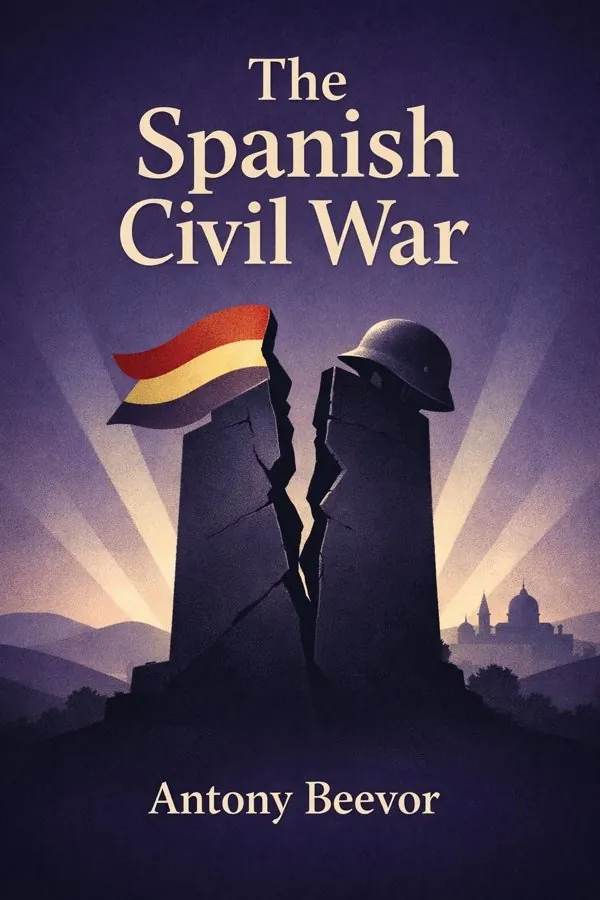
The Spanish Civil War: Summary & Key Insights
 10 min8 chapters
Key Takeaways from The Spanish Civil War
Civil wars rarely begin on the battlefield; they begin when a society stops believing it can live with itself.
History often turns on plans that do not go as expected.
Some wars matter not only for who fights them, but for what outsiders imagine they represent.
A side can lose a war even when its cause attracts sympathy, if it cannot convert passion into unity.
Heroism matters, but wars are usually decided by organization, supply, and command.
What Is The Spanish Civil War About?
The Spanish Civil War by Antony Beevor is a war_military book spanning 7 pages. Antony Beevor’s The Spanish Civil War is a gripping history of one of the twentieth century’s most consequential conflicts: the brutal struggle that tore Spain apart from 1936 to 1939 and foreshadowed the larger catastrophe of World War II. More than a military narrative, the book explains how deep social inequality, political extremism, religious conflict, and regional tensions pushed Spain into a war that became a testing ground for fascism, communism, and modern propaganda. Beevor shows that the conflict was not simply a clash between two neat sides, but a messy, tragic confrontation shaped by ideology, fear, revenge, and foreign intervention. His account moves from high politics and military campaigns to village-level terror and the daily suffering of civilians, making the war feel both historically vast and painfully intimate. Beevor’s authority comes from his reputation as one of Britain’s foremost military historians and his talent for turning complex archives into clear, compelling narrative. This book matters because it explains how democracies collapse, how polarization turns lethal, and how civil wars leave wounds that endure long after the shooting stops.
This FizzRead summary covers all 8 key chapters of The Spanish Civil War in approximately 10 minutes, distilling the most important ideas, arguments, and takeaways from Antony Beevor's work.
The Spanish Civil War
Antony Beevor’s The Spanish Civil War is a gripping history of one of the twentieth century’s most consequential conflicts: the brutal struggle that tore Spain apart from 1936 to 1939 and foreshadowed the larger catastrophe of World War II. More than a military narrative, the book explains how deep social inequality, political extremism, religious conflict, and regional tensions pushed Spain into a war that became a testing ground for fascism, communism, and modern propaganda. Beevor shows that the conflict was not simply a clash between two neat sides, but a messy, tragic confrontation shaped by ideology, fear, revenge, and foreign intervention. His account moves from high politics and military campaigns to village-level terror and the daily suffering of civilians, making the war feel both historically vast and painfully intimate. Beevor’s authority comes from his reputation as one of Britain’s foremost military historians and his talent for turning complex archives into clear, compelling narrative. This book matters because it explains how democracies collapse, how polarization turns lethal, and how civil wars leave wounds that endure long after the shooting stops.
Who Should Read The Spanish Civil War?
This book is perfect for anyone interested in war_military and looking to gain actionable insights in a short read. Whether you're a student, professional, or lifelong learner, the key ideas from The Spanish Civil War by Antony Beevor will help you think differently.
- ✓Readers who enjoy war_military and want practical takeaways
- ✓Professionals looking to apply new ideas to their work and life
- ✓Anyone who wants the core insights of The Spanish Civil War in just 10 minutes
Want the full summary?
Get instant access to this book summary and 100K+ more with Fizz Moment.
Get Free SummaryAvailable on App Store • Free to download
Key Chapters
Civil wars rarely begin on the battlefield; they begin when a society stops believing it can live with itself. Beevor shows that Spain in the early 1930s had become dangerously polarized long before the first shots of 1936. The fall of the monarchy and the birth of the Second Republic raised enormous hopes among workers, peasants, reformers, secular liberals, and regional nationalists. At the same time, landowners, conservative Catholics, monarchists, and much of the officer corps saw the new order as an assault on tradition, religion, property, and national unity. Reforms involving land redistribution, church influence, military restructuring, and education were intended to modernize Spain, but they also intensified fear and resentment. Each side increasingly viewed compromise as surrender.
Beevor’s key insight is that political conflict became existential. The left did not merely want policy change; many wanted social revolution. The right did not merely oppose reforms; many came to believe that only force could save Spain. Street violence, strikes, assassinations, anticlerical attacks, and retaliatory repression deepened mistrust. Moderate space shrank as extremist rhetoric grew louder.
This pattern has broad relevance. In any democracy, when institutions weaken and political opponents are treated as enemies rather than rivals, constitutional politics can collapse. Spain’s tragedy illustrates how reforms without consensus, inequality without remedy, and fear without restraint can produce catastrophe.
A practical way to use this idea is to look beyond dramatic events and ask what long-building fractures made them possible. Whenever politics becomes moralized into absolute camps, warning lights should flash. Actionable takeaway: pay attention to social polarization early, because by the time violence erupts, the habits of coexistence may already be broken.
History often turns on plans that do not go as expected. In July 1936, a group of generals including Francisco Franco and Emilio Mola launched a military uprising against the elected Republican government. Their intention was not to start a long war but to carry out a swift seizure of power. Instead, the coup only partially succeeded. Some cities and regions fell to the rebels, while others remained loyal to the Republic. That split transformed a conspiracy into a full-scale civil war.
Beevor explains how the first days were decisive because they revealed the importance of organization, local loyalty, and speed. In places where officers, police, workers’ militias, and political authorities moved decisively, control could be secured. In others, hesitation proved fatal. The army itself fractured, and ordinary citizens suddenly found that political identity could determine life or death. What might have been a short military takeover became a grinding conflict because neither side could dominate the entire country at once.
The outbreak also exposed one of the book’s central themes: events are shaped not only by ideology but by logistics, communications, and local power structures. A map of Spain became a map of fragmented authority, with roads, barracks, ports, and radio stations suddenly carrying enormous significance.
This idea applies well beyond military history. Crises reward preparation and punish assumptions. Institutions that look solid can fail quickly when command structures divide. In organizations, governments, or communities, the first response to disruption often shapes everything that follows. Actionable takeaway: in any crisis, focus on who controls the essential systems, because outcomes often depend less on intentions than on immediate operational capacity.
Some wars matter not only for who fights them, but for what outsiders imagine they represent. Beevor shows that the Spanish Civil War quickly became an international ideological battlefield. Nazi Germany and Fascist Italy backed the Nationalists with aircraft, troops, weapons, and technical aid, while the Soviet Union supported the Republic with arms, advisers, and political influence. Volunteers from many countries joined the International Brigades, believing they were defending democracy or fighting fascism before the wider European war began.
Yet Beevor avoids simplistic romanticism. Foreign intervention did not just help Spain’s factions; it also distorted them. German and Italian assistance strengthened Franco militarily and politically. Soviet aid came with strategic conditions and empowered communist influence inside the Republic. Meanwhile, Britain and France largely adhered to non-intervention, a policy that sounded neutral but in practice often favored the better-supported Nationalists. Spain thus became a rehearsal space for tactics, diplomacy, propaganda, and ideological myths that would soon shape Europe.
The practical lesson here is that local conflicts can be transformed by external actors pursuing their own agendas. What begins as a domestic crisis may evolve into a proxy struggle where internal priorities are overshadowed by foreign interests. We see similar dynamics in later conflicts where aid, sanctions, volunteers, or media narratives change the balance on the ground.
For readers, the key application is analytical discipline: ask not only what each side says it wants, but what its backers want. The story of Spain reminds us that solidarity from abroad is rarely free of calculation. Actionable takeaway: when assessing any conflict, always track outside intervention, because foreign support can reshape both the battlefield and the meaning of the war itself.
A side can lose a war even when its cause attracts sympathy, if it cannot convert passion into unity. One of Beevor’s most important arguments is that the Republican camp suffered from crippling internal divisions. It included liberals, socialists, communists, anarchists, regional nationalists, trade unionists, and revolutionary militias, all of whom opposed the military rebellion but disagreed sharply on what kind of Spain they were fighting for. Was the immediate goal to win the war through centralized command, or to push forward social revolution at the same time? That question poisoned Republican cohesion.
Beevor details how competing political centers, ideological suspicion, and purges weakened the anti-Franco side. The anarchist dream of decentralized revolutionary control clashed with communist demands for discipline and state authority. Soviet influence further complicated matters, as communist forces often prioritized control over allies as much as resistance to the Nationalists. Episodes such as the Barcelona May Days showed that the Republic was not merely fighting Franco; it was also fighting over itself.
This theme has broad practical value. Coalitions formed under pressure often assume that a shared enemy is enough to guarantee cooperation. Beevor shows the opposite: unless goals, command, and priorities are aligned, alliances can fracture at the worst possible moment. In politics, business, and social movements, internal coherence matters as much as external opposition.
The lesson is not that ideological diversity is fatal, but that unmanaged division is. Noble ideals cannot compensate for paralysis, rivalry, and mistrust. Actionable takeaway: when building any coalition, define the primary objective clearly and establish decision-making rules early, or internal conflict may destroy the mission before the external opponent does.
Heroism matters, but wars are usually decided by organization, supply, and command. Beevor’s account of the major campaigns shows that the Spanish Civil War was not won through symbolism alone. Early dramatic moments such as the defense of Madrid inspired the Republic and drew international admiration, but sustained military success required trained officers, coordinated operations, dependable weapons, and coherent strategy. Franco’s forces, though hardly flawless, generally developed greater military discipline and benefited from more unified leadership.
Beevor traces how battles such as Jarama, Brunete, Teruel, and especially the Ebro revealed the widening gap between Republican bravery and Nationalist effectiveness. The Republic often launched offensives to relieve pressure or win diplomatic attention, but these came at devastating cost. Shortages of ammunition, poor coordination, air inferiority, and political interference undermined battlefield gains. By contrast, the Nationalists exploited superior logistical support and gradually wore down their opponents.
One reason this theme remains useful is that it cuts through romantic narratives. Courage without structure can delay defeat, but rarely secures victory. The same principle applies outside war. Teams fail when they confuse motivation with capability, or rhetoric with execution. Grand ambitions require systems, not just belief.
A practical example is project management: an inspired mission statement means little without staffing, resources, and clear accountability. Beevor reminds us that dramatic gestures can be strategically empty if they are not linked to sustainable capacity. Actionable takeaway: measure strength not by morale alone, but by whether people, supplies, leadership, and timing are aligned behind a realistic plan.
The deepest truth of civil war is that front lines run through homes as much as across maps. Beevor emphasizes that the Spanish Civil War was marked by savage violence against civilians on both sides. Executions, reprisals, religious killings, prison massacres, denunciations, and local vendettas became part of the conflict’s fabric. The so-called Red Terror and White Terror were not identical in scale or structure, but both showed how quickly political hatred can become intimate and personal. Priests, teachers, labor organizers, landowners, officials, and suspected sympathizers were targeted because identity itself became evidence.
Beevor is particularly powerful in showing that mass violence was not just random cruelty. On the Nationalist side, repression often became systematic and strategic, designed to eliminate opposition and impose fear behind the lines. On the Republican side, early chaos and revolutionary fury led to uncontrolled killings, especially where state authority had collapsed. This distinction matters, but so does the broader moral point: once law gives way to vengeance, cruelty becomes contagious.
The relevance today is clear. Societies under extreme polarization often see dehumanizing language before they see mass violence. When people begin to classify neighbors as traitors, parasites, or enemies of civilization, the moral barriers to atrocity weaken. Civil conflict is not only a military breakdown but an ethical one.
Readers can apply this idea by treating rhetoric seriously. Words that strip groups of legitimacy can prepare the ground for abuse. Historical awareness helps us identify such danger earlier. Actionable takeaway: defend legal norms and human dignity especially in moments of crisis, because once violence against civilians is normalized, recovery becomes far harder.
Victory in civil war is never just territorial; it is also political, psychological, and institutional. Beevor shows that Franco’s triumph in 1939 was the result not only of battlefield gains but of his ability to consolidate authority over the Nationalist camp and present himself as the indispensable leader of a unified cause. Rival right-wing currents, including monarchists, Falangists, conservatives, and military factions, were gradually subordinated to his command. Where the Republic fragmented, Franco centralized.
Beevor also highlights the grim fact that Franco’s victory was followed by a peace without reconciliation. The end of fighting did not mean the end of suffering. Imprisonment, execution, exile, censorship, and decades of dictatorship followed. The Nationalist win therefore shaped Spain not just for the immediate postwar years but for a generation. Franco understood that winning the war meant controlling memory, institutions, and fear.
This idea has practical significance because it reminds us that the aftermath of conflict often determines its true legacy. A side may win militarily yet fail politically if it cannot stabilize power. Conversely, leaders who secure institutions, propaganda, and coercive mechanisms can turn wartime victory into long-term rule.
In modern terms, post-conflict planning matters as much as combat. Whether in politics, organizations, or national transitions, what follows the decisive contest often matters more than the contest itself. Beevor’s account warns that victory without justice can freeze trauma into the future. Actionable takeaway: when evaluating any conflict, ask not just who won, but what kind of order they built afterward and at what human cost.
People do not experience war only through events; they experience it through stories about events. Beevor demonstrates how the Spanish Civil War became one of the most mythologized conflicts in modern history. Journalists, intellectuals, volunteers, and governments projected onto Spain their own hopes and fears. For some, the Republic symbolized pure anti-fascist virtue. For others, the Nationalists represented order against chaos and atheistic revolution. Reality was far more complex, and Beevor’s strength lies in refusing to flatten it.
He shows how propaganda worked at every level. Atrocities were emphasized, denied, or instrumentalized depending on who controlled the narrative. Foreign observers often saw only the side they wished to see. Even genuine heroism became part of ideological branding. The war’s memory was later shaped by exile communities, Cold War politics, Francoist censorship, and post-dictatorship efforts to recover suppressed truths.
The modern application is obvious in an age of information overload. Conflicts are still turned into moral theater, where complexity is treated as betrayal and nuance as weakness. Beevor encourages readers to resist emotionally satisfying simplifications. Historical honesty requires acknowledging both legitimate causes and ugly methods.
A practical habit is to compare sources, distinguish evidence from slogans, and ask what each narrative omits. This is useful not only for history but for current events, workplace disputes, and political debates. The point is not cynicism but disciplined judgment. Actionable takeaway: whenever a conflict is presented as morally simple, pause and investigate the missing details, because myth can be as powerful and dangerous as military force.
All Chapters in The Spanish Civil War
About the Author
Antony Beevor is a British historian, former army officer, and one of the most widely read writers on modern warfare. Educated at Sandhurst, he served in the British Army before turning to history and becoming known for combining rigorous archival research with vivid narrative storytelling. Beevor gained international acclaim with books such as Stalingrad, Berlin: The Downfall 1945, and D-Day, all of which reflect his talent for connecting military operations with political decisions and civilian experience. His work is valued for its clarity, balance, and ability to make complex conflicts understandable without oversimplifying them. In The Spanish Civil War, Beevor brings these strengths to a conflict that remains politically charged, offering readers a nuanced account of war, ideology, repression, and historical memory.
Get This Summary in Your Preferred Format
Read or listen to the The Spanish Civil War summary by Antony Beevor anytime, anywhere. FizzRead offers multiple formats so you can learn on your terms — all free.
Available formats: App · Audio · PDF · EPUB — All included free with FizzRead
Download The Spanish Civil War PDF and EPUB Summary
Key Quotes from The Spanish Civil War
“Civil wars rarely begin on the battlefield; they begin when a society stops believing it can live with itself.”
“History often turns on plans that do not go as expected.”
“Some wars matter not only for who fights them, but for what outsiders imagine they represent.”
“A side can lose a war even when its cause attracts sympathy, if it cannot convert passion into unity.”
“Heroism matters, but wars are usually decided by organization, supply, and command.”
Frequently Asked Questions about The Spanish Civil War
The Spanish Civil War by Antony Beevor is a war_military book that explores key ideas across 8 chapters. Antony Beevor’s The Spanish Civil War is a gripping history of one of the twentieth century’s most consequential conflicts: the brutal struggle that tore Spain apart from 1936 to 1939 and foreshadowed the larger catastrophe of World War II. More than a military narrative, the book explains how deep social inequality, political extremism, religious conflict, and regional tensions pushed Spain into a war that became a testing ground for fascism, communism, and modern propaganda. Beevor shows that the conflict was not simply a clash between two neat sides, but a messy, tragic confrontation shaped by ideology, fear, revenge, and foreign intervention. His account moves from high politics and military campaigns to village-level terror and the daily suffering of civilians, making the war feel both historically vast and painfully intimate. Beevor’s authority comes from his reputation as one of Britain’s foremost military historians and his talent for turning complex archives into clear, compelling narrative. This book matters because it explains how democracies collapse, how polarization turns lethal, and how civil wars leave wounds that endure long after the shooting stops.
More by Antony Beevor
You Might Also Like
Patriot
Andrew Britton
10 min
War
John Hersey
10 min
An Army at Dawn: The War in North Africa, 1942–1943
Rick Atkinson
10 min
Brave New War: The Next Stage of Terrorism and the End of Globalization
John Robb
10 min
Catch-22
Joseph Heller
10 min
Command and Control: Nuclear Weapons, the Damascus Accident, and the Illusion of Safety
Eric Schlosser
10 minBrowse by Category
Ready to read The Spanish Civil War?
Get the full summary and 100K+ more books with Fizz Moment.