
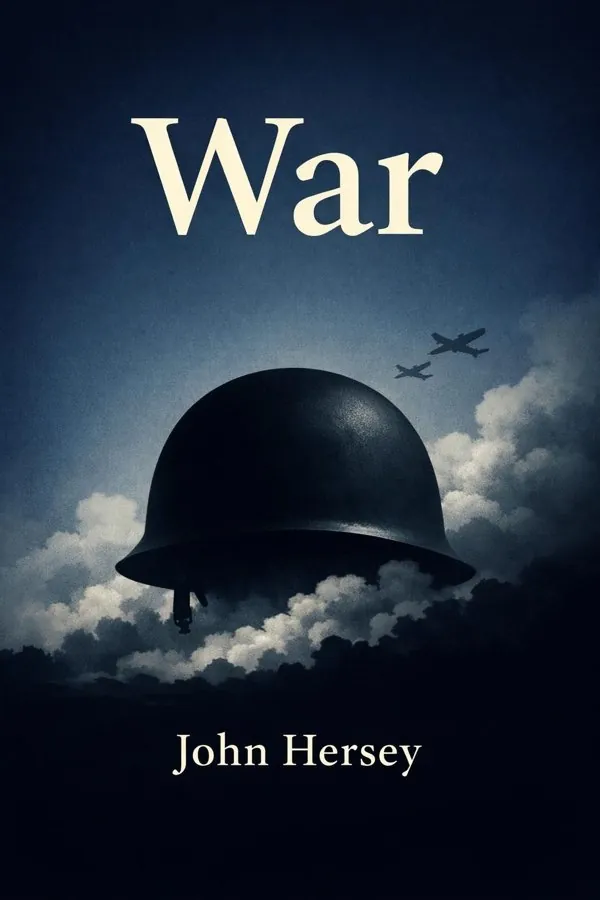
War: Summary & Key Insights
by John Hersey
 10 min8 chaptersAudio available
Key Takeaways from War
The most important truth about war is that it is never experienced in the abstract.
One of Hersey’s most enduring insights is that courage rarely appears in the dramatic form people expect.
In Hersey’s wartime world, time does not move evenly.
War is never only fought on battlefields; it is also fought through narratives.
A common mistake in writing about war is to treat civilians as background to military action.
What Is War About?
War by John Hersey is a war_military book. John Hersey’s War is not a strategy manual, a political manifesto, or a distant chronicle of campaigns and commanders. It is a vivid, morally alert collection of wartime journalism that brings readers close to the people who endure conflict at ground level. First published in 1944, the book gathers Hersey’s reporting from the Second World War and transforms headline events into intimate human stories. He pays close attention to soldiers, civilians, fear, routine, exhaustion, duty, and the strange coexistence of heroism and ordinariness in combat zones. What makes War matter is Hersey’s refusal to reduce war to abstraction. He shows that battles are lived minute by minute by individuals making decisions under pressure, often with incomplete information and no guarantee of survival. That perspective gives the book lasting power. It helps modern readers see war not as spectacle, but as a system that reshapes bodies, minds, communities, and moral choices. Hersey’s authority comes from his work as one of America’s most respected journalists, celebrated for precise observation, humane reporting, and the ability to turn events into unforgettable narrative. War remains essential reading because it restores complexity to a subject too often flattened by slogans, numbers, and patriotic myth.
This FizzRead summary covers all 8 key chapters of War in approximately 10 minutes, distilling the most important ideas, arguments, and takeaways from John Hersey's work. Also available as an audio summary and Key Quotes Podcast.
War
John Hersey’s War is not a strategy manual, a political manifesto, or a distant chronicle of campaigns and commanders. It is a vivid, morally alert collection of wartime journalism that brings readers close to the people who endure conflict at ground level. First published in 1944, the book gathers Hersey’s reporting from the Second World War and transforms headline events into intimate human stories. He pays close attention to soldiers, civilians, fear, routine, exhaustion, duty, and the strange coexistence of heroism and ordinariness in combat zones.
What makes War matter is Hersey’s refusal to reduce war to abstraction. He shows that battles are lived minute by minute by individuals making decisions under pressure, often with incomplete information and no guarantee of survival. That perspective gives the book lasting power. It helps modern readers see war not as spectacle, but as a system that reshapes bodies, minds, communities, and moral choices. Hersey’s authority comes from his work as one of America’s most respected journalists, celebrated for precise observation, humane reporting, and the ability to turn events into unforgettable narrative. War remains essential reading because it restores complexity to a subject too often flattened by slogans, numbers, and patriotic myth.
Who Should Read War?
This book is perfect for anyone interested in war_military and looking to gain actionable insights in a short read. Whether you're a student, professional, or lifelong learner, the key ideas from War by John Hersey will help you think differently.
- ✓Readers who enjoy war_military and want practical takeaways
- ✓Professionals looking to apply new ideas to their work and life
- ✓Anyone who wants the core insights of War in just 10 minutes
Want the full summary?
Get instant access to this book summary and 100K+ more with Fizz Moment.
Get Free SummaryAvailable on App Store • Free to download
Key Chapters
The most important truth about war is that it is never experienced in the abstract. Maps, casualty figures, and communiques can make conflict seem impersonal, but John Hersey insists that war is always lived by particular people in particular moments. His reporting repeatedly narrows the frame from nations and armies to faces, decisions, injuries, fatigue, and fear. In doing so, he reminds readers that every military operation contains hundreds of private dramas that official history may barely acknowledge.
This approach changes how we understand conflict. Instead of asking only who advanced, who retreated, or who won a tactical objective, Hersey asks what it felt like to wait under bombardment, to obey orders while terrified, or to continue a task while aware that death may arrive in seconds. These details do not sentimentalize war; they clarify it. They reveal that war’s real substance lies in its effect on human beings, not in rhetoric about glory.
The practical value of this perspective extends beyond military history. It trains readers to resist abstraction in any crisis. In politics, business, healthcare, or public policy, large systems are often discussed in broad terms that obscure human consequences. Hersey’s method teaches us to ask: who bears the burden, who makes the sacrifice, and what does this decision feel like on the ground?
A useful application is in reading current events. When following news of conflict, look beyond strategic analysis and seek accounts from medics, refugees, junior officers, and families. Their stories often reveal realities that official narratives miss.
Actionable takeaway: whenever you encounter discussions of war or crisis, translate statistics back into lived experience by asking what the situation means for one ordinary person inside it.
One of Hersey’s most enduring insights is that courage rarely appears in the dramatic form people expect. Popular imagination often treats bravery as a burst of cinematic heroism, but in War, courage is frequently quieter: staying at a post, carrying out routine duties under fire, helping others while frightened, or simply continuing through exhaustion. Hersey’s portraits suggest that bravery is less about fearlessness than about action despite fear.
This matters because it corrects a dangerous myth. If we define courage only as spectacular valor, we overlook the disciplined persistence that makes survival and service possible. Soldiers, sailors, medics, and civilians in war do not spend every moment performing extraordinary feats. More often, they endure confusion, monotony, and dread, then do what is required anyway. Hersey’s journalism honors this kind of moral and practical steadiness.
The insight applies well beyond wartime. In ordinary life, many people underestimate their own courage because they are waiting for a dramatic test. Yet real courage often appears in smaller acts: speaking honestly in a difficult meeting, caring for a sick family member, reporting wrongdoing, or showing up consistently when conditions are hard. Quiet courage is still courage.
A practical way to use this idea is to reframe how you evaluate resilience in yourself and others. Instead of praising only the visible breakthrough, recognize the hidden endurance behind it. Teams become stronger when leaders notice the steady work of people who remain reliable under pressure.
Actionable takeaway: define courage in behavioral terms, not theatrical ones. This week, identify one difficult responsibility you have been avoiding and meet it with steady action, even if you do not feel fearless.
In Hersey’s wartime world, time does not move evenly. Periods of boredom can stretch endlessly, then a few seconds of violence can alter everything. This uneven rhythm is one of the book’s most revealing themes. War is not a constant blaze of action. It is waiting, interruption, sudden danger, administrative routine, uncertainty, and then abrupt transformation. Hersey captures how this rhythm unsettles ordinary expectations and leaves people struggling to maintain a sense of normality.
This distortion of time affects judgment and emotional life. Long stretches of waiting can produce numbness, anxiety, fatalism, or a false sense of safety. Then rapid crises demand instant decisions from exhausted minds. Hersey’s reporting shows how hard it is to preserve mental balance in such conditions. The result is not only physical strain but a deeper disruption of how people experience daily existence.
The concept has broad relevance because extreme stress in any domain can warp time in similar ways. Emergency workers, caregivers, founders in crisis, and people under chronic uncertainty may also feel trapped between tedious waiting and urgent reaction. Hersey helps readers understand that this rhythm itself is stressful; the challenge is not only the event, but the unpredictability surrounding it.
A practical application is in preparation. When you know you may face sudden high-pressure moments, do not ignore the waiting periods. Use them to establish routines, preserve rest where possible, clarify roles, and keep communication simple. Stability before crisis can reduce chaos during it.
Actionable takeaway: when facing uncertain conditions, create small rituals of normalcy, such as scheduled meals, notes, checklists, or debriefs, to anchor yourself against the disorienting rhythm of waiting and shock.
War is never only fought on battlefields; it is also fought through narratives. Governments, militaries, and publics all produce stories that simplify conflict into heroism, necessity, inevitability, or patriotic destiny. Hersey’s work matters because he resists this flattening. He does not deny courage or sacrifice, but he refuses to let official language replace observed reality. His reporting restores texture where propaganda prefers certainty.
This makes War a powerful example of journalism at its best. Hersey stands close enough to events to witness their confusion and human cost, yet writes with enough discipline to avoid mere sensationalism. His authority comes not from loud opinion but from careful attention. By describing what happened to actual people in concrete settings, he exposes what abstractions leave out. That is a civic service.
The lesson remains highly relevant. Modern media environments still reward simplification, especially during conflict. Readers are often pushed toward quick emotional conclusions rather than careful understanding. Hersey reminds us that ethical reporting should complicate easy stories, not merely confirm them.
In practical terms, this means developing a better information diet. When reading about war or geopolitical crisis, compare official statements with frontline reporting, eyewitness accounts, independent journalism, and historical context. Ask what is absent from triumphant or moralizing narratives. Beware of language that turns suffering into symbol.
This idea also applies in organizations. Leaders can produce polished explanations for failures or hard decisions, but those narratives may conceal frontline reality. Responsible decision-making requires hearing from those closest to the work.
Actionable takeaway: whenever a crisis is described in neat, confident terms, deliberately seek one grounded account from someone directly affected before accepting the dominant narrative.
A common mistake in writing about war is to treat civilians as background to military action. Hersey does the opposite. He understands that the civilian experience is central, not secondary, to the meaning of war. Homes, streets, routines, families, schools, hospitals, and local economies become part of the battlefield’s reality even when civilians are not carrying weapons. War spreads into domestic life, reshaping communities from the inside.
This perspective broadens moral understanding. Military history can sometimes focus so heavily on campaigns and command decisions that it neglects displacement, fear, hunger, grief, and the long afterlife of damage in civilian populations. Hersey reminds readers that war is not confined to combatants. It reorganizes the ordinary structures that make a human life stable and recognizable.
The practical significance of this idea is immense. It changes how we think about humanitarian aid, postwar reconstruction, and political responsibility. If civilian harm is not incidental but integral to war’s reality, then any serious evaluation of conflict must include shelter, medical care, trauma, food systems, and social rebuilding. Victory measured only in territory or military success may conceal deeper social ruin.
Readers can apply this insight by broadening the questions they ask about any conflict. Do not ask only who controls ground or who gains leverage. Ask what happens to children, hospitals, neighborhoods, water, schools, and the displaced. Those questions reveal the true scale of damage.
On a personal level, this idea can also deepen empathy. Instead of imagining war solely through soldiers, imagine what it means for ordinary families to live under recurring threat and uncertainty.
Actionable takeaway: when assessing any conflict, include at least one civilian-centered measure of reality, such as displacement, medical access, or family disruption, before forming your judgment.
Modern institutions like to believe that planning can master events. Hersey’s reporting shows the opposite. War repeatedly reveals the limits of foresight, command, and personal control. Orders are misunderstood, weather changes conditions, intelligence is incomplete, machinery fails, and individuals must improvise under pressure. Even highly organized systems are vulnerable to chance, friction, and human fallibility.
This does not mean planning is useless. Rather, Hersey demonstrates that planning must coexist with humility. The people who function best in wartime are often not those who expect perfect execution, but those who can adapt when reality diverges from expectation. In that sense, war becomes a harsh classroom in uncertainty.
This lesson has wide application. Businesses build detailed forecasts, governments draft scenarios, and individuals map out career and family plans. Yet life often interrupts with illness, market shocks, accidents, or institutional breakdown. Hersey’s work encourages a more flexible form of competence: prepare carefully, but remain ready to respond to the unplanned.
A practical example is team management. Many groups confuse preparedness with rigidity. They create procedures but do not train for exceptions. A more resilient approach includes backup roles, decision thresholds, communication protocols, and permission to escalate quickly when assumptions fail. In personal life, emergency savings, health documents, and support networks serve a similar function.
At a deeper level, Hersey’s message is moral as well as operational. People under conditions they cannot control still retain responsibility for judgment, compassion, and steadiness. Control may collapse, but character still matters.
Actionable takeaway: prepare for uncertainty by asking not only, “What is our plan?” but also, “What will we do when the plan stops matching reality?”
Hersey’s work suggests that to witness suffering accurately is itself a form of service. War generates chaos, fear, and death, but it also generates forgetting, distortion, and denial. Journalistic witnessing pushes against all three. By paying disciplined attention and recording what others might prefer to ignore, Hersey creates a public memory that resists disappearance.
This role is morally significant because violence often depends on distance. The farther suffering is from public imagination, the easier it is to rationalize. Hersey narrows that distance. He does not force meaning onto events too quickly; instead, he allows detail to carry moral weight. The reader is asked not merely to consume information, but to bear witness as well.
The idea extends beyond journalism. In families, workplaces, institutions, and civic life, harmful patterns often continue because no one names them clearly. Witnessing means refusing to look away from consequences. It involves careful observation, truthful description, and the willingness to make reality visible. That can be uncomfortable, but it is often the first step toward accountability.
A practical application is in leadership and citizenship. If a team is overstressed, if a community is absorbing hidden damage, or if policy creates human suffering, vague language is not enough. Someone must document what is happening with specificity. Facts paired with humane attention are harder to dismiss.
For readers, this principle also shapes how to engage with difficult books. The goal is not passive consumption or fleeting emotion, but informed moral attention. Let testimony alter what you notice and what you are willing to say aloud.
Actionable takeaway: choose one neglected reality in your workplace, community, or information diet and describe it concretely, truthfully, and humanely rather than allowing it to remain abstract.
Perhaps the most moving current in War is Hersey’s recognition that destruction does not entirely erase human dignity. Even in bombed landscapes, exhausted units, and frightened communities, people continue to improvise meaning through duty, care, humor, ritual, and companionship. Hersey does not present this as sentimental triumph. Rather, he shows that dignity survives in fragments, often in small acts that push back against chaos.
This insight matters because war can make people appear interchangeable or reduced to functions: soldier, casualty, refugee, target, survivor. Hersey restores individuality. A gesture of kindness, a moment of discipline, or a refusal to abandon others becomes evidence that humanity is not fully extinguished by violent systems. That recognition does not redeem war, but it does preserve moral clarity. The existence of dignity in war highlights what war threatens and why it is tragic.
The broader application is powerful. In any dehumanizing environment, whether institutional, medical, economic, or social, dignity is often protected through small practices: learning names, preserving routines, telling the truth, sharing burdens, or giving someone real attention. People do not need grand declarations to feel recognized; they need evidence that they still count.
This principle is especially useful in caregiving, leadership, and public service. Efficiency matters, but systems become corrosive when they treat people as cases rather than persons. Hersey’s sensitivity offers a corrective: precision and compassion can coexist.
Readers can apply this by noticing where pressure has made them transactional. Restoring dignity may be as simple as listening fully, acknowledging strain, or refusing dismissive language.
Actionable takeaway: in one pressured interaction today, do one concrete thing that affirms another person’s individuality, such as using their name, asking a real question, or recognizing an unseen burden.
All Chapters in War
About the Author
John Hersey was an American author and journalist born in 1914 in Tientsin, China, to missionary parents. Educated at Yale and Cambridge, he built a distinguished career as a reporter and writer known for his clarity, moral seriousness, and close attention to ordinary people caught in extraordinary events. During World War II, he worked as a correspondent, producing reporting that later informed books such as War. He became internationally famous for Hiroshima, his landmark 1946 account of six survivors of the atomic bombing, widely regarded as one of the greatest works of twentieth-century journalism. Across his career, Hersey combined literary skill with factual rigor, helping define narrative nonfiction as a serious public art. He died in 1993, leaving behind a body of work marked by empathy, discipline, and historical witness.
Get This Summary in Your Preferred Format
Read or listen to the War summary by John Hersey anytime, anywhere. FizzRead offers multiple formats so you can learn on your terms — all free.
Available formats: App · Audio · PDF · EPUB — All included free with FizzRead
Download War PDF and EPUB Summary
Key Quotes from War
“The most important truth about war is that it is never experienced in the abstract.”
“One of Hersey’s most enduring insights is that courage rarely appears in the dramatic form people expect.”
“In Hersey’s wartime world, time does not move evenly.”
“War is never only fought on battlefields; it is also fought through narratives.”
“A common mistake in writing about war is to treat civilians as background to military action.”
Frequently Asked Questions about War
War by John Hersey is a war_military book that explores key ideas across 8 chapters. John Hersey’s War is not a strategy manual, a political manifesto, or a distant chronicle of campaigns and commanders. It is a vivid, morally alert collection of wartime journalism that brings readers close to the people who endure conflict at ground level. First published in 1944, the book gathers Hersey’s reporting from the Second World War and transforms headline events into intimate human stories. He pays close attention to soldiers, civilians, fear, routine, exhaustion, duty, and the strange coexistence of heroism and ordinariness in combat zones. What makes War matter is Hersey’s refusal to reduce war to abstraction. He shows that battles are lived minute by minute by individuals making decisions under pressure, often with incomplete information and no guarantee of survival. That perspective gives the book lasting power. It helps modern readers see war not as spectacle, but as a system that reshapes bodies, minds, communities, and moral choices. Hersey’s authority comes from his work as one of America’s most respected journalists, celebrated for precise observation, humane reporting, and the ability to turn events into unforgettable narrative. War remains essential reading because it restores complexity to a subject too often flattened by slogans, numbers, and patriotic myth.
More by John Hersey
You Might Also Like
Patriot
Andrew Britton
10 min
An Army at Dawn: The War in North Africa, 1942–1943
Rick Atkinson
10 min
Brave New War: The Next Stage of Terrorism and the End of Globalization
John Robb
10 min
Catch-22
Joseph Heller
10 min
Command and Control: Nuclear Weapons, the Damascus Accident, and the Illusion of Safety
Eric Schlosser
10 min
Countdown to Zero Day: Stuxnet and the Launch of the World's First Digital Weapon
Kim Zetter
10 minBrowse by Category
Ready to read War?
Get the full summary and 100K+ more books with Fizz Moment.