
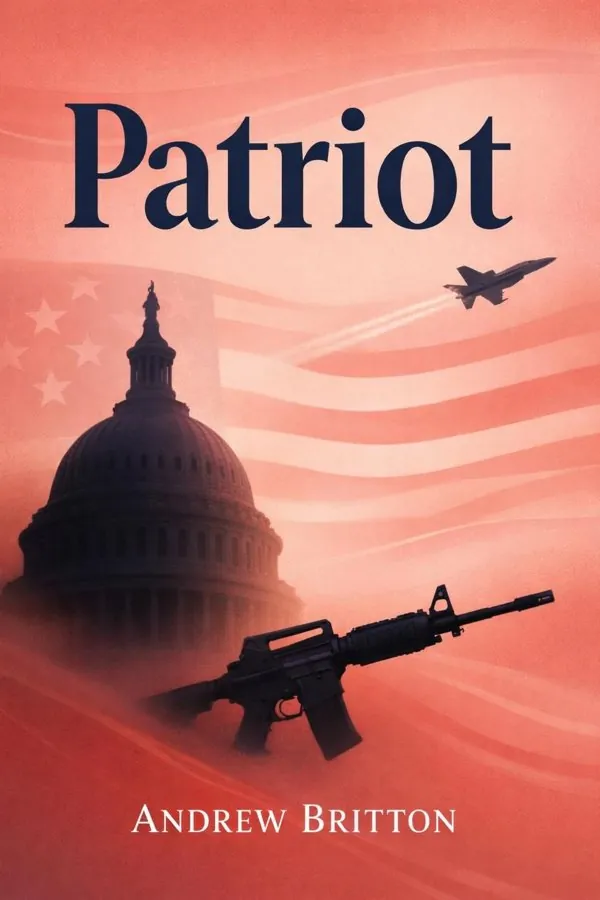
Patriot: Summary & Key Insights
 10 min9 chaptersAudio available
Key Takeaways from Patriot
True patriotism becomes most visible when comfort disappears.
The most dangerous threats are often the ones that remain invisible until the damage is already underway.
Decision-making becomes most consequential when certainty is impossible.
In moments of crisis, individual competence can alter the course of much larger systems.
A nation can possess immense power and still struggle to use it effectively when politics distorts priorities.
What Is Patriot About?
Patriot by Andrew Britton is a war_military book. Patriot by Andrew Britton is a fast-moving political thriller that drops readers into a world where intelligence failures, ideological extremism, and international power struggles collide with terrifying speed. At the center of the novel is CIA operative Ryan Kealey, a driven field agent forced into a race against time after a deadly terrorist operation signals something much larger in motion. What begins as an urgent investigation quickly expands into a high-stakes mission involving covert networks, political manipulation, and the constant threat of catastrophic violence. The novel matters because it taps into modern anxieties about national security, the fragility of public safety, and the hidden decisions that shape global events. Rather than presenting terrorism and espionage as abstract policy concerns, Britton turns them into immediate human drama, showing the physical, moral, and emotional cost of fighting unseen enemies. As a thriller writer known for combining detailed geopolitical awareness with relentless pacing, Andrew Britton built a reputation for stories that feel both cinematic and plausible. Patriot stands out as a sharp, suspenseful entry in the Ryan Kealey series and a gripping look at what patriotism demands when the battlefield has no clear front lines.
This FizzRead summary covers all 9 key chapters of Patriot in approximately 10 minutes, distilling the most important ideas, arguments, and takeaways from Andrew Britton's work. Also available as an audio summary and Key Quotes Podcast.
Patriot
Patriot by Andrew Britton is a fast-moving political thriller that drops readers into a world where intelligence failures, ideological extremism, and international power struggles collide with terrifying speed. At the center of the novel is CIA operative Ryan Kealey, a driven field agent forced into a race against time after a deadly terrorist operation signals something much larger in motion. What begins as an urgent investigation quickly expands into a high-stakes mission involving covert networks, political manipulation, and the constant threat of catastrophic violence. The novel matters because it taps into modern anxieties about national security, the fragility of public safety, and the hidden decisions that shape global events. Rather than presenting terrorism and espionage as abstract policy concerns, Britton turns them into immediate human drama, showing the physical, moral, and emotional cost of fighting unseen enemies. As a thriller writer known for combining detailed geopolitical awareness with relentless pacing, Andrew Britton built a reputation for stories that feel both cinematic and plausible. Patriot stands out as a sharp, suspenseful entry in the Ryan Kealey series and a gripping look at what patriotism demands when the battlefield has no clear front lines.
Who Should Read Patriot?
This book is perfect for anyone interested in war_military and looking to gain actionable insights in a short read. Whether you're a student, professional, or lifelong learner, the key ideas from Patriot by Andrew Britton will help you think differently.
- ✓Readers who enjoy war_military and want practical takeaways
- ✓Professionals looking to apply new ideas to their work and life
- ✓Anyone who wants the core insights of Patriot in just 10 minutes
Want the full summary?
Get instant access to this book summary and 100K+ more with Fizz Moment.
Get Free SummaryAvailable on App Store • Free to download
Key Chapters
True patriotism becomes most visible when comfort disappears. In Patriot, Andrew Britton explores this idea by placing his characters in situations where loyalty to country is not expressed through speeches or symbols, but through sacrifice, risk, and difficult decisions. Ryan Kealey is not asked to defend abstract ideals from a distance; he is forced to act in immediate, dangerous circumstances where a single hesitation can cost lives. This gives the novel its emotional charge. Patriotism here is not simplistic nationalism. It is the willingness to confront chaos, accept personal danger, and keep moving even when institutions are imperfect and outcomes uncertain.
Britton uses the machinery of a political thriller to ask a deeper question: what does it actually mean to protect a nation? The answer is messy. Kealey and the people around him operate in a world of incomplete intelligence, hidden agendas, and morally compromised choices. They must decide whether preserving national security justifies deception, violence, and secrecy. In this context, patriotism is not blind obedience. It becomes a practical ethic of responsibility under pressure.
Readers can apply this idea beyond espionage. In everyday life, loyalty to a cause, community, or profession is often measured not by what people claim to value, but by what they do when the stakes rise. A doctor in an emergency room, a firefighter entering a dangerous structure, or a whistleblower exposing corruption all demonstrate forms of applied patriotism or civic duty. Their commitment is proven through action.
Patriot reminds us that devotion to something larger than ourselves is meaningful only when it survives fear, ambiguity, and cost. Actionable takeaway: examine what values you claim to hold most deeply, then identify one concrete way to serve them when doing so is inconvenient, stressful, or personally risky.
Decision-making becomes most consequential when certainty is impossible. Patriot repeatedly emphasizes that intelligence operations are conducted in a fog of partial knowledge. Analysts and field officers rarely receive a clean picture of reality. Instead, they work with fragments, contradictions, rumors, surveillance results, and time-sensitive judgments. Ryan Kealey must act despite uncertainty, which creates much of the novel's tension. Waiting for perfect information may lead to disaster, but acting too soon can trigger the wrong outcome.
Britton captures the central dilemma of modern security work: information is abundant, but clarity is scarce. Agencies may have access to data, intercepts, briefings, and informants, yet still fail to understand intent. A clue only matters if someone interprets it correctly and fast enough. This is why the novel treats intelligence not as omniscience, but as disciplined inference under pressure.
This concept has broad real-world relevance. Leaders in business, medicine, finance, and public policy face similar conditions. A manager launching a new product lacks full market certainty. A physician treating a complex case may need to act before every test returns. A family making a major move or financial decision often does so without guarantees. The challenge is not to eliminate uncertainty, but to build methods for thinking within it.
Practical strategies include identifying what is known, what is assumed, what is unknown, and what would change the decision. Good operators also create contingency plans. If their first conclusion proves wrong, they already know what to do next.
Patriot shows that competence is not the absence of doubt. It is the ability to move intelligently while doubt remains. Actionable takeaway: in high-stakes situations, separate facts from assumptions, make the best decision available, and prepare a backup plan before you act.
In moments of crisis, individual competence can alter the course of much larger systems. Patriot builds much of its momentum around this principle through Ryan Kealey, whose skill, resilience, and field judgment make him more than just another government operative. Britton presents him as a force multiplier: someone who can interpret chaos faster than others, adapt under fire, and push an investigation forward when institutions are slowed by procedure or politics. The novel does not suggest that one person alone wins a global conflict, but it does argue that exceptional individuals matter enormously at key turning points.
This matters because large organizations often create an illusion that systems are self-sustaining. Patriot challenges that idea. In emergencies, progress frequently depends on one capable person recognizing what others miss and acting before the window closes. Kealey's value lies not only in physical courage, but in initiative, improvisation, and persistence. He keeps operating when plans fail.
This insight applies in many domains. A skilled emergency nurse can stabilize a chaotic situation before a team fully mobilizes. A project leader can rescue a failing launch by quickly identifying the real bottleneck. A teacher can change a student's future through sustained intervention that no broad policy could replicate. Institutions matter, but so do high performers within them.
The practical implication is that expertise should be developed before a crisis, not during one. Training, repetition, stress management, and pattern recognition create the kind of judgment that appears instinctive under pressure. People become reliable in emergencies because they have built capability in advance.
Patriot celebrates decisive competence without reducing conflict to fantasy heroics. It shows how one prepared person can create options where none seem to exist. Actionable takeaway: invest deliberately in a high-value skill set so that when pressure arrives, you can contribute more than panic or opinion.
A nation can possess immense power and still struggle to use it effectively when politics distorts priorities. One of Patriot's most compelling themes is that threats do not operate in a vacuum. Intelligence officers and counterterrorism personnel must work within governments shaped by rivalry, image management, bureaucratic caution, and competing agendas. Britton makes clear that danger increases when political actors treat security decisions as strategic theater rather than urgent operational realities.
In the novel, this creates friction between what field personnel believe must happen and what decision-makers are willing to authorize or acknowledge. Delays, miscommunications, and institutional self-protection can be just as dangerous as enemy action. Patriot does not depict government as useless, but it does show how chains of command can become clogged by ego, mistrust, or fear of accountability. The result is a system that may know a threat is growing yet still fail to respond with the necessary speed.
This idea extends beyond warfare and intelligence. In corporations, internal politics often delay solutions to obvious problems. In hospitals, schools, or nonprofits, important decisions may be slowed by concern over appearances, departmental boundaries, or conflicting incentives. The lesson is not to reject organizations, but to understand that structure alone does not guarantee effectiveness.
Practically, people can reduce this risk by building clear communication channels, defining decision authority early, and encouraging cultures where bad news moves upward quickly. The longer reality is filtered for political comfort, the worse the eventual consequences.
Patriot warns that institutions are most vulnerable when they care more about optics than outcomes. Actionable takeaway: in any team facing real stakes, identify where politics is slowing truth, then create direct paths for urgent information and faster decision-making.
Thrillers often move so quickly that violence becomes spectacle, but Patriot works best when it reminds readers that force always leaves a mark. Britton delivers action with speed and intensity, yet underneath the firefights and tactical maneuvers lies a sober recognition that every operation affects real bodies, minds, and relationships. Agents, soldiers, civilians, and even adversaries exist within the blast radius of political decisions. The result is a novel that entertains while still acknowledging the cost of the world it portrays.
Ryan Kealey operates in an environment where lethal action may be necessary, but necessity does not erase consequence. Each confrontation intensifies fatigue, pressure, and moral strain. This is important because it separates Patriot from more simplistic action fiction. The goal is not violence for its own sake. The use of force is tied to prevention, survival, and the terrible arithmetic of stopping something worse.
Readers can draw a practical lesson from this moral seriousness. In many areas of life, decisive action may be justified, but hard choices should not be made casually. Leaders who fire employees, prosecutors who pursue charges, parents who impose strict consequences, or executives who cut programs all affect lives in lasting ways. Strength without reflection becomes cruelty; reflection without action becomes paralysis.
A balanced approach asks three questions: is this action necessary, is it proportional, and have alternatives been considered? Those questions do not eliminate pain, but they impose discipline on power.
Patriot suggests that maturity lies in understanding both the necessity and the burden of force. Effective protectors do not celebrate damage; they try to contain it. Actionable takeaway: when making a severe decision, pause long enough to weigh necessity, proportionality, and downstream human impact before proceeding.
Some dangers grow faster than bureaucracies can process them. Patriot thrives on this reality. The novel's pacing reflects a key strategic truth: in modern terrorism and covert conflict, time is often the decisive factor. A plot does not need to be flawless if the response comes too late. Britton uses mounting urgency to show that once an attack network is mobilized, every hour matters. Intelligence that arrives after deployment, coordination that happens after movement, or authorization that comes after execution is effectively useless.
Ryan Kealey's role highlights the value of operational tempo. He must think quickly, move quickly, and force events before the enemy's timeline locks into place. This is not recklessness. It is recognition that delay favors adversaries who rely on surprise. The side that acts first with enough accuracy often seizes the initiative.
The lesson applies broadly. In cybersecurity, an unaddressed breach can spread through systems within minutes. In public relations, a false narrative can harden if not answered promptly. In health, symptoms ignored early may become emergencies later. In personal life, unresolved conflict or postponed financial problems usually grow more expensive over time.
The practical challenge is to distinguish speed from panic. Effective rapid response depends on preparation, protocols, and the ability to make tiered decisions. Not every issue demands the same urgency, but high-consequence threats should trigger predefined escalation paths so action does not stall in confusion.
Patriot demonstrates that urgency is not merely a storytelling device. It is a strategic condition of modern conflict. Actionable takeaway: decide in advance which situations require immediate response, then build a simple playbook so you can act fast without losing discipline when the pressure spikes.
The more secretive the environment, the harder it becomes to know whom to believe. Patriot uses espionage and counterterrorism not just to create suspense, but to explore the instability of trust in a world built on deception. Characters operate through classified channels, selective disclosure, false identities, and conflicting loyalties. In such an environment, trust is never automatic. It must be earned, tested, and constantly reassessed.
For Ryan Kealey, this means every alliance carries risk. A source may be compromised. A superior may be withholding crucial context. A partner may be competent but guided by different priorities. Britton shows that operational success depends partly on reading people as carefully as reading intelligence. Misplaced trust can expose an entire mission, but complete distrust can isolate an operative until cooperation becomes impossible.
This dynamic matters outside the spy world too. Startups depend on trust among founders handling money, product decisions, and strategy. Medical teams rely on trust in colleagues' judgment and communication. Families navigating a crisis need openness, but also realism about whether everyone is being candid. The challenge is not to become cynical, but to build trust with verification.
A practical framework is to look for consistency between words, incentives, and behavior over time. Trust grows when someone repeatedly shares useful information, accepts accountability, and acts predictably under pressure. It weakens when stories change, motives remain opaque, or commitments disappear when risk rises.
Patriot presents trust as a tactical asset and a vulnerability at the same time. In dangerous systems, relationships can save lives or destroy missions. Actionable takeaway: extend trust gradually, validate it through evidence, and never ignore early signs that words and behavior no longer match.
The difference between failure and eventual success is often the refusal to stop after a plan collapses. Patriot repeatedly demonstrates that resilience is not motivational language but operational necessity. Missions go wrong. Leads dry up. Enemies adapt. Institutions hesitate. Under these conditions, survival and success belong to those who can absorb disruption and continue functioning. Ryan Kealey embodies this form of resilience. He does not move through the story because everything works; he moves because he keeps recalibrating when it does not.
Britton's treatment of resilience is especially effective because it is practical rather than sentimental. Kealey's persistence is tied to action: reassessing intelligence, changing tactics, enduring physical and psychological strain, and staying mission-focused despite losses and uncertainty. This makes resilience look less like emotion and more like disciplined recovery.
That model is useful in ordinary life. A founder may need to pivot after a launch fails. A student may have to redesign study habits after poor results. Someone recovering from illness, grief, or financial setback often succeeds not by avoiding pain, but by building routines that allow progress despite it. Resilience means continuing with adjustment, not pretending the setback was small.
One practical method is the after-action review. After a failure, identify what happened, what was expected, what broke down, and what should change next time. This turns disappointment into usable data. Another useful tactic is preserving core purpose while changing methods. The mission remains; the approach evolves.
Patriot shows that pressure reveals character, but setbacks shape it. The people who matter most in crises are usually those who can take a hit, learn fast, and reengage. Actionable takeaway: after any setback, spend less time on self-judgment and more time extracting lessons, adjusting strategy, and taking the next concrete step.
All Chapters in Patriot
About the Author
Andrew Britton was the pen name of Andrew Waite, an American author known for writing high-intensity political and espionage thrillers. He became best known for the Ryan Kealey series, which earned praise for combining sharp pacing, international intrigue, and themes drawn from contemporary terrorism and intelligence work. Britton's novels appealed to readers who enjoyed action-driven fiction with a strong geopolitical edge, placing him in conversation with writers such as Vince Flynn and Tom Clancy. Despite his success and clear promise as a major thriller voice, his life and career were tragically brief. Even so, his books continue to attract readers who appreciate suspenseful stories grounded in national security concerns. Patriot remains a strong example of his ability to blend cinematic storytelling with modern political tension.
Get This Summary in Your Preferred Format
Read or listen to the Patriot summary by Andrew Britton anytime, anywhere. FizzRead offers multiple formats so you can learn on your terms — all free.
Available formats: App · Audio · PDF · EPUB — All included free with FizzRead
Download Patriot PDF and EPUB Summary
Key Quotes from Patriot
“True patriotism becomes most visible when comfort disappears.”
“The most dangerous threats are often the ones that remain invisible until the damage is already underway.”
“Decision-making becomes most consequential when certainty is impossible.”
“In moments of crisis, individual competence can alter the course of much larger systems.”
“A nation can possess immense power and still struggle to use it effectively when politics distorts priorities.”
Frequently Asked Questions about Patriot
Patriot by Andrew Britton is a war_military book that explores key ideas across 9 chapters. Patriot by Andrew Britton is a fast-moving political thriller that drops readers into a world where intelligence failures, ideological extremism, and international power struggles collide with terrifying speed. At the center of the novel is CIA operative Ryan Kealey, a driven field agent forced into a race against time after a deadly terrorist operation signals something much larger in motion. What begins as an urgent investigation quickly expands into a high-stakes mission involving covert networks, political manipulation, and the constant threat of catastrophic violence. The novel matters because it taps into modern anxieties about national security, the fragility of public safety, and the hidden decisions that shape global events. Rather than presenting terrorism and espionage as abstract policy concerns, Britton turns them into immediate human drama, showing the physical, moral, and emotional cost of fighting unseen enemies. As a thriller writer known for combining detailed geopolitical awareness with relentless pacing, Andrew Britton built a reputation for stories that feel both cinematic and plausible. Patriot stands out as a sharp, suspenseful entry in the Ryan Kealey series and a gripping look at what patriotism demands when the battlefield has no clear front lines.
You Might Also Like
War
John Hersey
10 min
An Army at Dawn: The War in North Africa, 1942–1943
Rick Atkinson
10 min
Brave New War: The Next Stage of Terrorism and the End of Globalization
John Robb
10 min
Catch-22
Joseph Heller
10 min
Command and Control: Nuclear Weapons, the Damascus Accident, and the Illusion of Safety
Eric Schlosser
10 min
Countdown to Zero Day: Stuxnet and the Launch of the World's First Digital Weapon
Kim Zetter
10 minBrowse by Category
Ready to read Patriot?
Get the full summary and 100K+ more books with Fizz Moment.