
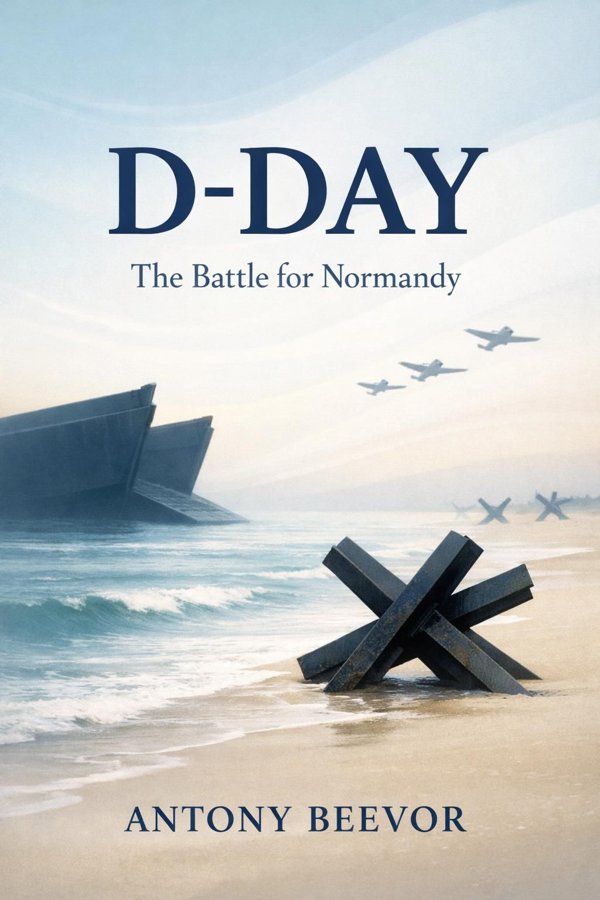
D-Day: The Battle for Normandy: Summary & Key Insights
 10 min9 chapters
Key Takeaways from D-Day: The Battle for Normandy
Before armies clash openly, wars are often decided in the realm of belief.
History remembers the beaches, but Beevor reminds us that D-Day began in confusion, isolation, and darkness.
D-Day is often spoken of as a single event, but Beevor makes clear that each beach represented a different battle shaped by terrain, weather, leadership, and luck.
One of Beevor’s sharpest insights is that the German response to D-Day was crippled not only by Allied force but by structural paralysis.
Many assume that once the Allies secured the beaches, superior numbers and matériel made victory inevitable.
What Is D-Day: The Battle for Normandy About?
D-Day: The Battle for Normandy by Antony Beevor is a war_military book spanning 6 pages. D-Day: The Battle for Normandy is Antony Beevor’s sweeping account of one of the most consequential military campaigns in modern history: the Allied invasion of France in June 1944 and the brutal struggle that followed. Rather than treating D-Day as a single day of heroism and victory, Beevor shows it as a vast, uncertain, and deeply human operation shaped by deception, logistics, weather, command rivalry, courage, fear, and terrible loss. From airborne troops dropped into darkness to soldiers fighting through surf, mines, and machine-gun fire, the book reconstructs the invasion with extraordinary immediacy. It also follows the campaign beyond the beaches into the hedgerow battles, the destruction of Caen, the collapse of German defenses, and the liberation of Paris. What makes this book matter is its refusal to romanticize war. Beevor combines archival depth, strategic clarity, and firsthand testimony to reveal both the necessity and the cost of liberation. As one of Britain’s most respected military historians and a former army officer, he brings authority, narrative skill, and moral seriousness to a subject too often reduced to legend.
This FizzRead summary covers all 9 key chapters of D-Day: The Battle for Normandy in approximately 10 minutes, distilling the most important ideas, arguments, and takeaways from Antony Beevor's work.
D-Day: The Battle for Normandy
D-Day: The Battle for Normandy is Antony Beevor’s sweeping account of one of the most consequential military campaigns in modern history: the Allied invasion of France in June 1944 and the brutal struggle that followed. Rather than treating D-Day as a single day of heroism and victory, Beevor shows it as a vast, uncertain, and deeply human operation shaped by deception, logistics, weather, command rivalry, courage, fear, and terrible loss. From airborne troops dropped into darkness to soldiers fighting through surf, mines, and machine-gun fire, the book reconstructs the invasion with extraordinary immediacy. It also follows the campaign beyond the beaches into the hedgerow battles, the destruction of Caen, the collapse of German defenses, and the liberation of Paris. What makes this book matter is its refusal to romanticize war. Beevor combines archival depth, strategic clarity, and firsthand testimony to reveal both the necessity and the cost of liberation. As one of Britain’s most respected military historians and a former army officer, he brings authority, narrative skill, and moral seriousness to a subject too often reduced to legend.
Who Should Read D-Day: The Battle for Normandy?
This book is perfect for anyone interested in war_military and looking to gain actionable insights in a short read. Whether you're a student, professional, or lifelong learner, the key ideas from D-Day: The Battle for Normandy by Antony Beevor will help you think differently.
- ✓Readers who enjoy war_military and want practical takeaways
- ✓Professionals looking to apply new ideas to their work and life
- ✓Anyone who wants the core insights of D-Day: The Battle for Normandy in just 10 minutes
Want the full summary?
Get instant access to this book summary and 100K+ more with Fizz Moment.
Get Free SummaryAvailable on App Store • Free to download
Key Chapters
Before armies clash openly, wars are often decided in the realm of belief. Beevor shows that Operation Overlord depended not only on men, ships, and aircraft, but on persuading Hitler and the German high command to expect the main invasion somewhere else. The Allied deception plan, most famously Operation Fortitude, created a false reality: phantom armies, misleading radio traffic, dummy equipment, and carefully managed intelligence leaks all pointed toward the Pas-de-Calais rather than Normandy. This mattered because German commanders were constrained by uncertainty. If they believed Normandy was only a diversion, they would delay committing reserves, especially armored divisions, and that delay could prove decisive.
Beevor explains how the Allies exploited German assumptions and command rigidities. Hitler expected a major landing at the narrowest point of the Channel, which seemed logical. The deception worked because it confirmed what the Germans already feared. This is one of the book’s most important lessons: successful strategy often amplifies an opponent’s existing bias rather than inventing a completely new illusion.
The practical application reaches far beyond military history. In business, politics, and negotiation, outcomes often depend on shaping expectations before the decisive moment arrives. Competitors react not only to your actual move but to what they think your move will be. Preparation, signaling, and timing can create openings that brute force alone cannot.
Beevor’s broader point is that D-Day was not won only on the beaches. It was made possible by months of intelligence work, coordination, and disciplined secrecy. The invasion succeeded in part because the Germans misunderstood what they were seeing.
Actionable takeaway: When preparing for any major challenge, do not focus only on direct execution; also ask how expectations, assumptions, and misinformation may shape the field before the real contest begins.
History remembers the beaches, but Beevor reminds us that D-Day began in confusion, isolation, and darkness. In the early hours of June 6, airborne troops were dropped behind enemy lines to secure bridges, disrupt communications, and sow chaos in the German rear. Their mission was crucial: if German reinforcements moved quickly and in good order, the landings could be crushed. Yet airborne warfare rarely unfolded as planned. Many paratroopers landed far from their assigned drop zones, lost equipment, became separated from units, or found themselves fighting in tiny improvised groups.
What emerges from Beevor’s account is not a neat story of precision but a powerful lesson in adaptability. Despite misdrops and heavy confusion, small groups of soldiers improvised effectively. They cut telephone lines, attacked isolated positions, held key crossings, and convinced German defenders that a much larger force was present. Disorder, paradoxically, became an advantage. The scattered drops made it hard for the Germans to understand where the real threat lay.
Beevor also captures the emotional reality of airborne combat: the fear of jumping into darkness, the loneliness of landing alone in enemy territory, and the burden placed on junior officers and ordinary soldiers forced to act without clear direction. These men were not merely following a script; they were making decisions under extreme uncertainty.
The lesson applies to modern leadership. Plans matter, but resilience matters more when conditions change. Teams that can act with initiative under disrupted conditions often outperform those that depend entirely on centralized control.
Actionable takeaway: Build systems and teams that can function when plans break down, because in high-stakes situations, adaptability is often more valuable than precision.
D-Day is often spoken of as a single event, but Beevor makes clear that each beach represented a different battle shaped by terrain, weather, leadership, and luck. Utah, Omaha, Gold, Juno, and Sword were linked strategically yet experienced very differently by the men who landed there. At Utah, the Americans were put ashore in the wrong place but benefited from weaker defenses and agile command. At Omaha, they encountered some of the fiercest resistance of the entire invasion, with steep bluffs, entrenched machine guns, obstacles in the surf, and devastating fire turning the landing into near-disaster. British and Canadian forces on Gold, Juno, and Sword had mixed progress, gaining ground but also facing delays, resistance, and costly local battles.
Beevor’s treatment strips away the temptation to generalize. Success on one beach did not guarantee success on another. The invasion was not a smooth wave moving inland but a fragmented series of local crises. Small decisions by officers, engineers clearing obstacles, naval gunfire support, and acts of initiative by scattered infantry all influenced whether men advanced, stalled, or died where they landed.
This granular perspective matters because it changes how we think about large operations. Grand strategy only becomes real through local execution. A plan can be brilliant in conception and still fail at the point of contact if terrain, morale, communication, or timing go wrong.
In practical terms, this is a lesson in operational realism. Whether managing a large project or organizational rollout, leaders should expect uneven performance across teams and environments. Uniform plans meet non-uniform reality.
Actionable takeaway: Break large missions into local realities, and prepare for each context separately rather than assuming one strategy will work equally well everywhere.
One of Beevor’s sharpest insights is that the German response to D-Day was crippled not only by Allied force but by structural paralysis. German commanders faced a command system distorted by Hitler’s personal control, rivalries between senior officers, and disputes over how armored reserves should be deployed. Some wanted panzer divisions positioned close to the coast for immediate counterattack; others preferred holding them back for a concentrated strike once the main landing site was confirmed. Because authority was fragmented and Hitler often had to approve key movements, critical hours were lost.
Beevor shows how these delays mattered enormously. On D-Day, time was everything. If the Germans had launched stronger, earlier, coordinated counterattacks against vulnerable beachheads, the invasion might have faced a much greater crisis. Instead, uncertainty, bureaucratic hesitation, and late decision-making weakened the response. German commanders also struggled with incomplete information, partly because Allied air power and resistance sabotage disrupted communication and movement.
This part of the book is especially valuable because it rejects simplistic explanations. Germany did not fail merely because its soldiers lacked courage. Many German units fought skillfully and tenaciously. The deeper problem was a command system unable to translate available force into timely action.
The application is clear in any complex organization. Talent and resources are not enough if decision rights are unclear, leaders mistrust one another, or central authority creates bottlenecks in moments that demand speed. Poor structure can waste strength.
Actionable takeaway: In high-pressure environments, clarify who can decide, when they can decide, and how quickly action must follow, because delayed authority can be as damaging as weak capability.
Many assume that once the Allies secured the beaches, superior numbers and matériel made victory inevitable. Beevor complicates that view by showing how the Normandy bocage, the dense hedgerow countryside, transformed the campaign into a brutal battle of attrition. Tanks could not move freely, visibility was limited, infantry were exposed to hidden defenders, and every field became a miniature fortress. German troops, though increasingly pressured, used the terrain with deadly effectiveness. Allied air superiority and artillery remained important, but they did not eliminate the tactical advantage of defenders concealed in close country.
Beevor’s account of the hedgerow fighting reveals why the campaign after D-Day was so much slower and bloodier than optimistic planners had hoped. Soldiers advanced not in sweeping maneuvers but through exhausting, repetitive engagements measured in fields, lanes, and villages. Innovation became essential. American forces adapted tanks with hedge-cutting devices; infantry and armor learned to coordinate more closely; commanders revised tactics through costly trial and error.
The larger lesson is that technological superiority never operates in a vacuum. Tools are shaped by environment. A powerful system can become awkward or vulnerable when used in the wrong terrain, market, or institutional context. Success requires adaptation, not faith in abstract superiority.
Beevor also reminds readers that strategic momentum can conceal tactical misery. Even when one side is broadly winning, the experience on the ground may remain uncertain, dangerous, and deeply exhausting.
Actionable takeaway: Never assume that greater resources guarantee easy progress; study the environment carefully and adapt your methods to the terrain in which the real struggle will occur.
Cities in war often become symbols before they become objectives, and Caen was both. Beevor explains that the city was supposed to fall early in the campaign, opening space for Allied maneuver and securing the eastern flank of the lodgment. Instead, it became the center of prolonged, punishing combat. British and Canadian forces faced determined German resistance, especially from armored and SS units, and the struggle for Caen absorbed enormous resources while inflicting devastating destruction on the city and its civilians.
Beevor does not present the Battle for Caen as a simple failure or success. On one level, the delay was a frustration. Plans unraveled, casualties mounted, and critics accused Allied commanders, particularly Montgomery, of overpromising and underdelivering. On another level, the battle pinned major German forces in the east, making them less able to resist the eventual American breakout in the west. What looked like stagnation in one sector contributed to movement in another.
This dual perspective is one of Beevor’s strengths. He resists easy verdicts and instead asks readers to judge campaigns by both immediate outcomes and wider operational consequences. Tactically costly actions may still create strategic advantage, though that does not erase the human price.
The practical lesson is relevant in long-term planning. Sometimes a visible struggle in one area is buying time or creating opportunity elsewhere. Yet leaders must be honest about costs and avoid dressing every setback in the language of hidden genius.
Actionable takeaway: Evaluate difficult campaigns on multiple levels, separating local disappointment from broader strategic effect while remaining clear-eyed about the real human and material costs.
Major victories often look sudden in hindsight, but Beevor shows that the Allied breakout from Normandy was the result of accumulated pressure rather than a single dramatic stroke. After weeks of attritional fighting, the Americans launched Operation Cobra, using concentrated air bombardment and ground attack to rupture German lines in the west. Once the front cracked, mobility returned. German forces, already stretched, exhausted, and poorly positioned, struggled to recover. The campaign shifted from static slogging to rapid exploitation.
Beevor emphasizes that breakthroughs are rarely self-executing. They require the patient buildup of logistics, reserves, intelligence, and tactical adaptation. Just as important, they require an enemy weakened enough that pressure finally becomes collapse. The German command by this stage was increasingly compromised by Hitler’s refusal to authorize sensible withdrawals and by the cumulative damage of Allied material superiority and relentless attacks.
The story of the breakout also underlines the importance of timing. Attack too early and you waste strength against defenses not yet ripe for collapse. Attack too late and the enemy may regroup. Successful commanders recognize when persistent pressure has created a moment that can be exploited decisively.
This principle carries into business strategy and organizational change. Breakthroughs usually emerge after groundwork, iteration, and pressure rather than from inspiration alone. What appears sudden to outsiders often rests on months of preparation.
Actionable takeaway: When aiming for transformative progress, do the slow work first, then watch carefully for the moment when accumulated pressure makes decisive action far more effective.
One of the most sobering features of Beevor’s book is his insistence that liberation did not feel liberating to everyone in the moment it arrived. Normandy’s civilians endured bombardment, displacement, hunger, fear, and sudden death on a massive scale. Towns and villages were destroyed, families were buried under rubble, and many French civilians suffered at the hands of both German occupation and Allied attack. Beevor refuses to sentimentalize this reality. The liberation of France was necessary and historic, but it was also accompanied by terrible suffering inflicted on the very people being freed.
This moral complexity deepens the book considerably. It reminds readers that just wars are not clean wars. Even operations undertaken for legitimate and urgent reasons can produce catastrophic civilian consequences. Beevor uses eyewitness testimony and local detail to restore civilians to the center of the story, where they belong. They are not background scenery to military heroism but participants in the campaign’s human tragedy.
The practical application is ethical as much as analytical. Any serious assessment of power, intervention, or strategic necessity must include second-order effects on noncombatants. Costs that are politically inconvenient or emotionally difficult are still real. Mature judgment requires holding two truths at once: the invasion was essential, and many innocents suffered because of it.
This is one reason the book remains so powerful. It expands the definition of what counts in military history.
Actionable takeaway: In judging major decisions, include those who bear the consequences without controlling the choices, because moral clarity requires attention to collateral human costs.
Battles are fought with bullets, but campaigns are shaped by politics, personalities, and competing visions of the future. Beevor demonstrates that Normandy was not merely a military operation to defeat German forces; it was also part of a struggle over who would shape liberated France and the postwar order. Allied unity, though real, was not seamless. British, American, and Free French leaders had different priorities, temperaments, and strategic assumptions. Charles de Gaulle, in particular, loomed as a difficult but indispensable political figure, determined to assert French sovereignty and legitimacy.
Beevor shows that liberation created immediate questions: Who would administer towns as they were freed? How would resistance groups be integrated or controlled? How could order be restored without appearing to replace one foreign domination with another? These tensions reveal an enduring truth: military success does not automatically settle political legitimacy. In fact, victory can intensify political contest by opening space for rival claimants and unresolved grievances.
For modern readers, this is an important corrective to purely battlefield-focused history. Winning territory is not the same as building stable authority. Organizations experience similar patterns after major transitions. Reaching the objective is only part of the challenge; governing what follows may be harder.
Beevor’s treatment of liberation and politics gives the book broader relevance. Normandy mattered not just because it broke German power in western France, but because it helped shape the political restoration of Europe.
Actionable takeaway: Plan for what comes after success, because operational victory means little if political legitimacy, governance, and trust are left unresolved.
All Chapters in D-Day: The Battle for Normandy
About the Author
Antony Beevor is a British military historian celebrated for making large, complex wars understandable through vivid narrative and rigorous research. Born in 1946, he was educated at Winchester and Sandhurst, and later served as an officer in the British Army. He became internationally known with Stalingrad, followed by acclaimed works such as Berlin: The Downfall 1945, The Second World War, and D-Day: The Battle for Normandy. Beevor is known for drawing on archival sources, memoirs, letters, and eyewitness accounts to connect strategic decisions with the lived experience of soldiers and civilians. His writing is widely praised for its clarity, dramatic force, and moral seriousness. He remains one of the most respected popular historians of World War II.
Get This Summary in Your Preferred Format
Read or listen to the D-Day: The Battle for Normandy summary by Antony Beevor anytime, anywhere. FizzRead offers multiple formats so you can learn on your terms — all free.
Available formats: App · Audio · PDF · EPUB — All included free with FizzRead
Download D-Day: The Battle for Normandy PDF and EPUB Summary
Key Quotes from D-Day: The Battle for Normandy
“Before armies clash openly, wars are often decided in the realm of belief.”
“History remembers the beaches, but Beevor reminds us that D-Day began in confusion, isolation, and darkness.”
“D-Day is often spoken of as a single event, but Beevor makes clear that each beach represented a different battle shaped by terrain, weather, leadership, and luck.”
“One of Beevor’s sharpest insights is that the German response to D-Day was crippled not only by Allied force but by structural paralysis.”
“Many assume that once the Allies secured the beaches, superior numbers and matériel made victory inevitable.”
Frequently Asked Questions about D-Day: The Battle for Normandy
D-Day: The Battle for Normandy by Antony Beevor is a war_military book that explores key ideas across 9 chapters. D-Day: The Battle for Normandy is Antony Beevor’s sweeping account of one of the most consequential military campaigns in modern history: the Allied invasion of France in June 1944 and the brutal struggle that followed. Rather than treating D-Day as a single day of heroism and victory, Beevor shows it as a vast, uncertain, and deeply human operation shaped by deception, logistics, weather, command rivalry, courage, fear, and terrible loss. From airborne troops dropped into darkness to soldiers fighting through surf, mines, and machine-gun fire, the book reconstructs the invasion with extraordinary immediacy. It also follows the campaign beyond the beaches into the hedgerow battles, the destruction of Caen, the collapse of German defenses, and the liberation of Paris. What makes this book matter is its refusal to romanticize war. Beevor combines archival depth, strategic clarity, and firsthand testimony to reveal both the necessity and the cost of liberation. As one of Britain’s most respected military historians and a former army officer, he brings authority, narrative skill, and moral seriousness to a subject too often reduced to legend.
More by Antony Beevor
You Might Also Like

Patriot
Andrew Britton
10 min
War
John Hersey
10 min
An Army at Dawn: The War in North Africa, 1942–1943
Rick Atkinson
10 min
Brave New War: The Next Stage of Terrorism and the End of Globalization
John Robb
10 min
Catch-22
Joseph Heller
10 min
Command and Control: Nuclear Weapons, the Damascus Accident, and the Illusion of Safety
Eric Schlosser
10 minBrowse by Category
Ready to read D-Day: The Battle for Normandy?
Get the full summary and 100K+ more books with Fizz Moment.