
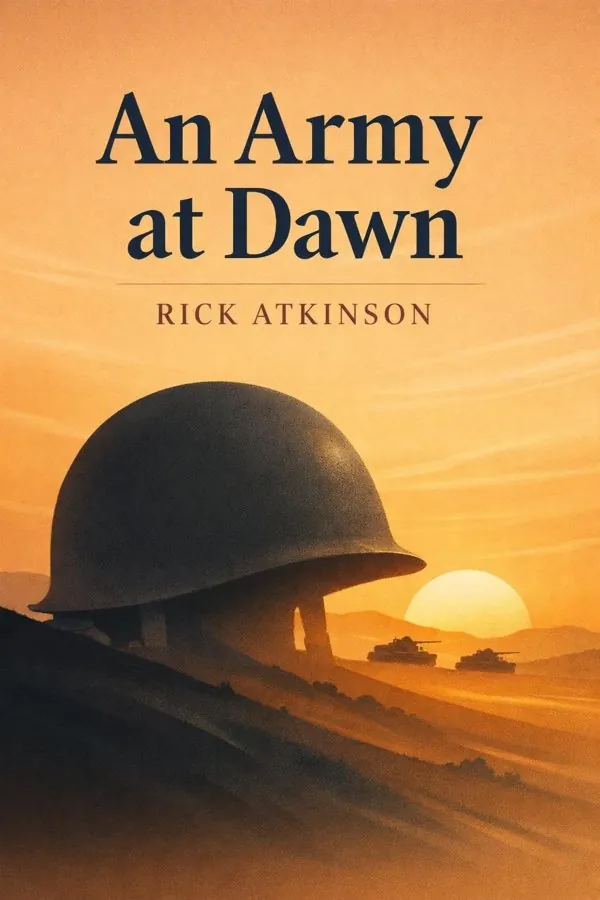
An Army at Dawn: The War in North Africa, 1942–1943: Summary & Key Insights
 10 min10 chaptersAudio available
Key Takeaways from An Army at Dawn: The War in North Africa, 1942–1943
Great campaigns often begin not with certainty but with disagreement.
First contact with reality usually shatters plans.
Armies do not rise above the quality of their leadership for long.
A successful landing is only the beginning; the enemy gets a vote.
Victory is sometimes delayed not by grand defeat but by accumulated friction.
What Is An Army at Dawn: The War in North Africa, 1942–1943 About?
An Army at Dawn: The War in North Africa, 1942–1943 by Rick Atkinson is a war_military book spanning 10 pages. An Army at Dawn tells the story of the Allied campaign in North Africa from the landings of Operation Torch in late 1942 to the final defeat of Axis forces in Tunisia in 1943. But Rick Atkinson’s book is far more than a battle chronicle. It is an account of how the United States Army, inexperienced and often poorly led, entered the Second World War against hardened German and Italian opponents and learned, painfully, what modern war demanded. Through vivid scenes, sharp portraits of commanders, and meticulous research, Atkinson shows that victory did not begin with smooth triumph but with confusion, miscalculation, political compromise, and costly improvisation. The campaign became the proving ground for Allied cooperation, battlefield adaptation, and strategic patience. Atkinson writes with the authority of a Pulitzer Prize-winning journalist and historian, combining archival depth with narrative power. The result is a military history that feels immediate and human, revealing how ordinary soldiers, flawed generals, and uneasy allies together shaped the first major American step toward the liberation of Europe.
This FizzRead summary covers all 10 key chapters of An Army at Dawn: The War in North Africa, 1942–1943 in approximately 10 minutes, distilling the most important ideas, arguments, and takeaways from Rick Atkinson's work. Also available as an audio summary and Key Quotes Podcast.
An Army at Dawn: The War in North Africa, 1942–1943
An Army at Dawn tells the story of the Allied campaign in North Africa from the landings of Operation Torch in late 1942 to the final defeat of Axis forces in Tunisia in 1943. But Rick Atkinson’s book is far more than a battle chronicle. It is an account of how the United States Army, inexperienced and often poorly led, entered the Second World War against hardened German and Italian opponents and learned, painfully, what modern war demanded. Through vivid scenes, sharp portraits of commanders, and meticulous research, Atkinson shows that victory did not begin with smooth triumph but with confusion, miscalculation, political compromise, and costly improvisation. The campaign became the proving ground for Allied cooperation, battlefield adaptation, and strategic patience. Atkinson writes with the authority of a Pulitzer Prize-winning journalist and historian, combining archival depth with narrative power. The result is a military history that feels immediate and human, revealing how ordinary soldiers, flawed generals, and uneasy allies together shaped the first major American step toward the liberation of Europe.
Who Should Read An Army at Dawn: The War in North Africa, 1942–1943?
This book is perfect for anyone interested in war_military and looking to gain actionable insights in a short read. Whether you're a student, professional, or lifelong learner, the key ideas from An Army at Dawn: The War in North Africa, 1942–1943 by Rick Atkinson will help you think differently.
- ✓Readers who enjoy war_military and want practical takeaways
- ✓Professionals looking to apply new ideas to their work and life
- ✓Anyone who wants the core insights of An Army at Dawn: The War in North Africa, 1942–1943 in just 10 minutes
Want the full summary?
Get instant access to this book summary and 100K+ more with Fizz Moment.
Get Free SummaryAvailable on App Store • Free to download
Key Chapters
Great campaigns often begin not with certainty but with disagreement. Operation Torch, the Allied invasion of French North Africa in November 1942, emerged from fierce debate between American and British leaders about where to strike the Axis first. U.S. commanders initially favored an early cross-Channel invasion of France, while the British argued that the Allies were not yet ready for such a direct assault. North Africa became the compromise: a campaign that could engage German forces, test American troops, secure Mediterranean routes, and prepare the coalition for larger operations ahead.
Atkinson shows that Torch was not simply a military landing plan. It was a geopolitical wager involving Vichy French authorities, uncertain local loyalties, secret diplomacy, and the risk that the Axis would react faster than the Allies could consolidate their gains. The invasion force had to cross the Atlantic, coordinate multinational commands, and land at Casablanca, Oran, and Algiers with only imperfect intelligence about what resistance they would face. Even before the first shots, the campaign exposed a central truth of coalition war: strategy is shaped as much by politics and logistics as by battlefield ambition.
The broader application is clear. In business, government, and leadership, major initiatives are rarely chosen from ideal options. More often, they are compromises shaped by timing, capability, and alliance management. Torch succeeded not because it was simple, but because leaders accepted an imperfect plan that still moved them toward a larger objective.
Actionable takeaway: When facing a high-stakes decision, do not wait for a flawless option. Choose the path that builds capability, preserves momentum, and prepares you for the bigger battle ahead.
First contact with reality usually shatters plans. The Allied landings in North Africa looked bold on paper, but once the troops approached shore, confusion spread quickly. At Casablanca, American forces encountered fierce resistance from French coastal batteries and naval gunfire, including the battleship Jean Bart. At Oran, navigational errors, communication failures, and underestimation of defenses created dangerous disorder. At Algiers, some landings went more smoothly, aided by local contacts and political maneuvering, but even there uncertainty ruled the opening hours.
Atkinson’s account emphasizes a crucial distinction: bravery is not the same as preparedness. The soldiers often behaved with remarkable courage, but the machinery around them—planning, coordination, intelligence, amphibious technique, command clarity—was still immature. Units became separated. Timetables unraveled. Supplies lagged behind. Officers struggled to make sense of rapidly changing conditions. These problems were not signs of cowardice; they were the inevitable consequences of sending an untested army into one of the most complicated forms of warfare.
That lesson extends far beyond military history. Organizations often celebrate commitment while neglecting execution. A team may be talented and motivated yet still fail if systems, training, and communication are weak. The landings in North Africa show that grit matters most when institutions have also invested in competence.
Practical examples abound: product launches fail from poor coordination, crisis responses falter from unclear authority, and ambitious reforms collapse when frontline teams receive too little preparation. Heroism cannot substitute for structure.
Actionable takeaway: Before any major launch, stress-test your plan for communication breakdowns, unclear roles, and logistical bottlenecks. Courage is essential, but preparation turns courage into results.
Armies do not rise above the quality of their leadership for long. One of Atkinson’s most powerful themes is that the North African campaign was a harsh examination of commanders at every level. Some officers proved inspiring, decisive, and capable of learning under fire. Others were vain, rigid, confused, or outmatched by events. The contrast between leaders mattered enormously because inexperienced troops needed clarity, discipline, and confidence from above.
The book pays close attention to figures such as Dwight Eisenhower, trying to hold together a politically fragile coalition; George Patton, bringing energy, severity, and operational drive; Lloyd Fredendall, whose poor command decisions would contribute to disaster; and British leaders navigating their own assumptions about American military inexperience. Leadership in this setting was not just about tactical brilliance. It involved temperament, coalition diplomacy, logistics, morale, and the willingness to confront unpleasant facts.
A recurring insight is that rank does not guarantee competence. Some commanders hid behind distance, reports, and self-protection, while others moved toward friction and uncertainty. Good leaders created coherence where conditions were chaotic. Poor leaders amplified confusion and cost lives.
This applies directly to modern institutions. In volatile environments, leadership is tested less by plans made in comfort than by choices made amid incomplete information. Teams notice quickly whether a leader is grounded in reality, open to feedback, and willing to adapt.
Examples from everyday work are familiar: a manager who blames subordinates weakens performance, while one who clarifies priorities and absorbs pressure strengthens the group. North Africa shows that leadership failures are rarely abstract; they become operational failures.
Actionable takeaway: Evaluate leaders not by confidence alone but by how well they communicate under pressure, learn from setbacks, and turn complexity into clear action.
A successful landing is only the beginning; the enemy gets a vote. One reason the North African campaign became so difficult was the speed and skill with which Germany responded to Operation Torch. Rather than surrendering Tunisia by default, the Axis rushed troops, aircraft, and equipment into the region, turning what might have been a quick exploitation into a grueling contest. The narrow distance from Sicily to Tunisia gave the Germans and Italians a logistical advantage the Allies could not easily offset in the early stages.
Atkinson shows that Allied assumptions about momentum were overly optimistic. Political success in securing parts of French North Africa did not automatically translate into operational dominance. German commanders recognized Tunisia’s value as a bridgehead and moved aggressively to hold it. Terrain, weather, and Allied inexperience compounded the problem. What followed was not a simple pursuit of a retreating enemy, but a race the Allies initially failed to win.
This key idea highlights the danger of confusing an initial breakthrough with lasting success. In strategy, competitors adapt. Markets react. Opponents exploit your transition period. The side that moves fastest after the first shock often seizes the initiative.
Practical application is easy to see in business and politics. A company launches a strong new product, but rivals respond with discounts, copycat features, or legal challenges. A reform agenda wins public attention, but entrenched interests regroup quickly. The opening move matters, yet the counter-move often determines the real struggle.
Actionable takeaway: After any early win, assume resistance will intensify. Build your follow-through plan before you celebrate the breakthrough.
Victory is sometimes delayed not by grand defeat but by accumulated friction. The struggle for Tunisia became the central test of the North African campaign because it forced the Allies to fight a stubborn enemy in difficult terrain under imperfect conditions. Mountain ridges, narrow passes, winter rains, muddy roads, and strained supply lines slowed every advance. Units that looked strong on maps found themselves exhausted by distance, weather, and the enemy’s tactical skill.
Atkinson captures how Tunisia defied easy narratives of liberation. The campaign became a prolonged contest of maneuver, artillery, air power, and endurance. The Axis held strong defensive positions and exploited the Allies’ mistakes. The Americans, in particular, discovered that modern war was not won through enthusiasm alone. It required coordination between infantry, armor, artillery, engineers, and aircraft. It also required patience. Every hill, valley, and road junction could consume time and lives.
This idea matters because many readers imagine turning points as dramatic single events. Atkinson reminds us that historical outcomes often emerge from attritional pressure: better logistics, steadier command, improved cooperation, and the gradual wearing down of an opponent’s options.
The same pattern appears in complex personal and professional goals. Major transformations rarely happen through one decisive effort. More often, progress comes from sustained pressure applied through systems, repetition, and resilience. A turnaround at work, a recovery plan, or a long-term research project succeeds because people keep solving small hard problems over time.
Actionable takeaway: When progress feels slow, measure momentum by cumulative gains, not dramatic moments. Endurance, coordination, and steady improvement often matter more than spectacular breakthroughs.
Nothing accelerates learning like failure that cannot be explained away. The Battle of Kasserine Pass in February 1943 stands as the campaign’s most sobering moment for American forces. German troops under experienced commanders struck U.S. positions in Tunisia and exploited weak dispositions, poor coordination, confused command relationships, and inadequate battlefield judgment. The result was a humiliating setback that shattered illusions about American readiness.
Atkinson does not present Kasserine as a simple story of cowardice or incompetence. Many American soldiers fought hard. The deeper problem was systemic: inexperienced units were badly deployed, senior leadership was ineffective, intelligence and reconnaissance were mishandled, and combined arms doctrine was not yet fully understood in practice. Men and materiel were lost, but just as important, a dangerous fantasy was stripped away. The U.S. Army could no longer pretend that industrial power and enthusiasm would automatically overcome veteran German forces.
Kasserine matters because institutions often need a painful reckoning before real reform becomes possible. Organizations cling to comforting narratives until hard evidence makes denial impossible. Defeat, while costly, can clarify weaknesses more honestly than partial success ever does.
Modern examples are common. A failed merger reveals cultural problems. A public product breakdown exposes weak quality control. A poor election result uncovers strategic confusion. In each case, the failure becomes valuable only if leaders diagnose rather than deflect.
Actionable takeaway: Treat major setbacks as audits of reality. After failure, identify the structural causes, not just the visible symptoms, and make changes while the lesson is still vivid.
The most important transformation in North Africa was not territorial; it was institutional. After early missteps and the shock of Kasserine Pass, the Allied command—especially the American Army—began to adapt. Under stronger leadership and with clearer operational methods, units improved their coordination, discipline, and responsiveness. Training became more realistic. Command structures were refined. Air-ground cooperation improved. Leaders who could not perform were replaced or sidelined.
Atkinson shows that military effectiveness is built, not assumed. The American Army that arrived in North Africa in late 1942 was not the same force that emerged months later. It had learned how to move supplies over long distances, how to synchronize armor and infantry, how to use artillery more effectively, and how to cooperate more credibly with British allies. None of this happened automatically. It came through criticism, friction, and repeated exposure to danger.
This is one of the book’s most useful lessons for any reader interested in improvement. Competence grows when feedback is taken seriously and translated into changed behavior. Too many institutions conduct postmortems that generate reports but not reform. In North Africa, the cost of failing to adapt was immediate and deadly, so learning became operational rather than theoretical.
You can apply this principle in smaller settings: after a difficult project, rewrite workflows; after a weak presentation, redesign preparation habits; after team misalignment, clarify decisions and accountability. Growth requires systems, not slogans.
Actionable takeaway: Build a habit of rapid learning loops—review what failed, decide what must change, and implement those changes before the next challenge arrives.
No single nation or commander won North Africa alone. One of Atkinson’s central achievements is showing how Allied victory depended on the difficult art of coalition warfare. Americans brought manpower, industrial potential, and growing operational energy. The British brought hard-earned battlefield experience, established logistics, and deep familiarity with the Mediterranean theater. Free French and local actors also influenced outcomes politically and militarily. The campaign succeeded because these strengths, however unevenly, were eventually combined.
Coalition war is inherently frustrating. Allies disagree over strategy, prestige, priorities, and methods. They carry different historical memories and institutional habits. Atkinson highlights these tensions without reducing them to personalities alone. Suspicion between American and British officers was real. So were cultural misunderstandings and clashes of doctrine. Yet the campaign demonstrates that effective collaboration does not require perfect harmony. It requires shared purpose, practical compromise, and enough mutual respect to keep fighting together.
The Allied counteroffensive in Tunisia reflected this growing maturity. Better coordination of land, air, and logistical power gradually compressed Axis options. What had once been a loose and awkward partnership became a more capable war-making system.
This insight has obvious modern relevance. Complex problems—public health, climate policy, large-scale innovation, multinational business operations—cannot be solved by isolated excellence. They demand coalitions across organizations that think differently and move at different speeds.
Actionable takeaway: In any partnership, stop waiting for perfect alignment. Define the shared objective, clarify complementary strengths, and create routines that make cooperation possible even when trust is still developing.
Sometimes a campaign’s true significance appears only when viewed from the next battlefield. The final collapse of Axis forces in Tunisia in May 1943 ended the North African war with the surrender of a vast number of German and Italian troops. This was more than a regional victory. It removed Axis power from North Africa, secured the southern Mediterranean, opened the path to the invasion of Sicily and then Italy, and gave the Western Allies confidence that they could defeat German forces in sustained operations.
Atkinson makes clear that the outcome was not inevitable. It was earned through months of difficult adaptation, coalition management, and cumulative pressure. By the time the Axis position became untenable, Allied superiority in air power, logistics, and operational coordination had grown overwhelming. The enemy’s inability to resupply and maneuver effectively turned resistance into collapse.
The larger lesson is that strategic victories often come from campaigns that look messy while they are unfolding. North Africa was full of mistakes, egos, delays, and avoidable losses. Yet it created the conditions for future success. Institutions sometimes become effective through imperfect, painful experience rather than elegant design.
In practical terms, this matters whenever people judge an effort too early. A rough first year in a new role, a flawed pilot program, or a difficult partnership may still build the capabilities needed for later success. Not every uneven beginning is a failure; some are formative stages.
Actionable takeaway: Evaluate progress by the capacity it creates for future wins. A hard campaign may be worthwhile if it leaves you stronger, smarter, and better positioned for what comes next.
The deepest truth in military history is that strategy is lived by individuals. Beyond maps, command disputes, and campaign outcomes, Atkinson never lets readers forget the human dimension of North Africa. Young soldiers crossed an ocean into danger with little understanding of what awaited them. Many were frightened, poorly prepared, and far from home. Some discovered courage they did not know they possessed; others broke under strain; many died in places whose names meant nothing to them before the war.
The book’s enduring power comes from this blend of operational history and intimate observation. Generals argue, governments maneuver, and armies advance, but war is finally measured in the bodies, memories, grief, and moral wear left behind. Atkinson also shows that victory does not erase suffering. Success in North Africa came with heavy losses and with lessons written in blood.
This matters because readers often consume history at the scale of nations and abstractions. Atkinson insists on a different perspective: institutions learn through people, and strategic achievements are purchased by individual sacrifice. Remembering that fact makes us more serious in how we think about power, leadership, and war.
The application is not limited to military matters. In any large system—corporations, governments, schools—high-level decisions affect real lives. Metrics can hide the human consequences of poor planning or careless leadership.
Actionable takeaway: Whenever you assess a strategy, ask who bears the cost of your decisions. Good judgment requires seeing not only outcomes and efficiencies, but also the people who must live through the process.
All Chapters in An Army at Dawn: The War in North Africa, 1942–1943
About the Author
Rick Atkinson is an American author, journalist, and historian best known for his acclaimed works on military history. A longtime reporter and editor at The Washington Post, he covered national security, the military, and international affairs with the depth and discipline that later shaped his historical writing. He has won multiple major honors, including the Pulitzer Prize, and is especially celebrated for the Liberation Trilogy, his sweeping account of the Allied war in Europe during World War II. The first volume, An Army at Dawn, received the Pulitzer Prize for History. Atkinson is admired for combining exhaustive research with vivid narrative storytelling, bringing commanders, soldiers, and campaigns to life while preserving analytical rigor. His work appeals to both serious historians and general readers.
Get This Summary in Your Preferred Format
Read or listen to the An Army at Dawn: The War in North Africa, 1942–1943 summary by Rick Atkinson anytime, anywhere. FizzRead offers multiple formats so you can learn on your terms — all free.
Available formats: App · Audio · PDF · EPUB — All included free with FizzRead
Download An Army at Dawn: The War in North Africa, 1942–1943 PDF and EPUB Summary
Key Quotes from An Army at Dawn: The War in North Africa, 1942–1943
“Great campaigns often begin not with certainty but with disagreement.”
“First contact with reality usually shatters plans.”
“Armies do not rise above the quality of their leadership for long.”
“A successful landing is only the beginning; the enemy gets a vote.”
“Victory is sometimes delayed not by grand defeat but by accumulated friction.”
Frequently Asked Questions about An Army at Dawn: The War in North Africa, 1942–1943
An Army at Dawn: The War in North Africa, 1942–1943 by Rick Atkinson is a war_military book that explores key ideas across 10 chapters. An Army at Dawn tells the story of the Allied campaign in North Africa from the landings of Operation Torch in late 1942 to the final defeat of Axis forces in Tunisia in 1943. But Rick Atkinson’s book is far more than a battle chronicle. It is an account of how the United States Army, inexperienced and often poorly led, entered the Second World War against hardened German and Italian opponents and learned, painfully, what modern war demanded. Through vivid scenes, sharp portraits of commanders, and meticulous research, Atkinson shows that victory did not begin with smooth triumph but with confusion, miscalculation, political compromise, and costly improvisation. The campaign became the proving ground for Allied cooperation, battlefield adaptation, and strategic patience. Atkinson writes with the authority of a Pulitzer Prize-winning journalist and historian, combining archival depth with narrative power. The result is a military history that feels immediate and human, revealing how ordinary soldiers, flawed generals, and uneasy allies together shaped the first major American step toward the liberation of Europe.
More by Rick Atkinson

You Might Also Like

Patriot
Andrew Britton
10 min
War
John Hersey
10 min
Brave New War: The Next Stage of Terrorism and the End of Globalization
John Robb
10 min
Catch-22
Joseph Heller
10 min
Command and Control: Nuclear Weapons, the Damascus Accident, and the Illusion of Safety
Eric Schlosser
10 min
Countdown to Zero Day: Stuxnet and the Launch of the World's First Digital Weapon
Kim Zetter
10 minBrowse by Category
Ready to read An Army at Dawn: The War in North Africa, 1942–1943?
Get the full summary and 100K+ more books with Fizz Moment.