
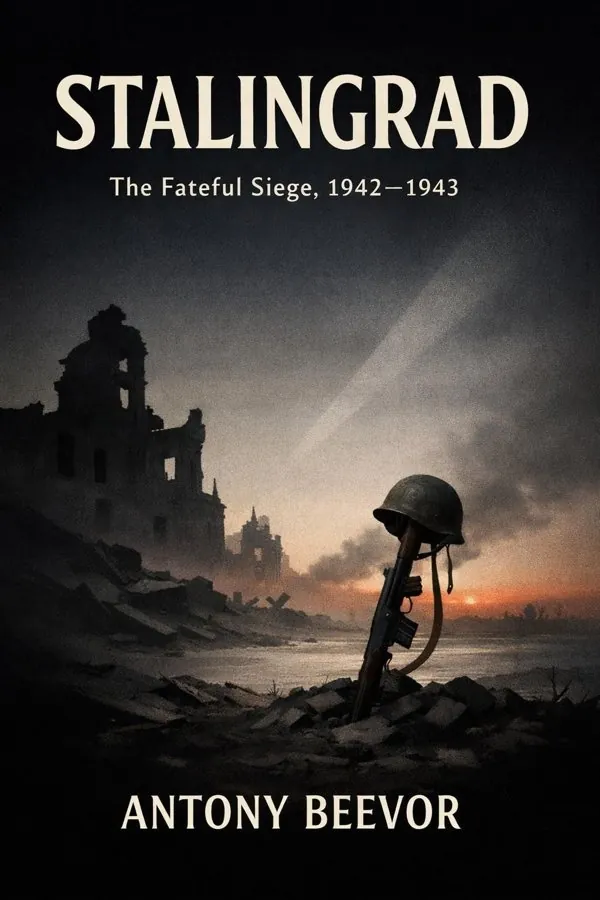
Stalingrad: The Fateful Siege, 1942–1943: Summary & Key Insights
 10 min9 chaptersAudio available
What Is Stalingrad: The Fateful Siege, 1942–1943 About?
Stalingrad: The Fateful Siege, 1942–1943 by Antony Beevor is a war_military book spanning 9 pages. A detailed historical account of the Battle of Stalingrad, one of the most decisive and brutal confrontations of World War II. Antony Beevor reconstructs the events from both the German and Soviet perspectives, drawing on extensive archival research to depict the human suffering, military strategy, and political context that shaped the outcome of the siege.
This FizzRead summary covers all 9 key chapters of Stalingrad: The Fateful Siege, 1942–1943 in approximately 10 minutes, distilling the most important ideas, arguments, and takeaways from Antony Beevor's work. Also available as an audio summary and Key Quotes Podcast.
Stalingrad: The Fateful Siege, 1942–1943
A detailed historical account of the Battle of Stalingrad, one of the most decisive and brutal confrontations of World War II. Antony Beevor reconstructs the events from both the German and Soviet perspectives, drawing on extensive archival research to depict the human suffering, military strategy, and political context that shaped the outcome of the siege.
Who Should Read Stalingrad: The Fateful Siege, 1942–1943?
This book is perfect for anyone interested in war_military and looking to gain actionable insights in a short read. Whether you're a student, professional, or lifelong learner, the key ideas from Stalingrad: The Fateful Siege, 1942–1943 by Antony Beevor will help you think differently.
- ✓Readers who enjoy war_military and want practical takeaways
- ✓Professionals looking to apply new ideas to their work and life
- ✓Anyone who wants the core insights of Stalingrad: The Fateful Siege, 1942–1943 in just 10 minutes
Want the full summary?
Get instant access to this book summary and 100K+ more with Fizz Moment.
Get Free SummaryAvailable on App Store • Free to download
Key Chapters
In the wake of Operation Barbarossa, launched in June 1941, the German army had achieved the unthinkable—sweeping deep across Soviet territory, capturing millions of prisoners, and devastating entire Soviet divisions with lightning speed. When the dust of summer settled, much of European Russia was under occupation. Hitler and his generals believed victory was inevitable and imminent.
But that triumph concealed a fatal miscalculation. The Wehrmacht’s success had outpaced its logistical capacity. Its armored spearheads stretched thin across vast landscapes that devoured fuel and ammunition faster than Germany could replace them. The Soviet system, though battered, had not collapsed; its core industries were relocated east beyond the Volga, its population mobilized for an existential struggle.
By the winter of 1941, the German advance stalled before Moscow. The myth of invincibility began to fracture. Men who had marched under the banner of quick blitzkrieg found themselves freezing in unheated positions, their supply lines shredded by the immensity of the Russian winter. Barbarossa had broken the old strategic rhythm and turned the war into a campaign of attrition.
From my research, drawn from field diaries and officer reports, it is clear that this moment marked the first shift in the balance of confidence. The German high command, pressed for resources, began looking southward—for oil from the Caucasus and for a symbolic victory that could demoralize the Soviets once and for all. That victory, Hitler decided, would come from taking Stalingrad—a city whose very name carried Stalin’s personal signature, and whose capture would resonate globally as proof of Nazi supremacy.
Hitler’s obsession with Stalingrad was not born purely of military logic. By 1942, he had begun micromanaging his generals to an extraordinary degree, seeing operational maps not only as planning tools but as instruments of personal vindication. The city offered dual allure: it sat astride the Volga River, vital for Soviet supply lines, and its name, echoing Stalin’s, promised enormous propaganda value.
It was this toxic fusion of vanity, ideology, and misjudgment that doomed the German Sixth Army. Hitler underestimated Soviet resilience and overestimated his own power to compel victory through sheer will. To him, controlling Stalingrad meant controlling the East. Yet, by reducing a strategic campaign to a symbolic contest between two dictators, he transformed rational objectives into fatal rigidity.
General Friedrich Paulus, appointed to lead the Sixth Army, was a meticulous planner but lacked the instinctive audacity of a field commander. He executed Hitler’s orders with precision even as the situation deteriorated beyond repair. For the soldiers on the ground, Stalingrad became less a battlefield than a labyrinth where fanaticism replaced foresight.
In archives from both sides, one sees how this decision unfolded as a psychological drama. Stalin, equally obsessed with defending the city, forbade withdrawal. Hitler forbade retreat. The result was an apocalyptic zero-sum contest. This fixation on ideological victory ignored the very real demands of logistics, climate, and morale. By summer’s end, both men had committed their nations to a siege that would define the war’s remainder.
+ 7 more chapters — available in the FizzRead app
All Chapters in Stalingrad: The Fateful Siege, 1942–1943
About the Author
Antony Beevor is a British historian and former army officer known for his works on World War II, including 'Stalingrad', 'Berlin: The Downfall 1945', and 'D-Day'. His books are acclaimed for their narrative clarity and use of newly available archival sources.
Get This Summary in Your Preferred Format
Read or listen to the Stalingrad: The Fateful Siege, 1942–1943 summary by Antony Beevor anytime, anywhere. FizzRead offers multiple formats so you can learn on your terms — all free.
Available formats: App · Audio · PDF · EPUB — All included free with FizzRead
Download Stalingrad: The Fateful Siege, 1942–1943 PDF and EPUB Summary
Key Quotes from Stalingrad: The Fateful Siege, 1942–1943
“When the dust of summer settled, much of European Russia was under occupation.”
“Hitler’s obsession with Stalingrad was not born purely of military logic.”
Frequently Asked Questions about Stalingrad: The Fateful Siege, 1942–1943
Stalingrad: The Fateful Siege, 1942–1943 by Antony Beevor is a war_military book that explores key ideas across 9 chapters. A detailed historical account of the Battle of Stalingrad, one of the most decisive and brutal confrontations of World War II. Antony Beevor reconstructs the events from both the German and Soviet perspectives, drawing on extensive archival research to depict the human suffering, military strategy, and political context that shaped the outcome of the siege.
More by Antony Beevor
You Might Also Like

Patriot
Andrew Britton
10 min
War
John Hersey
10 min
An Army at Dawn: The War in North Africa, 1942–1943
Rick Atkinson
10 min
Brave New War: The Next Stage of Terrorism and the End of Globalization
John Robb
10 min
Catch-22
Joseph Heller
10 min
Command and Control: Nuclear Weapons, the Damascus Accident, and the Illusion of Safety
Eric Schlosser
10 minBrowse by Category
Ready to read Stalingrad: The Fateful Siege, 1942–1943?
Get the full summary and 100K+ more books with Fizz Moment.