
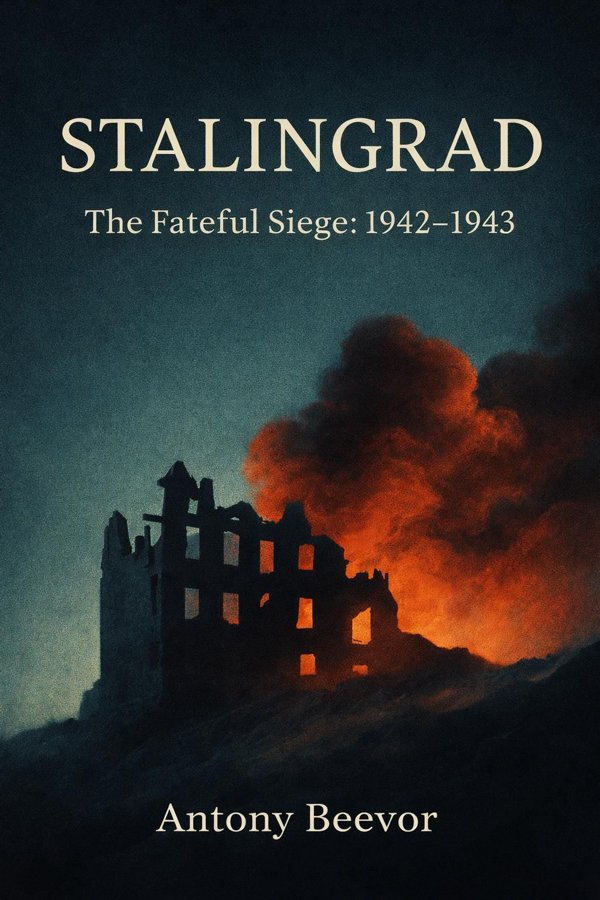
Stalingrad: The Fateful Siege: 1942-1943: Summary & Key Insights
 10 min9 chaptersAudio available
Key Takeaways from Stalingrad: The Fateful Siege: 1942-1943
Great disasters rarely begin in a single moment; they are usually the result of earlier delusions left uncorrected.
When leaders confuse symbols with strategy, they often drag entire institutions into ruin.
A city can stop being a place to live and become a machine for destruction.
Courage in war is rarely pure; it is often mixed with fear, coercion, duty, and desperation.
The most decisive victories often come not from brute force at the center, but from striking the neglected edges.
What Is Stalingrad: The Fateful Siege: 1942-1943 About?
Stalingrad: The Fateful Siege: 1942-1943 by Antony Beevor is a war_military book spanning 6 pages. Antony Beevor’s Stalingrad: The Fateful Siege: 1942-1943 is one of the most gripping and influential accounts ever written about the battle that changed the course of World War II. More than a military history, it is a study of how ideology, leadership, fear, hunger, and endurance collide under the most extreme conditions imaginable. Beevor reconstructs the German advance, the Soviet defense, the destruction of the city, the encirclement of the Sixth Army, and the terrible final collapse with both strategic clarity and emotional force. What makes the book especially powerful is its refusal to reduce Stalingrad to maps and troop movements alone; it restores the voices of soldiers, officers, nurses, civilians, and political enforcers who lived through the catastrophe. Drawing on Soviet archives, German records, letters, diaries, and firsthand testimony, Beevor combines deep research with a novelist’s sense of momentum. The result is a definitive portrait of a battle that was not only a turning point in the war, but also a warning about the human cost of pride, fanaticism, and total war.
This FizzRead summary covers all 9 key chapters of Stalingrad: The Fateful Siege: 1942-1943 in approximately 10 minutes, distilling the most important ideas, arguments, and takeaways from Antony Beevor's work. Also available as an audio summary and Key Quotes Podcast.
Stalingrad: The Fateful Siege: 1942-1943
Antony Beevor’s Stalingrad: The Fateful Siege: 1942-1943 is one of the most gripping and influential accounts ever written about the battle that changed the course of World War II. More than a military history, it is a study of how ideology, leadership, fear, hunger, and endurance collide under the most extreme conditions imaginable. Beevor reconstructs the German advance, the Soviet defense, the destruction of the city, the encirclement of the Sixth Army, and the terrible final collapse with both strategic clarity and emotional force. What makes the book especially powerful is its refusal to reduce Stalingrad to maps and troop movements alone; it restores the voices of soldiers, officers, nurses, civilians, and political enforcers who lived through the catastrophe. Drawing on Soviet archives, German records, letters, diaries, and firsthand testimony, Beevor combines deep research with a novelist’s sense of momentum. The result is a definitive portrait of a battle that was not only a turning point in the war, but also a warning about the human cost of pride, fanaticism, and total war.
Who Should Read Stalingrad: The Fateful Siege: 1942-1943?
This book is perfect for anyone interested in war_military and looking to gain actionable insights in a short read. Whether you're a student, professional, or lifelong learner, the key ideas from Stalingrad: The Fateful Siege: 1942-1943 by Antony Beevor will help you think differently.
- ✓Readers who enjoy war_military and want practical takeaways
- ✓Professionals looking to apply new ideas to their work and life
- ✓Anyone who wants the core insights of Stalingrad: The Fateful Siege: 1942-1943 in just 10 minutes
Want the full summary?
Get instant access to this book summary and 100K+ more with Fizz Moment.
Get Free SummaryAvailable on App Store • Free to download
Key Chapters
Great disasters rarely begin in a single moment; they are usually the result of earlier delusions left uncorrected. Beevor shows that Stalingrad cannot be understood without looking back to Operation Barbarossa in 1941, when Nazi Germany invaded the Soviet Union expecting a quick and decisive victory. The early gains were spectacular, but the campaign rested on false assumptions: that the Soviet state would collapse, that the Red Army could not recover, and that brutal occupation policies would not provoke deeper resistance. Instead, the Germans found themselves fighting across enormous distances against an enemy with vast reserves of manpower, industrial capacity, and political will.
The failure to secure a decisive victory in 1941 left Germany overstretched and increasingly dependent on risky offensives to regain momentum. Rather than reassess strategy, Hitler doubled down. He split forces, chased symbolic and economic objectives, and treated setbacks as matters of insufficient will rather than structural weakness. Beevor makes clear that Stalingrad was not an isolated mistake but the consequence of cumulative overreach.
The practical lesson extends far beyond military history. Organizations often mistake early success for proof that their assumptions are sound. A company expanding too fast, a political movement ignoring constraints, or a leader dismissing warnings can create the same pattern: short-term momentum masking long-term fragility.
Actionable takeaway: examine whether current ambition rests on verified capacity or on the dangerous belief that past victories guarantee future success.
When leaders confuse symbols with strategy, they often drag entire institutions into ruin. One of Beevor’s central insights is that Hitler’s determination to take Stalingrad was driven by more than military logic. The city mattered because of its location on the Volga and its connection to southern operations, but its name gave it enormous symbolic value. Capturing the city of Stalin became, for Hitler, a test of prestige, ideology, and personal dominance. Once that happened, rational military judgment began to disappear.
German commanders warned of overextension and the danger of fighting simultaneously for the Caucasus and Stalingrad. Their concerns were repeatedly overridden. Hitler’s command style became increasingly rigid, and his refusal to permit withdrawal would later doom the Sixth Army. Beevor portrays a leadership culture in which dissent narrowed, reality was distorted as it moved upward, and military planning became hostage to personal ego.
This idea matters because symbolic goals still distort modern decision-making. Companies chase headline-making acquisitions while neglecting balance sheets. Governments cling to public commitments long after circumstances change. Managers refuse to abandon failing projects because retreat feels humiliating. In each case, pride converts a manageable problem into a catastrophe.
Beevor’s account reminds us that strategic flexibility is not weakness. It is often the difference between survival and collapse. The inability to revise a plan in light of new evidence is itself a form of blindness.
Actionable takeaway: whenever a goal becomes emotionally charged or identity-defining, pause and ask whether you are pursuing real value or merely defending pride.
A city can stop being a place to live and become a machine for destruction. Beevor vividly describes how Stalingrad was transformed from an industrial center on the Volga into a shattered urban battlefield where every cellar, staircase, factory wall, and sewer tunnel became contested space. German firepower devastated the city, but the bombardment also created the very terrain that favored the defenders. Ruins neutralized many of the invaders’ advantages in mobility and coordination, forcing combat into brutal close quarters.
The Soviet defense under commanders such as Vasily Chuikov relied on tenacity, improvisation, and intimate knowledge of urban conditions. Soldiers fought from room to room, often at ranges so short that artillery and air support became difficult to use effectively. The famous phrase about “hugging” the enemy captures the logic: stay so close to German positions that the Wehrmacht could not exploit its technical superiority without hitting its own men.
Beevor also restores the human dimension of the city’s destruction. Civilians were trapped amid bombardment, starvation, and forced labor. Factories became fortresses. The landscape itself seemed to absorb and amplify suffering.
The wider application is clear: environments reshape outcomes. In any struggle, whether military, political, or organizational, context can overturn apparent advantages. Superior resources do not automatically translate into success if the terrain favors adaptation, resilience, and local initiative.
Actionable takeaway: before judging strength by numbers alone, assess how the environment may convert assets into liabilities and weaknesses into unexpected advantages.
Courage in war is rarely pure; it is often mixed with fear, coercion, duty, and desperation. Beevor’s account of the Soviet defense rejects simplistic heroism without denying real bravery. The Red Army’s stand at Stalingrad was sustained by patriotism, hatred of the invader, loyalty to comrades, and a growing belief that the Germans could be stopped. Yet it was also enforced by a ruthless system of discipline. Blocking detachments, political supervision, and severe punishment for retreat formed part of the machinery that held the line.
This duality is one of the book’s greatest strengths. Beevor does not romanticize Soviet resistance, but neither does he dismiss it as mere coercion. Soldiers endured unimaginable conditions for many reasons at once. Some fought because they believed in defending their homeland. Others fought because there was nowhere to go. Many fought because the men beside them were still fighting.
The practical relevance lies in understanding motivation honestly. Institutions often prefer flattering stories about morale, purpose, or loyalty. But durable performance under pressure usually rests on multiple forces: belief, peer pressure, incentives, discipline, fear of failure, and shared identity. Ignoring any one of these can lead to self-deception.
The lesson is not that terror is effective in any admirable sense, but that human behavior under extreme pressure is morally complicated. Beevor’s honesty helps us see how systems compel endurance while also extracting terrible costs.
Actionable takeaway: when evaluating resilience in any group, look beyond slogans and identify the full mix of incentives, beliefs, and pressures sustaining performance.
Few events reveal the fragility of morale more quickly than the realization that rescue may never come. After Operation Uranus sealed the ring around Stalingrad, the German Sixth Army moved from aggressive offense to anxious containment. Beevor traces how shock spread through the encircled forces. Soldiers who had expected victory found themselves cut off in freezing conditions with dwindling food, ammunition, fuel, and medical supplies. Commanders still spoke in the language of resolve, but reality grew harsher by the day.
A key part of the tragedy was Hitler’s insistence that the army hold its ground while Hermann Göring falsely promised that the Luftwaffe could supply it by air. The numbers never came close to what was required. Horses were slaughtered for food, the wounded went untreated, and units lost cohesion as physical deprivation deepened. Beevor captures the psychological collapse that follows when institutions continue to issue impossible orders long after circumstances have changed.
The broader lesson is that morale depends on trust as much as toughness. People can endure extraordinary hardship if they believe sacrifice has purpose and leaders are dealing honestly with reality. When leadership substitutes fantasy for logistics, confidence rots from within.
This pattern appears outside war as well: teams burn out when management promises resources that never arrive, communities lose faith when officials deny obvious facts, and organizations unravel when leaders mistake rhetoric for support.
Actionable takeaway: in any crisis, test plans against actual capacity and communicate constraints early, because false reassurance is often more destructive than bad news.
Nature does not care about ideology, and winter at Stalingrad became one of the battle’s most ruthless combatants. Beevor shows how cold magnified every existing weakness. Machines failed, weapons jammed, transport broke down, frostbite crippled troops, and inadequate clothing turned simple survival into a daily struggle. For the encircled Germans especially, winter was not just an uncomfortable backdrop; it was a force that accelerated starvation, sickness, and despair.
Yet the weather alone did not determine outcomes. Beevor carefully avoids the cliché that “General Winter” defeated the Germans by itself. Cold was devastating because it interacted with bad strategy, broken supply systems, exhausted men, and inflexible leadership. The Red Army suffered terribly too, but Soviet forces were operating within a framework increasingly better adapted to the conditions and supported by stronger logistics than the trapped Sixth Army.
This distinction matters. External conditions become decisive when systems are already brittle. Economic downturns, technological disruptions, public scrutiny, or sudden shocks do not ruin healthy institutions on their own; they expose weaknesses that were previously ignored.
The practical application is to build resilience before crisis hits. Stockpiles, contingency planning, realistic training, and flexible decision-making often seem inefficient in calm periods. In hard times, they become the difference between pressure and collapse.
Actionable takeaway: prepare for stress before it arrives by asking which environmental shocks would expose your current vulnerabilities, then strengthen those weak points while conditions are still manageable.
The end of Stalingrad was not a clean military conclusion but a descent into physical and moral exhaustion. Beevor recounts the final weeks of the trapped Sixth Army as a slow implosion. Starvation spread, discipline decayed, hospitals became scenes of horror, and thousands of wounded men were abandoned in cellars and frozen ruins. Senior officers faced impossible choices while Hitler promoted Paulus to field marshal in a transparent attempt to discourage surrender. Instead, surrender came anyway, though too late to save most of those still alive.
What makes this section so powerful is its refusal to isolate suffering on one side. Beevor also tracks the toll on Soviet troops and civilians, many of whom emerged from victory traumatized, brutalized, and bereaved. Triumph did not erase the degradation imposed by total war. The battle destroyed bodies, cities, illusions, and moral boundaries.
This idea matters because history is often simplified into winners and losers. Beevor insists that even decisive victory can leave deep spiritual and social damage. Institutions under extreme pressure may achieve their objective while normalizing cruelty, secrecy, and indifference to human cost.
In modern life, this is a warning against success metrics that ignore collateral damage. A project completed, a market won, or a political battle secured can still leave lasting harm if the means corrode the people involved.
Actionable takeaway: evaluate outcomes not only by whether a goal was achieved, but by what the process did to the humans who carried it through.
History does not end when the shooting stops; it enters a second life in memory, propaganda, and national identity. Beevor shows that Stalingrad quickly became more than a battle. In the Soviet Union, it was elevated into a sacred symbol of patriotic sacrifice, resilience, and inevitable victory. In Germany, it became a byword for catastrophe, hubris, and abandonment. These memory cultures shaped how generations understood the war, heroism, leadership, and national suffering.
Beevor’s contribution is to recover the complexity buried beneath official narratives. Soviet commemoration often minimized coercion, chaos, and the state’s own brutality. German memory could emphasize the suffering of ordinary soldiers while obscuring the ideological and criminal framework of the invasion. By returning to letters, archives, and testimonies, Beevor pushes back against comforting simplifications.
This is deeply relevant today because all societies edit their past. Organizations do it too. They create origin myths, failure stories, and heroic legends that help define identity but can also conceal uncomfortable truths. If left unchallenged, myth hardens into doctrine.
The practical lesson is not to reject collective memory altogether, but to interrogate it. Honest memory is more valuable than flattering memory because it enables learning. Sanitized remembrance produces pride without wisdom.
Actionable takeaway: revisit the stories your institution, community, or nation tells about its defining moments and ask what has been omitted, softened, or mythologized.
All Chapters in Stalingrad: The Fateful Siege: 1942-1943
About the Author
Antony Beevor is a British historian and former army officer renowned for his narrative histories of the Second World War. He gained international recognition with Stalingrad, which helped redefine popular military history by combining operational analysis with letters, diaries, interviews, and archival sources that illuminate the lived experience of war. He later wrote other major works including Berlin: The Downfall 1945, D-Day, and The Second World War. Beevor is widely admired for his ability to make complex campaigns readable without sacrificing seriousness or nuance. His work consistently emphasizes both command decisions and the suffering of ordinary people, making him one of the most influential and widely read modern historians of twentieth-century conflict.
Get This Summary in Your Preferred Format
Read or listen to the Stalingrad: The Fateful Siege: 1942-1943 summary by Antony Beevor anytime, anywhere. FizzRead offers multiple formats so you can learn on your terms — all free.
Available formats: App · Audio · PDF · EPUB — All included free with FizzRead
Download Stalingrad: The Fateful Siege: 1942-1943 PDF and EPUB Summary
Key Quotes from Stalingrad: The Fateful Siege: 1942-1943
“Great disasters rarely begin in a single moment; they are usually the result of earlier delusions left uncorrected.”
“When leaders confuse symbols with strategy, they often drag entire institutions into ruin.”
“A city can stop being a place to live and become a machine for destruction.”
“Courage in war is rarely pure; it is often mixed with fear, coercion, duty, and desperation.”
“The most decisive victories often come not from brute force at the center, but from striking the neglected edges.”
Frequently Asked Questions about Stalingrad: The Fateful Siege: 1942-1943
Stalingrad: The Fateful Siege: 1942-1943 by Antony Beevor is a war_military book that explores key ideas across 9 chapters. Antony Beevor’s Stalingrad: The Fateful Siege: 1942-1943 is one of the most gripping and influential accounts ever written about the battle that changed the course of World War II. More than a military history, it is a study of how ideology, leadership, fear, hunger, and endurance collide under the most extreme conditions imaginable. Beevor reconstructs the German advance, the Soviet defense, the destruction of the city, the encirclement of the Sixth Army, and the terrible final collapse with both strategic clarity and emotional force. What makes the book especially powerful is its refusal to reduce Stalingrad to maps and troop movements alone; it restores the voices of soldiers, officers, nurses, civilians, and political enforcers who lived through the catastrophe. Drawing on Soviet archives, German records, letters, diaries, and firsthand testimony, Beevor combines deep research with a novelist’s sense of momentum. The result is a definitive portrait of a battle that was not only a turning point in the war, but also a warning about the human cost of pride, fanaticism, and total war.
More by Antony Beevor
You Might Also Like

Patriot
Andrew Britton
10 min
War
John Hersey
10 min
An Army at Dawn: The War in North Africa, 1942–1943
Rick Atkinson
10 min
Brave New War: The Next Stage of Terrorism and the End of Globalization
John Robb
10 min
Catch-22
Joseph Heller
10 min
Command and Control: Nuclear Weapons, the Damascus Accident, and the Illusion of Safety
Eric Schlosser
10 minBrowse by Category
Ready to read Stalingrad: The Fateful Siege: 1942-1943?
Get the full summary and 100K+ more books with Fizz Moment.