
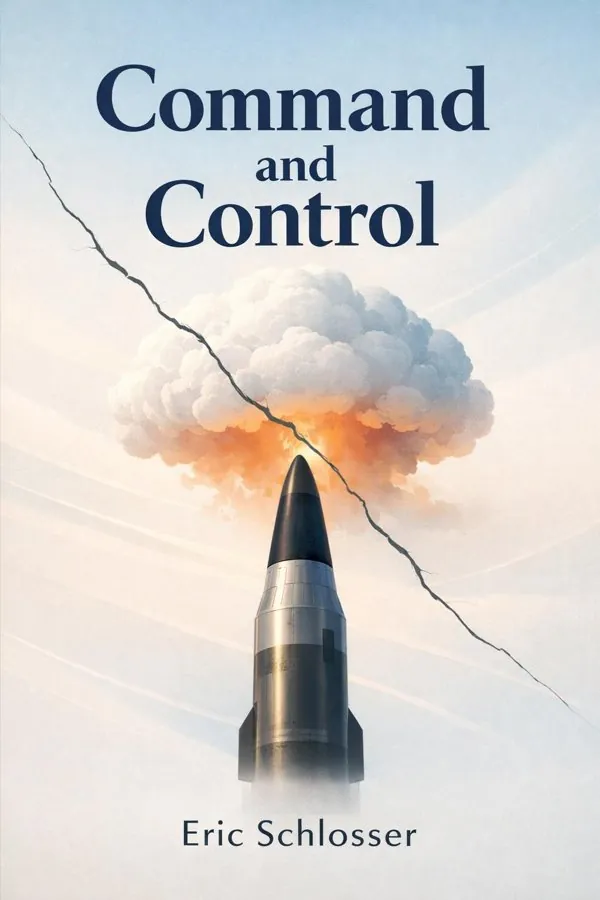
Command and Control: Nuclear Weapons, the Damascus Accident, and the Illusion of Safety: Summary & Key Insights
 10 min6 chaptersAudio available
What Is Command and Control: Nuclear Weapons, the Damascus Accident, and the Illusion of Safety About?
Command and Control: Nuclear Weapons, the Damascus Accident, and the Illusion of Safety by Eric Schlosser is a war_military book spanning 6 pages. Command and Control is a detailed historical investigation into the management, safety, and potential dangers of the United States' nuclear arsenal. Through the lens of the 1980 Damascus Titan II missile accident in Arkansas, Eric Schlosser explores the complex interplay between human error, technological failure, and bureaucratic secrecy that has shaped nuclear weapons policy. The book reveals how close the world has come to nuclear catastrophe and questions the illusion of control over such destructive power.
This FizzRead summary covers all 6 key chapters of Command and Control: Nuclear Weapons, the Damascus Accident, and the Illusion of Safety in approximately 10 minutes, distilling the most important ideas, arguments, and takeaways from Eric Schlosser's work. Also available as an audio summary and Key Quotes Podcast.
Command and Control: Nuclear Weapons, the Damascus Accident, and the Illusion of Safety
Command and Control is a detailed historical investigation into the management, safety, and potential dangers of the United States' nuclear arsenal. Through the lens of the 1980 Damascus Titan II missile accident in Arkansas, Eric Schlosser explores the complex interplay between human error, technological failure, and bureaucratic secrecy that has shaped nuclear weapons policy. The book reveals how close the world has come to nuclear catastrophe and questions the illusion of control over such destructive power.
Who Should Read Command and Control: Nuclear Weapons, the Damascus Accident, and the Illusion of Safety?
This book is perfect for anyone interested in war_military and looking to gain actionable insights in a short read. Whether you're a student, professional, or lifelong learner, the key ideas from Command and Control: Nuclear Weapons, the Damascus Accident, and the Illusion of Safety by Eric Schlosser will help you think differently.
- ✓Readers who enjoy war_military and want practical takeaways
- ✓Professionals looking to apply new ideas to their work and life
- ✓Anyone who wants the core insights of Command and Control: Nuclear Weapons, the Damascus Accident, and the Illusion of Safety in just 10 minutes
Want the full summary?
Get instant access to this book summary and 100K+ more with Fizz Moment.
Get Free SummaryAvailable on App Store • Free to download
Key Chapters
The Titan II stood at the heart of America’s nuclear strategy—a towering, liquid-fueled missile buried underground, always ready for war but ideally never to be fired. Its presence symbolized the logic of deterrence: readiness equals peace. But the environment in which these missiles existed was neither serene nor certain. Each silo was a sealed ecosystem of volatile chemistry, strict protocol, and relentless vigilance. Those who served within this system lived in close proximity to disaster. The fuel that powered the Titan II was hypergolic—it ignited spontaneously on contact—and slightest mishandling could trigger catastrophe.
I wanted to convey the duality of this environment: on one hand, the disciplined order of military procedure; on the other, the constant hum of danger that could erupt in seconds. The men stationed in Damascus, Arkansas, were young—many barely out of their teens—entrusted with the management of weapons able to vaporize entire cities. This combination of youth, responsibility, and monotony formed a psychological tension emblematic of the Cold War apparatus. It was not only about machines, but about human beings asked to live indefinitely at the edge of the unimaginable.
The Titan II’s design also reflected the mindset of its era: size equaled power, and power equaled deterrence. Yet as technology advanced, the complexity of these devices made them less predictable and harder to manage. Safety systems were often designed after accidents occurred rather than before. Through archives and interviews, I uncovered repeated patterns of risk disguised as innovation. The Titan II was not unique—it was part of a sprawling arsenal built faster than it could be adequately understood or controlled. In telling its story, I sought to illuminate how the Cold War’s faith in systems replaced the simpler, humbler awareness of their fallibility.
On the evening of September 18, 1980, routine maintenance at the Damascus silo went terribly wrong. Two maintenance airmen, working deep underground, dropped a socket from a wrench. The tool fell down the silo’s long shaft and punctured the missile’s pressurized fuel tank. In seconds, explosive vapor began filling the silo. The sequence that followed was a mixture of chaos, courage, and near-miraculous survival. I reconstructed this event through the voices of those who were there—technicians, commanders, and local residents who had no idea that an intercontinental missile carrying the most powerful warhead ever deployed by the United States was on the verge of exploding in their backyard.
The ensuing hours were filled with confusion. Safety procedures existed, but the situation had surpassed what the manuals could cover. Communication broke down between the silo crew and their higher command, as specialists argued over conflicting assessments. The airmen on site worked feverishly to prevent ignition, knowing that a spark could obliterate much of Arkansas. Some were ordered to withdraw; others insisted on staying, determined to contain the crisis. When the explosion came after midnight, the blast leveled the missile complex and killed Senior Airman David Livingston. The warhead was catapulted out of the silo; miraculously, it did not detonate.
What struck me most profoundly was that this catastrophe was not the result of incompetence. It arose from the ordinary realities of complex technology—tiny errors magnified by tightly coupled systems. A dropped socket revealed the inherent unpredictability in machines designed to be perfect. The Damascus accident laid bare a terrifying truth: control, when it comes to nuclear weapons, is a matter of luck as much as design.
+ 4 more chapters — available in the FizzRead app
All Chapters in Command and Control: Nuclear Weapons, the Damascus Accident, and the Illusion of Safety
About the Author
Eric Schlosser is an American investigative journalist and author known for his in-depth reporting on social, political, and economic issues. He gained prominence with his bestselling book Fast Food Nation and has written extensively on topics such as labor, nuclear weapons, and the American prison system.
Get This Summary in Your Preferred Format
Read or listen to the Command and Control: Nuclear Weapons, the Damascus Accident, and the Illusion of Safety summary by Eric Schlosser anytime, anywhere. FizzRead offers multiple formats so you can learn on your terms — all free.
Available formats: App · Audio · PDF · EPUB — All included free with FizzRead
Download Command and Control: Nuclear Weapons, the Damascus Accident, and the Illusion of Safety PDF and EPUB Summary
Key Quotes from Command and Control: Nuclear Weapons, the Damascus Accident, and the Illusion of Safety
“The Titan II stood at the heart of America’s nuclear strategy—a towering, liquid-fueled missile buried underground, always ready for war but ideally never to be fired.”
“On the evening of September 18, 1980, routine maintenance at the Damascus silo went terribly wrong.”
Frequently Asked Questions about Command and Control: Nuclear Weapons, the Damascus Accident, and the Illusion of Safety
Command and Control: Nuclear Weapons, the Damascus Accident, and the Illusion of Safety by Eric Schlosser is a war_military book that explores key ideas across 6 chapters. Command and Control is a detailed historical investigation into the management, safety, and potential dangers of the United States' nuclear arsenal. Through the lens of the 1980 Damascus Titan II missile accident in Arkansas, Eric Schlosser explores the complex interplay between human error, technological failure, and bureaucratic secrecy that has shaped nuclear weapons policy. The book reveals how close the world has come to nuclear catastrophe and questions the illusion of control over such destructive power.
More by Eric Schlosser

You Might Also Like
Patriot
Andrew Britton
10 min
War
John Hersey
10 min
An Army at Dawn: The War in North Africa, 1942–1943
Rick Atkinson
10 min
Brave New War: The Next Stage of Terrorism and the End of Globalization
John Robb
10 min
Catch-22
Joseph Heller
10 min
Countdown to Zero Day: Stuxnet and the Launch of the World's First Digital Weapon
Kim Zetter
10 minBrowse by Category
Ready to read Command and Control: Nuclear Weapons, the Damascus Accident, and the Illusion of Safety?
Get the full summary and 100K+ more books with Fizz Moment.