
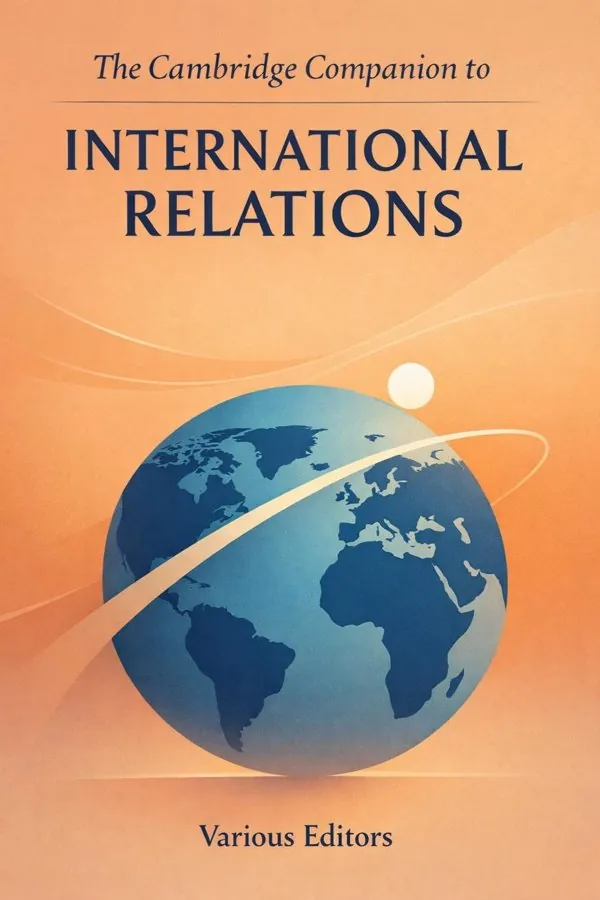
The Cambridge Companion to International Relations: Summary & Key Insights
 10 min10 chaptersAudio available
Key Takeaways from The Cambridge Companion to International Relations
Disciplines are often born from crisis, and international relations is no exception.
No single theory can capture world politics in full, and that is one of the central lessons of this companion.
Power is one of the oldest ideas in international relations, yet the book makes clear that it is never as simple as military force alone.
The more connected the world becomes, the less plausible it is to treat states as isolated units.
If the international system lacks a world government, why does cooperation happen as often as it does?
What Is The Cambridge Companion to International Relations About?
The Cambridge Companion to International Relations by Various Editors is a politics book spanning 13 pages. International relations is often described as the study of war, diplomacy, and states. This volume shows that it is far more than that: it is a way of understanding how power is organized, challenged, and transformed across the world. The Cambridge Companion to International Relations brings together leading scholars to map the discipline’s intellectual foundations, core debates, and emerging frontiers. Rather than defending one grand theory, it introduces readers to the major traditions that have shaped the field, from realism and liberalism to constructivism, critical theory, and beyond. What makes this book especially valuable is its balance. It explains big concepts such as sovereignty, security, globalization, institutions, and justice while also showing how they matter in practice, whether in war, trade negotiations, climate politics, or human rights advocacy. The collection matters because international relations affects everyday life: inflation, migration, conflict, energy markets, pandemics, and environmental risks all cross borders. Written by expert contributors with deep knowledge of both theory and contemporary global politics, this companion serves as an accessible but sophisticated guide for students, professionals, and curious readers seeking to understand how the international system works and why it remains contested.
This FizzRead summary covers all 10 key chapters of The Cambridge Companion to International Relations in approximately 10 minutes, distilling the most important ideas, arguments, and takeaways from Various Editors's work. Also available as an audio summary and Key Quotes Podcast.
The Cambridge Companion to International Relations
International relations is often described as the study of war, diplomacy, and states. This volume shows that it is far more than that: it is a way of understanding how power is organized, challenged, and transformed across the world. The Cambridge Companion to International Relations brings together leading scholars to map the discipline’s intellectual foundations, core debates, and emerging frontiers. Rather than defending one grand theory, it introduces readers to the major traditions that have shaped the field, from realism and liberalism to constructivism, critical theory, and beyond.
What makes this book especially valuable is its balance. It explains big concepts such as sovereignty, security, globalization, institutions, and justice while also showing how they matter in practice, whether in war, trade negotiations, climate politics, or human rights advocacy. The collection matters because international relations affects everyday life: inflation, migration, conflict, energy markets, pandemics, and environmental risks all cross borders. Written by expert contributors with deep knowledge of both theory and contemporary global politics, this companion serves as an accessible but sophisticated guide for students, professionals, and curious readers seeking to understand how the international system works and why it remains contested.
Who Should Read The Cambridge Companion to International Relations?
This book is perfect for anyone interested in politics and looking to gain actionable insights in a short read. Whether you're a student, professional, or lifelong learner, the key ideas from The Cambridge Companion to International Relations by Various Editors will help you think differently.
- ✓Readers who enjoy politics and want practical takeaways
- ✓Professionals looking to apply new ideas to their work and life
- ✓Anyone who wants the core insights of The Cambridge Companion to International Relations in just 10 minutes
Want the full summary?
Get instant access to this book summary and 100K+ more with Fizz Moment.
Get Free SummaryAvailable on App Store • Free to download
Key Chapters
Disciplines are often born from crisis, and international relations is no exception. The modern study of IR emerged in the early twentieth century as scholars and policymakers tried to explain why great powers repeatedly fell into catastrophic war. The devastation of World War I gave urgency to questions about diplomacy, alliance systems, nationalism, and the conditions for peace. World War II then deepened the field’s concerns, forcing analysts to confront total war, ideological conflict, genocide, and the future of world order.
This historical origin matters because it explains the field’s enduring preoccupations. IR was never only an abstract academic subject. It developed as an attempt to understand real problems: how states survive in an anarchic environment, why cooperation breaks down, and what institutions might reduce conflict. The Cold War further shaped the discipline, pushing attention toward nuclear deterrence, superpower rivalry, decolonization, and the political development of newly independent states. After the Cold War, the agenda widened again to include globalization, transnational actors, human rights, environmental change, and terrorism.
The book shows that the history of IR as a discipline is inseparable from the history of the international system itself. Each era raised new questions and exposed the limits of older frameworks. For example, balance-of-power thinking made sense in Europe’s multipolar past, but it had to be reconsidered in a bipolar nuclear world and again in a globalized era shaped by markets, technology, and nonstate actors.
A practical takeaway is to treat every IR theory as historically situated. When reading about foreign policy, war, or global governance, ask not only whether an argument is persuasive, but also what historical conditions produced it and what new realities may now require different tools.
No single theory can capture world politics in full, and that is one of the central lessons of this companion. International relations is defined by competing frameworks because the international arena contains conflict, cooperation, identity, institutions, economics, and ideas all at once. Realism emphasizes power, insecurity, and the strategic behavior of states under anarchy. Liberalism highlights institutions, interdependence, domestic politics, and the possibility of cooperation. Constructivism shows how norms, identities, and shared meanings shape interests themselves. Critical approaches ask whose interests dominant theories serve and which forms of domination they overlook.
The value of these theories is not that one permanently defeats the others. Rather, each brings certain patterns into focus. Realism may better explain military rivalry between major powers. Liberalism may better illuminate the role of trade agreements, international organizations, and democratic constraints. Constructivism helps us understand why sovereignty, legitimacy, or human rights matter politically even when they are not reducible to material power. Feminist and postcolonial approaches reveal how global politics is structured by hierarchy, exclusion, and historically unequal voice.
Consider a real-world issue such as sanctions. A realist may see sanctions as instruments of coercive statecraft. A liberal may ask how institutions coordinate them and whether they alter incentives. A constructivist may examine how sanctions express moral condemnation and redefine acceptable behavior. A critical scholar may ask who bears the economic burden and whether sanctions reproduce global inequality.
The actionable takeaway is to use theories as lenses, not dogmas. When analyzing a global event, compare at least two or three theoretical interpretations. Doing so will sharpen your judgment and prevent simplistic explanations of complicated international outcomes.
Power is one of the oldest ideas in international relations, yet the book makes clear that it is never as simple as military force alone. States still matter because they possess territory, legal authority, coercive capacity, and diplomatic recognition. Sovereignty remains a foundational concept because it defines who is entitled to govern and who is recognized as a legitimate participant in international society. But power today also operates through markets, institutions, technology, information, legitimacy, and norms.
This means sovereignty is both resilient and under pressure. On one hand, states fiercely defend control over borders, law, taxation, and security. On the other, they routinely share or constrain their authority through treaties, regional organizations, international courts, financial rules, and digital infrastructures they do not fully control. Humanitarian intervention, refugee protection, cyber conflict, and multinational corporate influence all complicate the idea that states are fully autonomous masters of their own affairs.
A useful practical example is the European Union. Member states remain sovereign, but they voluntarily pool aspects of decision-making in trade, law, and regulation. Another example is global finance: governments can set policy, yet capital flows and market reactions often limit their room to maneuver. Similarly, a state may formally control its territory but still struggle against transnational criminal networks, online disinformation campaigns, or climate-driven resource pressures.
The companion encourages readers to think of power as multidimensional and sovereignty as negotiated rather than absolute. The practical takeaway is to assess political events by asking two questions: who has the capacity to shape outcomes, and through what channels do they exercise that power? Those channels may be military, economic, legal, institutional, or symbolic.
The more connected the world becomes, the less plausible it is to treat states as isolated units. Globalization has transformed international relations by increasing flows of goods, money, people, information, and risk across borders. The book presents globalization not as a simple story of borderless progress, but as a complex process that creates both opportunity and fragility. Interdependence can generate prosperity, cooperation, and shared problem-solving. It can also transmit crises with startling speed.
Economic interdependence is the most visible example. Supply chains link factories, ports, banks, and consumers across continents. A disruption in one region can affect inflation, production, and employment elsewhere. The COVID-19 pandemic showed this clearly: a health emergency quickly became a crisis of logistics, trade, labor, governance, and geopolitical trust. Energy markets offer another example. A war or embargo in one part of the world can raise prices globally and reshape alliances.
But globalization is not only economic. Digital communication spreads ideas, activism, propaganda, and surveillance. Migration connects societies culturally and politically while also provoking debate over identity, security, and citizenship. Environmental interdependence is perhaps the clearest case of shared vulnerability: emissions produced in one country affect populations everywhere.
The companion avoids simplistic conclusions. Interdependence does not eliminate conflict; in some cases, it creates new forms of coercion and dependency. States may weaponize trade, technology, finance, or data. Yet interdependence also makes purely national solutions less effective in many policy areas.
The actionable takeaway is to think beyond borders when evaluating any major issue. Ask how global networks shape the problem and whether resilience depends not on self-isolation, but on diversifying dependencies, strengthening institutions, and improving cross-border coordination.
If the international system lacks a world government, why does cooperation happen as often as it does? One of the book’s core answers is that institutions matter. International organizations, treaties, regimes, and norms help states coordinate expectations, reduce uncertainty, monitor behavior, and create repeated interactions that make cooperation more sustainable. Institutions do not erase power politics, but they structure how power is exercised and contested.
The United Nations, World Trade Organization, International Monetary Fund, and regional bodies such as the African Union or European Union illustrate different institutional roles. Some provide forums for diplomacy. Others establish rules, settle disputes, coordinate sanctions, monitor compliance, or mobilize resources during crises. Even informal institutions, such as recurring summit processes or accepted diplomatic protocols, can stabilize interactions by creating predictable procedures.
Still, the book does not romanticize institutions. They reflect unequal power, can become bureaucratically rigid, and often struggle when major powers reject constraints. For instance, climate agreements may articulate shared goals but face weak enforcement. International law can shape behavior, yet its effectiveness often depends on political will and material leverage. Institutions can also become arenas of rivalry, where states compete to set rules in their favor.
A practical example is global health governance. During pandemics, institutions are needed to share data, coordinate travel guidance, fund response efforts, and distribute vaccines. Without them, every government acts with less information and more mistrust. But if powerful states politicize those institutions or underfund them, collective action falters.
The actionable takeaway is to evaluate institutions by both design and politics. When confronting an international problem, ask what rules exist, who benefits from them, how compliance is encouraged, and what reforms would make cooperation more credible and inclusive.
Security used to be understood primarily in military terms: defending territory, deterring attack, and prevailing in war. This companion shows how that view remains important but is no longer sufficient. Traditional concerns such as great-power rivalry, arms races, alliances, and deterrence still shape international politics. Yet security studies has expanded to include civil wars, terrorism, cyber threats, environmental stress, disease, food insecurity, and the protection of individuals as well as states.
This broadening reflects the changing nature of danger. A country can possess a strong military and still be highly vulnerable to cyberattacks on infrastructure, disinformation campaigns that erode public trust, or climate shocks that destabilize livelihoods. Fragile states may face internal conflict fueled by transnational financing, illicit weapons flows, or regional spillovers. Meanwhile, the persistence of nuclear weapons means that classic strategic dilemmas remain deeply relevant even in an age of new threats.
The concept of human security captures this wider lens. It asks whether people are safe from chronic threats such as hunger, disease, displacement, and repression. For example, a drought intensified by climate change may trigger migration, local conflict, and regional political strain. Such a case cannot be understood through military analysis alone.
The book encourages readers to resist false choices between old and new security agendas. Interstate war has not disappeared, but neither can policymakers ignore nontraditional threats. Effective security policy often requires combining defense planning with governance reform, public health capacity, environmental adaptation, and multilateral coordination.
The actionable takeaway is to define security in relation to the threat you are studying. Before proposing solutions, identify whether the danger is military, political, economic, technological, environmental, or human and then match tools accordingly rather than relying on force by default.
States do not act as perfectly unified, purely rational entities. One of the book’s most useful insights is that foreign policy emerges from a mix of strategic pressures, domestic politics, institutional routines, leadership perceptions, and diplomatic practice. International relations can look abstract at the systemic level, but foreign policy analysis brings decisions back to the people and organizations that actually make them.
Diplomacy sits at the center of this process. It is the craft of representing interests, managing disagreement, gathering information, signaling intentions, and negotiating outcomes. Diplomacy can prevent escalation, build coalitions, broker agreements, and preserve communication even during intense conflict. Yet diplomatic success depends not only on skill abroad but also on coherence at home. Ministries, intelligence agencies, legislatures, military institutions, and executive leaders may hold competing priorities.
Consider why different governments respond differently to similar external pressures. One state may seek compromise because its leadership values institutional legitimacy and economic stability. Another may escalate because leaders face nationalist pressures or misread an adversary’s intentions. Bureaucratic politics also matter: agencies may defend their own preferences, producing inconsistent or delayed responses.
Modern foreign policy extends beyond embassies and summit meetings. Public diplomacy, media strategy, sanctions design, development assistance, and digital communication all shape international influence. Small states can sometimes gain disproportionate leverage through niche diplomacy, coalition-building, or moral leadership in areas such as climate advocacy.
The actionable takeaway is to analyze foreign policy on two levels at once. Ask what external constraints a state faces, but also what internal political, institutional, and ideational forces shape how leaders interpret and respond to those constraints.
World politics is no longer a stage occupied by states alone. The companion shows how transnational actors have become essential to understanding international outcomes. Multinational corporations shape investment, labor patterns, supply chains, technology standards, and even regulatory agendas. Nongovernmental organizations influence humanitarian relief, environmental advocacy, human rights monitoring, and public awareness. Terrorist networks, criminal organizations, diasporas, media platforms, and expert communities all operate across borders in ways that can challenge, complement, or bypass state authority.
This matters because many contemporary issues cannot be explained solely through interstate relations. Climate activism, for example, depends heavily on networks of scientists, civil society groups, cities, philanthropic organizations, and youth movements. Corporate decisions affect emissions, resource extraction, data privacy, and labor practices on a global scale. Likewise, transnational extremist networks can destabilize regions even when no formal state confrontation exists.
The rise of these actors does not mean the state has become irrelevant. States still regulate, license, tax, negotiate, and coerce. But they increasingly share political space with actors whose resources or legitimacy can be substantial. Technology firms may control communication infrastructures used by billions of people. Credit-rating agencies can affect government borrowing costs. Advocacy networks can pressure states through naming and shaming campaigns that alter reputations and policy calculations.
A practical application is to examine any major issue as a networked problem. In migration, for instance, governments, humanitarian agencies, smugglers, local communities, international organizations, and digital platforms all influence outcomes. Ignoring any of these actors leads to poor analysis.
The actionable takeaway is to map the relevant ecosystem before drawing conclusions. Identify which nonstate actors shape the issue, what resources they command, how they interact with governments, and whether they expand or constrain the available policy options.
Some of the most important debates in international relations are no longer about order alone, but about whose order it is and at what cost. This companion integrates themes that older approaches often treated as secondary: human rights, global justice, economic inequality, development, and environmental politics. These are not peripheral concerns. They reveal how power is embedded in international rules, institutions, and everyday outcomes.
Human rights politics illustrates this well. Universal principles have become deeply influential, shaping law, advocacy, diplomacy, and public expectations. Yet enforcement remains uneven, and rights language can be used selectively. Development raises similar tensions. International economic relations can generate growth, but they can also entrench dependency, debt burdens, unequal exchange, and vulnerability to external shocks. Postcolonial and critical perspectives remind readers that the global order was not built on a level playing field.
Environmental politics brings these distributive conflicts into sharp relief. Climate change is a global problem, but responsibility and capacity are unevenly distributed. Wealthy states have historically emitted more, while poorer populations often face the harshest consequences. Negotiations therefore involve not just science and targets, but questions of fairness, finance, adaptation, technology transfer, and loss and damage. The same is true for biodiversity, water governance, and resource extraction.
The book’s broader point is that international relations cannot be understood solely through stability and survival. Legitimacy, morality, and inequality shape political possibilities. Rules that appear neutral may benefit some actors far more than others.
The actionable takeaway is to add an ethical dimension to every international analysis. When evaluating policy, ask not only whether it is effective, but who gains, who bears the costs, and whether the arrangement is sustainable and just over the long term.
The international system is global, but it is also regional, layered, and in motion. The companion emphasizes that world order is not produced only by great-power interactions at the top; it is also shaped by regional dynamics, local histories, and emerging challenges that cut across established categories. Europe, East Asia, the Middle East, Africa, and Latin America each display distinct security patterns, institutional developments, colonial legacies, and modes of integration. Regionalism can promote stability, trade, and policy coordination, but it can also intensify competition and exclusion.
Studying regional order helps explain why similar international pressures produce different outcomes. The European Union represents an unusually deep form of institutional integration. ASEAN embodies a looser, consensus-based model. African regional organizations often confront peace and security challenges under conditions of limited capacity but strong normative ambition. These variations matter because they show that global order is plural rather than uniform.
At the same time, new issues are forcing IR to evolve. Cybersecurity, artificial intelligence, digital sovereignty, biosecurity, space governance, and algorithmic influence are reshaping questions of power and regulation. Climate emergencies, mass displacement, and democratic backsliding are altering assumptions about resilience and legitimacy. Traditional boundaries between domestic and international politics are increasingly blurred as online networks, financial contagion, and transnational polarization move rapidly across borders.
The book invites readers to see IR as a living discipline that must continuously revise its concepts. New technologies and crises do not replace older concerns such as war and power, but they interact with them in unpredictable ways.
The actionable takeaway is to remain intellectually flexible. Use the classic foundations of IR, but test them against regional variation and emerging issues. The best analysis combines respect for enduring structures with openness to transformative change.
All Chapters in The Cambridge Companion to International Relations
About the Author
Various Editors refers to the editorial team and contributing scholars behind The Cambridge Companion to International Relations. As with many Cambridge Companion volumes, the book is a collaborative academic project rather than the work of a single author. The editors are leading figures in political science and international relations who curate the volume’s structure, select its themes, and commission chapters from specialists in areas such as IR theory, diplomacy, security studies, international political economy, human rights, and global governance. The contributors are typically affiliated with respected universities and research institutions and bring deep expertise to their subjects. Together, they provide a broad, authoritative, and multidisciplinary account of how international relations has developed as a field and how it helps explain the changing dynamics of world politics.
Get This Summary in Your Preferred Format
Read or listen to the The Cambridge Companion to International Relations summary by Various Editors anytime, anywhere. FizzRead offers multiple formats so you can learn on your terms — all free.
Available formats: App · Audio · PDF · EPUB — All included free with FizzRead
Download The Cambridge Companion to International Relations PDF and EPUB Summary
Key Quotes from The Cambridge Companion to International Relations
“Disciplines are often born from crisis, and international relations is no exception.”
“No single theory can capture world politics in full, and that is one of the central lessons of this companion.”
“Power is one of the oldest ideas in international relations, yet the book makes clear that it is never as simple as military force alone.”
“The more connected the world becomes, the less plausible it is to treat states as isolated units.”
“If the international system lacks a world government, why does cooperation happen as often as it does?”
Frequently Asked Questions about The Cambridge Companion to International Relations
The Cambridge Companion to International Relations by Various Editors is a politics book that explores key ideas across 10 chapters. International relations is often described as the study of war, diplomacy, and states. This volume shows that it is far more than that: it is a way of understanding how power is organized, challenged, and transformed across the world. The Cambridge Companion to International Relations brings together leading scholars to map the discipline’s intellectual foundations, core debates, and emerging frontiers. Rather than defending one grand theory, it introduces readers to the major traditions that have shaped the field, from realism and liberalism to constructivism, critical theory, and beyond. What makes this book especially valuable is its balance. It explains big concepts such as sovereignty, security, globalization, institutions, and justice while also showing how they matter in practice, whether in war, trade negotiations, climate politics, or human rights advocacy. The collection matters because international relations affects everyday life: inflation, migration, conflict, energy markets, pandemics, and environmental risks all cross borders. Written by expert contributors with deep knowledge of both theory and contemporary global politics, this companion serves as an accessible but sophisticated guide for students, professionals, and curious readers seeking to understand how the international system works and why it remains contested.
More by Various Editors


You Might Also Like
Antifa: The Anti-Fascist Handbook
Mark Bray
10 min
Attack from Within: How Disinformation Is Sabotaging America
Barbara McQuade
10 min
Coercion, Capital, and European States, AD 990–1992
Charles Tilly
10 min
Digital Democracy: Concepts, Methodologies, Tools, and Applications
Various Authors
10 min
Fascism
Stanley G. Payne
10 min
Fire And Fury: Inside The Trump White House
Michael Wolff
10 minBrowse by Category
Ready to read The Cambridge Companion to International Relations?
Get the full summary and 100K+ more books with Fizz Moment.