
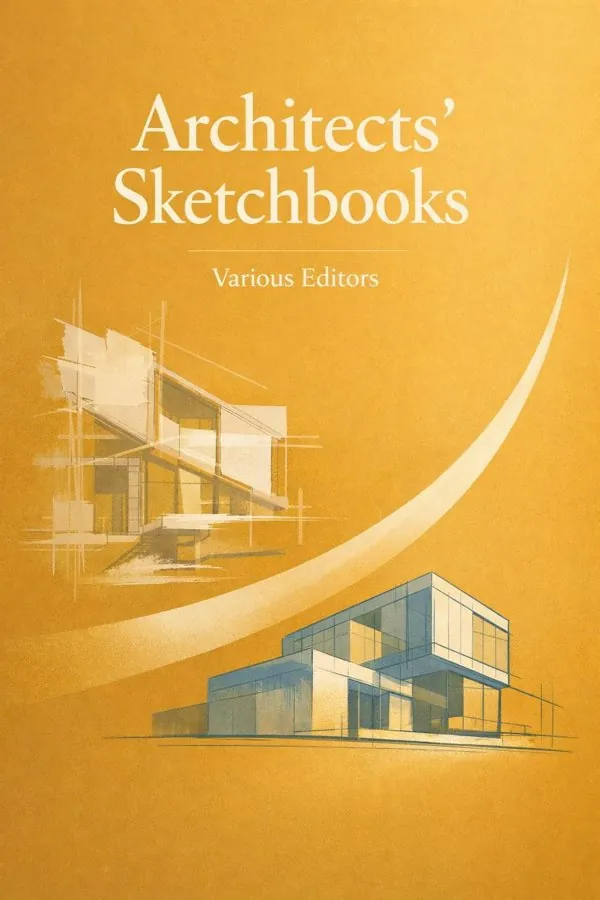
Architects' Sketchbooks: Summary & Key Insights
 10 min8 chaptersAudio available
Key Takeaways from Architects' Sketchbooks
The most revealing truth in Architects' Sketchbooks is that a sketch is not just a picture of an idea; it is often the place where the idea is first discovered.
One of the book's most powerful lessons is that creative quality rarely begins with polished output.
A striking pattern throughout Architects' Sketchbooks is that originality often begins with close observation, not abstract invention.
Many of the sketchbooks in this collection show that travel is not just inspirational decoration for architects; it is an active method of education.
Another fascinating insight from Architects' Sketchbooks is that no single way of drawing defines architectural intelligence.
What Is Architects' Sketchbooks About?
Architects' Sketchbooks by Various Editors is a design book. Architects' Sketchbooks is not a conventional architecture book about finished buildings, polished renderings, or technical perfection. Instead, it opens the private, working notebooks of architects and reveals something far more valuable: how ideas begin. Edited as a curated visual anthology, the book gathers sketchbook pages from a wide range of architects, showing rough lines, fleeting observations, spatial experiments, travel notes, and half-formed concepts that later inform real projects. What makes this collection so compelling is its intimacy. These drawings are not primarily made for clients or publication; they are thinking tools, records of curiosity, and evidence of design in motion. The editors' authority comes from assembling a diverse, global portrait of architectural practice through authentic primary material, allowing readers to compare methods across generations, styles, and cultures. The book matters because it reminds us that architecture does not emerge fully formed from software or theory. It grows through looking, drawing, revising, and imagining. For designers, students, and visually curious readers, Architects' Sketchbooks offers a rare chance to witness creativity before it becomes certainty.
This FizzRead summary covers all 8 key chapters of Architects' Sketchbooks in approximately 10 minutes, distilling the most important ideas, arguments, and takeaways from Various Editors's work. Also available as an audio summary and Key Quotes Podcast.
Architects' Sketchbooks
Architects' Sketchbooks is not a conventional architecture book about finished buildings, polished renderings, or technical perfection. Instead, it opens the private, working notebooks of architects and reveals something far more valuable: how ideas begin. Edited as a curated visual anthology, the book gathers sketchbook pages from a wide range of architects, showing rough lines, fleeting observations, spatial experiments, travel notes, and half-formed concepts that later inform real projects. What makes this collection so compelling is its intimacy. These drawings are not primarily made for clients or publication; they are thinking tools, records of curiosity, and evidence of design in motion. The editors' authority comes from assembling a diverse, global portrait of architectural practice through authentic primary material, allowing readers to compare methods across generations, styles, and cultures. The book matters because it reminds us that architecture does not emerge fully formed from software or theory. It grows through looking, drawing, revising, and imagining. For designers, students, and visually curious readers, Architects' Sketchbooks offers a rare chance to witness creativity before it becomes certainty.
Who Should Read Architects' Sketchbooks?
This book is perfect for anyone interested in design and looking to gain actionable insights in a short read. Whether you're a student, professional, or lifelong learner, the key ideas from Architects' Sketchbooks by Various Editors will help you think differently.
- ✓Readers who enjoy design and want practical takeaways
- ✓Professionals looking to apply new ideas to their work and life
- ✓Anyone who wants the core insights of Architects' Sketchbooks in just 10 minutes
Want the full summary?
Get instant access to this book summary and 100K+ more with Fizz Moment.
Get Free SummaryAvailable on App Store • Free to download
Key Chapters
The most revealing truth in Architects' Sketchbooks is that a sketch is not just a picture of an idea; it is often the place where the idea is first discovered. Across the collection, drawings function as a live record of thought. Lines are tentative, layered, erased, redrawn, and annotated. This imperfect quality matters because it shows architecture as an evolving conversation rather than a fixed solution. Sketching allows architects to externalize uncertainty, giving form to intuitions that would remain vague if kept only in the mind.
The book demonstrates that drawing is a cognitive tool. A quick section, a plan fragment, or a perspective doodle can test proportion, circulation, mood, or structure in seconds. Unlike finished digital models, sketchbook pages invite ambiguity, which is often productive in early design stages. An architect may begin by drawing a street corner observed while traveling and later transform that observation into a courtyard concept, facade rhythm, or public circulation strategy. The page becomes both notebook and laboratory.
This principle applies beyond architecture. Product designers sketch interfaces, filmmakers storyboard scenes, and entrepreneurs diagram systems because drawing helps reveal relationships quickly. Even non-artists can benefit by making rough diagrams rather than waiting for perfect words. A teacher planning a classroom layout, for example, can sketch movement paths and sightlines more effectively than describing them abstractly.
The key lesson is simple: if you want clearer ideas, make them visible early. Keep a notebook, sketch before refining, and let rough marks do the work of discovery.
One of the book's most powerful lessons is that creative quality rarely begins with polished output. The sketchbooks are full of fragments, crossed-out thoughts, unfinished studies, and visual detours. Far from signaling weakness, these imperfect pages reveal the real engine of design: iteration. By showing work before it is cleaned up for presentation, the book challenges the common misconception that accomplished architects move directly from inspiration to resolution.
In many pages, a building idea emerges through repetition. A form is drawn several times at different scales. A staircase is reconsidered from multiple angles. Notes crowd around images, suggesting shifts in concept, site response, or material strategy. This accumulation of attempts shows that refinement is built on variation. Good design often depends less on having one brilliant first concept and more on testing many possibilities until a strong direction appears.
This mindset has practical value for anyone engaged in creative work. Students often become stuck because they judge early efforts too harshly. Professionals can also overinvest in a first scheme because it looks convincing. The sketchbooks argue for another approach: produce many small, low-stakes studies before committing. In architecture practice, this may mean generating three massing options before modeling. In graphic design, it might mean thumbnailing twenty layout ideas before selecting one.
The actionable takeaway is to separate exploration from evaluation. Give yourself permission to make messy drafts, collect alternatives, and learn from incomplete work before asking for perfection.
A striking pattern throughout Architects' Sketchbooks is that originality often begins with close observation, not abstract invention. Many pages record streets, ruins, landscapes, windows, staircases, people, light conditions, and urban textures encountered in daily life or travel. These are not merely souvenirs. They are acts of study. By drawing what they see, architects train themselves to notice proportion, sequence, structure, rhythm, and atmosphere, all of which later inform design decisions.
The book suggests that the architect's eye is developed through attention. A hand-drawn facade study, for instance, can reveal how repetition creates order without monotony. A sketch of a market street might capture how thresholds, signage, and movement combine to produce social energy. Even a quick drawing of a tree can teach lessons about branching systems, shading, or asymmetrical balance. Observation becomes a way of gathering design intelligence from the world.
This has broad application. Interior designers can sketch cafes to study seating density and acoustics. Urban planners can record pedestrian flow at intersections. Photographers, writers, and entrepreneurs can all use notebooks to capture patterns in behavior, environment, or experience. The discipline of looking carefully often leads to more grounded, original solutions than brainstorming in isolation.
The practical takeaway is to build a habit of observational sketching. Draw buildings, rooms, streets, and objects from life. Focus less on artistic perfection and more on what the subject teaches you about how space, form, and people interact.
Many of the sketchbooks in this collection show that travel is not just inspirational decoration for architects; it is an active method of education. When architects move through unfamiliar cities, landscapes, and buildings, they encounter alternative ways of organizing space, responding to climate, handling materials, and expressing culture. Their sketchbooks preserve these encounters as immediate visual reflections rather than polished retrospective analyses.
What makes travel sketching valuable is its combination of presence and interpretation. A quick drawing of a courtyard in Morocco, a church in Italy, or a dense street in Tokyo is not just a copy. It is a selective act of understanding. The architect decides what to emphasize: shadow, enclosure, section, human scale, ornament, circulation, or urban edge. In doing so, the sketch distills what is most instructive about the place. These distilled observations can later shape new design work without turning into imitation.
The lesson is especially relevant in an age of endless digital images. Seeing photos online is convenient, but drawing on site slows perception. It forces attention to temperature, sound, movement, and proportion. A student visiting a neighborhood can learn more by sketching one corner for twenty minutes than by taking fifty photos and never reviewing them.
An actionable way to apply this idea is to treat every trip, even a local one, as field research. Bring a small notebook, sketch places that feel spatially memorable, and annotate what makes them effective. Over time, these pages become a personal design library built from experience rather than borrowed imagery.
Another fascinating insight from Architects' Sketchbooks is that no single way of drawing defines architectural intelligence. Some architects fill pages with dense technical studies; others use expressive washes, diagrammatic arrows, tiny notes, or loose perspectives. Some sketch rapidly in ink, while others build careful pencil layers. This variety shows that the sketchbook is not only a design tool but also a signature medium through which each architect develops a personal visual language.
A visual language is more than style. It reflects priorities. An architect concerned with movement may draw sequences and paths. One focused on structure may emphasize joints, grids, and load-bearing logic. Another interested in atmosphere may concentrate on light, shade, and human occupation. In this sense, the form of the sketch reveals the form of the designer's thinking. The page becomes a map of attention.
This idea is useful because many learners imitate drawing styles without understanding their purpose. The book encourages readers to notice how representation and intention align. If your main challenge is spatial organization, your sketching might need clearer diagrams. If material character matters most, texture studies may be more useful than polished perspectives. Rather than copying someone else's aesthetic, you can shape a method that supports the way you think.
The takeaway is to study your own habits and build a sketching approach that serves your design questions. Experiment with diagrams, notes, perspectives, sections, and abstract marks until you find a visual language that helps you think more deeply and communicate more clearly.
What gives this book much of its emotional force is the sense that readers are being invited into a private creative space. Unlike presentation boards or published project photographs, sketchbooks are usually made for the architect alone or for immediate studio use. They hold raw impressions, speculative ideas, visual jokes, corrections, and unfinished thoughts. This privacy is important because it allows freedom. In the sketchbook, architects can test unusual possibilities without the pressure of defending them publicly.
The collection makes clear that innovation often needs protected space. A notebook page can hold contradictory ideas side by side. One concept may be poetic, another practical, another impossible. The architect does not have to resolve everything at once. This openness encourages risk-taking and cross-pollination between observation, memory, and invention. A rough landscape drawing may sit next to a structural note; later, the connection between them may lead to a new concept.
In professional and academic settings, people often jump too quickly to presentation mode. They polish slides, choose fonts, and present certainty before the work has matured. The sketchbook suggests a healthier sequence: first create privately and experimentally, then refine selectively for others. Writers use journals this way; scientists use lab notebooks; designers use sketchbooks.
The practical takeaway is to maintain a protected place for unfiltered thinking. Keep a notebook that is not judged by presentation standards. Use it to record odd ideas, unresolved problems, and visual experiments. Creative breakthroughs often emerge from spaces where you are allowed to think without performing.
Although Architects' Sketchbooks is deeply visual, its argument is not nostalgic in a simplistic way. It does not claim that hand drawing is superior because it is old-fashioned. Instead, the collection shows that drawing by hand preserves a kind of human judgment that is difficult to replace: the immediate connection between seeing, thinking, and marking. The speed, pressure, hesitation, and selectivity of a hand-drawn line reveal decision-making in real time.
In architectural practice dominated by software, this matters. Digital tools are excellent for precision, coordination, simulation, and production. But early design often benefits from something looser. A hand sketch can hold uncertainty without forcing premature exactness. It can suggest atmosphere before dimensions are fixed, relationships before components are finalized. When an architect draws a plaza, for instance, they may instinctively exaggerate tree cover, human activity, or sightlines to express priorities that a technically accurate model might obscure.
The broader point is not to reject technology but to sequence tools wisely. Hand sketching can generate and test ideas quickly, while digital tools can later evaluate and develop them. This combined approach is common in strong design practice. A designer might begin with trace-paper site studies, then move to digital massing, then return to hand markup during critique.
The actionable lesson is to use hand drawing intentionally at the beginning and throughout the process. Start meetings with quick sketches, annotate printed drawings by hand, and use the physical act of drawing to keep judgment, intuition, and observation active.
Perhaps the most inspiring message in Architects' Sketchbooks is that architecture is not only a profession of buildings; it is a way of paying sustained attention to the world. The sketchbooks reveal curiosity everywhere: in small observations, travel notes, structural questions, spatial doodles, and captured atmospheres. Great design does not seem to arise only during official project hours. It grows through an ongoing habit of looking, wondering, recording, and connecting ideas across time.
This is why the book feels so alive. It presents architects not just as problem-solvers but as collectors of experience. A staircase noticed in one city, a roofline sketched years earlier, a diagram of social movement, and a study of topography may all resurface in future work. The sketchbook becomes an archive of curiosity, storing fragments that can later combine in unexpected ways. Creative depth comes from this accumulation.
For readers in any field, this is liberating. You do not need to wait for a major assignment to begin thinking creatively. Everyday experiences can become source material if you learn to capture them. A retail strategist can note how people navigate crowded aisles. A filmmaker can sketch urban light. A student can diagram how classmates use a campus courtyard. Curiosity becomes a disciplined practice rather than a vague personality trait.
The takeaway is to treat your creative life as continuous. Carry a notebook, document what intrigues you, revisit old pages, and trust that consistent curiosity will build a richer, more original body of work over time.
All Chapters in Architects' Sketchbooks
About the Author
Various Editors refers to the editorial team behind Architects' Sketchbooks, a curated volume that brings together sketchbook material from numerous architects rather than advancing a single author's personal thesis. Their expertise lies in selection, organization, and contextual presentation: identifying compelling examples of architectural drawing, balancing different styles and generations, and shaping the book into a coherent exploration of creative process. In a collection like this, the editors serve as cultural interpreters, revealing what sketchbooks can teach about observation, design development, travel, and visual thinking. Their contribution is especially important because they transform private working documents into a public resource for students, professionals, and general readers. Through careful curation, they make visible the hidden stages of architecture and highlight the diversity of ways architects think through drawing.
Get This Summary in Your Preferred Format
Read or listen to the Architects' Sketchbooks summary by Various Editors anytime, anywhere. FizzRead offers multiple formats so you can learn on your terms — all free.
Available formats: App · Audio · PDF · EPUB — All included free with FizzRead
Download Architects' Sketchbooks PDF and EPUB Summary
Key Quotes from Architects' Sketchbooks
“The most revealing truth in Architects' Sketchbooks is that a sketch is not just a picture of an idea; it is often the place where the idea is first discovered.”
“One of the book's most powerful lessons is that creative quality rarely begins with polished output.”
“A striking pattern throughout Architects' Sketchbooks is that originality often begins with close observation, not abstract invention.”
“Many of the sketchbooks in this collection show that travel is not just inspirational decoration for architects; it is an active method of education.”
“Another fascinating insight from Architects' Sketchbooks is that no single way of drawing defines architectural intelligence.”
Frequently Asked Questions about Architects' Sketchbooks
Architects' Sketchbooks by Various Editors is a design book that explores key ideas across 8 chapters. Architects' Sketchbooks is not a conventional architecture book about finished buildings, polished renderings, or technical perfection. Instead, it opens the private, working notebooks of architects and reveals something far more valuable: how ideas begin. Edited as a curated visual anthology, the book gathers sketchbook pages from a wide range of architects, showing rough lines, fleeting observations, spatial experiments, travel notes, and half-formed concepts that later inform real projects. What makes this collection so compelling is its intimacy. These drawings are not primarily made for clients or publication; they are thinking tools, records of curiosity, and evidence of design in motion. The editors' authority comes from assembling a diverse, global portrait of architectural practice through authentic primary material, allowing readers to compare methods across generations, styles, and cultures. The book matters because it reminds us that architecture does not emerge fully formed from software or theory. It grows through looking, drawing, revising, and imagining. For designers, students, and visually curious readers, Architects' Sketchbooks offers a rare chance to witness creativity before it becomes certainty.
More by Various Editors


You Might Also Like
The Design of Everyday Things
Don Norman
10 min
The Better Angels of Our Nature
Steven Pinker
10 min
A Designer's Art
Paul Rand
10 min
Architectural Graphic Standards
The American Institute of Architects
10 min
Design Is Storytelling
Ellen Lupton
10 min
Grid Systems in Graphic Design: A Visual Communication Manual for Graphic Designers, Typographers and Three Dimensional Designers
Josef Müller-Brockmann
10 minFeatured In
Browse by Category
Ready to read Architects' Sketchbooks?
Get the full summary and 100K+ more books with Fizz Moment.