
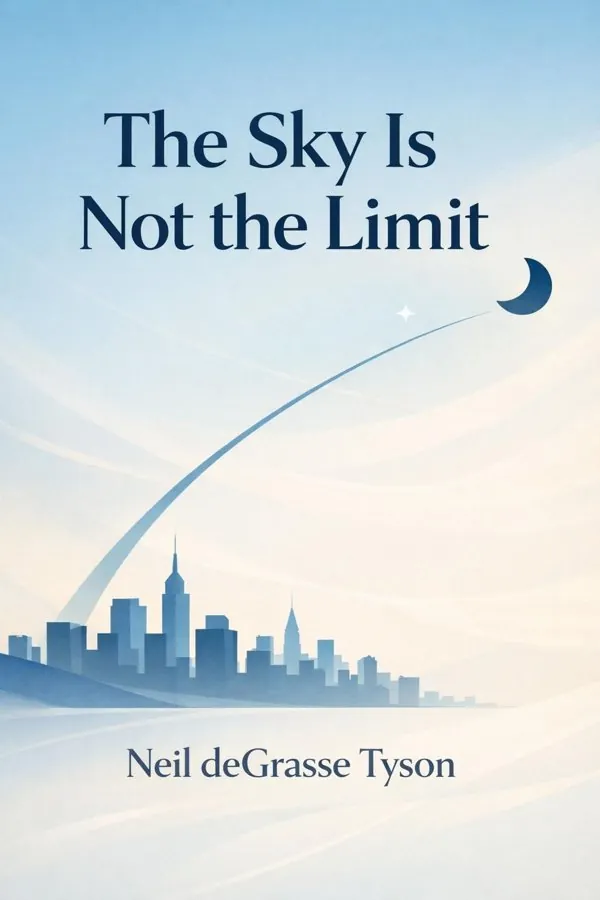
The Sky Is Not the Limit: Adventures of an Urban Astrophysicist: Summary & Key Insights
 10 min9 chaptersAudio available
Key Takeaways from The Sky Is Not the Limit: Adventures of an Urban Astrophysicist
A life in science rarely starts with formulas; it starts with awe.
Talent develops faster when someone takes it seriously before the world does.
The city is often seen as a place of commerce, culture, and speed, not contemplation.
Knowledge has limited value if it never leaves the expert’s circle.
Science aims at universal truths, but scientists live particular lives.
What Is The Sky Is Not the Limit: Adventures of an Urban Astrophysicist About?
The Sky Is Not the Limit: Adventures of an Urban Astrophysicist by Neil deGrasse Tyson is a popular_sci book spanning 12 pages. Neil deGrasse Tyson’s The Sky Is Not the Limit: Adventures of an Urban Astrophysicist is part memoir, part cultural reflection, and part celebration of scientific curiosity. Through a series of essays, Tyson recounts how a boy growing up in New York City became one of the world’s most recognizable astrophysicists. What makes the book distinctive is its setting: this is not a story of science unfolding in remote observatories alone, but in classrooms, museums, subways, neighborhoods, and public institutions. Tyson shows that wonder does not require pristine wilderness or a perfect night sky. It can begin anywhere, even under the glow of city lights. The book matters because it expands what a scientist’s life can look like. Tyson explores mentorship, race, education, public communication, and the responsibility of translating complex ideas for broad audiences. He argues that science is not separate from culture but deeply embedded within it. As director of the Hayden Planetarium and one of the most influential science communicators of his generation, Tyson writes with both authority and accessibility. The result is an engaging reminder that curiosity, when nurtured, can transform both a life and a society.
This FizzRead summary covers all 9 key chapters of The Sky Is Not the Limit: Adventures of an Urban Astrophysicist in approximately 10 minutes, distilling the most important ideas, arguments, and takeaways from Neil deGrasse Tyson's work. Also available as an audio summary and Key Quotes Podcast.
The Sky Is Not the Limit: Adventures of an Urban Astrophysicist
Neil deGrasse Tyson’s The Sky Is Not the Limit: Adventures of an Urban Astrophysicist is part memoir, part cultural reflection, and part celebration of scientific curiosity. Through a series of essays, Tyson recounts how a boy growing up in New York City became one of the world’s most recognizable astrophysicists. What makes the book distinctive is its setting: this is not a story of science unfolding in remote observatories alone, but in classrooms, museums, subways, neighborhoods, and public institutions. Tyson shows that wonder does not require pristine wilderness or a perfect night sky. It can begin anywhere, even under the glow of city lights.
The book matters because it expands what a scientist’s life can look like. Tyson explores mentorship, race, education, public communication, and the responsibility of translating complex ideas for broad audiences. He argues that science is not separate from culture but deeply embedded within it. As director of the Hayden Planetarium and one of the most influential science communicators of his generation, Tyson writes with both authority and accessibility. The result is an engaging reminder that curiosity, when nurtured, can transform both a life and a society.
Who Should Read The Sky Is Not the Limit: Adventures of an Urban Astrophysicist?
This book is perfect for anyone interested in popular_sci and looking to gain actionable insights in a short read. Whether you're a student, professional, or lifelong learner, the key ideas from The Sky Is Not the Limit: Adventures of an Urban Astrophysicist by Neil deGrasse Tyson will help you think differently.
- ✓Readers who enjoy popular_sci and want practical takeaways
- ✓Professionals looking to apply new ideas to their work and life
- ✓Anyone who wants the core insights of The Sky Is Not the Limit: Adventures of an Urban Astrophysicist in just 10 minutes
Want the full summary?
Get instant access to this book summary and 100K+ more with Fizz Moment.
Get Free SummaryAvailable on App Store • Free to download
Key Chapters
A life in science rarely starts with formulas; it starts with awe. One of Tyson’s most important insights is that intellectual ambition is often born from a single vivid encounter with wonder. For him, visits to the Hayden Planetarium did more than entertain a curious child. They created a lasting image of the universe as something grand, structured, and worth understanding. That early emotional spark mattered because it gave direction to later discipline. Before there is mastery, there is fascination.
This idea broadens the way we think about scientific talent. Many people imagine future scientists as children who excel instantly at math or display unusual technical brilliance from the beginning. Tyson’s story suggests something more human and more inclusive: curiosity can come first, and expertise can follow. Museums, public lectures, documentaries, teachers, and even a single unforgettable experience can redirect a life.
The practical implication is significant for parents, educators, and institutions. If you want more people to enter science, do not begin only with standards, testing, and performance metrics. Begin by giving them something worth loving. A child staring up at a projected night sky may be taking the first step toward a scientific career, even if no one can see it yet. Adults are no different. A well-told explanation of black holes or a first look through a telescope can revive dormant curiosity.
Tyson also reminds us that environment is not destiny. Growing up in a light-polluted city did not prevent him from becoming an astrophysicist. In some ways, the contrast between urban life and cosmic imagination sharpened his vision. Wonder can survive inconvenience, noise, and limitation.
Actionable takeaway: deliberately seek out experiences that expand your sense of scale, and help others do the same. Curiosity grows when wonder is treated as the beginning of education rather than a distraction from it.
Talent develops faster when someone takes it seriously before the world does. Tyson emphasizes that no scientific career is built alone. His journey from the Bronx to elite academic institutions was shaped by mentors who recognized his potential, challenged his thinking, and helped him translate enthusiasm into disciplined effort. The lesson is clear: ambition needs guidance if it is to mature into excellence.
Mentorship matters because science is not just a body of knowledge; it is also a culture with hidden rules, expectations, and pathways. A student may love astronomy yet have no idea how to prepare for college research, apply for programs, speak to professors, or navigate institutions that can feel intimidating. Mentors shorten that learning curve. They offer encouragement, but just as importantly, they offer structure. They say, in effect, here is what this dream requires.
Tyson’s reflections also reveal that mentorship is powerful partly because it is personal. A good mentor does more than deliver general advice. They notice your specific strengths, push against your weaknesses, and model what seriousness looks like. In education and work, many people advance not simply because they are capable, but because someone helped them imagine themselves in spaces that once felt inaccessible.
This applies beyond science. In any field, people benefit from guides who can demystify the path ahead. Students can seek professors, supervisors, librarians, or community leaders. Professionals can mentor interns or younger colleagues. Institutions can create structured programs rather than leaving development to chance.
Tyson’s experience also implies a responsibility: if mentorship helped you, you should eventually become a mentor yourself. Knowledge compounds when it is shared generationally.
Actionable takeaway: identify one person who is farther along the path you want to follow, ask a specific question, and begin a real mentoring relationship. If you are experienced, offer that same clarity to someone coming behind you.
The city is often seen as a place of commerce, culture, and speed, not contemplation. Tyson challenges that assumption by showing that science can flourish in the middle of urban life. New York City, with its crowded streets, public schools, museums, and constant motion, was not a barrier to discovery. It was the setting in which his scientific identity formed. This reframes science as something woven into civic life rather than isolated in laboratories or distant observatories.
The power of this idea lies in accessibility. When science is presented as remote, many people assume it belongs to specialists. Tyson instead presents it as a public good. Planetariums, museums, lectures, science journalism, and school programs bring cosmic questions into ordinary environments. A subway ride can lead to a museum visit. A neighborhood school can host a speaker. A city park can become a place for stargazing events. Urban density, often blamed for disconnecting people from nature, can actually make scientific outreach more efficient and democratic.
This matters especially for communities historically excluded from scientific spaces. If science only appears in elite settings, participation narrows. When it becomes visible in local institutions, more people can imagine themselves as part of it. Tyson’s perspective argues for public investment in places where curiosity can be encountered casually and repeatedly.
There is also a symbolic point here. To study the universe from a city is to reject the idea that beauty and insight require perfect conditions. Intellectual life can emerge amid noise and constraint. That is an empowering message for anyone who feels their environment is too imperfect for serious growth.
Actionable takeaway: bring science into your routine instead of waiting for ideal circumstances. Visit a museum, attend a local lecture, follow a public science program, or help organize one in your community. Curiosity thrives when it becomes part of daily life.
Knowledge has limited value if it never leaves the expert’s circle. One of Tyson’s defining contributions is his insistence that explaining science to the public is not secondary to real science; it is part of science’s public mission. In this book, he reflects on speaking, writing, and engaging broad audiences in ways that preserve intellectual integrity while inviting participation. The challenge is not merely to simplify. It is to make complex ideas understandable without draining them of their depth.
This is harder than it sounds. Jargon can create the illusion of precision while excluding nonexperts. Over-simplification can produce clarity at the expense of truth. Tyson’s communication style works because it combines rigor with metaphor, humor, narrative, and scale. He connects astrophysical concepts to ordinary experiences, making the unfamiliar feel graspable. When people understand even a little more about the universe, they often become more curious, not less.
The practical importance of science communication extends far beyond public entertainment. Citizens vote on policies shaped by scientific evidence. They make medical, environmental, and technological decisions influenced by what they understand. If experts cannot communicate, misinformation will fill the vacuum. Tyson’s example suggests that public engagement is not about self-promotion; it is about stewardship of knowledge.
This lesson applies in every field. If you are an expert, teacher, manager, or specialist, your job includes translation. Can you explain your work to a teenager? To a skeptical neighbor? To someone intelligent but unfamiliar with your field? That effort improves not only public understanding but often your own thinking.
Actionable takeaway: practice explaining one complex idea from your field in plain language, using one vivid example and one analogy. If people can understand it without being talked down to, you are doing meaningful intellectual work.
Science aims at universal truths, but scientists live particular lives. Tyson explores the reality that race, culture, class, and personal background shape how one moves through educational and professional institutions. This does not weaken science; it clarifies the human context in which science is practiced. His essays suggest that becoming an astrophysicist was never just about mastering equations. It also involved navigating assumptions, expectations, and the social meanings attached to who he was.
This insight is essential because many people still imagine science as a neutral pipeline where merit alone determines outcomes. Tyson’s story complicates that myth. Ability matters, but so do visibility, encouragement, access, and whether institutions signal that you belong. For people from underrepresented backgrounds, achievement can require not only technical competence but also resilience against subtle and overt barriers.
At the same time, Tyson does not frame identity solely as an obstacle. Cultural perspective can deepen one’s sense of purpose and public responsibility. A scientist who understands exclusion may feel a stronger calling to widen access, challenge stereotypes, and serve as a visible example for others. Representation matters not because it replaces excellence, but because it expands who can imagine excellence as theirs.
In practical terms, this has consequences for schools, employers, and scientific organizations. Inclusion is not accomplished by rhetoric alone. It requires mentoring, outreach, equitable opportunity, and environments where difference does not have to be hidden in order to be tolerated.
For readers, the broader lesson is that professional growth is never detached from human context. We bring our histories into our work, and institutions must decide whether to ignore that reality or respond to it constructively.
Actionable takeaway: if you lead, teach, or hire, examine whether your environment merely welcomes talent in theory or actively signals belonging in practice. If you are building a path for yourself, do not mistake social friction for lack of ability.
To study the universe is also to study perspective. Tyson uses the role of the astrophysicist to show that astronomy is not only about distant objects; it is about learning how to think. The astrophysicist must handle data, uncertainty, scale, patience, and imagination all at once. This discipline requires technical precision, but it also encourages philosophical humility. When you confront the age of the universe, the size of galaxies, or the fragility of Earth, everyday assumptions can begin to shift.
Tyson’s reflections suggest that the astrophysicist occupies a unique cultural role. On one hand, the job is deeply specialized, grounded in mathematics, observation, and scientific method. On the other hand, its subject matter naturally provokes broad human questions. Where are we? How did this begin? What is our significance? Because of that, astrophysicists often become interpreters between hard science and existential curiosity.
This makes the field especially valuable in public life. It reminds people that expertise need not be narrow in spirit even when it is precise in method. A researcher can be rigorous and expansive at the same time. In practical terms, that mindset can inform decision-making outside science. Thinking astronomically teaches proportionality. A short-term frustration may matter less when seen against larger timescales. A political dispute may look different when one remembers that all humans share a tiny planet.
Tyson also implies that scientific identity carries civic obligations. If your work changes how people understand reality, then your responsibility includes helping them integrate that understanding into culture.
Actionable takeaway: borrow one habit from astrophysics in your own life by regularly asking, “What does this look like from a larger scale?” Expanding perspective often improves judgment, reduces ego, and reveals what truly deserves your energy.
Few ideas define Tyson’s worldview more than the cosmic perspective: the recognition that Earth is a small, fragile world in an enormous universe. This insight is not meant to diminish human life but to clarify it. When we understand our physical smallness, we may become less arrogant, less tribal, and more attentive to what actually matters. The universe does not revolve around us, and that can be liberating.
The cosmic perspective has ethical as well as intellectual consequences. From the vantage point of astronomy, many human divisions look parochial. Borders vanish from orbit. Ethnic conflict, national vanity, and status competition begin to appear strangely local. This does not erase real suffering or political complexity, but it can challenge the self-importance that often intensifies them. Tyson suggests that science can cultivate humility without draining life of meaning.
Practically, this perspective can influence how people respond to conflict, ambition, and uncertainty. Someone overwhelmed by professional competition might remember that personal prestige is not the highest measure of a life. Communities debating environmental policy might think more carefully when they realize how rare and precious a habitable planet is. Educators can use astronomy not merely to teach facts but to expand moral imagination.
This is one reason Tyson’s writing resonates beyond science enthusiasts. He offers astronomy as a mental tool for living wisely. A larger universe can produce a larger self, one less trapped by petty urgency.
Still, the point is not escapism. The cosmic perspective should return us to Earth with renewed seriousness. If this small planet is our home, then stewardship, cooperation, and curiosity become more urgent, not less.
Actionable takeaway: when faced with ego-driven stress or social division, pause and deliberately adopt a cosmic frame. Ask what remains important when seen from the scale of Earth, humanity, and deep time.
People often assume that making science exciting requires exaggeration. Tyson argues the opposite: the universe is already astonishing enough. The challenge in science communication is not to sensationalize reality but to present it accurately and vividly. This is especially important in a media environment where oversimplification, hype, and false certainty spread faster than nuance.
Tyson’s essays reveal the tension every communicator faces. If explanations are too technical, audiences disengage. If they are too casual, people may leave with distorted ideas. Good science communication therefore depends on disciplined storytelling. It requires choosing the right analogy, acknowledging what is unknown, and resisting the temptation to promise more than the evidence supports.
This principle matters in everyday life because misinformation thrives where complexity is treated as weakness. People are often drawn to confident but shallow explanations. Tyson’s example suggests that credibility comes from balancing accessibility with honesty. A communicator should be engaging, but also transparent about uncertainty. Saying “we do not know yet” is not failure; it is a core scientific virtue.
The same standard applies outside astrophysics. In health, politics, technology, finance, and education, responsible explanation means helping people think better, not merely react faster. Teachers, journalists, leaders, and creators all face the question Tyson implicitly raises: are you informing your audience, or only impressing them?
Clear explanation can itself generate wonder. Understanding how stars form, how gravity works, or how vast the universe is does not reduce mystery. It deepens it by making reality more intelligible without pretending it is fully conquered.
Actionable takeaway: whenever you share complex information, separate what is known, what is likely, and what remains uncertain. Precision builds trust, and trust is what allows genuine wonder to endure.
Scientific work does not unfold outside public life; it depends on institutions, funding, education systems, and political priorities. Tyson’s reflections on science and policy highlight an often overlooked truth: society gets the scientific culture it chooses to support. Research, museums, public education, and outreach do not sustain themselves automatically. They require civic commitment.
This matters because people sometimes treat science as an isolated engine of progress that will keep advancing regardless of social conditions. Tyson’s career shows the opposite. Public institutions such as planetariums, schools, and universities can change lives by making knowledge available. Policy decisions determine whether those institutions thrive, stagnate, or disappear. A society that undervalues science communication and education eventually weakens its own capacity for innovation and informed citizenship.
Tyson also implies that scientists should not retreat from public conversation. While research must remain independent of ideology, scientists still have a role in advocating for scientific literacy, evidence-based policy, and robust public institutions. This is not partisan by nature. It is a defense of the conditions under which truth-seeking can flourish.
Readers can apply this idea by seeing science not only as content to consume but as infrastructure to support. Voting, philanthropy, school involvement, museum attendance, and community programming all affect the scientific health of a culture. Even small acts, such as taking children to public science spaces or supporting local educational initiatives, help normalize curiosity as a civic value.
Tyson’s broader point is hopeful: institutions can widen access to wonder and knowledge when societies choose to invest in them.
Actionable takeaway: support at least one public-facing scientific institution with your time, attention, or resources. If you value scientific understanding, help sustain the systems that make it possible for others.
All Chapters in The Sky Is Not the Limit: Adventures of an Urban Astrophysicist
About the Author
Neil deGrasse Tyson is an American astrophysicist, author, and science communicator known for bringing complex scientific ideas to broad audiences. Born and raised in New York City, he developed an early fascination with the cosmos after visiting the Hayden Planetarium, a place that would later become central to his career. Tyson studied physics at Harvard, earned a master’s degree at the University of Texas at Austin, and completed his doctorate in astrophysics at Columbia University. He later became director of the Hayden Planetarium at the American Museum of Natural History. Beyond academia, Tyson is widely recognized for his books, public lectures, television appearances, and media projects that popularize astronomy and scientific thinking. His work has made him one of the most influential public advocates for science literacy in modern culture.
Get This Summary in Your Preferred Format
Read or listen to the The Sky Is Not the Limit: Adventures of an Urban Astrophysicist summary by Neil deGrasse Tyson anytime, anywhere. FizzRead offers multiple formats so you can learn on your terms — all free.
Available formats: App · Audio · PDF · EPUB — All included free with FizzRead
Download The Sky Is Not the Limit: Adventures of an Urban Astrophysicist PDF and EPUB Summary
Key Quotes from The Sky Is Not the Limit: Adventures of an Urban Astrophysicist
“A life in science rarely starts with formulas; it starts with awe.”
“Talent develops faster when someone takes it seriously before the world does.”
“The city is often seen as a place of commerce, culture, and speed, not contemplation.”
“Knowledge has limited value if it never leaves the expert’s circle.”
“Science aims at universal truths, but scientists live particular lives.”
Frequently Asked Questions about The Sky Is Not the Limit: Adventures of an Urban Astrophysicist
The Sky Is Not the Limit: Adventures of an Urban Astrophysicist by Neil deGrasse Tyson is a popular_sci book that explores key ideas across 9 chapters. Neil deGrasse Tyson’s The Sky Is Not the Limit: Adventures of an Urban Astrophysicist is part memoir, part cultural reflection, and part celebration of scientific curiosity. Through a series of essays, Tyson recounts how a boy growing up in New York City became one of the world’s most recognizable astrophysicists. What makes the book distinctive is its setting: this is not a story of science unfolding in remote observatories alone, but in classrooms, museums, subways, neighborhoods, and public institutions. Tyson shows that wonder does not require pristine wilderness or a perfect night sky. It can begin anywhere, even under the glow of city lights. The book matters because it expands what a scientist’s life can look like. Tyson explores mentorship, race, education, public communication, and the responsibility of translating complex ideas for broad audiences. He argues that science is not separate from culture but deeply embedded within it. As director of the Hayden Planetarium and one of the most influential science communicators of his generation, Tyson writes with both authority and accessibility. The result is an engaging reminder that curiosity, when nurtured, can transform both a life and a society.
More by Neil deGrasse Tyson
Astrophysics for People in a Hurry
Neil deGrasse Tyson
10 min
Death by Black Hole: And Other Cosmic Quandaries
Neil deGrasse Tyson
10 min
Origins: Fourteen Billion Years of Cosmic Evolution
Neil deGrasse Tyson, Donald Goldsmith
10 min
The Pluto Files: The Rise and Fall of America’s Favorite Planet
Neil deGrasse Tyson
10 minYou Might Also Like
Structures: Or Why Things Don"t Fall Down
J.E. Gordon
10 min
The Road to Wigan Pier
George Orwell
10 min
Bonk: The Curious Coupling of Science and Sex
Mary Roach
10 min
First Bite: How We Learn to Eat
Bee Wilson
10 min
In Pursuit Of The Unknown: 17 Equations That Changed The World
Ian Stewart
10 min
Napoleon's Buttons: 17 Molecules That Changed History
Penny Le Couteur and Jay Burreson
10 minBrowse by Category
Ready to read The Sky Is Not the Limit: Adventures of an Urban Astrophysicist?
Get the full summary and 100K+ more books with Fizz Moment.