
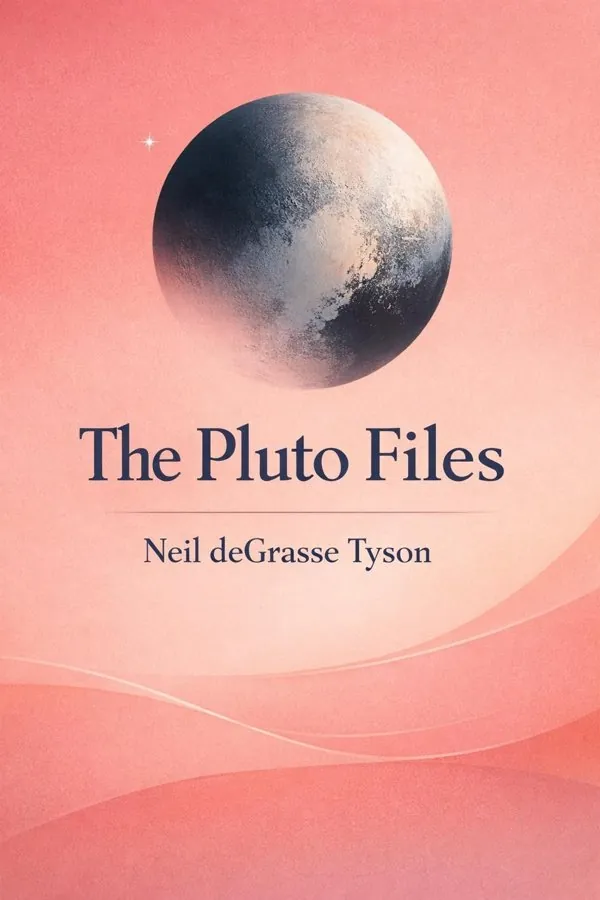
The Pluto Files: The Rise and Fall of America’s Favorite Planet: Summary & Key Insights
 10 min6 chaptersAudio available
What Is The Pluto Files: The Rise and Fall of America’s Favorite Planet About?
The Pluto Files: The Rise and Fall of America’s Favorite Planet by Neil deGrasse Tyson is a popular_sci book spanning 6 pages. In this engaging and humorous exploration, Neil deGrasse Tyson recounts the cultural and scientific saga surrounding Pluto’s demotion from planet status. Drawing from letters, media reactions, and public debates, Tyson examines how science and sentiment collided over the fate of the ninth planet, offering insight into how astronomical discoveries shape public imagination.
This FizzRead summary covers all 6 key chapters of The Pluto Files: The Rise and Fall of America’s Favorite Planet in approximately 10 minutes, distilling the most important ideas, arguments, and takeaways from Neil deGrasse Tyson's work. Also available as an audio summary and Key Quotes Podcast.
The Pluto Files: The Rise and Fall of America’s Favorite Planet
In this engaging and humorous exploration, Neil deGrasse Tyson recounts the cultural and scientific saga surrounding Pluto’s demotion from planet status. Drawing from letters, media reactions, and public debates, Tyson examines how science and sentiment collided over the fate of the ninth planet, offering insight into how astronomical discoveries shape public imagination.
Who Should Read The Pluto Files: The Rise and Fall of America’s Favorite Planet?
This book is perfect for anyone interested in popular_sci and looking to gain actionable insights in a short read. Whether you're a student, professional, or lifelong learner, the key ideas from The Pluto Files: The Rise and Fall of America’s Favorite Planet by Neil deGrasse Tyson will help you think differently.
- ✓Readers who enjoy popular_sci and want practical takeaways
- ✓Professionals looking to apply new ideas to their work and life
- ✓Anyone who wants the core insights of The Pluto Files: The Rise and Fall of America’s Favorite Planet in just 10 minutes
Want the full summary?
Get instant access to this book summary and 100K+ more with Fizz Moment.
Get Free SummaryAvailable on App Store • Free to download
Key Chapters
Our story begins in 1930, in the quiet observatories of Flagstaff, Arizona, where a young astronomer named Clyde Tombaugh was painstakingly comparing photographic plates of the sky. He wasn’t seeking fame, nor was he riding a wave of astronomical breakthroughs. He was, quite literally, sweeping the heavens in search of a faint, moving dot — the long-hypothesized Planet X. When he finally found it, a tiny speck shifting just enough against the backdrop of stars, he entered scientific legend.
In those early days, the discovery of Pluto felt monumental. The world celebrated a new planet — a new member of our solar family. Pluto symbolized both American ingenuity and cosmic mystery. Its discovery by a farm boy from Kansas elevated national pride; America, at last, had a planet to call its own. The Lowell Observatory, which had sponsored the search, proudly announced the find, and soon the public — not the scientists — christened it “Pluto.” The name, submitted by an eleven-year-old British schoolgirl, Venetia Burney, captured the scientific and mythic balance perfectly.
But beneath the excitement lay a quiet uncertainty. Early estimates had attributed to Pluto a mass comparable to Earth’s, which helped justify its classification. Over time, however, as telescopic technology improved, its diminutive size became undeniable. It was smaller than our Moon, reflecting little light, and followed an eccentric orbit that made it an odd planetary companion. Yet for decades, sentimental inertia kept Pluto in our textbooks. It was simply too beloved to question.
As the twentieth century unfolded, our instruments sharpened, and our cosmic vision expanded. The once-lonely outer reaches of the solar system began to teem with newfound neighbors. Through deep-sky surveys, we uncovered dozens, then hundreds, of icy bodies orbiting beyond Neptune — a region now recognized as the Kuiper Belt.
By the 1990s, discoveries such as 1992 QB1 and other trans-Neptunian objects made it clear that Pluto was merely one among many. Its tilted, elongated orbit, its composition of rock and ice, its small size — all mirrored these newly found worlds. The uniqueness that had once seemed self-evident faded rapidly. If Pluto remained a planet, logic would dictate dozens, even hundreds of others must join its ranks.
These discoveries challenged not only scientific classification but cultural comfort. Science thrives on revision, but humans crave stability. When the foundations of our cosmic order shift, our language — and our emotions — must follow. Pluto’s story revealed the tension between our desire for permanence and the reality of discovery. As scientists debated definitions, the public clung to memory. For many, Pluto’s demotion felt like an act of betrayal, an erasure of childhood wonder. Yet this very discomfort marked progress — a sign that we were seeing the solar system as it truly is: vibrant, dynamic, and far richer than our textbooks had dared to suggest.
+ 4 more chapters — available in the FizzRead app
All Chapters in The Pluto Files: The Rise and Fall of America’s Favorite Planet
About the Author
Neil deGrasse Tyson is an American astrophysicist, author, and science communicator. He serves as the director of the Hayden Planetarium at the American Museum of Natural History and is known for his ability to make complex scientific ideas accessible to the public through books, television, and lectures.
Get This Summary in Your Preferred Format
Read or listen to the The Pluto Files: The Rise and Fall of America’s Favorite Planet summary by Neil deGrasse Tyson anytime, anywhere. FizzRead offers multiple formats so you can learn on your terms — all free.
Available formats: App · Audio · PDF · EPUB — All included free with FizzRead
Download The Pluto Files: The Rise and Fall of America’s Favorite Planet PDF and EPUB Summary
Key Quotes from The Pluto Files: The Rise and Fall of America’s Favorite Planet
“Our story begins in 1930, in the quiet observatories of Flagstaff, Arizona, where a young astronomer named Clyde Tombaugh was painstakingly comparing photographic plates of the sky.”
“As the twentieth century unfolded, our instruments sharpened, and our cosmic vision expanded.”
Frequently Asked Questions about The Pluto Files: The Rise and Fall of America’s Favorite Planet
The Pluto Files: The Rise and Fall of America’s Favorite Planet by Neil deGrasse Tyson is a popular_sci book that explores key ideas across 6 chapters. In this engaging and humorous exploration, Neil deGrasse Tyson recounts the cultural and scientific saga surrounding Pluto’s demotion from planet status. Drawing from letters, media reactions, and public debates, Tyson examines how science and sentiment collided over the fate of the ninth planet, offering insight into how astronomical discoveries shape public imagination.
More by Neil deGrasse Tyson

Astrophysics for People in a Hurry
Neil deGrasse Tyson
10 min
Death by Black Hole: And Other Cosmic Quandaries
Neil deGrasse Tyson
10 min
Origins: Fourteen Billion Years of Cosmic Evolution
Neil deGrasse Tyson, Donald Goldsmith
10 min
The Sky Is Not the Limit: Adventures of an Urban Astrophysicist
Neil deGrasse Tyson
10 minYou Might Also Like

Structures: Or Why Things Don"t Fall Down
J.E. Gordon
10 min
The Road to Wigan Pier
George Orwell
10 min
Bonk: The Curious Coupling of Science and Sex
Mary Roach
10 min
First Bite: How We Learn to Eat
Bee Wilson
10 min
In Pursuit Of The Unknown: 17 Equations That Changed The World
Ian Stewart
10 min
Napoleon's Buttons: 17 Molecules That Changed History
Penny Le Couteur and Jay Burreson
10 minBrowse by Category
Ready to read The Pluto Files: The Rise and Fall of America’s Favorite Planet?
Get the full summary and 100K+ more books with Fizz Moment.