
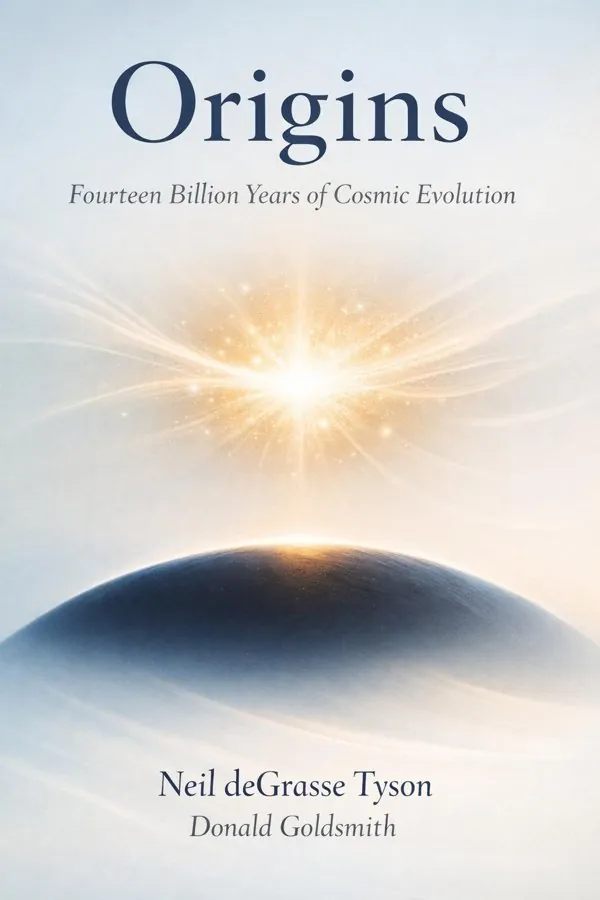
Origins: Fourteen Billion Years of Cosmic Evolution: Summary & Key Insights
by Neil deGrasse Tyson, Donald Goldsmith
 10 min9 chaptersAudio available
What Is Origins: Fourteen Billion Years of Cosmic Evolution About?
Origins: Fourteen Billion Years of Cosmic Evolution by Neil deGrasse Tyson, Donald Goldsmith is a popular_sci book spanning 9 pages. This book explores the story of the universe from the Big Bang to the emergence of life and intelligence. Tyson and Goldsmith trace cosmic evolution across 14 billion years, explaining how galaxies, stars, planets, and life itself came to be, and how humanity fits into the grand cosmic narrative.
This FizzRead summary covers all 9 key chapters of Origins: Fourteen Billion Years of Cosmic Evolution in approximately 10 minutes, distilling the most important ideas, arguments, and takeaways from Neil deGrasse Tyson, Donald Goldsmith's work. Also available as an audio summary and Key Quotes Podcast.
Origins: Fourteen Billion Years of Cosmic Evolution
This book explores the story of the universe from the Big Bang to the emergence of life and intelligence. Tyson and Goldsmith trace cosmic evolution across 14 billion years, explaining how galaxies, stars, planets, and life itself came to be, and how humanity fits into the grand cosmic narrative.
Who Should Read Origins: Fourteen Billion Years of Cosmic Evolution?
This book is perfect for anyone interested in popular_sci and looking to gain actionable insights in a short read. Whether you're a student, professional, or lifelong learner, the key ideas from Origins: Fourteen Billion Years of Cosmic Evolution by Neil deGrasse Tyson, Donald Goldsmith will help you think differently.
- ✓Readers who enjoy popular_sci and want practical takeaways
- ✓Professionals looking to apply new ideas to their work and life
- ✓Anyone who wants the core insights of Origins: Fourteen Billion Years of Cosmic Evolution in just 10 minutes
Want the full summary?
Get instant access to this book summary and 100K+ more with Fizz Moment.
Get Free SummaryAvailable on App Store • Free to download
Key Chapters
Every story has a beginning, and ours begins not with an explosion in space but with the expansion of space itself. The universe once existed in a state of unimaginable density and temperature. In that primal moment—what we call the Big Bang—space, time, energy, and the fundamental forces burst into being. The physics of that instant can still be traced in the glow that permeates all of space: the cosmic microwave background, a faint afterlight of creation.
The Big Bang was not an explosion that happened somewhere; it happened everywhere. Every point in the observable universe once shared that same dense state. As the universe expanded, it cooled. Within seconds, energy began to freeze into matter. Quarks combined into protons and neutrons, which a few minutes later fused into the first atomic nuclei—mostly hydrogen and helium. For hundreds of thousands of years, the universe remained a searing plasma of charged particles, opaque to radiation. Only after it cooled enough for the first atoms to form did light decouple from matter and begin its journey across space. That primordial light, stretched by cosmic expansion, still reaches us today.
Understanding this epoch is not speculation; it is observation. The Big Bang’s fingerprints are etched across the cosmos—in the abundance of light elements, in the expansion of distant galaxies, and most beautifully, in the cosmic microwave background radiation first detected by Penzias and Wilson in 1965. The early universe tells us that simplicity can give rise to complexity, that from a few physical laws operating over immense time, entire galaxies may bloom.
As the cosmic fireball cooled and expanded, a transformation occurred: energy solidified into matter. Hydrogen and helium emerged as the universe’s first elements, their dominance defining the chemistry of the cosmos. They became the raw ingredients for every future act of creation.
The early universe was incredibly uniform, but not perfectly so. Tiny fluctuations in the sea of particles—mere whispers of uneven density—served as the seeds from which structure would eventually form. These small differences were amplified by gravity, setting the stage for galaxies, stars, and planets to take shape. Meanwhile, the cosmic microwave background preserved a snapshot of that ancient time, offering astronomers a window into the conditions of the early universe. Analyzing it allows us to trace the universe’s density, geometry, and eventual fate. What began as primordial simplicity sowed the complexity we now live among.
+ 7 more chapters — available in the FizzRead app
All Chapters in Origins: Fourteen Billion Years of Cosmic Evolution
About the Authors
Neil deGrasse Tyson is an American astrophysicist, author, and science communicator, known for his work in popularizing science through books and television. Donald Goldsmith is an American astronomer and science writer specializing in astrophysics and cosmology.
Get This Summary in Your Preferred Format
Read or listen to the Origins: Fourteen Billion Years of Cosmic Evolution summary by Neil deGrasse Tyson, Donald Goldsmith anytime, anywhere. FizzRead offers multiple formats so you can learn on your terms — all free.
Available formats: App · Audio · PDF · EPUB — All included free with FizzRead
Download Origins: Fourteen Billion Years of Cosmic Evolution PDF and EPUB Summary
Key Quotes from Origins: Fourteen Billion Years of Cosmic Evolution
“Every story has a beginning, and ours begins not with an explosion in space but with the expansion of space itself.”
“As the cosmic fireball cooled and expanded, a transformation occurred: energy solidified into matter.”
Frequently Asked Questions about Origins: Fourteen Billion Years of Cosmic Evolution
Origins: Fourteen Billion Years of Cosmic Evolution by Neil deGrasse Tyson, Donald Goldsmith is a popular_sci book that explores key ideas across 9 chapters. This book explores the story of the universe from the Big Bang to the emergence of life and intelligence. Tyson and Goldsmith trace cosmic evolution across 14 billion years, explaining how galaxies, stars, planets, and life itself came to be, and how humanity fits into the grand cosmic narrative.
You Might Also Like

Structures: Or Why Things Don"t Fall Down
J.E. Gordon
10 min
The Road to Wigan Pier
George Orwell
10 min
Bonk: The Curious Coupling of Science and Sex
Mary Roach
10 min
First Bite: How We Learn to Eat
Bee Wilson
10 min
In Pursuit Of The Unknown: 17 Equations That Changed The World
Ian Stewart
10 min
Napoleon's Buttons: 17 Molecules That Changed History
Penny Le Couteur and Jay Burreson
10 minBrowse by Category
Ready to read Origins: Fourteen Billion Years of Cosmic Evolution?
Get the full summary and 100K+ more books with Fizz Moment.