
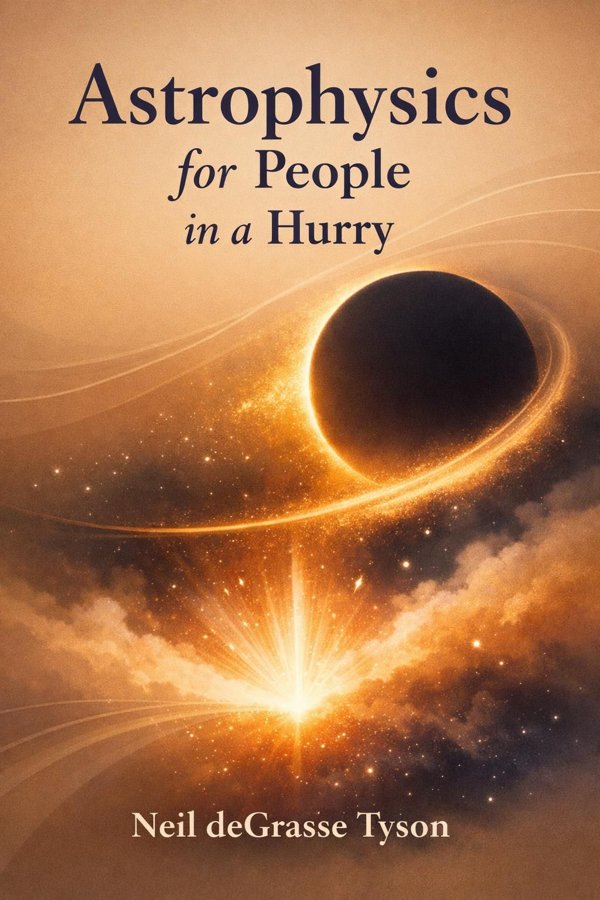
Astrophysics for People in a Hurry: Summary & Key Insights
 10 min5 chaptersAudio available
What Is Astrophysics for People in a Hurry About?
Astrophysics for People in a Hurry by Neil deGrasse Tyson is a popular_sci book spanning 5 pages. Astrophysics for People in a Hurry offers a concise and accessible overview of the universe, explaining complex cosmic phenomena such as black holes, dark matter, and the Big Bang in clear, engaging language. Tyson distills the essential principles of astrophysics for readers who want to understand the cosmos without delving into technical detail.
This FizzRead summary covers all 5 key chapters of Astrophysics for People in a Hurry in approximately 10 minutes, distilling the most important ideas, arguments, and takeaways from Neil deGrasse Tyson's work. Also available as an audio summary and Key Quotes Podcast.
Astrophysics for People in a Hurry
Astrophysics for People in a Hurry offers a concise and accessible overview of the universe, explaining complex cosmic phenomena such as black holes, dark matter, and the Big Bang in clear, engaging language. Tyson distills the essential principles of astrophysics for readers who want to understand the cosmos without delving into technical detail.
Who Should Read Astrophysics for People in a Hurry?
This book is perfect for anyone interested in popular_sci and looking to gain actionable insights in a short read. Whether you're a student, professional, or lifelong learner, the key ideas from Astrophysics for People in a Hurry by Neil deGrasse Tyson will help you think differently.
- ✓Readers who enjoy popular_sci and want practical takeaways
- ✓Professionals looking to apply new ideas to their work and life
- ✓Anyone who wants the core insights of Astrophysics for People in a Hurry in just 10 minutes
Want the full summary?
Get instant access to this book summary and 100K+ more with Fizz Moment.
Get Free SummaryAvailable on App Store • Free to download
Key Chapters
Every origin story shapes how we understand ourselves, and ours begins not in myth but in an explosion — the Big Bang. Thirteen-point-eight billion years ago, everything we know — space, time, energy, and matter — burst forth from a single, infinitesimal point. It wasn’t an explosion into space; it was the creation of space itself. In those first fractions of a second, the universe expanded faster than light, and from that cosmic furnace emerged the building blocks of all things: quarks bound into protons and neutrons, which later combined into the first atomic nuclei.
As the universe cooled, matter and radiation decoupled, releasing the cosmic microwave background — the oldest light we can still detect. These remnants, faint though they may be, are a baby picture of the universe, frozen in time. Every galaxy that now speckles the night sky traces its ancestry to tiny fluctuations in that early sea of hot plasma.
When I share this story, I often remind readers: the Big Bang doesn’t just describe how the universe began; it describes how order arises from chaos, structure from simplicity. Hydrogen and helium were the universe’s first ingredients. Every star born after that — every shining point you see overhead — has acted as a cosmic forge, fusing simple elements into carbon, nitrogen, oxygen, and iron. In time, those elements drifted across space, seeded new solar systems, and one day coalesced into a small blue planet called Earth. The Big Bang, then, is not some remote event lost in the void of time. It is the opening note of a cosmic symphony that continues to play within and around us.
We humans once believed Earth to be a realm apart from the heavens, a unique center around which everything revolved. But the more we learned, the clearer it became that the same laws governing an apple’s fall also steer the moon’s orbit and the stars’ dance. In physics, there is no distinction between celestial and terrestrial; the universe is governed by consistency.
The power of this revelation cannot be overstated. Newton’s law of gravity unified the skies with Earth, and Maxwell’s equations later unified electricity, magnetism, and light. These unifications remind us that simplicity underlies complexity, and that beauty often emerges where least expected. What thrills me about astrophysics isn’t merely discovering a new object or phenomenon but watching how the same few equations explain galaxies and grains of sand alike.
When you see a rainbow, the scattering of sunlight in water droplets follows the same optics we use to study the atmospheres of distant exoplanets. When a leaf’s green emerges from chlorophyll’s absorption of light, it echoes the same atomic transitions that color the cosmos. The unity of these laws is what makes science universal — a language that transcends culture, religion, or politics. When we grasp that the Earth and the heavens are bound by the same rules, we begin to see ourselves not as separate, but as participants in the very fabric of creation.
+ 3 more chapters — available in the FizzRead app
All Chapters in Astrophysics for People in a Hurry
About the Author
Neil deGrasse Tyson is an American astrophysicist, author, and science communicator. He is the director of the Hayden Planetarium at the American Museum of Natural History and is known for his work in popularizing science through books, television, and public lectures.
Get This Summary in Your Preferred Format
Read or listen to the Astrophysics for People in a Hurry summary by Neil deGrasse Tyson anytime, anywhere. FizzRead offers multiple formats so you can learn on your terms — all free.
Available formats: App · Audio · PDF · EPUB — All included free with FizzRead
Download Astrophysics for People in a Hurry PDF and EPUB Summary
Key Quotes from Astrophysics for People in a Hurry
“Every origin story shapes how we understand ourselves, and ours begins not in myth but in an explosion — the Big Bang.”
“We humans once believed Earth to be a realm apart from the heavens, a unique center around which everything revolved.”
Frequently Asked Questions about Astrophysics for People in a Hurry
Astrophysics for People in a Hurry by Neil deGrasse Tyson is a popular_sci book that explores key ideas across 5 chapters. Astrophysics for People in a Hurry offers a concise and accessible overview of the universe, explaining complex cosmic phenomena such as black holes, dark matter, and the Big Bang in clear, engaging language. Tyson distills the essential principles of astrophysics for readers who want to understand the cosmos without delving into technical detail.
More by Neil deGrasse Tyson
Death by Black Hole: And Other Cosmic Quandaries
Neil deGrasse Tyson
10 min
Origins: Fourteen Billion Years of Cosmic Evolution
Neil deGrasse Tyson, Donald Goldsmith
10 min
The Sky Is Not the Limit: Adventures of an Urban Astrophysicist
Neil deGrasse Tyson
10 min
The Pluto Files: The Rise and Fall of America’s Favorite Planet
Neil deGrasse Tyson
10 minYou Might Also Like

Structures: Or Why Things Don"t Fall Down
J.E. Gordon
10 min
The Road to Wigan Pier
George Orwell
10 min
Bonk: The Curious Coupling of Science and Sex
Mary Roach
10 min
First Bite: How We Learn to Eat
Bee Wilson
10 min
In Pursuit Of The Unknown: 17 Equations That Changed The World
Ian Stewart
10 min
Napoleon's Buttons: 17 Molecules That Changed History
Penny Le Couteur and Jay Burreson
10 minBrowse by Category
Ready to read Astrophysics for People in a Hurry?
Get the full summary and 100K+ more books with Fizz Moment.