
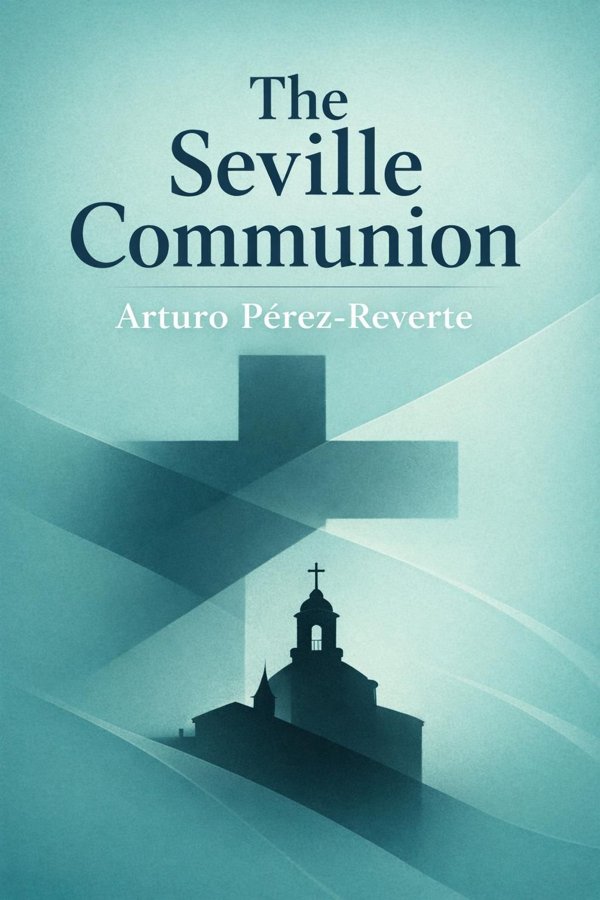
The Seville Communion: Summary & Key Insights
 10 min8 chaptersAudio available
Key Takeaways from The Seville Communion
The most dangerous mysteries are not the ones hidden in darkness, but the ones protected by institutions that believe they serve a higher truth.
Some people do not merely enter a story—they destabilize it.
Faith becomes most visible when it stops being comfortable.
Cities often reveal truths that their inhabitants would rather hide.
To investigate someone is to cross a moral boundary.
What Is The Seville Communion About?
The Seville Communion by Arturo Pérez-Reverte is a mystery book spanning 3 pages. What happens when a place of worship becomes the center of a lethal mystery? In The Seville Communion, Arturo Pérez-Reverte begins with an unforgettable premise: a hacker breaches the Vatican’s internal systems with a message claiming that a small church in Seville is killing those who try to interfere with it. The Vatican responds by sending Father Lorenzo Quart, a disciplined and morally complex operative, to investigate. What he finds is not just a puzzle of crime and conspiracy, but a struggle involving faith, money, pride, family loyalties, and desire. This novel matters because it turns a suspense plot into a meditation on institutions and belief. Pérez-Reverte does not treat the Church as a simple symbol of sanctity or corruption. Instead, he shows it as a living structure full of ambition, ritual, beauty, and contradiction. Set against the sensuous atmosphere of Seville, the story combines theological tension, political maneuvering, and psychological depth. Pérez-Reverte brings unusual authority to this material through his background as a journalist and novelist known for mixing history, conflict, and intrigue. The result is a literary mystery that asks not only who is guilty, but what faith means when power and conscience collide.
This FizzRead summary covers all 8 key chapters of The Seville Communion in approximately 10 minutes, distilling the most important ideas, arguments, and takeaways from Arturo Pérez-Reverte's work. Also available as an audio summary and Key Quotes Podcast.
The Seville Communion
What happens when a place of worship becomes the center of a lethal mystery? In The Seville Communion, Arturo Pérez-Reverte begins with an unforgettable premise: a hacker breaches the Vatican’s internal systems with a message claiming that a small church in Seville is killing those who try to interfere with it. The Vatican responds by sending Father Lorenzo Quart, a disciplined and morally complex operative, to investigate. What he finds is not just a puzzle of crime and conspiracy, but a struggle involving faith, money, pride, family loyalties, and desire.
This novel matters because it turns a suspense plot into a meditation on institutions and belief. Pérez-Reverte does not treat the Church as a simple symbol of sanctity or corruption. Instead, he shows it as a living structure full of ambition, ritual, beauty, and contradiction. Set against the sensuous atmosphere of Seville, the story combines theological tension, political maneuvering, and psychological depth. Pérez-Reverte brings unusual authority to this material through his background as a journalist and novelist known for mixing history, conflict, and intrigue. The result is a literary mystery that asks not only who is guilty, but what faith means when power and conscience collide.
Who Should Read The Seville Communion?
This book is perfect for anyone interested in mystery and looking to gain actionable insights in a short read. Whether you're a student, professional, or lifelong learner, the key ideas from The Seville Communion by Arturo Pérez-Reverte will help you think differently.
- ✓Readers who enjoy mystery and want practical takeaways
- ✓Professionals looking to apply new ideas to their work and life
- ✓Anyone who wants the core insights of The Seville Communion in just 10 minutes
Want the full summary?
Get instant access to this book summary and 100K+ more with Fizz Moment.
Get Free SummaryAvailable on App Store • Free to download
Key Chapters
The most dangerous mysteries are not the ones hidden in darkness, but the ones protected by institutions that believe they serve a higher truth. The Seville Communion opens with precisely that tension. A message breaks into the Vatican’s secure systems claiming that a church in Seville is somehow killing those who try to save it. From the beginning, Pérez-Reverte frames the Church not only as a spiritual authority but also as a political organism—one that gathers intelligence, manages reputations, and intervenes quietly when public scandal threatens order.
Father Lorenzo Quart is sent into this atmosphere as both priest and investigator. His mission appears simple: determine what is happening around the church and contain the problem. But the deeper he goes, the less the case resembles a straightforward criminal inquiry. The church at the center of the conflict is entangled in legal battles, local loyalties, hidden motives, and the Vatican’s concern for authority. Faith is present everywhere, yet it is filtered through bureaucracy, self-interest, and strategic silence.
This idea matters because Pérez-Reverte shows that institutions often become most revealing under pressure. In modern life, this applies far beyond religion. Corporations, governments, universities, and even families frequently defend themselves with the same mixture of loyalty, secrecy, and moral language. A public crisis exposes what an institution values most: truth, image, tradition, or survival.
Readers can apply this insight by looking more closely at the systems they trust. When a conflict emerges, ask not only what people say they are protecting, but what their actions actually preserve. In your own life, whether at work or in community settings, examine where duty ends and self-protection begins. The actionable takeaway: when confronting any powerful institution, pay attention to the gap between sacred ideals and practical behavior—that gap usually contains the real story.
Some people do not merely enter a story—they destabilize it. Macarena Bruner is that force in The Seville Communion. Wealthy, poised, emotionally layered, and fiercely connected to the threatened church, she becomes one of the central figures in Quart’s investigation. Yet she is not simply a suspect, ally, or romantic interest. She embodies the novel’s deeper conflict between obligation and longing, between the roles society imposes and the private truths people protect.
For Quart, Macarena is a test. He arrives in Seville armed with discipline, trained to observe without being seduced by appearances. But Macarena challenges his certainty. Her motivations are difficult to classify. She can appear devout and strategic, vulnerable and manipulative, sincere and theatrical, often in the same scene. Pérez-Reverte uses her not as a femme fatale stereotype but as a complex person whose intelligence and charisma force Quart to reconsider the emotional distance on which his authority depends.
This relationship matters because it reveals how investigations are never purely rational. In high-stakes situations, personal attraction, admiration, pity, and resentment shape judgment as much as facts do. This is true in everyday life as well. Leaders are influenced by charisma. Professionals make exceptions for people who unsettle them. Moral clarity becomes harder when emotion enters the room.
A practical example can be found in workplace decisions or personal conflicts. If you are evaluating someone’s behavior, ask whether your attraction, sympathy, or discomfort is distorting your reading of the evidence. Quart’s struggle reminds us that self-knowledge is as important as intelligence.
The actionable takeaway: when desire—romantic, emotional, or psychological—starts influencing your judgment, pause and name it clearly. You cannot remain fair if you pretend you are untouched.
Faith becomes most visible when it stops being comfortable. As The Seville Communion moves toward its revelations, Pérez-Reverte shifts the story beyond the mechanics of mystery into a spiritual reckoning. The question is no longer only who is responsible for violence and deception, but what each character truly believes when tested by loss, temptation, and institutional pressure.
Quart begins as a man formed by obedience. He understands hierarchy, discipline, and service. Yet the events in Seville force him into situations where official answers feel morally incomplete. Around him, other characters display different versions of faith: faith as ritual, faith as nostalgia, faith as social identity, faith as love for beauty, and faith as resistance against modern erasure. The threatened church itself becomes symbolic—less a building than a vessel for memory, dignity, and competing visions of what should survive.
Pérez-Reverte refuses a simplistic conclusion. Faith is not presented as pure innocence, nor is the Church reduced to corruption. Instead, the novel suggests that belief survives through imperfection. People fail, institutions compromise, motives blur, but something still compels sacrifice, loyalty, and reverence. The reckoning lies in recognizing that faith without realism becomes naïveté, while realism without faith becomes emptiness.
This idea has practical value for anyone wrestling with disappointment. Many people lose trust in organizations, leaders, or traditions because they expect perfection. The novel encourages a harder but more durable stance: distinguish between the failures of people and the values that may still be worth defending. In civic life, family life, or personal belief, this distinction can prevent both cynicism and blind devotion.
The actionable takeaway: when your ideals are shaken, do not ask only whether others have failed them. Ask whether the ideal itself still deserves your loyalty—and if so, how to serve it without illusion.
Cities often reveal truths that their inhabitants would rather hide. In The Seville Communion, Seville is not a decorative backdrop but a living force that shapes the novel’s mood, tempo, and moral texture. Pérez-Reverte uses its streets, churches, heat, old wealth, and ceremonial culture to create an atmosphere where beauty and danger coexist. The city radiates devotion and spectacle, intimacy and surveillance, seduction and decay.
Seville matters because the conflict at the center of the novel could not unfold in a neutral setting. The old church under threat is surrounded by a society that still remembers lineage, prestige, and religious pageantry. Public appearances carry weight. Reputation can protect or destroy. Every conversation seems connected to class, history, and local allegiance. Quart, as an outsider, must navigate not just facts but codes of behavior embedded in the city itself.
This use of setting teaches an important interpretive lesson: context changes meaning. The same legal battle, death, or scandal would carry a different emotional charge in a modern anonymous city than it does in Seville, where architecture, memory, and ritual preserve old hierarchies. In our own lives, this insight is useful whenever we judge behavior across cultures or institutions. People rarely act in a vacuum. Their surroundings tell us what they fear, value, and perform.
For example, when entering a new workplace, community, or social circle, pay attention to its rituals: who speaks first, what symbols matter, what stories are repeated, what topics remain untouched. These are clues to power. Pérez-Reverte shows that reading a place carefully is part of reading people accurately.
The actionable takeaway: before trying to solve a conflict, study the environment around it. Places hold hidden rules, and those rules often explain choices better than stated intentions do.
To investigate someone is to cross a moral boundary. Father Lorenzo Quart is not a detective in the classic secular sense; he is an emissary of an institution that claims spiritual authority. That makes his mission ethically complicated. He is expected to uncover the truth, but also to protect the Church, avoid scandal, and maintain order. The novel repeatedly asks whether truth-seeking can remain pure when the investigator serves competing masters.
Quart’s professionalism is one of his defining traits. He is observant, restrained, and skilled at moving through hostile terrain. But Pérez-Reverte makes clear that method is never morally neutral. Whom Quart trusts, what he reports, what he withholds, and when he chooses empathy over procedure all become part of the drama. Investigation here is not just information gathering; it is an exercise in power.
This concept extends beyond the novel. Journalists, auditors, compliance officers, managers, clergy, and even parents often investigate in situations where the discovery of truth may damage the very structure they are trying to preserve. The temptation is to redefine truth as whatever produces stability. Yet that choice comes at a cost. Short-term protection can create deeper corruption.
A practical application lies in decision-making under institutional pressure. If you are responsible for reviewing misconduct, performance, or conflict, clarify in advance what your non-negotiables are. Are you committed to accuracy even if the result is embarrassing? Are you protecting people or just preserving appearances? Quart’s dilemma reminds us that these answers should be settled before emotion and loyalty cloud them.
The actionable takeaway: when investigating any serious problem, define your duty to truth before you define your duty to the institution. If you reverse that order, your conclusions will likely serve power rather than justice.
People do not remain loyal to traditions only because of doctrine; often, they stay because beauty gives belief a home. One of the most compelling dimensions of The Seville Communion is its attention to ritual, architecture, and sacred atmosphere. Pérez-Reverte understands that churches are not merely administrative units or real estate assets. They are spaces where art, memory, and transcendence gather. This is part of what makes the threatened church in Seville so important to the people around it.
The novel treats beauty as morally ambiguous. It can inspire reverence, preserve continuity, and nurture the soul. At the same time, it can also be used to conceal power, manipulate emotion, or justify inertia. The splendor of religious life does not eliminate corruption; it can coexist with it. That paradox gives the story much of its richness. Characters are moved by ceremony and sacred space even when they mistrust the institutions behind them.
This insight applies widely. In modern life, people often dismiss symbols and rituals as superficial, yet they continue to be shaped by them—national holidays, family traditions, professional ceremonies, and communal spaces all influence commitment. Beauty can deepen belonging, but it can also make us less critical of systems we should question.
A practical example: think about how people respond differently in environments that feel dignified and meaningful versus those that feel purely transactional. Spaces affect conduct. Rituals affect memory. The novel invites readers to notice how form shapes conviction.
The actionable takeaway: honor the beauty and emotional power of traditions, but do not confuse aesthetic depth with moral innocence. Let beauty move you, while still asking what it is being used to protect.
The most convincing corruption often arrives wearing the language of necessity. One of Pérez-Reverte’s strengths in The Seville Communion is his refusal to divide the world into saints and monsters. Characters maneuver for advantage, hide truths, and justify dubious actions, but they rarely see themselves as evil. Instead, they act in the name of prudence, loyalty, reputation, or preservation. That is what makes the novel’s intrigue feel psychologically real.
The threatened church becomes a focal point for overlapping interests: financial concerns, institutional reputation, private agendas, local pride, and personal survival. In such a setting, corruption does not emerge as cartoonish malice. It develops through rationalization. A small concealment protects a larger mission. A lie avoids scandal. A manipulation prevents chaos. Step by step, people persuade themselves that means no longer matter because the end seems worthy.
This is a powerful lesson for readers because most ethical failures in real life follow the same pattern. Few individuals begin by choosing wrongdoing as a grand principle. More often, they adapt to pressure, excuse compromise, and normalize behavior that once seemed unacceptable. By the time the damage becomes visible, everyone involved has a story explaining why there was no alternative.
In practical terms, this idea is useful in professional and personal ethics. If you hear repeated phrases like “This is how things are done,” “We had no choice,” or “It’s for the greater good,” treat them as warning signs rather than reassuring explanations. Those phrases often signal moral drift.
The actionable takeaway: do not measure corruption only by dramatic crimes. Watch for the quieter habit of excusing bad means with noble language. Ethical collapse usually starts there.
All Chapters in The Seville Communion
About the Author
Arturo Pérez-Reverte is a Spanish novelist, journalist, and former war correspondent whose fiction is known for blending suspense, history, intellectual intrigue, and moral ambiguity. Before dedicating himself fully to literature, he spent more than twenty years reporting from war zones around the world, an experience that sharpened his understanding of conflict, power, and human behavior. That background deeply informs his novels, which often feature dangerous investigations, layered codes of honor, and protagonists navigating compromised institutions. He is the author of internationally recognized works such as The Club Dumas, The Flanders Panel, and the Captain Alatriste series. Pérez-Reverte is especially admired for his atmospheric settings, cultured references, and ability to combine literary sophistication with page-turning storytelling, making him one of the most distinctive contemporary voices in Spanish fiction.
Get This Summary in Your Preferred Format
Read or listen to the The Seville Communion summary by Arturo Pérez-Reverte anytime, anywhere. FizzRead offers multiple formats so you can learn on your terms — all free.
Available formats: App · Audio · PDF · EPUB — All included free with FizzRead
Download The Seville Communion PDF and EPUB Summary
Key Quotes from The Seville Communion
“The most dangerous mysteries are not the ones hidden in darkness, but the ones protected by institutions that believe they serve a higher truth.”
“Some people do not merely enter a story—they destabilize it.”
“Faith becomes most visible when it stops being comfortable.”
“Cities often reveal truths that their inhabitants would rather hide.”
“To investigate someone is to cross a moral boundary.”
Frequently Asked Questions about The Seville Communion
The Seville Communion by Arturo Pérez-Reverte is a mystery book that explores key ideas across 8 chapters. What happens when a place of worship becomes the center of a lethal mystery? In The Seville Communion, Arturo Pérez-Reverte begins with an unforgettable premise: a hacker breaches the Vatican’s internal systems with a message claiming that a small church in Seville is killing those who try to interfere with it. The Vatican responds by sending Father Lorenzo Quart, a disciplined and morally complex operative, to investigate. What he finds is not just a puzzle of crime and conspiracy, but a struggle involving faith, money, pride, family loyalties, and desire. This novel matters because it turns a suspense plot into a meditation on institutions and belief. Pérez-Reverte does not treat the Church as a simple symbol of sanctity or corruption. Instead, he shows it as a living structure full of ambition, ritual, beauty, and contradiction. Set against the sensuous atmosphere of Seville, the story combines theological tension, political maneuvering, and psychological depth. Pérez-Reverte brings unusual authority to this material through his background as a journalist and novelist known for mixing history, conflict, and intrigue. The result is a literary mystery that asks not only who is guilty, but what faith means when power and conscience collide.
More by Arturo Pérez-Reverte




You Might Also Like





Browse by Category
Ready to read The Seville Communion?
Get the full summary and 100K+ more books with Fizz Moment.