
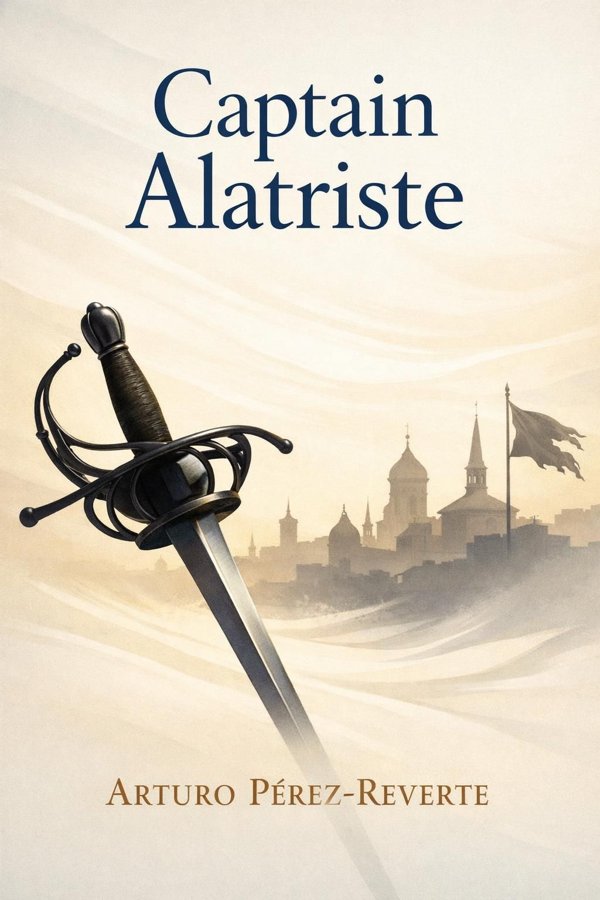
Captain Alatriste: Summary & Key Insights
 10 min9 chaptersAudio available
Key Takeaways from Captain Alatriste
Empires often collapse long before they admit it, and Captain Alatriste lives inside that contradiction.
A seemingly simple assignment is often the doorway to hidden power.
Cities reveal character by what they force people to hide, and Madrid in Captain Alatriste is a city of masks.
Honor matters most when it is costly.
Coming of age often means discovering that bravery is more complicated than stories suggest.
What Is Captain Alatriste About?
Captain Alatriste by Arturo Pérez-Reverte is a classics book spanning 4 pages. Captain Alatriste is the electrifying opening novel in Arturo Pérez-Reverte’s celebrated historical adventure series, set in the shadowed streets, taverns, theaters, and palaces of seventeenth-century Madrid. Told through the eyes of the young page Íñigo Balboa, the story follows Diego Alatriste y Tenorio, a veteran soldier turned swordsman-for-hire, as he is drawn into a dangerous assignment that quickly reveals a web of political manipulation, religious pressure, and international intrigue. On the surface, it is a tale of duels, ambushes, and cloak-and-dagger conspiracies. At a deeper level, it is a portrait of a civilization at once brilliant and decaying, where honor survives even as institutions rot. The novel matters because it transforms history into lived experience: readers do not merely learn about Spain’s Golden Age, they feel its hunger, vanity, courage, and decline. Pérez-Reverte brings unusual authority to this world through his background as a journalist, war correspondent, and meticulous historical novelist. He writes with both romantic energy and moral seriousness, creating a hero who is not idealized, but profoundly human.
This FizzRead summary covers all 9 key chapters of Captain Alatriste in approximately 10 minutes, distilling the most important ideas, arguments, and takeaways from Arturo Pérez-Reverte's work. Also available as an audio summary and Key Quotes Podcast.
Captain Alatriste
Captain Alatriste is the electrifying opening novel in Arturo Pérez-Reverte’s celebrated historical adventure series, set in the shadowed streets, taverns, theaters, and palaces of seventeenth-century Madrid. Told through the eyes of the young page Íñigo Balboa, the story follows Diego Alatriste y Tenorio, a veteran soldier turned swordsman-for-hire, as he is drawn into a dangerous assignment that quickly reveals a web of political manipulation, religious pressure, and international intrigue. On the surface, it is a tale of duels, ambushes, and cloak-and-dagger conspiracies. At a deeper level, it is a portrait of a civilization at once brilliant and decaying, where honor survives even as institutions rot. The novel matters because it transforms history into lived experience: readers do not merely learn about Spain’s Golden Age, they feel its hunger, vanity, courage, and decline. Pérez-Reverte brings unusual authority to this world through his background as a journalist, war correspondent, and meticulous historical novelist. He writes with both romantic energy and moral seriousness, creating a hero who is not idealized, but profoundly human.
Who Should Read Captain Alatriste?
This book is perfect for anyone interested in classics and looking to gain actionable insights in a short read. Whether you're a student, professional, or lifelong learner, the key ideas from Captain Alatriste by Arturo Pérez-Reverte will help you think differently.
- ✓Readers who enjoy classics and want practical takeaways
- ✓Professionals looking to apply new ideas to their work and life
- ✓Anyone who wants the core insights of Captain Alatriste in just 10 minutes
Want the full summary?
Get instant access to this book summary and 100K+ more with Fizz Moment.
Get Free SummaryAvailable on App Store • Free to download
Key Chapters
Empires often collapse long before they admit it, and Captain Alatriste lives inside that contradiction. Diego Alatriste moves through a Spain that still speaks the language of destiny, Catholic supremacy, and imperial grandeur, yet the reality beneath the rhetoric is debt, corruption, exhausted soldiers, and social decay. Pérez-Reverte uses Alatriste’s world to show that decline is rarely sudden; it arrives as a slow separation between noble ideals and compromised institutions. Madrid is full of noblemen obsessed with appearance, officials who profit from influence, and veterans who gave everything only to be forgotten. The result is a society where the symbols of greatness remain intact while the moral and political foundations have begun to crumble.
What makes this idea powerful is that the novel never presents history as abstract. It shows decline in taverns, back alleys, and cramped lodgings. Alatriste himself embodies the costs of empire: brave, disciplined, scarred, and underpaid, he is the kind of man who made Spanish power possible but receives little reward from it. Through him, Pérez-Reverte asks what happens when a nation celebrates honor in poetry but neglects it in practice.
This theme has modern resonance. Organizations, governments, and even individuals can fall into the same trap: clinging to prestige while ignoring structural weakness. A company may boast of its legacy while mistreating its best people. A person may cultivate an image of strength while quietly eroding their own values.
Actionable takeaway: judge strength by integrity and substance, not by ceremony, reputation, or inherited glory.
A seemingly simple assignment is often the doorway to hidden power. The plot of Captain Alatriste begins when two masked employers hire Alatriste and the Italian assassin Gualterio Malatesta to attack two foreign travelers arriving in Madrid. At first, the task appears to be routine mercenary work: intercept, wound, perhaps kill, and leave no loose ends. But when Alatriste realizes the victims are not ordinary men and that darker motives are involved, the mission becomes a moral and political crossroads.
This turning point matters because Pérez-Reverte uses it to expose how ordinary violence serves larger systems. Street-level brutality is linked to court politics, religious ambition, diplomatic tension, and private vendettas. The travelers are connected to England, and what seems like an alleyway crime is really entangled with international rivalry and factional power inside Spain. Alatriste’s decision not to follow the most ruthless course marks him as dangerous not because he is disloyal, but because he acts according to his own code instead of blindly obeying those above him.
The novel suggests that the most consequential choices often arrive disguised as technical decisions. In work and life, we are sometimes asked to do something “small” without being told its wider purpose. Sign this document. Deliver this message. Stay silent about this detail. The ethical question is not only whether the task is legal or profitable, but what larger game it serves.
Practical application means learning to pause before action. Ask: Who benefits? What is being concealed? What happens if I obey without understanding? Alatriste survives because he sees beyond the immediate order.
Actionable takeaway: when a task feels morally cloudy, investigate the broader context before committing yourself.
Cities reveal character by what they force people to hide, and Madrid in Captain Alatriste is a city of masks. Pérez-Reverte presents the capital not merely as a backdrop but as a living system in which everyone performs a role: noblemen cultivate elegance while drowning in debt, priests preach virtue while maneuvering for power, writers seek patronage, and soldiers maintain dignity amid poverty. In this world, appearance is currency. To survive, people conceal fear, ambition, shame, and often truth itself.
This theatrical quality gives the novel much of its richness. Madrid’s taverns, churches, prisons, and playhouses form a social map where status and danger intersect. One of the sharpest insights in the book is that deception is not confined to spies or criminals. It is built into public life. Institutions that should uphold moral order become stages for vanity and coercion. Yet the city is not reduced to cynicism. It is also intellectually vibrant and artistically alive, filled with language, wit, and cultural brilliance. That combination of splendor and corruption is what makes the setting unforgettable.
For readers today, Madrid functions as a lesson in reading environments carefully. Every workplace, network, or community has visible rules and invisible ones. Titles may matter less than alliances. Public values may differ from private incentives. Understanding a system requires observing not just what people say, but what they reward, punish, and avoid.
A practical example is professional life: the official mission of an organization may emphasize service or innovation, while actual advancement depends on politics, discretion, or strategic loyalty. Like Íñigo learning the city, we must become students of context.
Actionable takeaway: in any complex environment, look beyond formal roles and learn the hidden codes that truly govern behavior.
Honor matters most when it is costly. Captain Alatriste is not a sentimental celebration of virtue; it is a hard examination of what remains of dignity in a world where institutions repeatedly fail. Alatriste is no spotless hero. He kills, lies when necessary, and works for money. Yet he possesses a code that distinguishes him from the hypocrites around him. He keeps faith with comrades, protects the weak when he can, refuses unnecessary cruelty, and accepts danger without theatrical self-praise. In a society where many powerful men speak endlessly of principle while acting from greed or fear, his rough integrity becomes a form of resistance.
Pérez-Reverte is careful not to romanticize this code. Honor does not make Alatriste prosperous or safe. It isolates him, complicates his choices, and often places him at a disadvantage against those willing to betray, flatter, or manipulate. Through Íñigo’s admiration, the novel asks whether moral character is still meaningful when it brings no reward. Its answer is yes: honor may not save the world, but it preserves the self from becoming complicit in rot.
This idea remains deeply relevant. Modern life often encourages convenience over conviction. It is easier to stay silent, to compromise a little, to excuse bad behavior because “that’s how the system works.” Alatriste reminds us that ethical consistency is rarely glamorous. It appears in small acts: telling the truth when a lie would help, defending a colleague, refusing to exploit someone weaker, or declining an opportunity that violates your principles.
Actionable takeaway: define your code before pressure arrives, so that in moments of compromise you know what you will and will not do.
Coming of age often means discovering that bravery is more complicated than stories suggest. The novel is narrated by Íñigo Balboa, who looks back on his youth and his apprenticeship under Alatriste. This perspective is crucial because Captain Alatriste is not just an adventure story; it is also an education in how innocence encounters history. Íñigo begins with admiration for swordsmen, noble causes, and heroic reputation. What he learns instead is that courage is mixed with hunger, loyalty with violence, and greatness with failure.
Through Íñigo, Pérez-Reverte captures the painful but necessary shift from romantic illusion to mature perception. The boy witnesses duels, political conspiracies, and the casual injustice of class society. He also learns to recognize quality in people who do not fit official ideals. Alatriste may be socially marginal, but he has more integrity than many aristocrats. Conversely, men who speak in the language of religion, patriotism, or refinement may be morally hollow. Íñigo’s education lies not only in swordsmanship or street survival, but in learning to judge character beneath costume and rank.
This is one of the book’s most practical lessons. Maturity requires revising inherited narratives. In school, work, or family life, we often begin by trusting labels: successful people must be admirable, authority figures must be wise, polished speech must reflect virtue. Experience teaches otherwise. A more grounded worldview emerges when we compare words with conduct over time.
A practical application is mentorship. Seek teachers who model consistency, not just charisma. Learn from people who have endured hardship without surrendering their standards.
Actionable takeaway: let experience deepen your ideals rather than destroy them, and choose role models by actions, not appearances.
Skill is never morally neutral once it is placed in human hands. Swordsmanship in Captain Alatriste is thrilling, but Pérez-Reverte refuses to present violence as clean entertainment. Fencing, ambush, and dueling are shown as arts shaped by discipline, speed, reputation, and instinct, yet every blade encounter carries consequences beyond spectacle. Men are wounded, frightened, humiliated, or killed for causes that are often petty, political, or concealed. The novel respects martial skill while exposing the social world that turns that skill into a commodity.
Alatriste’s expertise with the sword is one of the foundations of his identity. It earns him survival, work, and a certain grim prestige. But it also traps him. A man known for violence becomes useful to dangerous people. His competence attracts assignments he might prefer not to take. In that sense, the novel explores a broader truth: our strengths can become the means by which systems exploit us. The very thing we do best may draw us deeper into morally compromised situations.
This idea applies far beyond combat. A talented negotiator may be asked to defend bad decisions. A gifted marketer may be used to promote a harmful product. A skilled engineer may be told to optimize a system they do not ethically support. Capability creates leverage, but also responsibility.
The practical lesson is to pair excellence with boundaries. Being good at something does not mean you must use it for any available purpose. Alatriste remains compelling because, despite all compromise, he still tries to choose when and for whom he fights.
Actionable takeaway: master your craft, but decide in advance the causes, clients, and systems you refuse to serve.
The most dangerous power often presents itself as moral necessity. One of the darkest dimensions of Captain Alatriste is its portrayal of the alliance between politics and religious authority. Figures linked to the court and the Inquisition do not simply defend faith or order; they use those ideals to justify coercion, surveillance, and violence. Pérez-Reverte shows how institutions gain strength when they claim exclusive access to truth, because that claim turns dissent into sin and opposition into treason.
The novel’s conspiracies are effective precisely because they operate under respectable cover. Publicly, the powerful speak of duty, orthodoxy, and national interest. Privately, they pursue influence, revenge, and strategic advantage. This gap between declared virtue and actual motive is one of the book’s central insights. It reveals why Alatriste, a flawed mercenary, can seem more trustworthy than men with offices, titles, and clerical robes. His motives are limited and legible. Theirs are grand, concealed, and therefore more dangerous.
For modern readers, the relevance is obvious. Whether in politics, corporate culture, media, or social movements, moral language can be used sincerely or manipulatively. When leaders insist that only they represent justice, patriotism, faith, or progress, scrutiny becomes essential. The key question is not how elevated the rhetoric sounds, but how power is actually exercised.
A practical application is to evaluate institutions by transparency and accountability. Do they permit criticism? Do they punish questions? Do they demand loyalty without explanation? Healthy systems survive examination; corrupt ones often hide behind sanctity.
Actionable takeaway: whenever authority cloaks itself in absolute moral certainty, pay closer attention to incentives, secrecy, and who bears the cost.
A civilization can be spiritually alive even while politically sick. One of Captain Alatriste’s greatest achievements is its evocation of Spain’s Golden Age as a world of astonishing artistic brilliance emerging from social hardship and imperial decline. Pérez-Reverte fills the novel with references to poets, playwrights, and intellectual life, reminding us that cultural greatness does not necessarily coincide with just governance or material well-being. Madrid may be dangerous and corrupt, but it is also the city of wit, theater, language, and literary ambition.
This tension deepens the novel. Art is not presented as an escape from reality, but as one of the few places where reality can be named honestly. Writers and actors move through the same compromised world as soldiers and courtiers, yet they preserve memory, sharpen satire, and articulate the contradictions others would prefer to ignore. The presence of literary culture enriches the story’s atmosphere, but it also serves a larger purpose: it shows that beauty and truth can endure inside damaged societies.
Readers can apply this lesson personally. During periods of uncertainty or institutional failure, it is tempting to treat culture as secondary. The novel argues the opposite. Stories, poems, and performances help people maintain perspective, identity, and moral imagination. They remind us that survival is not only physical or economic, but also intellectual and emotional.
A practical example is deliberate engagement with art during stressful periods. Reading serious fiction, attending theater, or discussing ideas can deepen judgment and resilience. Culture trains us to notice nuance in a world that rewards simplification.
Actionable takeaway: use literature and art not as distraction alone, but as tools for understanding human complexity and preserving inner independence.
A historical novel endures when it explains the present as much as the past. Although Captain Alatriste is set in seventeenth-century Spain, its emotional and political logic feels strikingly contemporary. Readers recognize the distance between official narratives and lived reality, the exhaustion of veterans after public praise fades, the corruption of institutions that speak the language of moral purpose, and the difficulty of maintaining integrity in transactional systems. The costumes are old, but the pressures are familiar.
This modern relevance helps explain the book’s lasting appeal. Alatriste is not inspiring because he is triumphant. He is inspiring because he continues to act with restraint, courage, and loyalty inside conditions he knows are compromised. That posture resonates in a time when many people feel similarly disenchanted with politics, bureaucracy, and public rhetoric. The novel does not promise that good people will win or that history bends neatly toward justice. Instead, it offers a sterner consolation: even in decline, individual conduct matters.
The practical value of this perspective is emotional as well as ethical. Many readers struggle with cynicism because they assume that if systems are flawed, principles are useless. Pérez-Reverte rejects that conclusion. Corruption does not make character irrelevant; it makes it harder and therefore more meaningful.
In daily life, this can mean doing competent, honest work inside imperfect institutions; maintaining loyalty to trustworthy people; and refusing to let disillusionment become an excuse for cruelty or passivity.
Actionable takeaway: do not wait for a perfect world to practice courage, discernment, and decency—those virtues are most necessary in imperfect ones.
All Chapters in Captain Alatriste
About the Author
Arturo Pérez-Reverte, born in Cartagena, Spain, in 1951, is a distinguished novelist, journalist, and member of the Royal Spanish Academy. Before devoting himself fully to fiction, he spent many years as a reporter and war correspondent, covering conflicts around the world. That experience shaped his writing style, which often combines realism, moral ambiguity, political insight, and a deep understanding of violence and power. Pérez-Reverte has earned international acclaim for novels such as The Club Dumas, The Flanders Panel, and the Captain Alatriste series. He is especially known for blending literary sophistication with gripping plots and meticulously researched historical settings. In Captain Alatriste, he draws on his talents as both storyteller and historian to recreate Spain’s Golden Age with vivid texture and sharp intelligence.
Get This Summary in Your Preferred Format
Read or listen to the Captain Alatriste summary by Arturo Pérez-Reverte anytime, anywhere. FizzRead offers multiple formats so you can learn on your terms — all free.
Available formats: App · Audio · PDF · EPUB — All included free with FizzRead
Download Captain Alatriste PDF and EPUB Summary
Key Quotes from Captain Alatriste
“Empires often collapse long before they admit it, and Captain Alatriste lives inside that contradiction.”
“A seemingly simple assignment is often the doorway to hidden power.”
“Cities reveal character by what they force people to hide, and Madrid in Captain Alatriste is a city of masks.”
“Captain Alatriste is not a sentimental celebration of virtue; it is a hard examination of what remains of dignity in a world where institutions repeatedly fail.”
“Coming of age often means discovering that bravery is more complicated than stories suggest.”
Frequently Asked Questions about Captain Alatriste
Captain Alatriste by Arturo Pérez-Reverte is a classics book that explores key ideas across 9 chapters. Captain Alatriste is the electrifying opening novel in Arturo Pérez-Reverte’s celebrated historical adventure series, set in the shadowed streets, taverns, theaters, and palaces of seventeenth-century Madrid. Told through the eyes of the young page Íñigo Balboa, the story follows Diego Alatriste y Tenorio, a veteran soldier turned swordsman-for-hire, as he is drawn into a dangerous assignment that quickly reveals a web of political manipulation, religious pressure, and international intrigue. On the surface, it is a tale of duels, ambushes, and cloak-and-dagger conspiracies. At a deeper level, it is a portrait of a civilization at once brilliant and decaying, where honor survives even as institutions rot. The novel matters because it transforms history into lived experience: readers do not merely learn about Spain’s Golden Age, they feel its hunger, vanity, courage, and decline. Pérez-Reverte brings unusual authority to this world through his background as a journalist, war correspondent, and meticulous historical novelist. He writes with both romantic energy and moral seriousness, creating a hero who is not idealized, but profoundly human.
More by Arturo Pérez-Reverte


You Might Also Like






Browse by Category
Ready to read Captain Alatriste?
Get the full summary and 100K+ more books with Fizz Moment.