
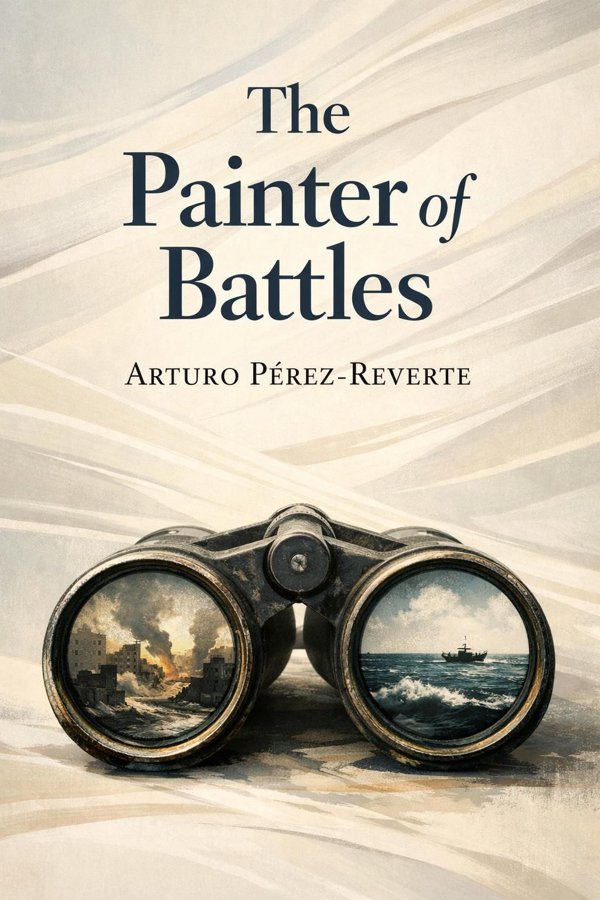
The Painter of Battles: Summary & Key Insights
 10 min9 chaptersAudio available
Key Takeaways from The Painter of Battles
Isolation is rarely an escape; more often, it is a laboratory where unfinished thoughts become impossible to ignore.
The past does not disappear because we stop speaking about it; sometimes it simply waits for the right moment to knock on the door.
To witness suffering is never a neutral act, especially when that suffering becomes material for art.
Forgetting is not the opposite of memory; often it is memory’s shadow, the force that reveals what cannot be erased.
One of the novel’s most unsettling ideas is that violence is not random chaos but a pattern with recurring forms.
What Is The Painter of Battles About?
The Painter of Battles by Arturo Pérez-Reverte is a bestsellers book spanning 4 pages. What happens when a man who has spent his life documenting war can no longer bear to simply record it? In The Painter of Battles, Arturo Pérez-Reverte follows Andrés Faulques, a retired war photographer who has withdrawn to a lonely tower on the Mediterranean coast. There, he paints an immense mural meant to capture the hidden geometry of violence: not one battle, but the recurring pattern beneath all battles. His solitude is broken by the arrival of Ivo Markovic, a man from the Balkan wars who believes Faulques’s camera helped destroy his life. Their encounter becomes a tense, philosophical reckoning over guilt, witness, fate, and the price of turning suffering into art. This novel matters because it goes far beyond a revenge plot. It asks whether observing violence is ever morally neutral, whether art can reveal truth without exploiting pain, and whether human brutality follows a recognizable design. Pérez-Reverte writes with unusual authority. Before becoming a celebrated novelist, he spent more than two decades as a war correspondent, and that lived knowledge gives the book its hard realism, moral seriousness, and haunting psychological depth.
This FizzRead summary covers all 9 key chapters of The Painter of Battles in approximately 10 minutes, distilling the most important ideas, arguments, and takeaways from Arturo Pérez-Reverte's work. Also available as an audio summary and Key Quotes Podcast.
The Painter of Battles
What happens when a man who has spent his life documenting war can no longer bear to simply record it? In The Painter of Battles, Arturo Pérez-Reverte follows Andrés Faulques, a retired war photographer who has withdrawn to a lonely tower on the Mediterranean coast. There, he paints an immense mural meant to capture the hidden geometry of violence: not one battle, but the recurring pattern beneath all battles. His solitude is broken by the arrival of Ivo Markovic, a man from the Balkan wars who believes Faulques’s camera helped destroy his life. Their encounter becomes a tense, philosophical reckoning over guilt, witness, fate, and the price of turning suffering into art.
This novel matters because it goes far beyond a revenge plot. It asks whether observing violence is ever morally neutral, whether art can reveal truth without exploiting pain, and whether human brutality follows a recognizable design. Pérez-Reverte writes with unusual authority. Before becoming a celebrated novelist, he spent more than two decades as a war correspondent, and that lived knowledge gives the book its hard realism, moral seriousness, and haunting psychological depth.
Who Should Read The Painter of Battles?
This book is perfect for anyone interested in bestsellers and looking to gain actionable insights in a short read. Whether you're a student, professional, or lifelong learner, the key ideas from The Painter of Battles by Arturo Pérez-Reverte will help you think differently.
- ✓Readers who enjoy bestsellers and want practical takeaways
- ✓Professionals looking to apply new ideas to their work and life
- ✓Anyone who wants the core insights of The Painter of Battles in just 10 minutes
Want the full summary?
Get instant access to this book summary and 100K+ more with Fizz Moment.
Get Free SummaryAvailable on App Store • Free to download
Key Chapters
Isolation is rarely an escape; more often, it is a laboratory where unfinished thoughts become impossible to ignore. That is the atmosphere in which Andrés Faulques begins this novel. After years spent photographing war zones across the world, he retreats to a tower above the Mediterranean, believing distance from human conflict might finally offer peace. Yet the tower is not a refuge in any simple sense. It is a place of reckoning. On its walls, Faulques paints a vast mural intended to capture what his photographs never fully could: the underlying structure of war, the pattern linking chaos, fear, cruelty, beauty, and inevitability.
The mural matters because it represents a shift from documenting events to searching for meaning. A camera freezes fragments. Painting allows Faulques to assemble those fragments into a vision of how violence repeats across time. The tower becomes both studio and confession booth. Every brushstroke is an attempt to convert memory into order, to transform trauma into form. But the project also reveals a painful truth: intellectual distance does not erase emotional involvement. The more he paints, the more he revisits what he saw, and the more clearly he senses that he was never merely an observer.
In practical terms, the tower and mural symbolize what many people do after intense experience. We create systems, journals, artworks, or private narratives to make suffering legible. We arrange memory so it does not drown us. The question is whether such ordering heals us or only sharpens our awareness of what cannot be repaired.
Actionable takeaway: When a painful experience continues to haunt you, do not just revisit the event itself. Build a larger frame around it—through writing, art, conversation, or reflection—to understand the pattern it belongs to.
The past does not disappear because we stop speaking about it; sometimes it simply waits for the right moment to knock on the door. This truth takes human form when Ivo Markovic arrives at Faulques’s tower. Markovic is not a random visitor but a survivor of the Balkan war, a man whose life was devastated after Faulques photographed him in a moment of conflict. That image, once circulated, became part of a chain of consequences that Markovic believes ruined him. He has come not only for revenge but for explanation.
His arrival changes the novel from meditative solitude into moral confrontation. Markovic is not just an accuser; he is living evidence that images have afterlives. Faulques once believed he documented reality. Markovic forces him to consider that documentation can also intervene, expose, fix identities, and alter destinies. A photograph may seem passive, but in war it can become weapon, evidence, symbol, and curse all at once.
What makes this encounter so compelling is that Markovic is not written as a simple villain. He is intelligent, wounded, and relentless. He wants Faulques to understand that what appears to a photographer as a powerful image may, for the person inside it, become a lifelong sentence. The moral tension lies in the gap between artistic significance and human cost.
This dynamic applies beyond war reporting. In modern life, people constantly record, share, and interpret others’ most vulnerable moments. Journalists, content creators, even ordinary social media users face a version of Faulques’s dilemma: when does witnessing become exploitation, and when does exposure become harm?
Actionable takeaway: Before turning another person’s suffering into a story, image, or lesson, ask not only whether it is true or compelling, but what consequences that exposure may create for the person who must keep living inside it.
To witness suffering is never a neutral act, especially when that suffering becomes material for art. One of the novel’s deepest concerns is whether Faulques, as a war photographer and now painter, has any right to convert violence into images. He has spent years believing his work revealed truths the world needed to see. Yet Markovic’s accusation pierces that defense. What if bearing witness is morally compromised from the start? What if every act of representation contains an element of appropriation?
Pérez-Reverte refuses to offer a comforting answer. Instead, he presents art as both necessary and tainted. Without witnesses, atrocities vanish into silence. Images can awaken conscience, preserve memory, and resist denial. But representation also creates distance. The viewer sees composition, contrast, symbolism, and emotional power; the subject may relive humiliation, terror, or loss. The artist gains meaning while the victim remains marked.
Faulques’s mural embodies this contradiction. He is trying to create an honest artistic statement about war’s structure, not its sensational episodes. Yet the very ambition of the project risks abstraction. If violence becomes pattern, does individual suffering disappear inside theory? This is the responsibility problem at the heart of the book: the witness must not only show pain but remain answerable to the people who endured it.
The issue has broad relevance. Documentary filmmakers, therapists, historians, teachers, and leaders often interpret other people’s crises. The challenge is to illuminate without reducing, to explain without mastering, and to represent without claiming ownership of another’s pain.
Actionable takeaway: When you tell a difficult truth about someone else’s experience, pair honesty with humility. Include complexity, acknowledge your limits, and remember that accuracy is only one part of ethical representation.
Forgetting is not the opposite of memory; often it is memory’s shadow, the force that reveals what cannot be erased. In The Painter of Battles, the figure of Olvido and the novel’s attention to recollection deepen the emotional texture of Faulques’s project. His mural is not merely a catalogue of war scenes. It is an effort to gather fragments of his life, his loves, his losses, and the faces that remain with him long after the battles ended. Memory enters not as nostalgic comfort but as pressure: selective, unstable, intrusive, and unfinished.
The title-like resonance of Olvido, which suggests oblivion or forgetting, points to a central tension. Faulques wants distance from what he has seen, yet he also fears the moral emptiness of forgetting it. To remember too vividly is torment; to forget too fully is betrayal. The mural’s completion therefore becomes more than an artistic milestone. It is an attempt to achieve a form of coherence without lying about the fractures beneath it.
This struggle is familiar in ordinary life. People emerging from grief, burnout, trauma, or moral injury often try to “move on,” only to discover that healthy integration is different from erasure. The goal is not to delete the past but to place it somewhere survivable. Completion, in that sense, is never pure closure. It is the ability to continue with full knowledge that some questions remain unresolved.
Pérez-Reverte shows that memory can be both burden and responsibility. What we have seen shapes what we owe. Faulques finishes the mural not because he has solved war, guilt, or fate, but because unfinished meaning is itself a kind of prison.
Actionable takeaway: Do not wait for perfect closure before you move forward. Aim instead for honest integration—give the past a place in your life that acknowledges its weight without allowing it to govern everything.
Distance can clarify events, but it can also create the illusion of innocence. Faulques once stood behind a camera, believing that his task was to record what others did. The novel steadily dismantles that belief. To choose where to stand, what to frame, when to shoot, and which image to publish is already to act. The observer may not pull the trigger, but he shapes what the world sees, remembers, and ignores.
This is one of Pérez-Reverte’s most powerful insights. Modern culture often imagines spectatorship as passive. Yet in politics, media, and private life, attention itself has consequences. Images amplify some lives and erase others. Narratives legitimize certain interpretations while closing off alternatives. Faulques is forced to face the fact that he was not outside war. He participated in its symbolic economy, turning events into images that circulated far from the battlefield and continued to influence lives.
The lesson extends to anyone who consumes and shares information. Clicking, forwarding, commenting, and recording all seem minor, but each act contributes to what becomes visible, normalized, or monetized. Even silence can function as participation when it protects the powerful or abandons the vulnerable. The point is not that all witnessing is guilty in the same way, but that no witness is untouched by responsibility.
The novel’s seriousness comes from refusing easy absolution. Faulques is neither monster nor martyr. He is a human being discovering that detachment was always partly self-deception. That recognition hurts because it collapses the comforting line between those who commit violence and those who merely observe it.
Actionable takeaway: Treat observation as a form of involvement. Before you consume, share, or publicize suffering, ask how your attention changes the event, the narrative, and the lives of the people inside it.
The deepest wounds of war are not always physical; often they are fractures in meaning, trust, and identity. The novel shows this through both Faulques and Markovic. One carries the burden of witnessing too much; the other carries the burden of having been turned into part of someone else’s image of war. Both survive, yet survival itself is complicated. They are not simply damaged men but morally wounded men, trying to understand what remains of selfhood after exposure to extreme violence.
Moral injury differs from fear or grief alone. It emerges when a person sees, does, suffers, or becomes associated with something that violates their deepest beliefs about human beings and the world. Faulques has spent years absorbing scenes that stripped away his faith in progress, innocence, and perhaps even individuality. Markovic’s injury includes humiliation, loss of agency, and the sense of being fixed forever by a single moment. Each man is haunted not only by pain but by interpretation: What did that moment mean? Who did it make me?
This idea matters outside war. Healthcare workers, first responders, caregivers, whistleblowers, and people leaving abusive environments often experience moral injury when they feel implicated in systems that betray their values. The solution is rarely simple catharsis. What helps is acknowledgment, language, witness, and the rebuilding of agency.
The novel offers no therapeutic formula, but it does insist on confrontation. Faulques and Markovic cannot heal through denial. Their dialogue, dangerous as it is, becomes a brutal form of truth-telling. Sometimes the first movement toward repair is not comfort but accurate naming.
Actionable takeaway: If an experience has left you feeling contaminated, ashamed, or estranged from your values, treat it as more than stress. Put words to the moral dimension of the wound and seek conversation that honors its seriousness.
Not all serious art exists to heal; some of it exists to strip away illusions. The Painter of Battles is powerful because it does not offer neat redemption. Faulques does not discover a simple path to innocence, and Markovic does not arrive as a tool for therapeutic closure. Their encounter produces insight, but insight is not the same as relief. Pérez-Reverte insists that understanding violence may deepen sorrow rather than dissolve it.
This refusal of consolation is central to the novel’s integrity. Too many stories about trauma reassure readers that pain can be redeemed if properly narrated. Here, meaning is harsher. The mural may articulate a pattern, memory may be organized, and responsibility may be acknowledged, yet none of that restores the dead or repairs what war has broken. The value lies elsewhere: in lucidity, in moral seriousness, and in the courage to face reality without sentimental disguise.
That lesson can be unexpectedly practical. In personal crises, people often chase explanations as if understanding will automatically produce peace. Sometimes it does not. Sometimes the real achievement is more modest and more mature: seeing clearly, accepting ambiguity, and acting responsibly despite the absence of comforting answers. Meaning can guide us even when it does not soothe us.
This is why the novel lingers. It respects the reader enough to deny easy catharsis. Instead, it offers a demanding form of truth: human beings create patterns of destruction, witnesses are implicated in what they record, and art can illuminate reality without redeeming it.
Actionable takeaway: Do not measure insight only by whether it makes you feel better. Sometimes the most valuable understanding is the kind that clarifies your obligations, even when it leaves sorrow intact.
All Chapters in The Painter of Battles
About the Author
Arturo Pérez-Reverte, born in 1951 in Cartagena, Spain, is a celebrated novelist, journalist, and member of the Royal Spanish Academy. Before turning fully to fiction, he spent more than two decades as a war correspondent, reporting from conflicts in places such as the Middle East, Africa, and the Balkans. That firsthand exposure to violence, power, and human ambiguity strongly shapes his fiction. He is widely known for historical and literary novels including The Flanders Panel, The Club Dumas, and the bestselling Captain Alatriste series. Pérez-Reverte’s work is marked by intellectual seriousness, moral complexity, and a fascination with history, conflict, and codes of honor. In The Painter of Battles, his experience as a reporter gives exceptional credibility to his exploration of war, memory, and the ethics of artistic witness.
Get This Summary in Your Preferred Format
Read or listen to the The Painter of Battles summary by Arturo Pérez-Reverte anytime, anywhere. FizzRead offers multiple formats so you can learn on your terms — all free.
Available formats: App · Audio · PDF · EPUB — All included free with FizzRead
Download The Painter of Battles PDF and EPUB Summary
Key Quotes from The Painter of Battles
“Isolation is rarely an escape; more often, it is a laboratory where unfinished thoughts become impossible to ignore.”
“The past does not disappear because we stop speaking about it; sometimes it simply waits for the right moment to knock on the door.”
“To witness suffering is never a neutral act, especially when that suffering becomes material for art.”
“Forgetting is not the opposite of memory; often it is memory’s shadow, the force that reveals what cannot be erased.”
“One of the novel’s most unsettling ideas is that violence is not random chaos but a pattern with recurring forms.”
Frequently Asked Questions about The Painter of Battles
The Painter of Battles by Arturo Pérez-Reverte is a bestsellers book that explores key ideas across 9 chapters. What happens when a man who has spent his life documenting war can no longer bear to simply record it? In The Painter of Battles, Arturo Pérez-Reverte follows Andrés Faulques, a retired war photographer who has withdrawn to a lonely tower on the Mediterranean coast. There, he paints an immense mural meant to capture the hidden geometry of violence: not one battle, but the recurring pattern beneath all battles. His solitude is broken by the arrival of Ivo Markovic, a man from the Balkan wars who believes Faulques’s camera helped destroy his life. Their encounter becomes a tense, philosophical reckoning over guilt, witness, fate, and the price of turning suffering into art. This novel matters because it goes far beyond a revenge plot. It asks whether observing violence is ever morally neutral, whether art can reveal truth without exploiting pain, and whether human brutality follows a recognizable design. Pérez-Reverte writes with unusual authority. Before becoming a celebrated novelist, he spent more than two decades as a war correspondent, and that lived knowledge gives the book its hard realism, moral seriousness, and haunting psychological depth.
More by Arturo Pérez-Reverte
You Might Also Like
The Godfather
Mario Puzo
10 min
The Handmaid's Tale
Margaret Atwood
10 min
The Hunger Games
Suzanne Collins
10 min
The Nightingale
Kristin Hannah
10 min
The Seven Husbands of Evelyn Hugo
Taylor Jenkins Reid
10 min
Backwater Justice
Fern Michaels
10 minBrowse by Category
Ready to read The Painter of Battles?
Get the full summary and 100K+ more books with Fizz Moment.