
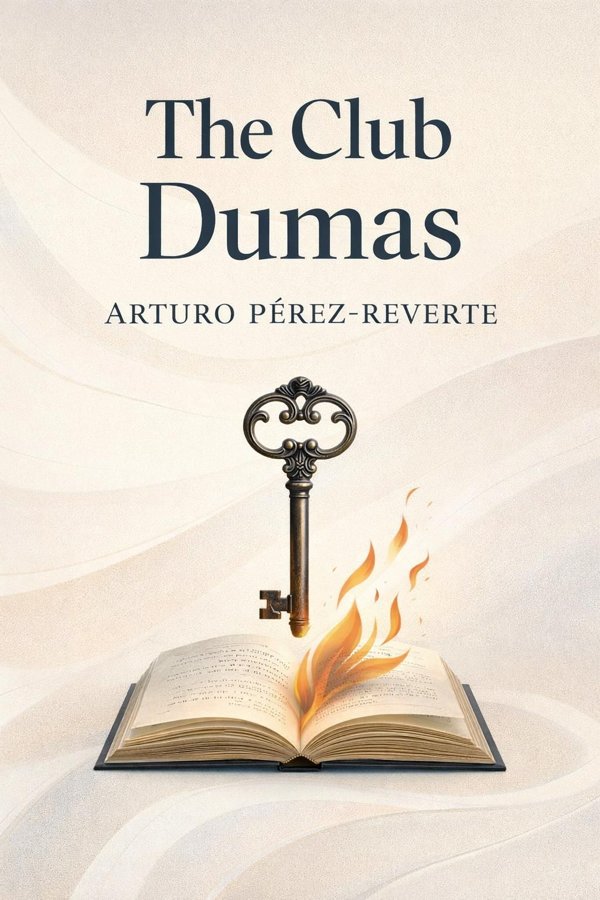
The Club Dumas: Summary & Key Insights
 10 min4 chaptersAudio available
What Is The Club Dumas About?
The Club Dumas by Arturo Pérez-Reverte is a mystery book spanning 4 pages. The Club Dumas is a literary mystery novel by Spanish author Arturo Pérez-Reverte. It follows Lucas Corso, a rare book dealer hired to authenticate a manuscript of The Three Musketeers by Alexandre Dumas. His investigation leads him into a shadowy world of book collectors, secret societies, and occult texts, where the boundaries between fiction and reality blur dangerously.
This FizzRead summary covers all 4 key chapters of The Club Dumas in approximately 10 minutes, distilling the most important ideas, arguments, and takeaways from Arturo Pérez-Reverte's work. Also available as an audio summary and Key Quotes Podcast.
The Club Dumas
The Club Dumas is a literary mystery novel by Spanish author Arturo Pérez-Reverte. It follows Lucas Corso, a rare book dealer hired to authenticate a manuscript of The Three Musketeers by Alexandre Dumas. His investigation leads him into a shadowy world of book collectors, secret societies, and occult texts, where the boundaries between fiction and reality blur dangerously.
Who Should Read The Club Dumas?
This book is perfect for anyone interested in mystery and looking to gain actionable insights in a short read. Whether you're a student, professional, or lifelong learner, the key ideas from The Club Dumas by Arturo Pérez-Reverte will help you think differently.
- ✓Readers who enjoy mystery and want practical takeaways
- ✓Professionals looking to apply new ideas to their work and life
- ✓Anyone who wants the core insights of The Club Dumas in just 10 minutes
Want the full summary?
Get instant access to this book summary and 100K+ more with Fizz Moment.
Get Free SummaryAvailable on App Store • Free to download
Key Chapters
Lucas Corso enters the novel like a skeptical detective who never asked to believe in miracles. He is a professional hunter of rare manuscripts, a man who thrives in the gray area between scholarship and crime. When he is hired to authenticate a fragment of *The Three Musketeers*, the commission seems routine. Yet from the moment that piece of paper crosses his hands, the ordinary dissolves. The manuscript leads him not just into the literary world of Alexandre Dumas but into a series of events that mirror that world—duels, conspiracies, secret passions, and the eternal question of loyalty.
Corso’s moral ambiguity is central. He prides himself on detachment, negotiating books as others deal weapons. But the deeper he moves into the history of Dumas, the more he realizes that fiction has invaded reality. Characters around him begin to echo the roles of Athos, Porthos, Aramis, and d’Artagnan. Letters read like scripts for old adventures. Even Corso’s clients and enemies start performing lines written long before, as if life itself were a repetitive play and he the latest actor to step onto the stage.
I wanted Corso’s cynicism to be both armor and blindness. He thinks he understands human greed and folly; he has lived amid forgeries and lies. But the manuscript’s mystery pushes him into an intellectual confrontation with belief itself. What if stories do more than reflect life? What if, in reading and rewriting them, we change the pattern of existence? Corso’s pursuit of the truth behind the Dumas fragment becomes his entry point into a grander secret—that literature can act as a mirror, or as a gate.
Through Corso’s eyes, I show the reader a Europe haunted by the residue of its own culture. Everywhere he travels—the worn bookstores of Paris, the private collections of Madrid, the libraries locked behind iron gates—he encounters guardians of words that have long ceased to be innocent. Books, in his world, are never just books. They are weapons, clues, and sometimes curses.
The second commission Corso accepts changes the nature of his search entirely. Varo Borja, a wealthy and secretive collector, hires him to authenticate one of three known copies of *The Nine Doors of the Kingdom of Shadows*, an obscure seventeenth-century volume reputed to summon the devil. The job sounds absurd, a relic of outdated superstition—yet Corso learns that people have died for these pages. Each copy contains nine engravings, and not all are identical. Somewhere within their differences may lie a hidden ritual, a code linking knowledge with damnation.
I constructed this part of the novel as both a detective puzzle and an initiation. As Corso moves between collectors—each guarding their copies—he begins to face the uncomfortable truth that the line between the rational and the esoteric is dangerously thin. Scholars argue over the authenticity of each engraving, collectors whisper about the power they might hold, and murders begin to follow Corso’s trail like punctuation marks in a text written by fate.
The journey across Europe becomes darker and more introspective. Corso visits the places where the engravings were believed to have been produced, consults with those who cling to their interpretations, and studies how *The Nine Doors* intertwines with its legendary author, Aristide Torchia—a man executed for heresy and for daring to combine sacred and profane knowledge. In each encounter, Corso feels the echo of a truth: that the pursuit of ultimate knowledge, whether through books or rituals, always demands a price.
The engraving sequences function as metaphors for the steps of understanding. In studying them, Corso begins to notice that interpretation itself is the key—they are not instructions but mirrors. Each reader, each seeker, reads what they need to see. And what Borja seeks is dominion; he interprets *The Nine Doors* as an instruction manual to conjure the devil. Corso, ever skeptical, interprets it as the perfect example of human arrogance—our belief that by decoding a symbol, we can control its power. Yet even he is forced to admit that something unseen flows through these pages. Whether divine or infernal, that energy is real enough to kill.
This section deepens the philosophical tension of the book: the relationship between knowledge and faith. Corso, like many of us, wants proof, not prayer. But *The Nine Doors* denies proof. Its ink whispers a paradox—that the act of reading is itself a ritual, a transformation. The more Corso reads, the more he becomes part of the text he seeks to decipher.
+ 2 more chapters — available in the FizzRead app
All Chapters in The Club Dumas
About the Author
Arturo Pérez-Reverte (born 1951 in Cartagena, Spain) is a Spanish novelist and journalist, and a member of the Royal Spanish Academy since 2003. Before becoming a full-time writer, he worked as a war correspondent for over twenty years. His internationally acclaimed novels include The Flanders Panel, Captain Alatriste, and The Queen of the South.
Get This Summary in Your Preferred Format
Read or listen to the The Club Dumas summary by Arturo Pérez-Reverte anytime, anywhere. FizzRead offers multiple formats so you can learn on your terms — all free.
Available formats: App · Audio · PDF · EPUB — All included free with FizzRead
Download The Club Dumas PDF and EPUB Summary
Key Quotes from The Club Dumas
“Lucas Corso enters the novel like a skeptical detective who never asked to believe in miracles.”
“The second commission Corso accepts changes the nature of his search entirely.”
Frequently Asked Questions about The Club Dumas
The Club Dumas by Arturo Pérez-Reverte is a mystery book that explores key ideas across 4 chapters. The Club Dumas is a literary mystery novel by Spanish author Arturo Pérez-Reverte. It follows Lucas Corso, a rare book dealer hired to authenticate a manuscript of The Three Musketeers by Alexandre Dumas. His investigation leads him into a shadowy world of book collectors, secret societies, and occult texts, where the boundaries between fiction and reality blur dangerously.
More by Arturo Pérez-Reverte

You Might Also Like




Browse by Category
Ready to read The Club Dumas?
Get the full summary and 100K+ more books with Fizz Moment.