
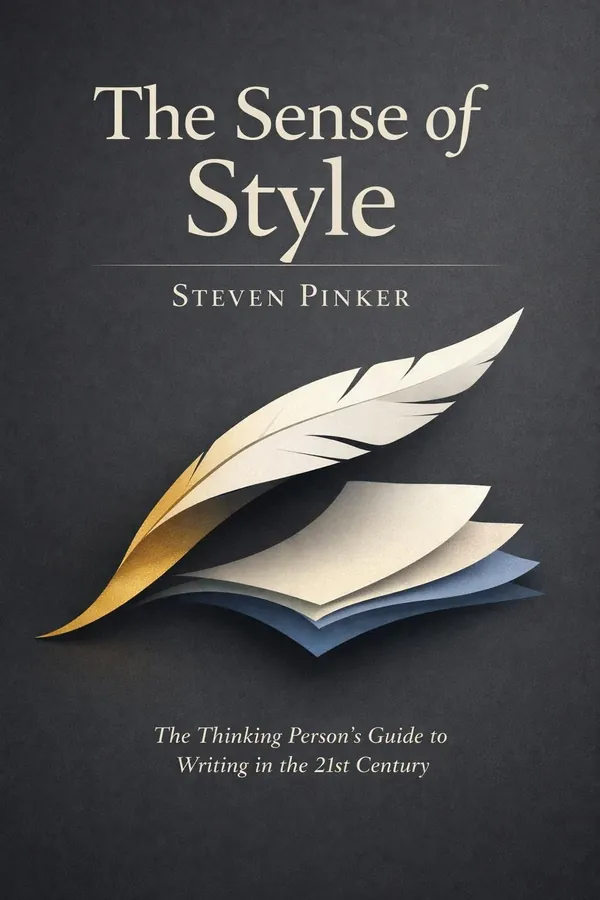
The Sense of Style: The Thinking Person’s Guide to Writing in the 21st Century: Summary & Key Insights
 10 min9 chaptersAudio available
What Is The Sense of Style: The Thinking Person’s Guide to Writing in the 21st Century About?
The Sense of Style: The Thinking Person’s Guide to Writing in the 21st Century by Steven Pinker is a writing book spanning 9 pages. In this guide, renowned cognitive scientist and linguist Steven Pinker explores how good writing works and why it matters. Blending insights from grammar, clarity, and human psychology, Pinker demystifies the rules of modern prose, helping writers convey complex ideas with elegance and precision. The book offers practical advice informed by linguistic science and is known for its engaging wit and evidence-based approach to style.
This FizzRead summary covers all 9 key chapters of The Sense of Style: The Thinking Person’s Guide to Writing in the 21st Century in approximately 10 minutes, distilling the most important ideas, arguments, and takeaways from Steven Pinker's work. Also available as an audio summary and Key Quotes Podcast.
The Sense of Style: The Thinking Person’s Guide to Writing in the 21st Century
In this guide, renowned cognitive scientist and linguist Steven Pinker explores how good writing works and why it matters. Blending insights from grammar, clarity, and human psychology, Pinker demystifies the rules of modern prose, helping writers convey complex ideas with elegance and precision. The book offers practical advice informed by linguistic science and is known for its engaging wit and evidence-based approach to style.
Who Should Read The Sense of Style: The Thinking Person’s Guide to Writing in the 21st Century?
This book is perfect for anyone interested in writing and looking to gain actionable insights in a short read. Whether you're a student, professional, or lifelong learner, the key ideas from The Sense of Style: The Thinking Person’s Guide to Writing in the 21st Century by Steven Pinker will help you think differently.
- ✓Readers who enjoy writing and want practical takeaways
- ✓Professionals looking to apply new ideas to their work and life
- ✓Anyone who wants the core insights of The Sense of Style: The Thinking Person’s Guide to Writing in the 21st Century in just 10 minutes
Want the full summary?
Get instant access to this book summary and 100K+ more with Fizz Moment.
Get Free SummaryAvailable on App Store • Free to download
Key Chapters
Every writer must begin with a stance toward the reader and the world being described. The model I call the “classic style” offers one of the most robust and timeless stances a writer can take. It goes back to mathematicians, essayists, and philosophers of the Enlightenment, who believed that prose should be a transparent medium. In classic style, the writer assumes that truth exists in the world, not merely in the writer’s head. Writing, then, becomes an invitation: Come, let’s look at this together.
This stance differs dramatically from the obfuscation that infects much academic or bureaucratic writing. When we hide behind abstractions or passives, we obscure ideas. The classic stylist, however, is a guide — they point toward reality and say, “See this?” The language disappears in service of insight. Instead of showing their mental effort, they reveal the object of attention.
What makes this style powerful is its moral clarity. It treats the reader as an equal intellect rather than a supplicant to expertise. It’s conversational in the sense that it recreates the intimacy of explanation between two curious minds. When I write in this mode, I feel as though we are sharing a windowpane, looking outward together. That’s what classic style teaches us: to respect our reader’s intelligence by giving them access to our view of the world, directly and without pretension.
It’s easy for prose to collapse inward — for writers to document their process, their uncertainty, and their tangled thoughts rather than the thing they wanted to convey. Yet good writing, like a clear window, allows the reader to see through it rather than notice the glass itself. The purpose of style, therefore, is to construct that transparency.
When I say prose should be a window onto the world, I mean that the reader’s attention should be on the *scene* you describe, not the *language* you labor over. This doesn’t mean suppressing beauty or individuality, but ensuring that every rhythm, metaphor, and syntactic choice serves clarity. When you write to show the world, not yourself, your language gains strength. Descriptive precision, concrete nouns, living verbs — these are not mechanical tips but reflections of attention. To focus on the world outside your mind automatically tunes your sentences toward lucidity.
That’s why scientific prose, often accused of coldness, fails not because it’s technical but because it forgets its subject. The writer talks about “processes” instead of what those processes mean in the real world. To fix this, you must mentally imagine your reader beside you, gazing through the same conceptual window. Every clause should build a perspective for them, every pronoun orient them within that mental landscape. This discipline transforms writing from report into revelation.
+ 7 more chapters — available in the FizzRead app
All Chapters in The Sense of Style: The Thinking Person’s Guide to Writing in the 21st Century
About the Author
Steven Pinker is a Canadian-American cognitive psychologist, linguist, and popular science author. He serves as Johnstone Family Professor in the Department of Psychology at Harvard University. Pinker’s research and writings focus on language, the mind, and human nature, with notable works including 'The Language Instinct', 'How the Mind Works', and 'The Better Angels of Our Nature'.
Get This Summary in Your Preferred Format
Read or listen to the The Sense of Style: The Thinking Person’s Guide to Writing in the 21st Century summary by Steven Pinker anytime, anywhere. FizzRead offers multiple formats so you can learn on your terms — all free.
Available formats: App · Audio · PDF · EPUB — All included free with FizzRead
Download The Sense of Style: The Thinking Person’s Guide to Writing in the 21st Century PDF and EPUB Summary
Key Quotes from The Sense of Style: The Thinking Person’s Guide to Writing in the 21st Century
“Every writer must begin with a stance toward the reader and the world being described.”
“It’s easy for prose to collapse inward — for writers to document their process, their uncertainty, and their tangled thoughts rather than the thing they wanted to convey.”
Frequently Asked Questions about The Sense of Style: The Thinking Person’s Guide to Writing in the 21st Century
The Sense of Style: The Thinking Person’s Guide to Writing in the 21st Century by Steven Pinker is a writing book that explores key ideas across 9 chapters. In this guide, renowned cognitive scientist and linguist Steven Pinker explores how good writing works and why it matters. Blending insights from grammar, clarity, and human psychology, Pinker demystifies the rules of modern prose, helping writers convey complex ideas with elegance and precision. The book offers practical advice informed by linguistic science and is known for its engaging wit and evidence-based approach to style.
More by Steven Pinker




You Might Also Like
The Art of Perspective
Christopher Castellani
10 min
Making a Point: The Persnickety Story of English Punctuation
David Crystal
10 min
The Elements Of Eloquence: How To Turn The Perfect English Phrase
Mark Forsyth
10 min
The Pocket Muse: Ideas and Inspirations for Writing
Monica Wood
10 min
A Little Book on Form: An Exploration into the Formal Imagination of Poetry
Robert Hass
10 min
Adventures In The Screen Trade: A Personal View Of Hollywood And Screenwriting
William Goldman
10 minBrowse by Category
Ready to read The Sense of Style: The Thinking Person’s Guide to Writing in the 21st Century?
Get the full summary and 100K+ more books with Fizz Moment.