
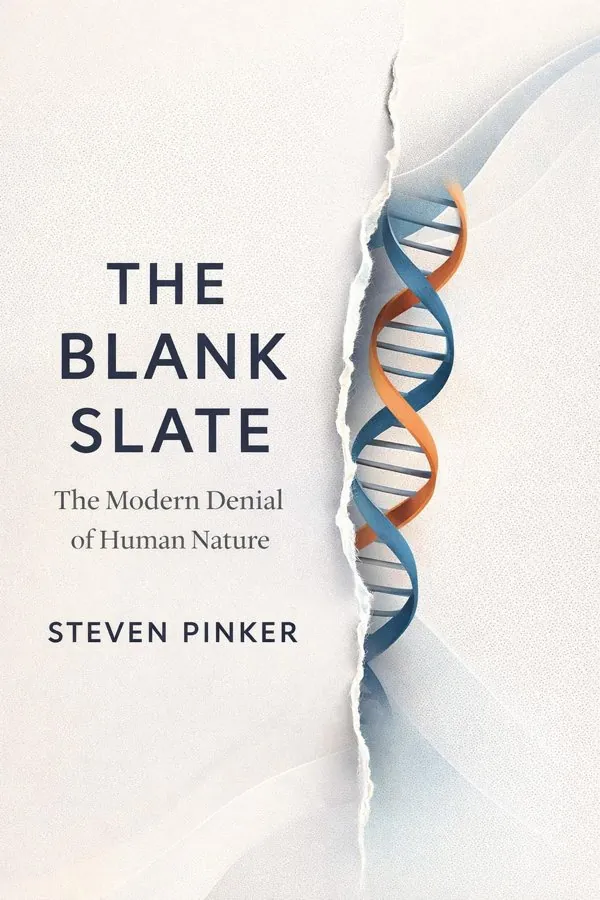
The Blank Slate: The Modern Denial of Human Nature: Summary & Key Insights
 10 min10 chaptersAudio available
Key Takeaways from The Blank Slate: The Modern Denial of Human Nature
Ideas can survive not because they are true, but because they are emotionally and politically attractive.
The most dangerous myths are often the ones that sound humane.
Modern thought, Pinker says, has often rested on a trio of seductive ideas: the Blank Slate, the Noble Savage, and the Ghost in the Machine.
If the mind was designed by evolution, then it should contain specialized tools for solving recurring problems of survival and social life.
One of Pinker’s most uncomfortable claims is also one of his most important: people differ partly because of inheritance.
What Is The Blank Slate: The Modern Denial of Human Nature About?
The Blank Slate: The Modern Denial of Human Nature by Steven Pinker is a popular_sci book spanning 10 pages. What if some of our most cherished beliefs about equality, morality, education, and politics rest on a false idea about what human beings are? In The Blank Slate, Steven Pinker takes aim at the influential modern assumption that the human mind is born empty and then shaped almost entirely by culture, parenting, and social forces. Drawing on evidence from cognitive science, behavioral genetics, evolutionary psychology, neuroscience, and anthropology, he argues that human nature is real: we are not infinitely malleable, and our minds come equipped with evolved predispositions that influence how we think, feel, learn, compete, cooperate, love, and create. Pinker’s goal is not to justify inequality or excuse bad behavior, but to show that denying human nature leads to confused policies and distorted moral reasoning. A renowned cognitive psychologist and public intellectual, Pinker combines scientific breadth with philosophical clarity, making a controversial subject accessible and urgent. This book matters because it reframes debates about gender, violence, parenting, art, politics, and ethics, asking readers to face a difficult but liberating truth: understanding what humans are may be the best path to building a more realistic and humane society.
This FizzRead summary covers all 10 key chapters of The Blank Slate: The Modern Denial of Human Nature in approximately 10 minutes, distilling the most important ideas, arguments, and takeaways from Steven Pinker's work. Also available as an audio summary and Key Quotes Podcast.
The Blank Slate: The Modern Denial of Human Nature
What if some of our most cherished beliefs about equality, morality, education, and politics rest on a false idea about what human beings are? In The Blank Slate, Steven Pinker takes aim at the influential modern assumption that the human mind is born empty and then shaped almost entirely by culture, parenting, and social forces. Drawing on evidence from cognitive science, behavioral genetics, evolutionary psychology, neuroscience, and anthropology, he argues that human nature is real: we are not infinitely malleable, and our minds come equipped with evolved predispositions that influence how we think, feel, learn, compete, cooperate, love, and create. Pinker’s goal is not to justify inequality or excuse bad behavior, but to show that denying human nature leads to confused policies and distorted moral reasoning. A renowned cognitive psychologist and public intellectual, Pinker combines scientific breadth with philosophical clarity, making a controversial subject accessible and urgent. This book matters because it reframes debates about gender, violence, parenting, art, politics, and ethics, asking readers to face a difficult but liberating truth: understanding what humans are may be the best path to building a more realistic and humane society.
Who Should Read The Blank Slate: The Modern Denial of Human Nature?
This book is perfect for anyone interested in popular_sci and looking to gain actionable insights in a short read. Whether you're a student, professional, or lifelong learner, the key ideas from The Blank Slate: The Modern Denial of Human Nature by Steven Pinker will help you think differently.
- ✓Readers who enjoy popular_sci and want practical takeaways
- ✓Professionals looking to apply new ideas to their work and life
- ✓Anyone who wants the core insights of The Blank Slate: The Modern Denial of Human Nature in just 10 minutes
Want the full summary?
Get instant access to this book summary and 100K+ more with Fizz Moment.
Get Free SummaryAvailable on App Store • Free to download
Key Chapters
Ideas can survive not because they are true, but because they are emotionally and politically attractive. Pinker argues that the blank slate became influential partly because it promised human perfectibility. If people are born with no built-in tendencies, then injustice can be blamed entirely on institutions, education can remake anyone into anything, and society can be redesigned without worrying about human limits. This vision drew strength from Enlightenment optimism and from philosophers like John Locke, whose image of the mind as a tabula rasa shaped modern thought.
But Pinker shows that the blank slate was never just a scientific hypothesis. It became a moral and political doctrine. Many intellectuals feared that admitting innate differences or evolved motives would legitimize racism, sexism, war, or oppression. As a result, the idea of human nature was often treated as morally suspicious rather than empirically testable. Pinker’s point is that good intentions do not make bad science true.
He also explains why the doctrine became deeply embedded in education, the social sciences, and public debate. It supported the belief that social reform could eliminate nearly all unwanted behaviors. Yet when policies assume total malleability, they often fail because they ignore recurring aspects of human motivation such as status-seeking, family attachment, self-interest, and tribal loyalties.
In everyday life, this matters when we judge parenting, schooling, workplace culture, or criminal justice. We often expect environmental change alone to solve problems rooted in both biology and context. Pinker urges a more balanced view: environments matter enormously, but they work on minds that already have structure.
Actionable takeaway: When evaluating any theory about human behavior, ask whether it is supported by evidence or simply attractive because of the moral hopes attached to it.
The most dangerous myths are often the ones that sound humane. The blank slate doctrine claims that personality, intelligence, moral intuitions, talents, and preferences are products of socialization alone. In this view, biology contributes little beyond keeping the brain alive. Pinker challenges this directly, arguing that no serious account of the mind can ignore our evolutionary past or the inherited architecture of cognition.
He does not deny the power of culture, family, education, or historical circumstance. Instead, he argues that these influences operate through built-in capacities: language learning, emotional systems, social reasoning, kin attachment, fear, jealousy, reciprocity, and many others. Human beings are not rigidly programmed, but neither are they empty. We arrive with mental mechanisms that make some behaviors easier to learn, some fears easier to acquire, and some social patterns more likely to emerge across cultures.
Pinker also shows why the doctrine persists. It flatters institutions by suggesting they can mold citizens at will. It encourages the belief that every difference in outcomes must be a product of injustice. While this can inspire reform, it can also produce simplistic explanations and unrealistic expectations. For example, schools can improve learning dramatically, but they do not erase all individual variation in temperament, motivation, or aptitude.
A more accurate model of human beings helps us set better goals. If children differ partly by nature, education should focus less on forcing identical outcomes and more on helping different strengths flourish. If people are prone to bias and self-interest, political systems should check power rather than assume virtue.
Actionable takeaway: Replace all-or-nothing thinking with an interaction model: ask how biology and environment combine rather than which one “wins.”
Modern thought, Pinker says, has often rested on a trio of seductive ideas: the Blank Slate, the Noble Savage, and the Ghost in the Machine. Together, they shape how we imagine human beings. The Blank Slate says we are infinitely moldable. The Noble Savage says humans are naturally peaceful and corrupted mainly by civilization. The Ghost in the Machine says the self is somehow separate from biology, as if the mind floats above the physical brain.
Pinker dismantles all three. Against the Noble Savage, he reviews evidence that violence is not merely a product of modern society; tribal and pre-state societies could be intensely violent as well. Against the Ghost in the Machine, he argues that mental life emerges from the brain’s physical processes. Thoughts, emotions, and decisions are not less meaningful because they are biological; they are meaningful precisely because brains are built to generate them.
These myths matter because they distort moral and political judgment. If we assume humans are naturally good and only institutions create evil, we may underestimate aggression, revenge, and competition. If we treat the mind as detached from the brain, we resist scientific explanations of behavior. And if we believe people are blank slates, we may expect social engineering to work far better than it can.
In practical terms, these myths affect debates on crime, war, education, therapy, and even parenting. A realistic view accepts that humans are capable of cruelty and compassion, selfishness and sacrifice, all rooted in evolved psychology interacting with culture.
Actionable takeaway: Be wary of theories that make human beings seem either angelic or limitless; more useful explanations begin by accepting our mixed nature.
If the mind was designed by evolution, then it should contain specialized tools for solving recurring problems of survival and social life. That is the central insight Pinker draws from evolutionary psychology. He argues that the brain is not a general-purpose sponge waiting to absorb culture, but a set of evolved systems shaped by natural selection. These systems help us navigate language, friendship, kinship, mating, danger, cooperation, status, and conflict.
This does not mean every behavior is genetically fixed or that modern actions are simple leftovers from the Stone Age. Instead, Pinker says evolution gave us predispositions and decision-making mechanisms, not rigid scripts. Humans remain flexible, but flexibility itself is part of our design. We can adapt to many environments because our minds contain tools for learning, inference, and social interpretation.
One example is language acquisition. Children do not learn language the way they learn a list of random facts. They seem prepared to detect grammar and build linguistic rules rapidly. Another example is social exchange: people are unusually good at spotting cheating in reciprocal arrangements, suggesting a built-in sensitivity to fairness and exploitation. Fear, attraction, parental care, jealousy, and coalition-building also show patterns too consistent and widespread to be explained by culture alone.
Understanding evolved tendencies can improve real-world decision-making. Marketers, educators, and policymakers often succeed when they align incentives with human motives rather than ignore them. Public health campaigns, for instance, work better when they account for emotion, status concerns, and in-group identity.
Actionable takeaway: When trying to change behavior, design systems around actual human motivations instead of assuming people will respond as purely rational or endlessly pliable beings.
One of Pinker’s most uncomfortable claims is also one of his most important: people differ partly because of inheritance. Using findings from behavioral genetics, especially twin and adoption studies, he argues that traits such as temperament, intelligence, risk tolerance, sociability, and vulnerability to mental illness are influenced in meaningful ways by genes. This does not make them destiny, but it does make them more than products of upbringing.
Pinker is careful here. He does not argue that genes determine worth, nor that social inequalities are justified because individuals vary by nature. His point is narrower and more scientific: if we want to understand human development, we cannot pretend all differences come from parenting or culture. In fact, one surprising finding in behavioral genetics is that siblings raised in the same home often turn out more different than expected, suggesting parents are not all-powerful sculptors of personality.
This has practical implications. Parents often carry unreasonable guilt for every trait their child displays. Schools may assume that equal treatment should produce equal outcomes. Workplaces may expect identical motivational structures across employees. Pinker encourages a more humane realism. Individuals vary in strengths and vulnerabilities, and fair institutions should accommodate these differences rather than deny them.
At the same time, acknowledging inherited variation should make us more compassionate, not less. If some people struggle with impulsivity, anxiety, or learning challenges partly because of biology, punishment and moralizing become less useful than support and structure.
Actionable takeaway: Treat individual differences as real and morally neutral, then build families, schools, and organizations that help different kinds of people succeed.
If human nature is real, then our artistic tastes are not arbitrary either. Pinker argues that art, music, storytelling, humor, and visual design resonate with us because they engage evolved features of the mind. Across cultures, people respond to rhythm, pattern, narrative tension, faces, landscapes, status display, and emotional expression. Culture shapes style, but the appetite for these forms reflects a shared mental architecture.
This perspective pushes back against extreme relativism in the arts. Not every aesthetic judgment is merely a social construct. Certain themes recur because they connect with universal aspects of perception and emotion. Stories often revolve around kinship, betrayal, ambition, love, revenge, sacrifice, danger, and status because those are central to human life. Likewise, visual art often exploits depth perception, symmetry, contrast, and attention to biologically meaningful objects such as faces and bodies.
Pinker’s broader point is that the humanities do not lose significance when linked to biology. Instead, they gain grounding. A novelist, filmmaker, or designer succeeds by understanding the minds of real human beings, not by assuming audiences are blank slates ready to enjoy anything equally. This also explains why some educational efforts fail when they treat cultural appreciation as infinitely engineerable. Tastes can be broadened, but not without recognizing the preferences people bring with them.
In modern work, this idea has direct applications in communication, branding, entertainment, and teaching. The most memorable messages usually fit human attention spans, emotional triggers, and narrative instincts.
Actionable takeaway: Whether you create or consume art, look for the underlying human patterns that make certain images, stories, and sounds consistently powerful.
Few topics generate more anxiety than the claim that sex differences or aggressive tendencies may have biological roots. Pinker argues that avoiding these subjects does not make them disappear; it only leaves us with weaker explanations. He reviews evidence that some average psychological differences between men and women, as well as patterns of aggression, mating, and risk-taking, are not wholly cultural inventions. Biology contributes, though always in interaction with norms and institutions.
This does not mean stereotypes are justified or that every individual fits group averages. Pinker repeatedly emphasizes overlap and variation. Most men are not highly violent, many women are highly competitive, and social rules strongly shape behavior. But pretending there are no recurring average differences can lead to confusion in debates about work, family, education, and public safety.
His discussion of violence is equally nuanced. Humans possess capacities for aggression, dominance, revenge, and dehumanization, yet we also possess empathy, self-control, moral reasoning, and a desire for cooperation. Civilization matters because it can suppress some instincts and strengthen others. Moral progress does not require denying darker impulses; it requires understanding and managing them.
For readers, this means abandoning both fatalism and denial. If aggression has roots in human nature, institutions must channel it. If empathy is natural too, education and culture can enlarge it. In practical settings, this perspective supports evidence-based approaches to crime prevention, conflict resolution, and gender policy rather than ideology-driven assumptions.
Actionable takeaway: Discuss sensitive differences and moral problems with precision: focus on averages versus individuals, causes versus justifications, and understanding versus excusing.
Many people fear that if morality has biological roots, then ethics becomes impossible. Pinker argues the opposite. Understanding human nature does not erase responsibility, dignity, or justice; it helps us build them on firmer ground. A realistic moral system should work with the kinds of creatures we are, not with imaginary beings free of bias, desire, competition, and kin loyalty.
He addresses a common confusion: explaining behavior is not the same as excusing it. To say jealousy, revenge, or favoritism have evolutionary origins is not to say they are morally good. Science describes what people are inclined to do; ethics helps decide what they ought to do. In fact, moral progress often depends on recognizing natural impulses clearly so we can restrain harmful ones and cultivate better norms.
Pinker also challenges the fear that innate traits undermine equality. Equality in a political and moral sense does not require identical abilities or personalities. It rests on principles about rights, protections, and dignity. Liberal democracy works best when it assumes citizens are imperfect: capable of cooperation, but also vulnerable to corruption and self-interest. That is why checks and balances matter more than moral idealism.
This framework has practical uses in law, public policy, and everyday relationships. Instead of demanding impossible purity from people, we can create environments that reward honesty, punish abuse, and reduce temptations. Good institutions are morally intelligent because they take human psychology seriously.
Actionable takeaway: Separate “is” from “ought,” but let your ethics be informed by reality: design moral expectations and institutions for human beings as they are, not as wishful theories imagine them.
Hope becomes stronger, not weaker, when it is grounded in reality. Pinker ends up defending a surprisingly optimistic position: acknowledging human nature can help societies become more humane. If we accept that people are not blank slates, we can stop designing utopian systems that ignore self-interest, kin favoritism, status competition, and tribal psychology. Instead, we can create institutions that channel these forces productively.
This realism supports progress. Markets, democracies, legal systems, and scientific norms work not because humans are saints, but because these systems harness ambition, rivalry, reciprocity, and error correction. Likewise, successful parenting, teaching, and management do not assume unlimited malleability. They recognize differences in temperament, use incentives wisely, and build habits that fit human cognition.
Pinker also warns against despair. Human nature includes capacities for empathy, language, imagination, self-control, and moral reflection. These capacities make reform possible. We are not prisoners of biology; we are organisms with tendencies that can be redirected, inhibited, or amplified by culture and institutions. The key is to stop confusing influence with omnipotence.
For readers today, this is especially relevant in debates about technology, polarization, education, and social change. Grand visions often fail because they misread the users, voters, students, or citizens involved. Better futures come from designing around actual human strengths and weaknesses.
Actionable takeaway: In any attempt to improve a system, begin with a sober map of human motives, then build rules and environments that encourage our better instincts while containing our worse ones.
All Chapters in The Blank Slate: The Modern Denial of Human Nature
About the Author
Steven Pinker is a Canadian-American cognitive psychologist, linguist, and popular science writer best known for bringing complex ideas about the mind to a broad audience. Born in Montreal, he studied experimental psychology at McGill University and Harvard, later teaching at institutions including MIT and Harvard University. His work spans language acquisition, visual cognition, human nature, violence, rationality, and social progress. Pinker is widely associated with cognitive science and evolutionary psychology, especially the view that the human mind contains evolved structures rather than beginning as a blank slate. He is the author of several influential books, including The Language Instinct, How the Mind Works, The Better Angels of Our Nature, and Enlightenment Now. A member of the National Academy of Sciences, Pinker is known for combining scientific range, intellectual ambition, and clear public argument.
Get This Summary in Your Preferred Format
Read or listen to the The Blank Slate: The Modern Denial of Human Nature summary by Steven Pinker anytime, anywhere. FizzRead offers multiple formats so you can learn on your terms — all free.
Available formats: App · Audio · PDF · EPUB — All included free with FizzRead
Download The Blank Slate: The Modern Denial of Human Nature PDF and EPUB Summary
Key Quotes from The Blank Slate: The Modern Denial of Human Nature
“Ideas can survive not because they are true, but because they are emotionally and politically attractive.”
“The most dangerous myths are often the ones that sound humane.”
“Modern thought, Pinker says, has often rested on a trio of seductive ideas: the Blank Slate, the Noble Savage, and the Ghost in the Machine.”
“If the mind was designed by evolution, then it should contain specialized tools for solving recurring problems of survival and social life.”
“One of Pinker’s most uncomfortable claims is also one of his most important: people differ partly because of inheritance.”
Frequently Asked Questions about The Blank Slate: The Modern Denial of Human Nature
The Blank Slate: The Modern Denial of Human Nature by Steven Pinker is a popular_sci book that explores key ideas across 10 chapters. What if some of our most cherished beliefs about equality, morality, education, and politics rest on a false idea about what human beings are? In The Blank Slate, Steven Pinker takes aim at the influential modern assumption that the human mind is born empty and then shaped almost entirely by culture, parenting, and social forces. Drawing on evidence from cognitive science, behavioral genetics, evolutionary psychology, neuroscience, and anthropology, he argues that human nature is real: we are not infinitely malleable, and our minds come equipped with evolved predispositions that influence how we think, feel, learn, compete, cooperate, love, and create. Pinker’s goal is not to justify inequality or excuse bad behavior, but to show that denying human nature leads to confused policies and distorted moral reasoning. A renowned cognitive psychologist and public intellectual, Pinker combines scientific breadth with philosophical clarity, making a controversial subject accessible and urgent. This book matters because it reframes debates about gender, violence, parenting, art, politics, and ethics, asking readers to face a difficult but liberating truth: understanding what humans are may be the best path to building a more realistic and humane society.
More by Steven Pinker
You Might Also Like

Structures: Or Why Things Don"t Fall Down
J.E. Gordon
10 min
The Road to Wigan Pier
George Orwell
10 min
Bonk: The Curious Coupling of Science and Sex
Mary Roach
10 min
First Bite: How We Learn to Eat
Bee Wilson
10 min
In Pursuit Of The Unknown: 17 Equations That Changed The World
Ian Stewart
10 min
Napoleon's Buttons: 17 Molecules That Changed History
Penny Le Couteur and Jay Burreson
10 minBrowse by Category
Ready to read The Blank Slate: The Modern Denial of Human Nature?
Get the full summary and 100K+ more books with Fizz Moment.