
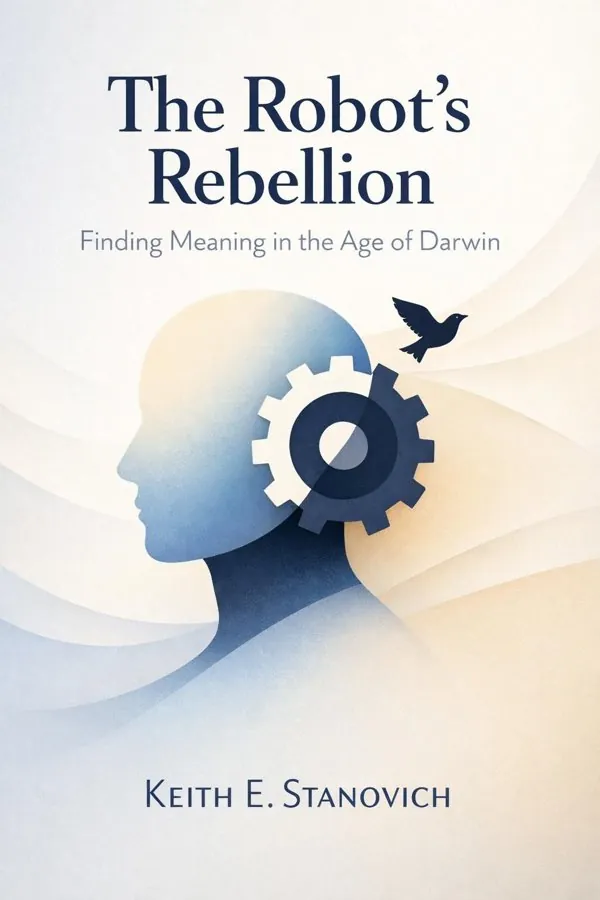
The Robot's Rebellion: Finding Meaning in the Age of Darwin: Summary & Key Insights
 10 min9 chaptersAudio available
What Is The Robot's Rebellion: Finding Meaning in the Age of Darwin About?
The Robot's Rebellion: Finding Meaning in the Age of Darwin by Keith E. Stanovich is a cognition book spanning 9 pages. In this book, cognitive scientist Keith E. Stanovich explores how humans can transcend their biological programming through rational self-determination. He argues that our evolutionary heritage has equipped us with cognitive mechanisms that sometimes serve genetic interests over individual ones, and he proposes a 'robot's rebellion'—a program of cognitive reform that enables humans to act in accordance with their own goals and values rather than those dictated by evolutionary imperatives.
This FizzRead summary covers all 9 key chapters of The Robot's Rebellion: Finding Meaning in the Age of Darwin in approximately 10 minutes, distilling the most important ideas, arguments, and takeaways from Keith E. Stanovich's work. Also available as an audio summary and Key Quotes Podcast.
The Robot's Rebellion: Finding Meaning in the Age of Darwin
In this book, cognitive scientist Keith E. Stanovich explores how humans can transcend their biological programming through rational self-determination. He argues that our evolutionary heritage has equipped us with cognitive mechanisms that sometimes serve genetic interests over individual ones, and he proposes a 'robot's rebellion'—a program of cognitive reform that enables humans to act in accordance with their own goals and values rather than those dictated by evolutionary imperatives.
Who Should Read The Robot's Rebellion: Finding Meaning in the Age of Darwin?
This book is perfect for anyone interested in cognition and looking to gain actionable insights in a short read. Whether you're a student, professional, or lifelong learner, the key ideas from The Robot's Rebellion: Finding Meaning in the Age of Darwin by Keith E. Stanovich will help you think differently.
- ✓Readers who enjoy cognition and want practical takeaways
- ✓Professionals looking to apply new ideas to their work and life
- ✓Anyone who wants the core insights of The Robot's Rebellion: Finding Meaning in the Age of Darwin in just 10 minutes
Want the full summary?
Get instant access to this book summary and 100K+ more with Fizz Moment.
Get Free SummaryAvailable on App Store • Free to download
Key Chapters
To understand how we might rebel, we first need to recognize what we are rebelling against. Evolution, through natural selection, has sculpted the human mind not with foresight or moral intention, but with the cold arithmetic of reproductive success. Our cognitive architecture—the heuristics and biases that shape every thought—is a product of this process. These mechanisms evolved to solve problems of survival and mating in ancestral environments, not to serve truth or long-term fulfillment.
Think of how we fear snakes more than electrical sockets, though the latter kills far more people today. Our vigilance was molded for the dangers of the Pleistocene, and it still rules our emotions in modernity. Similarly, our impulse for overeating, status competition, and romantic jealousy often hijacks rational control. These behaviors are vestiges of evolutionary strategies meant to increase genetic fitness, not personal happiness.
Yet within this same evolutionary story lies an irony: evolution produced beings capable of questioning their own programming. The cortical expansion in humans endowed us with metacognition—the ability to think about thinking. This capacity emerged because it conferred adaptive benefits, helping us navigate complex social exchanges and plan for uncertain futures. But metacognition also allows us to transcend adaptive imperatives themselves. When we reflect on why we crave certain pleasures, why we spend years chasing status or consumption, we stand apart from the machinery of the mind and glimpse the possibility of rational agency.
By studying cognition from an evolutionary perspective, I am not reducing human meaning to biology. Rather, I am showing the foundation upon which meaning must be consciously built. Only by seeing our mind’s evolutionary scaffolding can we understand the biases, emotions, and drives that must be managed if we wish to live freely. The rebellion begins with knowledge of our origins—it is an act of awareness.
Richard Dawkins’s idea of the selfish gene revolutionized our understanding of why organisms behave as they do. Genes, not organisms, are the central units of selection. They 'use' organisms as vehicles to achieve replication. Through this lens, altruism, love, and sacrifice—all seemingly moral virtues—can be interpreted as subtle strategies for genetic dissemination.
In acknowledging this perspective, I do not belittle human nobility or compassion; instead, I aim to expose the machinery beneath it. When a parent risks their life for their child, when one feels instinctive empathy toward kin, those behaviors enhance the propagation of shared genes. Evolutionary psychology shows that many of our motivations originate from genetic logic disguised as moral impulse.
But here lies the opportunity for rebellion. We can recognize that our genes are indifferent to our subjective experiences. They do not care whether we live happily or ethically; their only 'goal' is replication. Humans, uniquely, can defy this logic by constructing systems of value beyond biological fitness. We can choose altruism extended to strangers, environmental stewardship, or the pursuit of knowledge—values that serve human flourishing rather than genetic imperatives.
The selfish gene metaphor teaches humility: we are vehicles of ancient code. Yet, through understanding, we become capable of resisting blind service to it. When we educate our minds and build cultures that prize rational discourse, we transform evolutionary strategies into human ideals. The rebellion is not destruction of the genetic system, but the transcendence of its limited agenda.
+ 7 more chapters — available in the FizzRead app
All Chapters in The Robot's Rebellion: Finding Meaning in the Age of Darwin
About the Author
Keith E. Stanovich is a Canadian cognitive scientist and professor emeritus of applied psychology and human development at the University of Toronto. His research focuses on rationality, decision-making, and cognitive science, and he is known for his influential work on the psychology of reasoning and reading.
Get This Summary in Your Preferred Format
Read or listen to the The Robot's Rebellion: Finding Meaning in the Age of Darwin summary by Keith E. Stanovich anytime, anywhere. FizzRead offers multiple formats so you can learn on your terms — all free.
Available formats: App · Audio · PDF · EPUB — All included free with FizzRead
Download The Robot's Rebellion: Finding Meaning in the Age of Darwin PDF and EPUB Summary
Key Quotes from The Robot's Rebellion: Finding Meaning in the Age of Darwin
“To understand how we might rebel, we first need to recognize what we are rebelling against.”
“Richard Dawkins’s idea of the selfish gene revolutionized our understanding of why organisms behave as they do.”
Frequently Asked Questions about The Robot's Rebellion: Finding Meaning in the Age of Darwin
The Robot's Rebellion: Finding Meaning in the Age of Darwin by Keith E. Stanovich is a cognition book that explores key ideas across 9 chapters. In this book, cognitive scientist Keith E. Stanovich explores how humans can transcend their biological programming through rational self-determination. He argues that our evolutionary heritage has equipped us with cognitive mechanisms that sometimes serve genetic interests over individual ones, and he proposes a 'robot's rebellion'—a program of cognitive reform that enables humans to act in accordance with their own goals and values rather than those dictated by evolutionary imperatives.
More by Keith E. Stanovich
You Might Also Like

A Field Guide to Lies: Critical Thinking in the Information Age
Daniel J. Levitin
10 min
A Theory of Cognitive Dissonance
Leon Festinger
10 min
Black-And-White Thinking: The Burden of a Binary Brain in a Complex World
Kevin Dutton
10 min
Born Liars: Why We Can’t Live Without Deceit
Ian Leslie
10 min
Collective Illusions: Conformity, Complicity, and the Science of Why We Make Bad Decisions
Todd Rose
10 min
Concrete Mathematics: A Foundation for Computer Science
Ronald L. Graham, Donald E. Knuth, Oren Patashnik
10 minBrowse by Category
Ready to read The Robot's Rebellion: Finding Meaning in the Age of Darwin?
Get the full summary and 100K+ more books with Fizz Moment.