
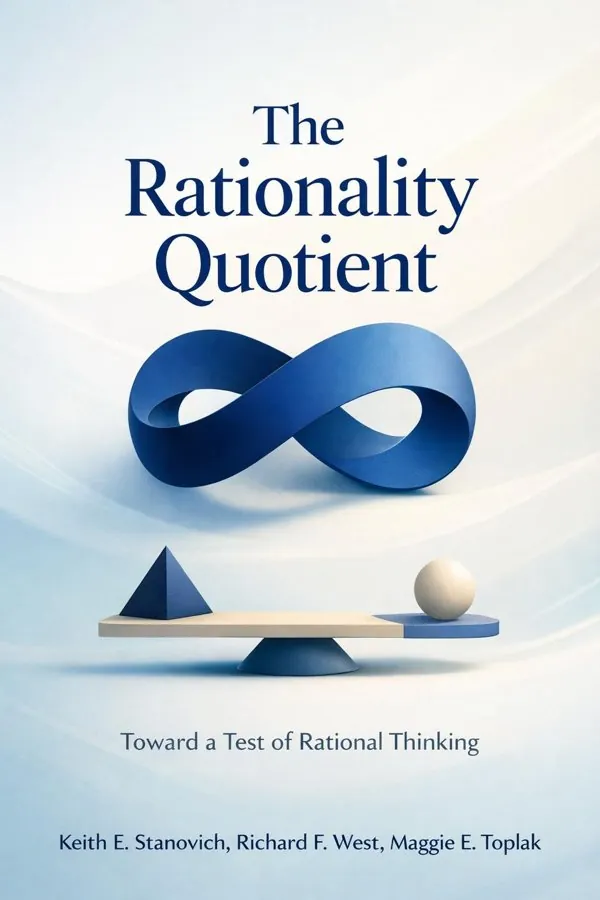
The Rationality Quotient: Toward a Test of Rational Thinking: Summary & Key Insights
by Keith E. Stanovich, Richard F. West, Maggie E. Toplak
 10 min7 chaptersAudio available
What Is The Rationality Quotient: Toward a Test of Rational Thinking About?
The Rationality Quotient: Toward a Test of Rational Thinking by Keith E. Stanovich, Richard F. West, Maggie E. Toplak is a cognition book spanning 7 pages. This book presents a comprehensive framework for measuring rational thought, distinct from intelligence. The authors propose the development of a Rationality Quotient (RQ) to assess cognitive biases, probabilistic reasoning, and decision-making competence. Drawing on decades of psychological research, the work explores how rationality can be quantified and improved, offering insights into human judgment and the psychology of reasoning.
This FizzRead summary covers all 7 key chapters of The Rationality Quotient: Toward a Test of Rational Thinking in approximately 10 minutes, distilling the most important ideas, arguments, and takeaways from Keith E. Stanovich, Richard F. West, Maggie E. Toplak's work. Also available as an audio summary and Key Quotes Podcast.
The Rationality Quotient: Toward a Test of Rational Thinking
This book presents a comprehensive framework for measuring rational thought, distinct from intelligence. The authors propose the development of a Rationality Quotient (RQ) to assess cognitive biases, probabilistic reasoning, and decision-making competence. Drawing on decades of psychological research, the work explores how rationality can be quantified and improved, offering insights into human judgment and the psychology of reasoning.
Who Should Read The Rationality Quotient: Toward a Test of Rational Thinking?
This book is perfect for anyone interested in cognition and looking to gain actionable insights in a short read. Whether you're a student, professional, or lifelong learner, the key ideas from The Rationality Quotient: Toward a Test of Rational Thinking by Keith E. Stanovich, Richard F. West, Maggie E. Toplak will help you think differently.
- ✓Readers who enjoy cognition and want practical takeaways
- ✓Professionals looking to apply new ideas to their work and life
- ✓Anyone who wants the core insights of The Rationality Quotient: Toward a Test of Rational Thinking in just 10 minutes
Want the full summary?
Get instant access to this book summary and 100K+ more with Fizz Moment.
Get Free SummaryAvailable on App Store • Free to download
Key Chapters
For more than a century, psychologists have succeeded in creating reliable instruments for measuring intelligence. IQ tests have consistently predicted academic success, job performance, and many life outcomes. Yet, over those same decades, we have collected ample evidence of the 'intelligence–rationality paradox': individuals who score high on IQ tests often make decisions that are strikingly irrational. They fall prey to framing effects, sunk-cost fallacies, or unwarranted overconfidence. High intelligence might help people solve abstract problems, but it does not immunize them against cognitive bias.
IQ tests measure mental efficiency in processing information and solving puzzles under tightly controlled conditions. Rational thinking, on the other hand, reflects how those cognitive resources are deployed in real-world contexts. A person can be highly intelligent yet fail to apply that intelligence rationally—to gather relevant evidence, evaluate probabilities, or adjust beliefs when faced with contradictory data. IQ testing neglects this dimension entirely.
Historically, intelligence measurement emerged under the influence of figures like Alfred Binet and Charles Spearman, who sought to capture a general mental capacity. These efforts focused on cognitive horsepower—speed, memory, pattern detection—but not on cognitive calibration. Instrumental rationality, which concerns achieving goals effectively, and epistemic rationality, which concerns forming true beliefs, were left out of the psychometric tradition. Our work seeks to fill that gap by recognizing rationality as an independent construct, every bit as measurable and vital as intelligence itself.
To understand what it means to think rationally, we must unpack two interrelated dimensions. Epistemic rationality concerns how accurately one’s beliefs correspond to reality; it is about forming judgments proportional to evidence. Instrumental rationality, in contrast, concerns acting in ways that efficiently achieve one’s goals given those beliefs. We are epistemically rational when our mental model of the world reliably predicts how it actually behaves. We are instrumentally rational when our choices systematically advance our ends. Failures of rationality can occur in either domain—a person might believe false things yet act efficiently on them, or hold accurate beliefs but act in ways that contravene their own goals.
Rationality thus demands more than raw intelligence; it requires knowledge structures—what we call 'mindware'—that enable us to process information appropriately, and a willingness to apply cognitive effort systematically. Rational thinkers not only know the rules of logic and probability but also apply them when emotion, habit, or social pressure push in other directions.
In our research, we discovered that individuals differ significantly in these capacities and that such differences are not captured by traditional IQ testing. Some minds operate with poor calibration—they might exhibit what we call 'contaminated mindware' such as superstitions, conspiratorial thinking, or motivated reasoning. Others simply lack critical mindware, such as an understanding of Bayesian reasoning or scientific inference. Rationality, therefore, is as much about what mental rules you possess as how you use them.
+ 5 more chapters — available in the FizzRead app
All Chapters in The Rationality Quotient: Toward a Test of Rational Thinking
About the Authors
Keith E. Stanovich is a cognitive scientist and professor emeritus at the University of Toronto, known for his research on rationality and intelligence. Richard F. West is a professor of psychology at James Madison University, specializing in reasoning and decision-making. Maggie E. Toplak is an associate professor at York University, focusing on cognitive development and rational thinking.
Get This Summary in Your Preferred Format
Read or listen to the The Rationality Quotient: Toward a Test of Rational Thinking summary by Keith E. Stanovich, Richard F. West, Maggie E. Toplak anytime, anywhere. FizzRead offers multiple formats so you can learn on your terms — all free.
Available formats: App · Audio · PDF · EPUB — All included free with FizzRead
Download The Rationality Quotient: Toward a Test of Rational Thinking PDF and EPUB Summary
Key Quotes from The Rationality Quotient: Toward a Test of Rational Thinking
“For more than a century, psychologists have succeeded in creating reliable instruments for measuring intelligence.”
“To understand what it means to think rationally, we must unpack two interrelated dimensions.”
Frequently Asked Questions about The Rationality Quotient: Toward a Test of Rational Thinking
The Rationality Quotient: Toward a Test of Rational Thinking by Keith E. Stanovich, Richard F. West, Maggie E. Toplak is a cognition book that explores key ideas across 7 chapters. This book presents a comprehensive framework for measuring rational thought, distinct from intelligence. The authors propose the development of a Rationality Quotient (RQ) to assess cognitive biases, probabilistic reasoning, and decision-making competence. Drawing on decades of psychological research, the work explores how rationality can be quantified and improved, offering insights into human judgment and the psychology of reasoning.
You Might Also Like
A Field Guide to Lies: Critical Thinking in the Information Age
Daniel J. Levitin
10 min
A Theory of Cognitive Dissonance
Leon Festinger
10 min
Black-And-White Thinking: The Burden of a Binary Brain in a Complex World
Kevin Dutton
10 min
Born Liars: Why We Can’t Live Without Deceit
Ian Leslie
10 min
Collective Illusions: Conformity, Complicity, and the Science of Why We Make Bad Decisions
Todd Rose
10 min
Concrete Mathematics: A Foundation for Computer Science
Ronald L. Graham, Donald E. Knuth, Oren Patashnik
10 minBrowse by Category
Ready to read The Rationality Quotient: Toward a Test of Rational Thinking?
Get the full summary and 100K+ more books with Fizz Moment.