
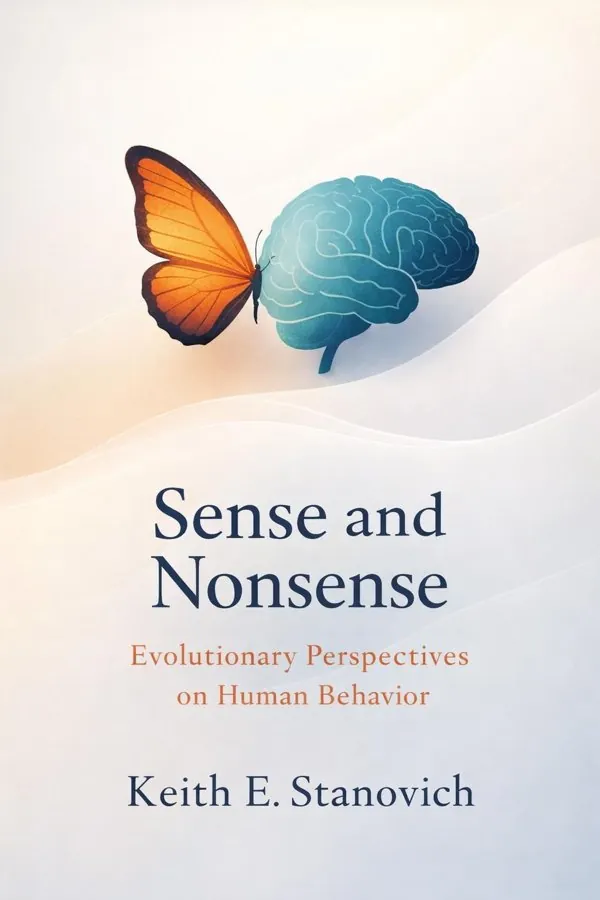
Sense and Nonsense: Evolutionary Perspectives on Human Behavior: Summary & Key Insights
 10 min8 chaptersAudio available
What Is Sense and Nonsense: Evolutionary Perspectives on Human Behavior About?
Sense and Nonsense: Evolutionary Perspectives on Human Behavior by Keith E. Stanovich is a cognition book spanning 8 pages. This book critically examines evolutionary psychology and its claims about human behavior. Stanovich explores how evolutionary theory can be applied to understanding cognition, decision-making, and social behavior, while distinguishing between scientifically grounded insights and speculative or misleading interpretations.
This FizzRead summary covers all 8 key chapters of Sense and Nonsense: Evolutionary Perspectives on Human Behavior in approximately 10 minutes, distilling the most important ideas, arguments, and takeaways from Keith E. Stanovich's work. Also available as an audio summary and Key Quotes Podcast.
Sense and Nonsense: Evolutionary Perspectives on Human Behavior
This book critically examines evolutionary psychology and its claims about human behavior. Stanovich explores how evolutionary theory can be applied to understanding cognition, decision-making, and social behavior, while distinguishing between scientifically grounded insights and speculative or misleading interpretations.
Who Should Read Sense and Nonsense: Evolutionary Perspectives on Human Behavior?
This book is perfect for anyone interested in cognition and looking to gain actionable insights in a short read. Whether you're a student, professional, or lifelong learner, the key ideas from Sense and Nonsense: Evolutionary Perspectives on Human Behavior by Keith E. Stanovich will help you think differently.
- ✓Readers who enjoy cognition and want practical takeaways
- ✓Professionals looking to apply new ideas to their work and life
- ✓Anyone who wants the core insights of Sense and Nonsense: Evolutionary Perspectives on Human Behavior in just 10 minutes
Want the full summary?
Get instant access to this book summary and 100K+ more with Fizz Moment.
Get Free SummaryAvailable on App Store • Free to download
Key Chapters
To understand how evolutionary reasoning enters psychology, we must start from Darwin’s core insight: traits that enhance reproductive success in a given environment tend to proliferate over generations. This principle, applied to mental traits, forms the backbone of evolutionary psychology. We assume that many aspects of our cognition and behavior—such as our preferences, fears, and decision patterns—are adaptations shaped by ancestral selection pressures.
However, we must tread carefully here. Saying that a trait has an evolutionary origin does not mean that it is genetically fixed or morally justified. The goal is to understand function, not to excuse behavior. When we think of something as an adaptation, we are hypothesizing about its past utility. We must rely on converging evidence—from anthropology, comparative psychology, and modern cognition—to support or reject that hypothesis.
In discussing the foundations, I emphasize that the environment of evolutionary adaptedness (EEA) is not a single place or time but a conceptual construct: the conditions under which our cognitive mechanisms evolved. For example, the human preference for calorically rich food made sense in environments where food scarcity was common. In today’s world of abundance, that same preference can work against us. This simple observation reflects both the power and the limits of evolutionary reasoning—it can explain why certain tendencies exist, but also why they may be maladaptive today.
Good evolutionary psychology, then, recognizes both the universality of certain cognitive mechanisms and the plasticity that allows individuals to adapt within their lifetimes through learning and culture. Bad evolutionary psychology, by contrast, mistakes historical storytelling for evidence.
In popular media, evolutionary psychology often gets caricatured as claiming that our genes control everything we do, that altruism is merely disguised selfishness, or that gender behaviors are biologically predestined. These are distortions. To understand behavior through an evolutionary lens is to investigate how selection pressures shaped flexible mechanisms, not rigid scripts.
I draw an important boundary between what I call genetic determinism and legitimate evolutionary explanation. Genes provide the structure for cognitive systems, but systems interact constantly with environments—social, cultural, and physical—that modulate their functioning. A gene’s effect depends entirely on context. To speak of “hardwiring” human behavior misses the essential truth that evolution has designed us to be learning, context-sensitive organisms.
In addressing these misconceptions, I remind readers that evolutionary explanations are probabilistic, not prescriptive. They describe tendencies, not mandates. If a behavior has an evolutionary root, it does not mean we must or should act that way. Understanding that aggression may have evolved under certain competitive pressures does not mean aggression is inevitable or acceptable. Science has no moral authority; it only offers causal insight.
This distinction matters profoundly because the misuse of evolutionary language has justified social hierarchies and prejudice in the past. Clarifying it protects both the integrity of science and the dignity of its subjects.
+ 6 more chapters — available in the FizzRead app
All Chapters in Sense and Nonsense: Evolutionary Perspectives on Human Behavior
About the Author
Keith E. Stanovich is a Canadian cognitive scientist and professor emeritus of applied psychology and human development at the University of Toronto. He is known for his research on rationality, reading, and cognitive science, and has authored several influential works on human reasoning and decision-making.
Get This Summary in Your Preferred Format
Read or listen to the Sense and Nonsense: Evolutionary Perspectives on Human Behavior summary by Keith E. Stanovich anytime, anywhere. FizzRead offers multiple formats so you can learn on your terms — all free.
Available formats: App · Audio · PDF · EPUB — All included free with FizzRead
Download Sense and Nonsense: Evolutionary Perspectives on Human Behavior PDF and EPUB Summary
Key Quotes from Sense and Nonsense: Evolutionary Perspectives on Human Behavior
“This principle, applied to mental traits, forms the backbone of evolutionary psychology.”
Frequently Asked Questions about Sense and Nonsense: Evolutionary Perspectives on Human Behavior
Sense and Nonsense: Evolutionary Perspectives on Human Behavior by Keith E. Stanovich is a cognition book that explores key ideas across 8 chapters. This book critically examines evolutionary psychology and its claims about human behavior. Stanovich explores how evolutionary theory can be applied to understanding cognition, decision-making, and social behavior, while distinguishing between scientifically grounded insights and speculative or misleading interpretations.
More by Keith E. Stanovich
You Might Also Like
A Field Guide to Lies: Critical Thinking in the Information Age
Daniel J. Levitin
10 min
A Theory of Cognitive Dissonance
Leon Festinger
10 min
Black-And-White Thinking: The Burden of a Binary Brain in a Complex World
Kevin Dutton
10 min
Born Liars: Why We Can’t Live Without Deceit
Ian Leslie
10 min
Collective Illusions: Conformity, Complicity, and the Science of Why We Make Bad Decisions
Todd Rose
10 min
Concrete Mathematics: A Foundation for Computer Science
Ronald L. Graham, Donald E. Knuth, Oren Patashnik
10 minBrowse by Category
Ready to read Sense and Nonsense: Evolutionary Perspectives on Human Behavior?
Get the full summary and 100K+ more books with Fizz Moment.