
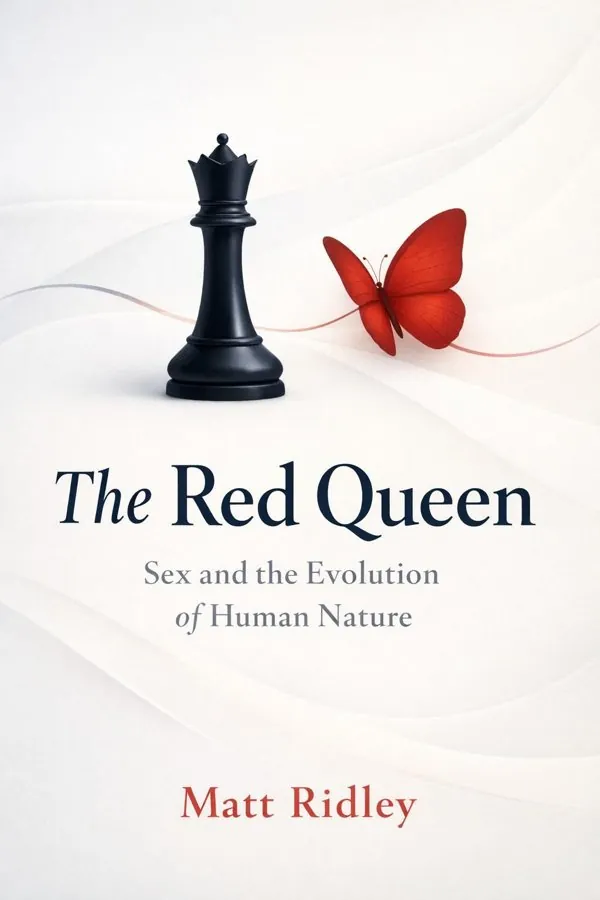
The Red Queen: Sex and the Evolution of Human Nature: Summary & Key Insights
by Matt Ridley
 10 min9 chaptersAudio available
Key Takeaways from The Red Queen: Sex and the Evolution of Human Nature
At first glance, sex looks like one of evolution’s worst bargains.
Evolution does not reward species with permanent victory.
Survival alone cannot explain many of the traits organisms possess.
One of Ridley’s most provocative arguments is that males and females often face different reproductive incentives, and those incentives can shape contrasting strategies.
Evolutionary struggle does not stop at the level of species or even individuals; Ridley shows that conflict can exist within reproduction itself.
What Is The Red Queen: Sex and the Evolution of Human Nature About?
The Red Queen: Sex and the Evolution of Human Nature by Matt Ridley is a life_science book spanning 4 pages. Why do organisms reproduce sexually when sex is so costly, risky, and inefficient compared with simple cloning? In The Red Queen, Matt Ridley tackles that puzzle and uses it to illuminate a much larger story: how sexual selection has helped shape human nature itself. Drawing on evolutionary biology, genetics, and psychology, Ridley argues that life is not a steady climb toward perfection but a relentless race of adaptation, where species must constantly change just to keep pace with parasites, rivals, and one another. The book’s title comes from Lewis Carroll’s Red Queen, who tells Alice that in her world you must run as fast as you can just to stay in the same place—a fitting metaphor for evolution’s ceaseless contest. Ridley is especially persuasive because he writes as both a journalist and a science interpreter, translating complex research into vivid, approachable ideas. The result is a provocative exploration of attraction, mating, intelligence, fidelity, conflict, and cooperation that invites readers to see love, beauty, and even culture through the lens of evolution.
This FizzRead summary covers all 9 key chapters of The Red Queen: Sex and the Evolution of Human Nature in approximately 10 minutes, distilling the most important ideas, arguments, and takeaways from Matt Ridley's work. Also available as an audio summary and Key Quotes Podcast.
The Red Queen: Sex and the Evolution of Human Nature
Why do organisms reproduce sexually when sex is so costly, risky, and inefficient compared with simple cloning? In The Red Queen, Matt Ridley tackles that puzzle and uses it to illuminate a much larger story: how sexual selection has helped shape human nature itself. Drawing on evolutionary biology, genetics, and psychology, Ridley argues that life is not a steady climb toward perfection but a relentless race of adaptation, where species must constantly change just to keep pace with parasites, rivals, and one another. The book’s title comes from Lewis Carroll’s Red Queen, who tells Alice that in her world you must run as fast as you can just to stay in the same place—a fitting metaphor for evolution’s ceaseless contest. Ridley is especially persuasive because he writes as both a journalist and a science interpreter, translating complex research into vivid, approachable ideas. The result is a provocative exploration of attraction, mating, intelligence, fidelity, conflict, and cooperation that invites readers to see love, beauty, and even culture through the lens of evolution.
Who Should Read The Red Queen: Sex and the Evolution of Human Nature?
This book is perfect for anyone interested in life_science and looking to gain actionable insights in a short read. Whether you're a student, professional, or lifelong learner, the key ideas from The Red Queen: Sex and the Evolution of Human Nature by Matt Ridley will help you think differently.
- ✓Readers who enjoy life_science and want practical takeaways
- ✓Professionals looking to apply new ideas to their work and life
- ✓Anyone who wants the core insights of The Red Queen: Sex and the Evolution of Human Nature in just 10 minutes
Want the full summary?
Get instant access to this book summary and 100K+ more with Fizz Moment.
Get Free SummaryAvailable on App Store • Free to download
Key Chapters
At first glance, sex looks like one of evolution’s worst bargains. Asexual reproduction seems far more efficient: every individual can reproduce, genes are passed on intact, and there is no need to spend time finding mates. Yet most complex organisms rely on sex. Ridley uses this apparent paradox to introduce the Red Queen hypothesis: species must keep evolving simply to survive in a world full of changing enemies, especially parasites and pathogens. Sexual reproduction shuffles genes each generation, creating variation that makes it harder for parasites to specialize on a single common genetic type.
This insight shifts the question from “Why is sex so wasteful?” to “What hidden advantage makes the waste worthwhile?” Ridley’s answer is that sex is a defense against stagnation. In a stable world, cloning might win. In a hostile and changing world, genetic variety is a survival strategy. The constant contest between hosts and parasites means yesterday’s successful genome may be vulnerable tomorrow. Sex keeps producing new combinations, giving populations a moving target.
You can see a practical echo of this logic in agriculture and medicine. Monocultures are fragile because uniform crops can be devastated by a single disease, while genetic diversity offers resilience. Likewise, viral evolution forces humans to keep updating vaccines and treatments. Diversity is not a luxury; it is protection.
Ridley’s larger point is that evolution is dynamic, not static. Fitness depends on what others are doing. Actionable takeaway: when thinking about biology, health, or even systems outside nature, value adaptability and diversity over short-term efficiency alone.
Evolution does not reward species with permanent victory. Ridley’s central metaphor, borrowed from Through the Looking-Glass, captures this perfectly: you must keep running just to stay where you are. In nature, every adaptation invites a counter-adaptation. A faster prey species selects for faster predators; better immune defenses select for cleverer parasites; more selective choosers in mating markets select for better displays, deceptions, or signals.
The power of the Red Queen metaphor is that it explains why life often looks extravagant, wasteful, or endlessly unfinished. Evolution is not moving toward an ideal endpoint. It is a competitive process shaped by feedback loops. A peacock’s tail, a parasite’s stealth, or a human courtship display may seem excessive, but such traits can emerge because success is always relative to rivals and threats. Survival means keeping up, not arriving.
This idea also helps explain why human beings remain psychologically conflicted. We are not designed for peace and simplicity, but for negotiation in a world of competition, cooperation, attraction, jealousy, status, and shifting alliances. Traits that helped in one social environment can become liabilities in another.
In everyday life, the Red Queen effect appears outside biology too. Careers, technology, and markets often operate the same way: standing still means falling behind because everyone else is improving. Skills that once guaranteed success can quickly become baseline expectations.
Ridley encourages readers to think relationally. Nothing evolves in isolation. Actionable takeaway: instead of seeking permanent solutions in changing environments, build habits of continual learning, adjustment, and response.
Survival alone cannot explain many of the traits organisms possess. Ridley emphasizes that evolution works through two filters: natural selection, which favors survival, and sexual selection, which favors reproductive success. Once mating enters the story, beauty, ornament, charm, aggression, and even deception can become adaptive. A trait may persist not because it helps an organism live longer, but because it helps it attract mates or outcompete rivals.
This is why animals often display dramatic differences that seem biologically expensive. Bright colors attract attention from predators, large antlers require energy, and elaborate songs consume time. Yet if those features increase mating opportunities, they can spread. Sexual selection therefore produces a world full of signaling. Organisms advertise health, vigor, fertility, commitment, dominance, or genetic quality. At the same time, signalers may exaggerate, and choosers must evolve ways to detect honesty.
Ridley applies this framework to human beings. Our grooming habits, fashion choices, humor, confidence, and social performances are not random cultural quirks detached from biology. They can also be understood as part of an ancient courtship language shaped by mate choice. This does not reduce love to a mechanical process, but it does suggest that attraction has deep evolutionary roots.
A practical application is to look more carefully at displays in modern life. Luxury spending, online self-presentation, physical fitness, and status competition often function as signals, whether people realize it or not. Seeing them this way makes behavior more intelligible.
Actionable takeaway: when evaluating social behavior, ask not only “Does this help survival?” but also “What is being signaled, and to whom?”
One of Ridley’s most provocative arguments is that males and females often face different reproductive incentives, and those incentives can shape contrasting strategies. Because eggs are biologically costly and sperm comparatively cheap, females in many species tend to be more selective, while males often compete more intensely for access. From that asymmetry flow patterns of display, rivalry, choosiness, guarding, seduction, and conflict.
Ridley does not claim that every individual fits a rigid template. Instead, he argues that recurring evolutionary pressures can create tendencies. If one sex invests more in gestation, child care, or parental certainty, its mating choices may emphasize different traits than the other’s. This helps explain why sexual politics are often charged with misunderstanding: each side may be navigating somewhat different evolutionary trade-offs involving fertility, commitment, opportunity, status, and risk.
In humans, these dynamics become especially complex because biology interacts with culture, morality, law, and personal values. We are not prisoners of instinct, but neither are we blank slates. Jealousy, flirtation, competition, selectiveness, and anxiety about fidelity can all be examined through this lens. Ridley’s contribution is to frame such emotions as evolved responses to recurring ancestral problems rather than mere social accidents.
A useful modern application is in relationships. Conflicts over commitment, attention, exclusivity, and investment are often easier to understand when seen as clashes of expectation and incentive, not simply moral failure.
Actionable takeaway: approach sex differences with nuance—recognize average evolutionary patterns, but apply them carefully, without stereotyping individuals or ignoring cultural influence.
Evolutionary struggle does not stop at the level of species or even individuals; Ridley shows that conflict can exist within reproduction itself. The union of male and female interests may produce offspring, but it does not erase the possibility that genes, bodies, and reproductive strategies have partially overlapping rather than identical goals. Courtship and mating can therefore involve hidden negotiations over investment, certainty, timing, and control.
This perspective helps explain why nature contains so many puzzling traits: mate guarding, sperm competition, concealed ovulation, strategic promiscuity, and mechanisms that influence paternity certainty. Ridley draws attention to the fact that reproduction is not a serene collaboration but often a contest shaped by incentives on both sides. Even after mating, evolutionary interests may diverge over parental care, resource allocation, and future mating opportunities.
In human terms, this idea clarifies why relationships often involve both cooperation and tension. Partners may genuinely love each other while still being influenced by concerns about trust, fairness, exclusivity, and long-term investment. Biology does not destroy romance, but it adds another layer of explanation to the feelings people experience.
Outside intimate relationships, this concept trains readers to expect mixed motives in systems that appear harmonious. Shared goals rarely eliminate competition altogether; they simply channel it into subtler forms.
Ridley’s argument is valuable because it replaces sentimental simplifications with a more realistic view of nature. Cooperation often emerges from negotiation among partly conflicting interests. Actionable takeaway: in any partnership, look for both aligned incentives and hidden tensions, and manage both consciously.
A striking possibility in Ridley’s account is that some of humanity’s most admired traits may have evolved partly because they were sexy. Intelligence, language, humor, creativity, storytelling, and artistic skill are often treated as tools for survival alone. Ridley invites readers to consider another force: these abilities may also have functioned as courtship displays, signals of mental fitness that impressed potential mates.
This helps explain why humans invest extraordinary energy in activities that seem impractical from a narrow survival standpoint. Poetry, music, wit, and ornamented language are not strictly necessary to catch food or avoid predators, yet they loom large in human life. If creative expression advertised health, imagination, social intelligence, or genetic quality, then sexual selection could have amplified such traits over generations.
Think about how attraction works in modern settings. People are often drawn not only to appearance but to conversation, humor, originality, confidence, and talent. A musician on stage, a brilliant speaker, or a funny conversationalist may be demonstrating evolved forms of display. Social media has not invented this tendency; it has simply digitized it.
Ridley’s broader point is that culture and biology are deeply entangled. Human civilization may be partly built on mating effort, with art and intellect emerging not just from utility but from display. That claim is intentionally provocative, yet it opens a powerful way of interpreting human achievement.
Actionable takeaway: notice how often intelligence and creativity function socially as signals, and cultivate your talents not only as tools, but as authentic expressions of value.
Feelings that seem intensely personal may also be evolutionarily ancient. Ridley treats love, romantic attachment, fidelity, and jealousy not as modern inventions or purely cultural scripts, but as emotional systems shaped by recurring reproductive challenges. Bonding can stabilize parental investment. Jealousy can guard against betrayal or diverted resources. Desire can promote mating, while attachment can keep partners together long enough to raise vulnerable offspring.
This evolutionary framing does not cheapen emotion. On the contrary, it shows why these feelings are so powerful: they mattered for survival and reproduction. Human children require prolonged care, making pair bonds unusually significant in our species. Yet long-term bonding exists alongside temptations, uncertainty, and conflicting interests, which is why human love is rarely simple. Our emotional lives carry the imprint of both cooperation and competition.
Modern relationships reveal these tensions constantly. People seek intimacy and autonomy, novelty and stability, attraction and trust. Ridley’s framework helps explain why these opposing desires coexist. We are descendants of ancestors who navigated complicated mating systems, not creatures designed for frictionless harmony.
A practical use of this idea is emotional self-understanding. Instead of viewing jealousy or insecurity only as weakness, one can recognize them as signals to be interpreted and managed wisely. Likewise, commitment is easier to appreciate when seen as a biological and social achievement rather than a default state.
Actionable takeaway: treat strong relationship emotions as evolved impulses—real and meaningful, but not automatically correct; respond with reflection instead of reflex.
Human beings do not leave evolution behind when they enter culture; they express it through culture. Ridley argues that social norms, status systems, fashion, art, and morality often interact with mating behavior in ways that reflect deeper evolutionary patterns. Culture can restrain biology, redirect it, exaggerate it, or disguise it, but it rarely exists in total independence from it.
This matters because many debates set biology and culture up as enemies, as if one must entirely explain human behavior. Ridley’s view is more integrated. Courtship rituals vary across societies, but the existence of courtship itself is universal. Standards of attractiveness shift, yet the importance of attractiveness persists. Status markers change form—from hunting ability to educational credentials to digital influence—but signaling remains central.
Consider modern dating. Profiles, photos, text exchanges, and curated lifestyles may look far removed from ancestral life, yet they still revolve around the same core tasks: attracting attention, demonstrating value, judging trustworthiness, and negotiating commitment. Even public virtue can become a signal of desirability or alliance. Culture supplies the symbols; evolution helps explain why signaling matters so much.
Ridley’s account encourages readers to decode social life with more realism. Many customs that appear arbitrary become more comprehensible when seen as strategies around mating, parenting, kinship, and reputation.
Actionable takeaway: when examining social trends, ask how they may shape mating signals, family structure, or status competition, rather than assuming culture floats free of human nature.
One of the book’s most valuable lessons is that human nature is not one thing. Ridley rejects simplistic pictures of humans as either naturally selfish beasts or naturally harmonious angels. Evolution, especially sexual and social evolution, produced a species that competes fiercely and cooperates deeply. We form alliances, share information, raise children collectively, pursue status, deceive rivals, and fall in love—all within the same evolutionary package.
The Red Queen framework helps make sense of this apparent contradiction. In social species, success depends not only on defeating others but also on working with them. Competition selects for cooperation when cooperation improves one’s chances of survival or reproduction. Likewise, cooperation creates opportunities for cheating, which then selects for vigilance, punishment, and reputation tracking. Human morality itself may be partly rooted in these repeated social games.
This duality appears everywhere. Workplaces reward teamwork but also promotion battles. Friend groups provide support but contain status hierarchies. Romantic partnerships require trust but are vulnerable to conflict. Human beings are experts at balancing mutual benefit with personal advantage because that is the world evolution prepared us for.
Ridley’s broader contribution is to normalize complexity. Mixed motives are not proof of hypocrisy; they are often the natural result of competing evolutionary demands. Understanding this can make social life less confusing and moral judgment more precise.
Actionable takeaway: expect both generosity and self-interest in yourself and others, and design relationships and institutions that reward cooperation while accounting for competition.
All Chapters in The Red Queen: Sex and the Evolution of Human Nature
About the Author
Matt Ridley is a British science writer, journalist, and author best known for exploring evolution, genetics, innovation, and human behavior in accessible prose. Educated at Oxford, he has written for major publications including The Economist and has built a wide readership through books that translate complex scientific debates into engaging arguments for general audiences. Ridley’s work often examines how large patterns emerge from biological and social processes, with a particular interest in human nature and evolutionary theory. In The Red Queen, he brings together insights from biology, psychology, and genetics to explain why sex evolved and how sexual selection shaped the human mind. His writing is valued for its clarity, intellectual ambition, and ability to connect scientific ideas with everyday life.
Get This Summary in Your Preferred Format
Read or listen to the The Red Queen: Sex and the Evolution of Human Nature summary by Matt Ridley anytime, anywhere. FizzRead offers multiple formats so you can learn on your terms — all free.
Available formats: App · Audio · PDF · EPUB — All included free with FizzRead
Download The Red Queen: Sex and the Evolution of Human Nature PDF and EPUB Summary
Key Quotes from The Red Queen: Sex and the Evolution of Human Nature
“At first glance, sex looks like one of evolution’s worst bargains.”
“Evolution does not reward species with permanent victory.”
“Survival alone cannot explain many of the traits organisms possess.”
“One of Ridley’s most provocative arguments is that males and females often face different reproductive incentives, and those incentives can shape contrasting strategies.”
“Evolutionary struggle does not stop at the level of species or even individuals; Ridley shows that conflict can exist within reproduction itself.”
Frequently Asked Questions about The Red Queen: Sex and the Evolution of Human Nature
The Red Queen: Sex and the Evolution of Human Nature by Matt Ridley is a life_science book that explores key ideas across 9 chapters. Why do organisms reproduce sexually when sex is so costly, risky, and inefficient compared with simple cloning? In The Red Queen, Matt Ridley tackles that puzzle and uses it to illuminate a much larger story: how sexual selection has helped shape human nature itself. Drawing on evolutionary biology, genetics, and psychology, Ridley argues that life is not a steady climb toward perfection but a relentless race of adaptation, where species must constantly change just to keep pace with parasites, rivals, and one another. The book’s title comes from Lewis Carroll’s Red Queen, who tells Alice that in her world you must run as fast as you can just to stay in the same place—a fitting metaphor for evolution’s ceaseless contest. Ridley is especially persuasive because he writes as both a journalist and a science interpreter, translating complex research into vivid, approachable ideas. The result is a provocative exploration of attraction, mating, intelligence, fidelity, conflict, and cooperation that invites readers to see love, beauty, and even culture through the lens of evolution.
More by Matt Ridley
Genome: The Autobiography of a Species in 23 Chapters
Matt Ridley
10 min
Nature Via Nurture: Genes, Experience, and What Makes Us Human
Matt Ridley
10 min
The Evolution of Everything: How New Ideas Emerge
Matt Ridley
10 min
The Agile Gene: How Nature Turns on Nurture
Matt Ridley
10 minYou Might Also Like
The Selfish Gene
Richard Dawkins
10 min
Awakenings
Oliver Sacks
10 min
Parasite Rex: Inside the Bizarre World of Nature's Most Dangerous Creatures
Carl Zimmer
10 min
The Atlas of Life on Earth
Various
10 min
The Book of Humans: The Story of How We Became Us
Adam Rutherford
10 min
The Horse
Wendy Williams
10 minBrowse by Category
Ready to read The Red Queen: Sex and the Evolution of Human Nature?
Get the full summary and 100K+ more books with Fizz Moment.