
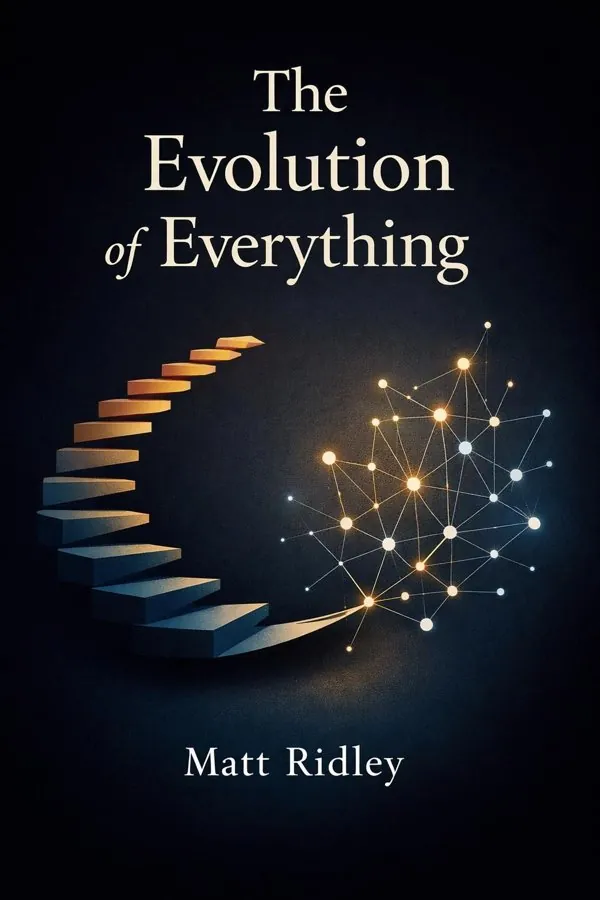
The Evolution of Everything: How New Ideas Emerge: Summary & Key Insights
by Matt Ridley
 10 min9 chaptersAudio available
Key Takeaways from The Evolution of Everything: How New Ideas Emerge
In nature, genes mutate and environments select what survives.
Some of the most remarkable forms of order in the world were never centrally planned.
Nature does not innovate by starting from scratch; it innovates by modifying what already exists.
Ideas spread in society much like traits spread in nature: by being imitated, adapted, and selected.
Prosperity is not usually the product of a master economic plan; it grows from exchange, specialization, and innovation spreading through networks of people.
What Is The Evolution of Everything: How New Ideas Emerge About?
The Evolution of Everything: How New Ideas Emerge by Matt Ridley is a popular_sci book spanning 13 pages. What if the biggest force shaping human progress is not planning, leadership, or design, but countless small experiments unfolding from the bottom up? In The Evolution of Everything, Matt Ridley makes that provocative case. He argues that evolution is not just a biological process explaining plants, animals, and genes. It is also the hidden engine behind language, markets, morality, technology, government, education, and culture itself. Instead of seeing history as a sequence of master plans imposed by powerful individuals, Ridley shows how order often emerges spontaneously from trial and error, adaptation, and decentralized exchange. This idea matters because it changes how we think about progress. If innovation grows through variation and selection rather than central control, then freedom, openness, and experimentation become far more important than rigid design. Ridley, a science writer, journalist, and author known for exploring evolution, economics, and optimism about human progress, brings together insights from biology, history, and social science to challenge conventional assumptions. The result is a sweeping and provocative book that invites readers to rethink where new ideas come from—and how societies improve.
This FizzRead summary covers all 9 key chapters of The Evolution of Everything: How New Ideas Emerge in approximately 10 minutes, distilling the most important ideas, arguments, and takeaways from Matt Ridley's work. Also available as an audio summary and Key Quotes Podcast.
The Evolution of Everything: How New Ideas Emerge
What if the biggest force shaping human progress is not planning, leadership, or design, but countless small experiments unfolding from the bottom up? In The Evolution of Everything, Matt Ridley makes that provocative case. He argues that evolution is not just a biological process explaining plants, animals, and genes. It is also the hidden engine behind language, markets, morality, technology, government, education, and culture itself. Instead of seeing history as a sequence of master plans imposed by powerful individuals, Ridley shows how order often emerges spontaneously from trial and error, adaptation, and decentralized exchange.
This idea matters because it changes how we think about progress. If innovation grows through variation and selection rather than central control, then freedom, openness, and experimentation become far more important than rigid design. Ridley, a science writer, journalist, and author known for exploring evolution, economics, and optimism about human progress, brings together insights from biology, history, and social science to challenge conventional assumptions. The result is a sweeping and provocative book that invites readers to rethink where new ideas come from—and how societies improve.
Who Should Read The Evolution of Everything: How New Ideas Emerge?
This book is perfect for anyone interested in popular_sci and looking to gain actionable insights in a short read. Whether you're a student, professional, or lifelong learner, the key ideas from The Evolution of Everything: How New Ideas Emerge by Matt Ridley will help you think differently.
- ✓Readers who enjoy popular_sci and want practical takeaways
- ✓Professionals looking to apply new ideas to their work and life
- ✓Anyone who wants the core insights of The Evolution of Everything: How New Ideas Emerge in just 10 minutes
Want the full summary?
Get instant access to this book summary and 100K+ more with Fizz Moment.
Get Free SummaryAvailable on App Store • Free to download
Key Chapters
We often speak as if evolution belongs exclusively to biology, but Ridley’s central insight is that evolution is a general pattern of change that appears wherever variation, selection, and retention exist. In nature, genes mutate and environments select what survives. In society, ideas compete, habits spread, institutions adapt, and useful practices endure. This broader view allows us to see progress not as a neat product of deliberate design, but as the cumulative result of many small experiments.
Ridley argues that many of the systems we depend on were not invented whole by any one mind. Language was not drafted by a committee. Money was not first imagined in a perfect blueprint. Even scientific knowledge did not emerge from one central authority but from generations of testing, error correction, and refinement. The same logic applies to customs, laws, and technologies: they evolve because people try things, copy what works, and abandon what does not.
This perspective is especially useful in a world that prizes control. We are tempted to believe that successful systems must be designed from above. Yet complex outcomes often arise from local interactions. A city neighborhood becomes vibrant through countless individual decisions. Software improves through user feedback and repeated iteration. Business models evolve through competition rather than master planning.
Ridley is not denying the role of human intelligence. Instead, he shows that intelligence works best when it participates in a larger process of experimentation. The practical lesson is clear: whenever you face complexity, resist the urge to overdesign. Create room for trial and error, let multiple approaches compete, and pay attention to what emerges naturally.
Some of the most remarkable forms of order in the world were never centrally planned. That idea feels unsettling because we instinctively look for architects behind complexity. Ridley challenges that instinct by showing how self-organizing systems emerge from simple interactions over time. The cosmos formed structure from physical laws. Ecosystems developed balance without a manager. Markets coordinate supply and demand without any single intelligence directing every exchange.
This principle matters because it explains how complexity can arise without command. In the economy, millions of buyers and sellers respond to prices, preferences, scarcity, and opportunity. No one person knows the whole system, yet food reaches supermarkets and innovations reach consumers. In language, grammar evolves from ordinary use. In science, consensus emerges through replication and criticism, not decree.
Ridley contrasts spontaneous order with the top-down model that dominates political and intellectual life. We often credit rulers, planners, reformers, or experts with achievements that actually depended on decentralized contributions. Even inventions associated with famous names usually involved networks of tinkerers, predecessors, and users improving a concept over time.
This does not mean central institutions are always useless. It means their power is often overstated, while the creative capacity of distributed systems is underestimated. Policies and organizations work best when they support adaptation rather than suppress it.
In practical terms, this applies to leadership, business, and everyday problem-solving. Strong teams usually outperform rigid hierarchies when members can experiment, share information, and respond quickly. If you want better outcomes, design conditions for emergence: encourage feedback, reduce unnecessary control, and trust local knowledge more than abstract plans.
Nature does not innovate by starting from scratch; it innovates by modifying what already exists. Ridley uses the evolution of life and genes to illustrate a broader truth: progress is usually cumulative, improvised, and messy. Biological evolution works through random variation filtered by natural selection, not by foresight. Eyes, wings, immune systems, and brains were not designed in advance for future purposes. They emerged step by step through useful modifications preserved over time.
Ridley extends this genetic logic to other domains. Just as genes carry inherited solutions to old problems, cultures and institutions store accumulated knowledge. A tool improves through many versions. A legal principle survives because it solved recurring disputes. A farming method spreads because it worked under local conditions. Evolution, then, is not blind chaos. It is a disciplined process of trial, retention, and adaptation.
This matters because people often reject imperfect systems in search of ideal replacements. Ridley’s view encourages humility. Evolved systems may look inefficient in isolation, but they often contain hidden wisdom built through repeated use. Consider medicine: many treatments emerged from observation and gradual refinement before science fully explained them. Or think of software development, where successful platforms are patched, upgraded, and improved continuously rather than rebuilt from zero.
The actionable takeaway is to value iterative improvement over grand reinvention. Whether you are developing a product, refining a habit, or improving a team process, ask what can be modified rather than discarded. Small improvements, preserved and compounded, often outperform bold but brittle redesigns.
Ideas spread in society much like traits spread in nature: by being imitated, adapted, and selected. Ridley’s account of cultural evolution shows that traditions, norms, languages, fashions, and beliefs are not simply imposed from above. They often emerge from the repeated choices of ordinary people responding to incentives, meanings, and circumstances. Culture is less like a monument and more like a living ecosystem.
This explains why no one invents a language in full. Words shift meaning, grammar mutates, accents travel, and expressions survive because they are useful or memorable. The same applies to cuisine, music, rituals, and social customs. Practices that resonate with people are copied; those that fail fade away. Even moral norms evolve as societies test ways of living together.
Ridley argues that cultural change is often decentralized and cumulative. Great artists, thinkers, and leaders matter, but they do not create in a vacuum. They work within traditions, borrow from predecessors, and influence others who then modify what they inherited. Renaissance art, modern democracy, and scientific culture all grew from dense networks of exchange.
This perspective has practical implications. Organizations often try to engineer culture through slogans or mission statements alone, but real culture emerges from repeated behavior. If a company wants openness, it must reward truth-telling. If a family wants trust, it must normalize honesty in daily interactions. Culture follows practice more than proclamation.
The takeaway is to treat culture as something cultivated through examples, incentives, and repetition. Instead of trying to impose values by decree, focus on the small behaviors people actually copy. What gets repeated becomes what endures.
Prosperity is not usually the product of a master economic plan; it grows from exchange, specialization, and innovation spreading through networks of people. Ridley presents the economy as an evolutionary system in which ideas, tools, and business models compete and improve. Wealth, in this view, comes not merely from resources but from the human capacity to trade and combine knowledge.
One of Ridley’s recurring themes is that no individual knows enough to make modern civilization alone. Even a simple pencil depends on miners, loggers, transport workers, engineers, manufacturers, and retailers. The market coordinates their efforts through prices and incentives, creating order without requiring anyone to understand the whole system. This is one reason decentralized economies can adapt so quickly: they harness dispersed information.
Innovation also follows an evolutionary pattern. Entrepreneurs try products, consumers respond, investors back winners, and unsuccessful ideas disappear. Over time, this process improves quality, lowers cost, and increases choice. Smartphones, online retail, and renewable energy technologies did not arrive fully formed; they improved through competition and iteration.
Ridley is especially skeptical of the belief that economic progress depends mainly on state direction. Governments can help by protecting property, enforcing contracts, and supporting basic research, but they rarely outperform open systems at discovering what people actually need.
For readers, the practical lesson is to think of economic life as a process of learning by exchange. In your own work, seek collaboration across specialties, because value often emerges at the intersection of different forms of knowledge. Trade information generously, stay open to market feedback, and remember that specialization works best when linked by cooperation.
We love stories of lone geniuses inventing the future, but Ridley shows that technology usually evolves through many contributors making small improvements over time. Breakthroughs are real, yet most breakthroughs sit atop decades of tinkering, failed prototypes, shared knowledge, and user adaptation. Innovation is less a lightning strike than a long chain reaction.
Consider flight, computing, or the internet. Famous names are attached to each, but the underlying technologies emerged from countless experiments by engineers, scientists, mechanics, entrepreneurs, and even customers. Early designs were clumsy. Components were unreliable. Competing versions circulated. Gradually, useful features survived while weak ones disappeared. In other words, technology evolves.
Ridley’s argument carries an important warning: when societies overcentralize innovation, they often slow it down. Bureaucracies tend to prefer predictability, while real invention requires uncertainty. Open systems, by contrast, allow many approaches to be tested at once. This is why startup ecosystems, open-source communities, and loosely connected research networks can outperform heavily controlled environments.
Technology also reshapes human behavior in return. Tools change workflows, habits, expectations, and even social norms. Email changed communication speed. Search engines changed memory habits. Mobile payments changed purchasing behavior. Evolution is therefore reciprocal: humans make tools, and tools remake human systems.
The practical takeaway is to approach innovation experimentally. If you are building something new, aim for prototypes rather than perfection. Gather feedback early, expect revision, and learn from user behavior instead of assuming you already know the ideal design. The future is usually built by adaptation, not by flawless first attempts.
Human nature feels fixed from the inside, yet Ridley argues that both the mind and morality are products of long evolutionary processes. Our brains are shaped by biological selection, but our ways of thinking are also influenced by culture, language, institutions, and social learning. Likewise, morality is not merely a set of eternal rules handed down unchanged; it evolves as communities discover better ways to cooperate.
Ridley draws attention to the social origins of much human intelligence. People do not become smart in isolation. We think with concepts inherited from others, use tools made by others, and reason inside traditions of language and knowledge. The individual mind is powerful, but it is amplified by collective evolution. This helps explain why literacy, science, and education can transform cognition across generations.
Morality follows a similar pattern. Many moral norms emerged because they helped groups function: fairness supports trust, honesty lowers transaction costs, and reciprocity stabilizes relationships. Over time, societies can become morally more expansive, extending concern beyond kin or tribe. This does not happen automatically or evenly, but moral progress often arises from debate, imitation, and institutional reinforcement rather than central moral design.
Modern examples are easy to find. Attitudes toward slavery, women’s rights, child labor, and same-sex relationships changed not because one authority rewrote human conscience overnight, but because public argument, lived experience, and shifting norms gradually selected more humane standards.
The takeaway is to treat both thought and ethics as improvable. Expose yourself to diverse viewpoints, participate in honest discussion, and build habits that reinforce cooperation. Better minds and better morals develop through practice, feedback, and social learning.
One of Ridley’s boldest claims is that government itself evolves, and it performs best when it behaves less like an all-knowing engineer and more like a learning system. Political institutions are often presented as rational designs imposed by founders or reformers, but in reality they are usually historical accumulations shaped by conflict, compromise, precedent, and adaptation. Constitutions, courts, parliaments, and bureaucracies all bear the marks of incremental change.
Ridley does not argue for the absence of government. Rather, he questions the assumption that centralized power can successfully design complex social outcomes. When governments try to micromanage dynamic systems such as economies, schools, or urban life, they often ignore local knowledge and suppress experimentation. By contrast, institutions that permit feedback and revision tend to perform better over time.
This applies strongly to law and public policy. Common law traditions, for example, evolved case by case, often preserving practical solutions discovered through experience. Federal systems can allow regions to test different approaches. Even successful social programs frequently emerged through pilots, revisions, and learning rather than perfect top-down design.
Ridley also connects this insight to religion and education. Religious practices survive when they meet social or emotional needs. Educational methods improve when teachers adapt to evidence and classroom reality rather than merely follow ideology.
The actionable lesson is to judge institutions by their capacity to learn. Whether in politics, management, or community life, prefer systems that allow correction, decentralization, and accountability. Ask not only who is in charge, but how the system discovers and fixes its mistakes.
Population growth and public health are often framed as disasters waiting to happen, yet Ridley argues that human societies have repeatedly adapted to pressures that once seemed overwhelming. This does not mean every problem solves itself, but it does mean doom-laden predictions often underestimate human ingenuity, cooperation, and the evolutionary power of innovation.
Historically, rising populations created challenges in food supply, sanitation, housing, and disease control. But they also produced more exchange, more specialization, and more problem-solvers. Agricultural improvements, cleaner water systems, vaccines, antibiotics, refrigeration, and better logistics all emerged through processes of experimentation and diffusion. Health, like technology, advanced through cumulative discovery.
Ridley is especially interested in how solutions emerge unevenly and then spread. One city pioneers sewage reform; another adopts it. One laboratory develops a treatment; global production scales it. Public health evolves through a mix of science, behavior change, infrastructure, and institutional learning. It is not centrally invented once and for all.
At the same time, Ridley’s framework encourages realism. New conditions create new selection pressures. Urbanization changes disease patterns. Longer lifespans increase chronic illness. Global connectivity spreads viruses faster. Evolution never stops; adaptation must continue.
For modern readers, the lesson is neither complacency nor panic, but constructive responsiveness. Support systems that generate and spread solutions: scientific research, transparent data, local experimentation, and public trust. In personal life, apply the same principle. Health rarely depends on one dramatic fix. It improves through sustainable habits, feedback, and gradual adjustment over time.
All Chapters in The Evolution of Everything: How New Ideas Emerge
About the Author
Matt Ridley is a British author, journalist, and science writer best known for his books on evolution, human nature, innovation, and economic progress. Trained in zoology, he has a talent for translating complex scientific and social ideas into clear, engaging narratives for general readers. His notable books include Genome, The Red Queen, and The Rational Optimist, all of which explore how biological and cultural forces shape human life. Ridley has also written extensively for newspapers and magazines on science, technology, and public policy. Across his work, he frequently emphasizes the power of bottom-up processes, exchange, adaptation, and trial-and-error learning. In The Evolution of Everything, he brings these themes together in a sweeping argument about how new ideas and institutions emerge.
Get This Summary in Your Preferred Format
Read or listen to the The Evolution of Everything: How New Ideas Emerge summary by Matt Ridley anytime, anywhere. FizzRead offers multiple formats so you can learn on your terms — all free.
Available formats: App · Audio · PDF · EPUB — All included free with FizzRead
Download The Evolution of Everything: How New Ideas Emerge PDF and EPUB Summary
Key Quotes from The Evolution of Everything: How New Ideas Emerge
“In nature, genes mutate and environments select what survives.”
“Some of the most remarkable forms of order in the world were never centrally planned.”
“Nature does not innovate by starting from scratch; it innovates by modifying what already exists.”
“Ideas spread in society much like traits spread in nature: by being imitated, adapted, and selected.”
“Prosperity is not usually the product of a master economic plan; it grows from exchange, specialization, and innovation spreading through networks of people.”
Frequently Asked Questions about The Evolution of Everything: How New Ideas Emerge
The Evolution of Everything: How New Ideas Emerge by Matt Ridley is a popular_sci book that explores key ideas across 9 chapters. What if the biggest force shaping human progress is not planning, leadership, or design, but countless small experiments unfolding from the bottom up? In The Evolution of Everything, Matt Ridley makes that provocative case. He argues that evolution is not just a biological process explaining plants, animals, and genes. It is also the hidden engine behind language, markets, morality, technology, government, education, and culture itself. Instead of seeing history as a sequence of master plans imposed by powerful individuals, Ridley shows how order often emerges spontaneously from trial and error, adaptation, and decentralized exchange. This idea matters because it changes how we think about progress. If innovation grows through variation and selection rather than central control, then freedom, openness, and experimentation become far more important than rigid design. Ridley, a science writer, journalist, and author known for exploring evolution, economics, and optimism about human progress, brings together insights from biology, history, and social science to challenge conventional assumptions. The result is a sweeping and provocative book that invites readers to rethink where new ideas come from—and how societies improve.
More by Matt Ridley
Genome: The Autobiography of a Species in 23 Chapters
Matt Ridley
10 min
The Red Queen: Sex and the Evolution of Human Nature
Matt Ridley
10 min
Nature Via Nurture: Genes, Experience, and What Makes Us Human
Matt Ridley
10 min
The Agile Gene: How Nature Turns on Nurture
Matt Ridley
10 minYou Might Also Like

Structures: Or Why Things Don"t Fall Down
J.E. Gordon
10 min
The Road to Wigan Pier
George Orwell
10 min
Bonk: The Curious Coupling of Science and Sex
Mary Roach
10 min
First Bite: How We Learn to Eat
Bee Wilson
10 min
In Pursuit Of The Unknown: 17 Equations That Changed The World
Ian Stewart
10 min
Napoleon's Buttons: 17 Molecules That Changed History
Penny Le Couteur and Jay Burreson
10 minBrowse by Category
Ready to read The Evolution of Everything: How New Ideas Emerge?
Get the full summary and 100K+ more books with Fizz Moment.