
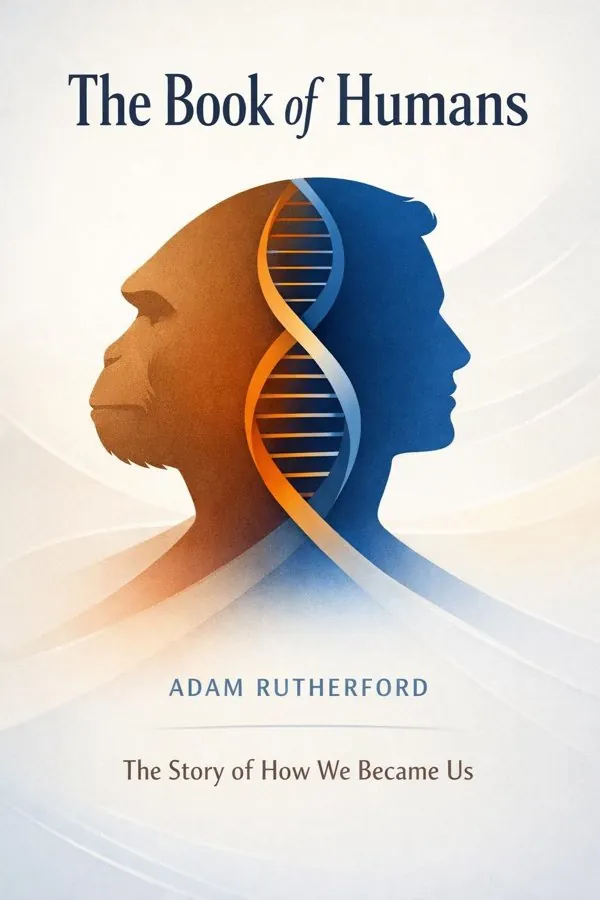
The Book of Humans: The Story of How We Became Us: Summary & Key Insights
 10 min9 chaptersAudio available
Key Takeaways from The Book of Humans: The Story of How We Became Us
One of the book’s most provocative ideas is that humans are special, but not in the simple, triumphant way we often imagine.
A powerful insight running through Rutherford’s book is that evolution is not an engineer aiming for perfection.
A deeply engaging theme in the book is that there is no single natural blueprint for human sex, romance, or family life.
A striking idea in The Book of Humans is that our species rose not simply through strength or ruthless competition, but through unusually rich forms of cooperation.
Genes matter, but they are not the only way humans inherit the past.
What Is The Book of Humans: The Story of How We Became Us About?
The Book of Humans: The Story of How We Became Us by Adam Rutherford is a life_science book. What makes humans different from every other animal is not a single trait, but a strange and powerful combination of biology, behavior, culture, and chance. In The Book of Humans, geneticist and science writer Adam Rutherford examines the familiar stories we tell about ourselves and asks whether they are actually true. Are humans naturally monogamous? Did language, intelligence, or cooperation suddenly set us apart? Is war deeply embedded in our genes? With wit, skepticism, and deep scientific knowledge, Rutherford explores how evolution shaped us without turning us into simple, predictable creatures. This book matters because it challenges easy myths about “human nature.” Instead of offering a flattering portrait of human exceptionalism, Rutherford shows that many of our prized characteristics exist in other animals too, while some of our most defining habits are messy products of history and social life. The result is a richer, more honest account of who we are. As a trained geneticist and acclaimed science communicator, Rutherford brings together evolutionary biology, anthropology, psychology, and genetics to reveal that becoming human was not a straight line toward superiority, but a complex story of adaptation, cooperation, conflict, sex, and culture.
This FizzRead summary covers all 9 key chapters of The Book of Humans: The Story of How We Became Us in approximately 10 minutes, distilling the most important ideas, arguments, and takeaways from Adam Rutherford's work. Also available as an audio summary and Key Quotes Podcast.
The Book of Humans: The Story of How We Became Us
What makes humans different from every other animal is not a single trait, but a strange and powerful combination of biology, behavior, culture, and chance. In The Book of Humans, geneticist and science writer Adam Rutherford examines the familiar stories we tell about ourselves and asks whether they are actually true. Are humans naturally monogamous? Did language, intelligence, or cooperation suddenly set us apart? Is war deeply embedded in our genes? With wit, skepticism, and deep scientific knowledge, Rutherford explores how evolution shaped us without turning us into simple, predictable creatures.
This book matters because it challenges easy myths about “human nature.” Instead of offering a flattering portrait of human exceptionalism, Rutherford shows that many of our prized characteristics exist in other animals too, while some of our most defining habits are messy products of history and social life. The result is a richer, more honest account of who we are. As a trained geneticist and acclaimed science communicator, Rutherford brings together evolutionary biology, anthropology, psychology, and genetics to reveal that becoming human was not a straight line toward superiority, but a complex story of adaptation, cooperation, conflict, sex, and culture.
Who Should Read The Book of Humans: The Story of How We Became Us?
This book is perfect for anyone interested in life_science and looking to gain actionable insights in a short read. Whether you're a student, professional, or lifelong learner, the key ideas from The Book of Humans: The Story of How We Became Us by Adam Rutherford will help you think differently.
- ✓Readers who enjoy life_science and want practical takeaways
- ✓Professionals looking to apply new ideas to their work and life
- ✓Anyone who wants the core insights of The Book of Humans: The Story of How We Became Us in just 10 minutes
Want the full summary?
Get instant access to this book summary and 100K+ more with Fizz Moment.
Get Free SummaryAvailable on App Store • Free to download
Key Chapters
One of the book’s most provocative ideas is that humans are special, but not in the simple, triumphant way we often imagine. We like to believe that language, intelligence, morality, and culture clearly separate us from the rest of life. Rutherford argues that this story is too neat. Many traits we call uniquely human exist in partial or surprising forms in other species. Chimpanzees form political alliances, crows solve problems, whales transmit learned behaviors, and meerkats teach their young. The difference is often one of degree, combination, and scale rather than absolute novelty.
That does not mean humans are ordinary in every respect. What makes us remarkable is how multiple capacities stack together: symbolic thought, cumulative culture, complex cooperation, technological inheritance, and the ability to pass ideas across generations with extraordinary speed. A beaver can build a dam, but it does not improve dam engineering through written manuals, apprenticeships, and global collaboration. Humans do.
This matters because exaggerated claims about human exceptionalism can distort science and ethics. If we assume we stand entirely outside nature, we may ignore biological realities. If we assume our behavior is wholly predetermined by biology, we miss the transforming power of culture. A balanced view helps us better understand education, social policy, animal cognition, and even environmental responsibility.
In daily life, this idea encourages humility. Rather than asking, “What makes us superior?” ask, “What combination of traits allows us to live as we do?” That shift improves how we think about intelligence, relationships, and our responsibilities toward other species.
Actionable takeaway: Replace simplistic ideas of human superiority with a more useful question: which human abilities are shared, which are amplified, and how does culture turn those differences into civilization?
A powerful insight running through Rutherford’s book is that evolution is not an engineer aiming for perfection. It is a blind, opportunistic process that works with what already exists. Humans are not the polished final product of progress. We are a patched-together species full of contradictions, vulnerabilities, and awkward compromises. Our backs hurt because bipedalism came with structural costs. Childbirth is dangerous because large brains and narrow pelvises are in tension. Our teeth often do not fit well in our jaws. We are clever enough to build cities, yet emotionally reactive enough to be driven by tribal fears and status competition.
This perspective corrects a common misunderstanding. People often talk about evolution as if it creates ideal solutions. In reality, it favors traits that are “good enough” to reproduce in a particular environment. That is why many human features make more sense as historical leftovers and trade-offs than as elegant designs. Even our social behavior reflects compromise: we can cooperate on an immense scale, but we are also prone to jealousy, violence, and self-deception.
Understanding imperfection has practical value. It can improve how we think about health, education, and work. For example, modern sedentary life clashes with bodies shaped for movement. Stress systems useful in short-term danger become harmful when constantly activated by emails, deadlines, and social comparison. Rather than blaming ourselves for failing to function like machines, we can design environments that better fit evolved human needs.
The lesson is not pessimism. Human imperfection is part of the story of adaptation. We are resilient not because we were perfectly designed, but because we can compensate through tools, institutions, medicine, and culture.
Actionable takeaway: When confronting human limitations, stop expecting perfection from biology and start designing habits, workplaces, and communities that account for our evolved trade-offs.
A deeply engaging theme in the book is that there is no single natural blueprint for human sex, romance, or family life. Many societies treat their current norms as biologically inevitable, whether that means monogamy, strict gender roles, or certain forms of parenting. Rutherford challenges this by showing that human reproductive behavior is extraordinarily flexible. Across history and cultures, humans have lived in many arrangements: pair-bonding, polygyny, extended kin networks, cooperative child-rearing, stepfamilies, and socially varied gender expectations.
Biology clearly matters. Sexual reproduction, parental investment, mate choice, and hormonal systems all shape human behavior. But biology does not produce one rigid social script. Humans are a species in which culture powerfully modifies mating systems and domestic life. That is why people can form durable romantic bonds while also displaying infidelity, jealousy, serial partnership, or communal parenting. The evidence from anthropology and comparative biology suggests not a single “natural” pattern, but a repertoire of possibilities constrained by both evolution and circumstance.
This insight is useful because so many public arguments misuse science to justify moral certainty. Claims like “humans are naturally monogamous” or “men are built for one role and women for another” often collapse under closer inspection. Understanding flexibility can foster tolerance and reduce the tendency to pathologize family structures that differ from one’s own.
In practical terms, this means focusing less on whether a family matches some imagined ancestral ideal and more on whether it provides stability, care, safety, and emotional support. Children do not require ideological purity; they require dependable relationships.
Actionable takeaway: Instead of asking whether your relationships look “natural,” ask whether they are honest, supportive, and sustainable for the people involved.
A striking idea in The Book of Humans is that our species rose not simply through strength or ruthless competition, but through unusually rich forms of cooperation. Human beings survive because they share knowledge, divide labor, care for offspring collectively, and coordinate with people beyond immediate kin. This capacity is easy to overlook because modern culture often glorifies individual genius, ambition, and survival-of-the-fittest thinking. Rutherford reminds us that a lone human is relatively weak; a networked human community is astonishingly powerful.
Cooperation begins early in life. Human children are dependent for an unusually long time, which means successful child-rearing often requires more than two parents acting alone. Grandparents, siblings, neighbors, and broader social groups have historically played major roles. This cooperative system likely helped support large brains, long development, and cumulative learning. Over time, the ability to teach, imitate, trust, punish cheaters, and form shared norms allowed humans to scale cooperation far beyond what other animals usually manage.
This does not mean humans are naturally harmonious. We are selective cooperators. We often cooperate intensely within groups while competing against outsiders. Yet even this pattern reveals how central collective organization is to our success. Markets, science, governments, schools, and digital networks all depend on forms of trust and shared rules.
In practical life, this insight should change how we think about achievement. No career, invention, or act of creativity emerges in a vacuum. High-functioning teams, healthy families, and resilient communities are not sentimental add-ons to human life; they are core survival systems.
Actionable takeaway: Invest intentionally in cooperative structures, whether in parenting, work, or community life, because human flourishing depends less on isolated excellence than on reliable collaboration.
Genes matter, but they are not the only way humans inherit the past. One of Rutherford’s most important arguments is that culture functions as a second inheritance system, allowing knowledge, habits, values, and technologies to accumulate across generations. This is a decisive part of how we became human. Biological evolution is slow. Cultural evolution can be astonishingly fast. A genetic adaptation may take thousands of years; a farming method, a legal norm, or a scientific breakthrough can spread within decades or even days.
This cumulative cultural ability transforms everything. We do not each start from zero. A child born today inherits language, tools, institutions, stories, and techniques created by countless people long dead. That means human success cannot be understood through genes alone. Cooking, writing, medicine, religion, money, mathematics, and democracy are not encoded in DNA, yet they shape human life as profoundly as anatomy does.
Rutherford’s point also helps explain why there is no single fixed human nature independent of context. Culture modifies behavior, opportunity, and even biology itself. For example, dairy farming altered selection pressures around lactose tolerance in some populations. Literacy changes cognition. Urban living influences disease patterns and social norms. Culture and biology are not rivals; they are entangled.
For modern readers, this idea has practical relevance in parenting, leadership, and education. If culture is an inheritance system, then what we normalize becomes part of the developmental environment for others. The habits of a household, workplace, or nation become invisible scaffolding for future behavior.
Actionable takeaway: Treat the norms you pass on—how you speak, teach, cooperate, and solve problems—as a powerful inheritance, because culture shapes lives long after individual actions fade.
It is tempting to explain war, cruelty, and domination by saying humans are simply violent by nature. Rutherford treats that claim with needed nuance. Violence is undeniably part of the human story. We are capable of aggression, revenge, coercion, and organized conflict on scales unmatched in the animal kingdom. But to say violence exists in our species is not to say it is our sole or inevitable essence. Humans are also capable of restraint, law, empathy, negotiation, and peacebuilding. The same species that invents weapons also invents ethics, courts, and humanitarian norms.
The key is to understand violence as emerging from a mix of evolved capacities and social conditions. Status competition, territoriality, fear of outsiders, and group loyalty may have deep roots. Yet their expression depends heavily on culture, institutions, economics, and leadership. Some societies have been far more violent than others. Rates of homicide, warfare, and domestic abuse can rise or fall dramatically depending on norms and structures. That variation is powerful evidence against biological fatalism.
This idea is practically important because bad explanations produce bad politics. If violence is treated as unavoidable, prevention seems pointless. If it is treated as entirely artificial, policymakers may ignore recurring features of human psychology. A better approach accepts our risk factors while building institutions that reduce opportunities for escalation.
On a personal level, the same lesson applies to conflict. Anger may be natural, but acting destructively is not inevitable. Reflection, mediation, and well-designed systems can redirect dangerous impulses.
Actionable takeaway: Treat aggression as a real human capacity that must be managed, not excused—by creating norms, incentives, and institutions that reward cooperation over domination.
One of the most refreshing aspects of Rutherford’s book is his insistence that many stories about human nature are themselves cultural artifacts. We often inherit neat explanations: men hunted while women gathered, religion evolved for one simple reason, civilization emerged in a straightforward line, or certain modern behaviors directly mirror life on the prehistoric savannah. Rutherford shows that these narratives are often oversimplified, selective, or unsupported by the evidence.
This matters because stories about origins are rarely neutral. They are used to justify present-day assumptions about gender, power, race, class, and morality. If people believe a social arrangement is ancient and biologically ordained, they may treat it as beyond criticism. But evolutionary history is messy, and the archaeological record is fragmentary. That uncertainty should make us cautious, not cynical. Good science does not eliminate mystery; it narrows plausible explanations and resists ideological certainty.
The practical value of this idea is intellectual self-defense. It encourages readers to question claims that begin with phrases like “humans evolved to…” especially when those claims conveniently support current prejudices. Evolutionary explanations can be illuminating, but they are often abused when detached from evidence.
In workplaces, politics, and family debates, this means distinguishing between what is common, what is adaptive in one context, and what is morally desirable. A behavior may have roots in our past without being wise for our future.
Actionable takeaway: Whenever a claim about “human nature” is used to justify a social rule or stereotype, pause and ask what evidence supports it—and whose interests the story serves.
The book’s deepest lesson is that no single discipline can explain what humans are. Genetics alone cannot account for morality, art, institutions, or love. Anthropology alone cannot explain our physiology. Psychology alone cannot reconstruct our evolutionary past. Rutherford’s approach is intentionally synthetic: to understand how we became us, we need biology, archaeology, evolutionary theory, social science, and history working together.
This complexity can feel unsatisfying because people prefer clean answers. We want one trait that made us human, one moment when civilization began, one law that explains behavior. But human beings are products of layered processes: anatomy shaped by selection, minds shaped by development, identities shaped by culture, and societies shaped by feedback between technology and values. The inability to reduce humanity to a single cause is not a weakness of the explanation. It is the truth of the subject.
This has broad practical significance. Whether discussing mental health, education, inequality, or ethics, simplistic explanations usually fail. A student’s performance is not only intelligence; it is also nutrition, family stability, expectations, language exposure, schooling, and opportunity. A society’s violence is not just genetics or economics; it is also institutions, history, and narratives.
Rutherford’s broader message is that complexity should inspire curiosity rather than paralysis. Humans are hard to explain precisely because we are dynamic creatures who reshape our own environments and then adapt to them.
Actionable takeaway: Resist one-cause explanations for human behavior, and look instead for interacting biological, social, and historical factors before forming strong conclusions.
All Chapters in The Book of Humans: The Story of How We Became Us
About the Author
Adam Rutherford is a British geneticist, author, and science broadcaster known for translating complex ideas in biology and evolution into engaging, accessible writing. Trained in genetics, he has built a distinguished career at the intersection of research and public communication, writing for major publications and presenting programs on radio and television. His work often focuses on heredity, human evolution, race, and the ways science is misunderstood in public debate. Rutherford is widely admired for combining scientific rigor with wit, skepticism, and narrative clarity. In books such as The Book of Humans, he challenges simplistic explanations of who we are and how we got here, helping readers see human nature as a product of both biology and culture rather than myth or ideology.
Get This Summary in Your Preferred Format
Read or listen to the The Book of Humans: The Story of How We Became Us summary by Adam Rutherford anytime, anywhere. FizzRead offers multiple formats so you can learn on your terms — all free.
Available formats: App · Audio · PDF · EPUB — All included free with FizzRead
Download The Book of Humans: The Story of How We Became Us PDF and EPUB Summary
Key Quotes from The Book of Humans: The Story of How We Became Us
“One of the book’s most provocative ideas is that humans are special, but not in the simple, triumphant way we often imagine.”
“A powerful insight running through Rutherford’s book is that evolution is not an engineer aiming for perfection.”
“A deeply engaging theme in the book is that there is no single natural blueprint for human sex, romance, or family life.”
“A striking idea in The Book of Humans is that our species rose not simply through strength or ruthless competition, but through unusually rich forms of cooperation.”
“Genes matter, but they are not the only way humans inherit the past.”
Frequently Asked Questions about The Book of Humans: The Story of How We Became Us
The Book of Humans: The Story of How We Became Us by Adam Rutherford is a life_science book that explores key ideas across 9 chapters. What makes humans different from every other animal is not a single trait, but a strange and powerful combination of biology, behavior, culture, and chance. In The Book of Humans, geneticist and science writer Adam Rutherford examines the familiar stories we tell about ourselves and asks whether they are actually true. Are humans naturally monogamous? Did language, intelligence, or cooperation suddenly set us apart? Is war deeply embedded in our genes? With wit, skepticism, and deep scientific knowledge, Rutherford explores how evolution shaped us without turning us into simple, predictable creatures. This book matters because it challenges easy myths about “human nature.” Instead of offering a flattering portrait of human exceptionalism, Rutherford shows that many of our prized characteristics exist in other animals too, while some of our most defining habits are messy products of history and social life. The result is a richer, more honest account of who we are. As a trained geneticist and acclaimed science communicator, Rutherford brings together evolutionary biology, anthropology, psychology, and genetics to reveal that becoming human was not a straight line toward superiority, but a complex story of adaptation, cooperation, conflict, sex, and culture.
More by Adam Rutherford
You Might Also Like
The Selfish Gene
Richard Dawkins
10 min
Awakenings
Oliver Sacks
10 min
Parasite Rex: Inside the Bizarre World of Nature's Most Dangerous Creatures
Carl Zimmer
10 min
The Atlas of Life on Earth
Various
10 min
The Horse
Wendy Williams
10 min
What Makes Us Human?
Charles Pasternak
10 minBrowse by Category
Ready to read The Book of Humans: The Story of How We Became Us?
Get the full summary and 100K+ more books with Fizz Moment.