
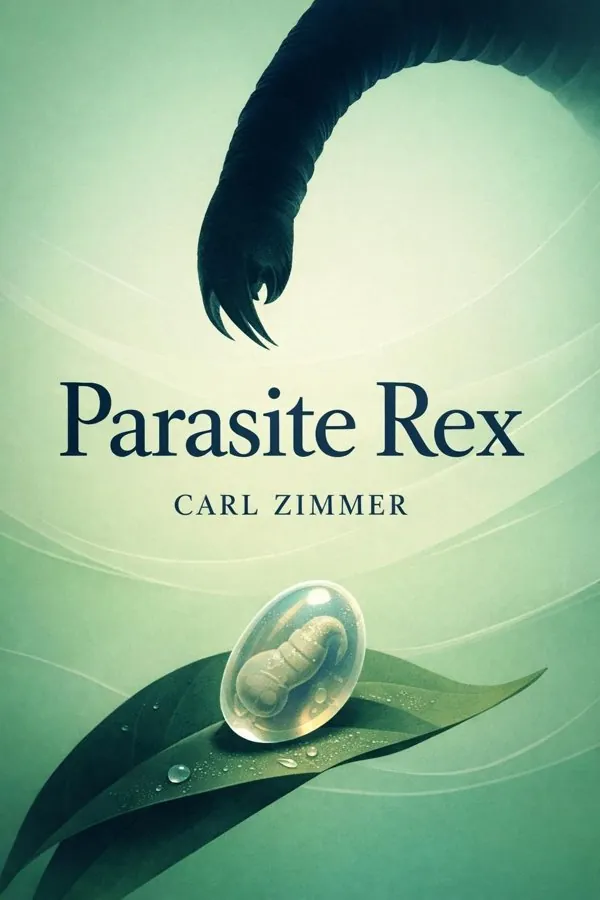
Parasite Rex: Inside the Bizarre World of Nature's Most Dangerous Creatures: Summary & Key Insights
by Carl Zimmer
 10 min9 chaptersAudio available
Key Takeaways from Parasite Rex: Inside the Bizarre World of Nature's Most Dangerous Creatures
The most influential creatures in an ecosystem are not always the biggest predators or the most visible plants.
Nature does not reward moral beauty; it rewards successful reproduction.
A parasite’s life cycle can read like science fiction, yet it is often the key to understanding how disease spreads and persists.
One of the most unsettling ideas in Parasite Rex is that a parasite may not only live inside a host but also influence what that host does.
Parasites provoke disgust, and for good reason: they invade bodies, consume tissues, and can cause misery or death.
What Is Parasite Rex: Inside the Bizarre World of Nature's Most Dangerous Creatures About?
Parasite Rex: Inside the Bizarre World of Nature's Most Dangerous Creatures by Carl Zimmer is a life_science book. Parasites are usually treated as the villains of nature: hidden, repulsive organisms that steal life from their hosts. In Parasite Rex, science writer Carl Zimmer turns that instinctive disgust into fascination. He takes readers into a largely unseen world of tapeworms, flukes, wasps, protozoa, fungi, and other organisms that survive by infiltrating, exploiting, and often manipulating other living beings. The result is not just a catalog of horrors, but a powerful exploration of evolution, ecology, medicine, and the delicate balance of life itself. What makes the book matter is Zimmer’s central argument: parasites are not biological side notes. They are major forces that shape species, ecosystems, behavior, and even human history. By understanding parasites, we better understand immunity, disease, adaptation, and the hidden connections between organisms. Zimmer writes with the narrative energy of a storyteller and the rigor of an accomplished science journalist. Known for making complex biology vivid and accessible, he combines field reporting, interviews with researchers, and evolutionary insight to reveal a strange truth: some of the most dangerous creatures on Earth are also among the most important.
This FizzRead summary covers all 9 key chapters of Parasite Rex: Inside the Bizarre World of Nature's Most Dangerous Creatures in approximately 10 minutes, distilling the most important ideas, arguments, and takeaways from Carl Zimmer's work. Also available as an audio summary and Key Quotes Podcast.
Parasite Rex: Inside the Bizarre World of Nature's Most Dangerous Creatures
Parasites are usually treated as the villains of nature: hidden, repulsive organisms that steal life from their hosts. In Parasite Rex, science writer Carl Zimmer turns that instinctive disgust into fascination. He takes readers into a largely unseen world of tapeworms, flukes, wasps, protozoa, fungi, and other organisms that survive by infiltrating, exploiting, and often manipulating other living beings. The result is not just a catalog of horrors, but a powerful exploration of evolution, ecology, medicine, and the delicate balance of life itself.
What makes the book matter is Zimmer’s central argument: parasites are not biological side notes. They are major forces that shape species, ecosystems, behavior, and even human history. By understanding parasites, we better understand immunity, disease, adaptation, and the hidden connections between organisms.
Zimmer writes with the narrative energy of a storyteller and the rigor of an accomplished science journalist. Known for making complex biology vivid and accessible, he combines field reporting, interviews with researchers, and evolutionary insight to reveal a strange truth: some of the most dangerous creatures on Earth are also among the most important.
Who Should Read Parasite Rex: Inside the Bizarre World of Nature's Most Dangerous Creatures?
This book is perfect for anyone interested in life_science and looking to gain actionable insights in a short read. Whether you're a student, professional, or lifelong learner, the key ideas from Parasite Rex: Inside the Bizarre World of Nature's Most Dangerous Creatures by Carl Zimmer will help you think differently.
- ✓Readers who enjoy life_science and want practical takeaways
- ✓Professionals looking to apply new ideas to their work and life
- ✓Anyone who wants the core insights of Parasite Rex: Inside the Bizarre World of Nature's Most Dangerous Creatures in just 10 minutes
Want the full summary?
Get instant access to this book summary and 100K+ more with Fizz Moment.
Get Free SummaryAvailable on App Store • Free to download
Key Chapters
The most influential creatures in an ecosystem are not always the biggest predators or the most visible plants. Often, they are the organisms living inside others. One of Carl Zimmer’s most important insights is that parasites are not marginal oddities but dominant evolutionary players. They inhabit nearly every habitat, infect nearly every branch of life, and exert constant pressure on their hosts. In sheer variety and abundance, parasites represent one of the most successful ways of life on Earth.
Parasites survive by drawing energy, shelter, or reproductive advantage from a host. That dependence creates an intense biological relationship. Hosts evolve defenses such as immune responses, grooming habits, behavioral avoidance, and physiological barriers. Parasites respond with stealth, chemical tricks, altered life cycles, and immune evasion. This creates a continuous arms race that shapes both sides. Instead of seeing evolution as a simple contest between predators and prey, Zimmer shows that many of nature’s deepest changes are driven by infection.
This perspective changes how we view health and ecology. A healthy wolf population, a fishery, a tropical forest, or a human city is also a network of parasites and hosts. Public health systems, veterinary medicine, farming, and conservation all depend on recognizing this hidden layer. For example, controlling mosquito-borne disease means studying the parasite, the insect vector, the host, and the environmental conditions that connect them.
The broader practical lesson is intellectual humility. Much of life is governed by forces we do not readily see. Whether you are thinking about disease outbreaks, wildlife management, or your own health, it helps to ask what hidden biological relationships are influencing the surface picture.
Actionable takeaway: Train yourself to look beyond obvious causes and consider invisible systems, especially when thinking about health, behavior, and environmental change.
Nature does not reward moral beauty; it rewards successful reproduction. Parasites make this fact impossible to ignore. Zimmer uses them to strip away sentimental ideas about evolution and replace them with a more accurate understanding of natural selection. Parasites thrive not because they are admirable in human terms, but because evolution has refined strategies that work.
These strategies can be astonishingly specialized. Some parasites require multiple hosts at different life stages, moving from snail to fish to bird with precise timing. Others produce enormous numbers of offspring to compensate for low odds of success. Still others can remain dormant until the right host appears. Evolution shapes their bodies, behaviors, and chemistry around one central problem: how to enter, exploit, and leave a host effectively enough to reproduce.
This logic helps readers understand why parasites often seem grotesque or excessively complex. Their bizarre forms are not accidents. They are solutions. A tapeworm without a digestive tract is not incomplete; it has evolved to absorb nutrients directly from its host. A parasitic wasp that lays eggs inside another insect is not cruel; it is highly adapted. Looking at life this way encourages a more scientific and less emotional interpretation of biological design.
There is also a practical application for medicine and public policy. If we want to control parasites, we must stop assuming they behave in simple or predictable ways. Control measures work best when they target the parasite’s actual evolutionary incentives and life cycle bottlenecks. Interrupting transmission routes, reducing breeding opportunities, or altering host exposure can be more effective than reacting only after illness appears.
Actionable takeaway: When confronting any biological problem, focus on function over appearance and ask what strategy evolution is rewarding.
One of the most unsettling ideas in Parasite Rex is that a parasite may not only live inside a host but also influence what that host does. Zimmer explores cases in which parasites alter movement, feeding, fear responses, reproduction, or social behavior in ways that improve the parasite’s chances of survival and transmission. This is one of the clearest demonstrations that behavior itself can be an evolutionary battleground.
A classic example involves parasites that need one host to be eaten by another. If they can make an infected animal more reckless, conspicuous, or slow to escape, they increase the odds of reaching the next stage of their life cycle. Other parasites manipulate immune systems or hormones, indirectly changing the host’s actions. The host remains alive, but its biological priorities have been subtly rewritten.
This theme matters beyond shock value. It expands our understanding of what behavior is. We often think of actions as expressions of an organism’s own interests, yet parasites reveal that behavior can be shaped by competing biological agendas. For science, this opens important questions in neuroscience, immunology, and evolutionary biology. For the public, it encourages caution about simplistic explanations for animal or human behavior in disease contexts.
There are also practical implications. Farmers, veterinarians, and conservationists may need to monitor behavioral changes as early indicators of infection. Public health researchers can study how pathogens affect cognition, mood, or risk-taking. Even if most human behavior is not parasite-driven, the principle remains useful: biology can influence decision-making in unseen ways.
Actionable takeaway: Treat unusual or sudden behavioral shifts in animals, ecosystems, or health systems as possible biological signals worth investigating early.
Parasites provoke disgust, and for good reason: they invade bodies, consume tissues, and can cause misery or death. But Zimmer argues that disgust is a poor guide to scientific importance. Because parasites are easy to dismiss as revolting exceptions, we often fail to appreciate how central they are to the story of life. Emotional reactions can hide intellectual value.
The book repeatedly invites readers to move from revulsion to curiosity. When we do, we begin to see that parasites are elegant examples of adaptation. They reveal how immune systems work, how ecosystems are connected, how species coevolve, and how diseases emerge. They also remind us that moral categories like clean and dirty, natural and unnatural, rarely fit biology well. Nature is full of exploitation, dependency, and compromise.
This shift in perspective has real-world applications. In medicine, stigma can interfere with treatment and prevention. Diseases associated with poverty, poor sanitation, sexuality, or visible infestation are often burdened by shame, making people less likely to seek care. In education, students may tune out topics that seem gross rather than intellectually rich. In conservation, fear of parasites can lead to simplistic eradication thinking without considering ecosystem effects.
Zimmer’s writing models a better response: emotional honesty paired with scientific discipline. We can acknowledge the horror of parasitic disease while still asking precise questions about mechanism, adaptation, and ecological role. That balance is essential for good science communication and better policy.
Actionable takeaway: When disgust or fear shapes your reaction to a biological topic, pause and ask what understanding you might be missing because of that emotion.
It is tempting to think of parasites as merely destructive, but Zimmer shows that they can help structure entire ecosystems. By weakening some hosts, regulating population sizes, and influencing competition between species, parasites can affect which organisms thrive and which decline. In other words, parasites are not just passengers in nature; they are active participants in ecological balance.
A parasite that disproportionately affects a dominant species can prevent that species from overwhelming others, preserving diversity. In food webs, parasites connect species that might otherwise seem unrelated. They can influence predator-prey dynamics, reproductive success, migration, and habitat use. Some ecologists now recognize that leaving parasites out of ecosystem models means ignoring a major source of regulation and complexity.
This matters for conservation and environmental management. Reintroducing animals, moving species between habitats, or altering landscapes can change parasite dynamics in unexpected ways. A well-intentioned intervention may expose naïve hosts to new pathogens or remove natural checks that once stabilized a community. Climate change can also shift ranges of hosts and vectors, bringing parasite relationships into new regions.
For readers, the lesson is that health and diversity are linked. An ecosystem with no parasites is not necessarily a healthy ecosystem; it may be an impossible one. The goal is not simplistic eradication of all parasitic life but informed management of harmful outbreaks while respecting ecological reality. This is especially important in fisheries, livestock systems, wildlife reserves, and urban environments where humans interact closely with other species.
Actionable takeaway: Support ecological and public-health decisions that account for whole-system effects rather than assuming every parasite can be removed without consequences.
Many people think of disease as a personal event: one body gets infected, a doctor prescribes treatment, and the problem is solved. Parasite Rex challenges that narrow view. Parasites force us to see health ecologically. Infection depends on hosts, vectors, water, climate, sanitation, animal reservoirs, social behavior, and evolutionary change. Human medicine, in this sense, is inseparable from environmental understanding.
Zimmer illustrates how parasitic diseases are often embedded in infrastructure and inequality. Poor drainage can support mosquitoes. Contaminated water can spread worms and protozoa. Crowded housing, weak healthcare systems, and disrupted ecosystems can sustain transmission. This means that treating individual patients, while essential, addresses only part of the problem. Long-term control requires better systems.
This insight is highly practical today. Global travel, urbanization, deforestation, and warming climates increase opportunities for parasites and vectors to expand their range. Public health strategies must therefore combine biology with engineering, education, and governance. Bed nets, sewage systems, veterinary surveillance, and habitat management can be as important as drugs. The same principle applies at smaller scales: pet care, food safety, travel precautions, and insect control all depend on understanding ecological context.
Zimmer’s broader contribution is to make readers think in layers. A symptom is not just a symptom; it may be the endpoint of a chain of environmental and social conditions. Better health comes from seeing those conditions clearly and intervening upstream.
Actionable takeaway: Approach health problems as ecological systems, and prioritize prevention measures that change the conditions allowing infection to spread.
The immune system may feel like a fixed defense mechanism, but Zimmer shows it is better understood as part of an ongoing war shaped by parasites over millions of years. Parasites survive only if they can evade, manipulate, suppress, or outlast host defenses. Hosts survive only if they can detect and limit these intrusions. The result is a dynamic coevolutionary struggle written into bodies themselves.
This perspective helps explain why immune responses can be so complicated. Parasites often present moving targets. They may change surface proteins, hide within cells, mimic host molecules, or cloak themselves in host-derived substances. Some trigger weak immune reactions; others provoke damaging overreactions that harm the host as much as the invader. These interactions have likely influenced the evolution of immune diversity across species, including humans.
Understanding this battlefield has practical benefits. It clarifies why vaccines for some parasites are harder to develop than vaccines for many viruses or bacteria. It also explains why treatment can require combination approaches and why reinfection is common in some settings. In research, parasite studies have contributed to immunology by revealing the subtleties of inflammation, tolerance, and immune memory.
For ordinary readers, the lesson is that health is not simply about killing germs. It is about managing a relationship between host defenses and evolving opponents. Overuse of treatments, poor adherence, and neglect of preventive measures can all give parasites more opportunities to adapt. Respecting evolutionary pressure leads to better decision-making.
Actionable takeaway: Think of immunity as a dynamic system and support health habits, treatments, and policies that reduce evolutionary opportunities for parasites to persist and adapt.
Perhaps the book’s deepest achievement is philosophical. By the end of Parasite Rex, readers are likely to see life differently. Parasites challenge comforting assumptions about independence, individuality, and progress. No organism exists entirely on its own. Bodies are habitats, ecosystems are webs of exploitation and cooperation, and survival often depends on relationships that are intimate, unequal, and invisible.
Zimmer does not present this as a reason for despair. Instead, it is a reason for wonder. Parasites reveal the creativity of evolution in extreme form. They show how life can colonize almost any opportunity, however narrow or unpleasant it may seem. They also remind us that intelligence begins with attention. To understand the world, we must look where we would rather not look.
This change in outlook has practical value beyond biology. It encourages systems thinking, tolerance for complexity, and skepticism toward simplistic narratives. In science, business, medicine, and public policy, the visible story is often sustained by hidden interactions. Parasites become a metaphor as well as a biological reality: what appears secondary may actually be central.
Readers who absorb this lesson will likely become more careful observers and better thinkers. They will ask what unseen relationships are driving outcomes, what incentives shape behavior, and how adaptation works under pressure. Those are valuable habits in any field.
Actionable takeaway: Use parasites as a mental model for deeper thinking by asking, in any complex system, what hidden dependencies and pressures are shaping the result.
All Chapters in Parasite Rex: Inside the Bizarre World of Nature's Most Dangerous Creatures
About the Author
Carl Zimmer is an award-winning American science writer best known for translating complex topics in biology and medicine into clear, compelling prose. His work often focuses on evolution, heredity, parasites, microbes, and the hidden systems that shape life. Over the course of his career, he has written influential books and contributed to major publications, earning a reputation as one of the most trusted voices in popular science. Zimmer is especially admired for combining rigorous research with vivid storytelling, helping general readers engage with subjects that might otherwise feel intimidating or obscure. In Parasite Rex, he brings that talent to the strange world of parasitism, revealing its scientific importance with clarity, curiosity, and narrative force.
Get This Summary in Your Preferred Format
Read or listen to the Parasite Rex: Inside the Bizarre World of Nature's Most Dangerous Creatures summary by Carl Zimmer anytime, anywhere. FizzRead offers multiple formats so you can learn on your terms — all free.
Available formats: App · Audio · PDF · EPUB — All included free with FizzRead
Download Parasite Rex: Inside the Bizarre World of Nature's Most Dangerous Creatures PDF and EPUB Summary
Key Quotes from Parasite Rex: Inside the Bizarre World of Nature's Most Dangerous Creatures
“The most influential creatures in an ecosystem are not always the biggest predators or the most visible plants.”
“Nature does not reward moral beauty; it rewards successful reproduction.”
“A parasite’s life cycle can read like science fiction, yet it is often the key to understanding how disease spreads and persists.”
“One of the most unsettling ideas in Parasite Rex is that a parasite may not only live inside a host but also influence what that host does.”
“Parasites provoke disgust, and for good reason: they invade bodies, consume tissues, and can cause misery or death.”
Frequently Asked Questions about Parasite Rex: Inside the Bizarre World of Nature's Most Dangerous Creatures
Parasite Rex: Inside the Bizarre World of Nature's Most Dangerous Creatures by Carl Zimmer is a life_science book that explores key ideas across 9 chapters. Parasites are usually treated as the villains of nature: hidden, repulsive organisms that steal life from their hosts. In Parasite Rex, science writer Carl Zimmer turns that instinctive disgust into fascination. He takes readers into a largely unseen world of tapeworms, flukes, wasps, protozoa, fungi, and other organisms that survive by infiltrating, exploiting, and often manipulating other living beings. The result is not just a catalog of horrors, but a powerful exploration of evolution, ecology, medicine, and the delicate balance of life itself. What makes the book matter is Zimmer’s central argument: parasites are not biological side notes. They are major forces that shape species, ecosystems, behavior, and even human history. By understanding parasites, we better understand immunity, disease, adaptation, and the hidden connections between organisms. Zimmer writes with the narrative energy of a storyteller and the rigor of an accomplished science journalist. Known for making complex biology vivid and accessible, he combines field reporting, interviews with researchers, and evolutionary insight to reveal a strange truth: some of the most dangerous creatures on Earth are also among the most important.
More by Carl Zimmer
Soul Made Flesh: The Discovery of the Brain—and How It Changed the World
Carl Zimmer
10 min
She Has Her Mother’s Laugh: The Powers, Perversions, and Potential of Heredity
Carl Zimmer
10 min
The Tangled Bank: An Introduction to Evolution
Carl Zimmer
10 min
Evolution: The Triumph of an Idea
Carl Zimmer
10 minYou Might Also Like

The Selfish Gene
Richard Dawkins
10 min
Awakenings
Oliver Sacks
10 min
The Atlas of Life on Earth
Various
10 min
The Book of Humans: The Story of How We Became Us
Adam Rutherford
10 min
The Horse
Wendy Williams
10 min
What Makes Us Human?
Charles Pasternak
10 minBrowse by Category
Ready to read Parasite Rex: Inside the Bizarre World of Nature's Most Dangerous Creatures?
Get the full summary and 100K+ more books with Fizz Moment.