
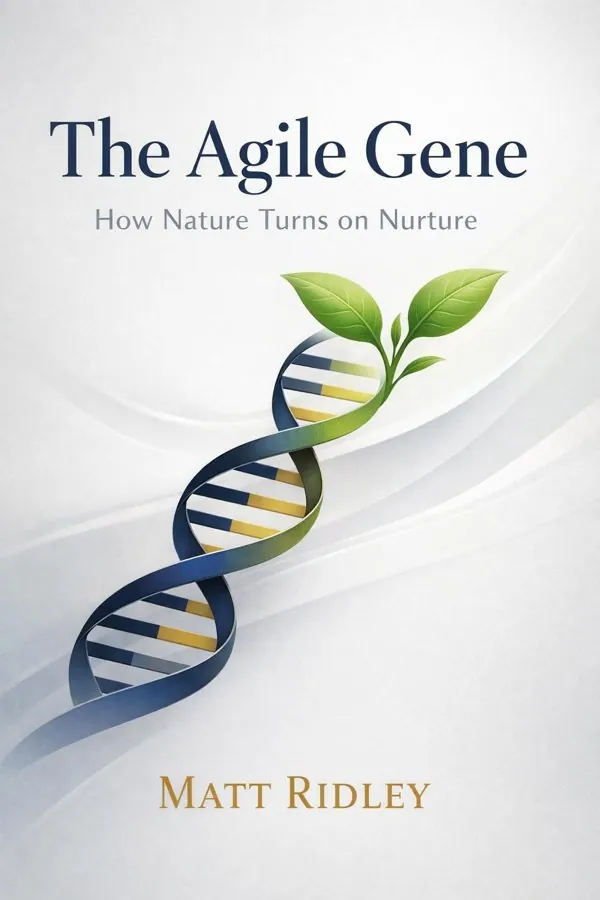
The Agile Gene: How Nature Turns on Nurture: Summary & Key Insights
by Matt Ridley
 10 min9 chaptersAudio available
What Is The Agile Gene: How Nature Turns on Nurture About?
The Agile Gene: How Nature Turns on Nurture by Matt Ridley is a popular_sci book spanning 9 pages. In this influential work, Matt Ridley examines how genes and environment interact to shape human behavior and identity. He argues that nature and nurture are not opposing forces but partners in the development of every individual. Drawing on genetics, neuroscience, and psychology, Ridley explains how genes respond to experience, offering a nuanced view of what makes us human.
This FizzRead summary covers all 9 key chapters of The Agile Gene: How Nature Turns on Nurture in approximately 10 minutes, distilling the most important ideas, arguments, and takeaways from Matt Ridley's work. Also available as an audio summary and Key Quotes Podcast.
The Agile Gene: How Nature Turns on Nurture
In this influential work, Matt Ridley examines how genes and environment interact to shape human behavior and identity. He argues that nature and nurture are not opposing forces but partners in the development of every individual. Drawing on genetics, neuroscience, and psychology, Ridley explains how genes respond to experience, offering a nuanced view of what makes us human.
Who Should Read The Agile Gene: How Nature Turns on Nurture?
This book is perfect for anyone interested in popular_sci and looking to gain actionable insights in a short read. Whether you're a student, professional, or lifelong learner, the key ideas from The Agile Gene: How Nature Turns on Nurture by Matt Ridley will help you think differently.
- ✓Readers who enjoy popular_sci and want practical takeaways
- ✓Professionals looking to apply new ideas to their work and life
- ✓Anyone who wants the core insights of The Agile Gene: How Nature Turns on Nurture in just 10 minutes
Want the full summary?
Get instant access to this book summary and 100K+ more with Fizz Moment.
Get Free SummaryAvailable on App Store • Free to download
Key Chapters
At the start of the twentieth century, scientific thought leaned heavily toward genetic determinism. Thinkers believed that human traits, from intelligence to morality, were etched permanently into our genes. The discovery of DNA’s structure and the mapping of genomes seemed to confirm this view. If heredity governed so much—eye color, susceptibility to disease—couldn’t it also dictate psychology and behavior? Yet as biologists, psychologists, and anthropologists dug deeper, cracks appeared in that certainty.
I trace this shift in perspective through figures like Francis Galton, who pioneered the measurement of heredity, and his successors in behavioral genetics who overemphasized genes as destiny. Opposing them were thinkers such as John Watson and later developmental psychologists, who insisted experience sculpted the mind. For decades this debate polarized science into two camps. However, the discoveries of molecular biology and neuroscience gradually unveiled a third path: genes do not act in isolation but in constant conversation with the environment.
Consider Konrad Lorenz’s work on imprinting in geese, or the twin studies that showed how even identical genetic makeup leads to different life outcomes depending on upbringing. These examples illuminated a profound fact: genes provide possibilities, not predeterminations. Science moved from a simple, deterministic model to a dynamic one, where what mattered was not just what genes a person had, but how those genes were expressed in the context of life experience. The intellectual journey from Galton to modern epigenetics is the backbone of this transformation—and it sets the scene for the flexible, responsive view of heredity presented throughout this book.
To understand the agility of genes, we must first see them not as static instruction manuals but as sensitive, reactive entities. Genes can be switched on, modified, or silenced by environmental factors—chemicals, experiences, emotions, even social relationships. Within each human cell lies a flexible machinery that reads genetic information according to context. This ability allows organisms to adapt swiftly and survive changing conditions.
A striking example comes from the way stress affects cortisol production. Chronic emotional strain can alter the expression of genes controlling hormonal systems, which, in turn, impacts immunity and behavior. Similarly, nurturing in early childhood—such as attentive parental care—can activate genes that regulate serotonin receptors, influencing emotional stability throughout life. These are not metaphors but established molecular facts. The environment literally changes the way our genes behave.
This responsiveness makes the genome more like a musician than a mechanic. It improvises, responding to cues from surroundings and experiences. Without this flexibility, evolution itself would stall, unable to bridge the gap between biological inheritance and adaptation. I often emphasize that genes are not dictators; they are facilitators. They make us capable of responding, learning, and altering course. Recognizing this reality dissolves the rigid boundaries that once separated nature and nurture—it reveals life as a symphony of interaction.
+ 7 more chapters — available in the FizzRead app
All Chapters in The Agile Gene: How Nature Turns on Nurture
About the Author
Matt Ridley is a British science writer and journalist known for his accessible explorations of genetics, evolution, and human behavior. His books, including 'The Red Queen' and 'Genome', have been widely acclaimed for making complex scientific ideas engaging to general readers.
Get This Summary in Your Preferred Format
Read or listen to the The Agile Gene: How Nature Turns on Nurture summary by Matt Ridley anytime, anywhere. FizzRead offers multiple formats so you can learn on your terms — all free.
Available formats: App · Audio · PDF · EPUB — All included free with FizzRead
Download The Agile Gene: How Nature Turns on Nurture PDF and EPUB Summary
Key Quotes from The Agile Gene: How Nature Turns on Nurture
“At the start of the twentieth century, scientific thought leaned heavily toward genetic determinism.”
“To understand the agility of genes, we must first see them not as static instruction manuals but as sensitive, reactive entities.”
Frequently Asked Questions about The Agile Gene: How Nature Turns on Nurture
The Agile Gene: How Nature Turns on Nurture by Matt Ridley is a popular_sci book that explores key ideas across 9 chapters. In this influential work, Matt Ridley examines how genes and environment interact to shape human behavior and identity. He argues that nature and nurture are not opposing forces but partners in the development of every individual. Drawing on genetics, neuroscience, and psychology, Ridley explains how genes respond to experience, offering a nuanced view of what makes us human.
More by Matt Ridley
Genome: The Autobiography of a Species in 23 Chapters
Matt Ridley
10 min
The Red Queen: Sex and the Evolution of Human Nature
Matt Ridley
10 min
Nature Via Nurture: Genes, Experience, and What Makes Us Human
Matt Ridley
10 min
The Evolution of Everything: How New Ideas Emerge
Matt Ridley
10 minYou Might Also Like

Structures: Or Why Things Don"t Fall Down
J.E. Gordon
10 min
The Road to Wigan Pier
George Orwell
10 min
Bonk: The Curious Coupling of Science and Sex
Mary Roach
10 min
First Bite: How We Learn to Eat
Bee Wilson
10 min
In Pursuit Of The Unknown: 17 Equations That Changed The World
Ian Stewart
10 min
Napoleon's Buttons: 17 Molecules That Changed History
Penny Le Couteur and Jay Burreson
10 minBrowse by Category
Ready to read The Agile Gene: How Nature Turns on Nurture?
Get the full summary and 100K+ more books with Fizz Moment.