
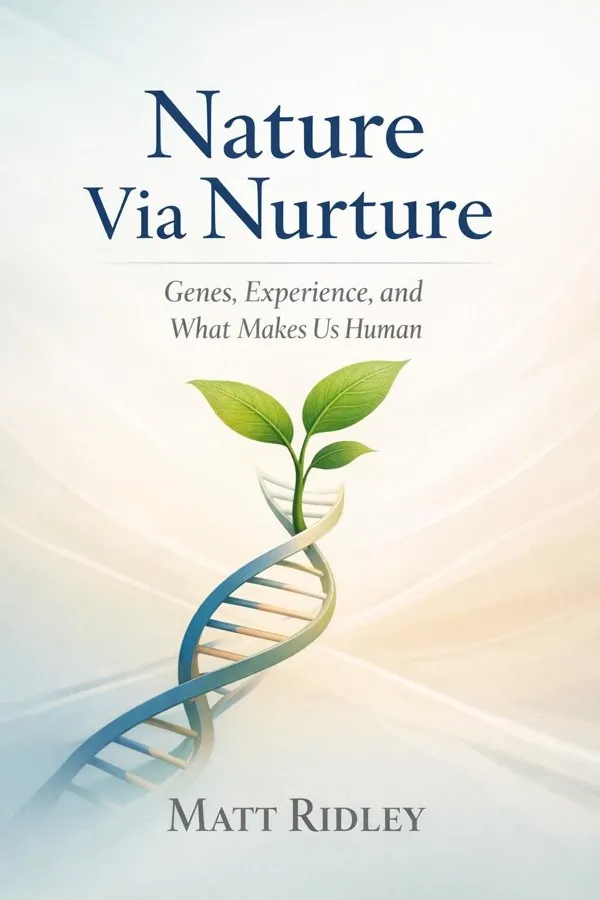
Nature Via Nurture: Genes, Experience, and What Makes Us Human: Summary & Key Insights
by Matt Ridley
 10 min9 chaptersAudio available
Key Takeaways from Nature Via Nurture: Genes, Experience, and What Makes Us Human
Some of the most damaging ideas in science survive because they simplify a messy reality into an easy opposition.
The most important misconception about genes is that they are tiny tyrants issuing orders from within.
A human brain is not simply delivered at birth as a finished product; it is assembled through use.
We often talk about learning as if it floats above biology, but Ridley reminds us that every memory, habit, and skill must be physically encoded in the brain.
At first glance, it may seem that evolution should favor fixed instincts rather than adaptable behavior.
What Is Nature Via Nurture: Genes, Experience, and What Makes Us Human About?
Nature Via Nurture: Genes, Experience, and What Makes Us Human by Matt Ridley is a popular_sci book spanning 8 pages. In Nature Via Nurture, Matt Ridley takes aim at one of the most stubborn false choices in modern thought: are we shaped more by our genes or by our environment? His answer is both elegant and disruptive. Human beings are not the product of nature versus nurture, but of nature through nurture. Genes do not act as rigid instructions that lock in destiny. Instead, they respond to signals from the world, helping organisms adapt, learn, and develop in ways that are deeply influenced by experience. Drawing on genetics, neuroscience, psychology, and evolutionary theory, Ridley shows that heredity and environment are partners in a single developmental process. The book matters because it challenges simplistic beliefs about intelligence, personality, behavior, and responsibility—beliefs that still shape education, parenting, politics, and medicine. Ridley is especially well suited to make this case. As one of the best-known popular science writers on genetics and evolution, he translates technical research into clear, persuasive arguments. The result is a highly readable exploration of what makes us human, and why the old debate has been framed all wrong.
This FizzRead summary covers all 9 key chapters of Nature Via Nurture: Genes, Experience, and What Makes Us Human in approximately 10 minutes, distilling the most important ideas, arguments, and takeaways from Matt Ridley's work. Also available as an audio summary and Key Quotes Podcast.
Nature Via Nurture: Genes, Experience, and What Makes Us Human
In Nature Via Nurture, Matt Ridley takes aim at one of the most stubborn false choices in modern thought: are we shaped more by our genes or by our environment? His answer is both elegant and disruptive. Human beings are not the product of nature versus nurture, but of nature through nurture. Genes do not act as rigid instructions that lock in destiny. Instead, they respond to signals from the world, helping organisms adapt, learn, and develop in ways that are deeply influenced by experience. Drawing on genetics, neuroscience, psychology, and evolutionary theory, Ridley shows that heredity and environment are partners in a single developmental process. The book matters because it challenges simplistic beliefs about intelligence, personality, behavior, and responsibility—beliefs that still shape education, parenting, politics, and medicine. Ridley is especially well suited to make this case. As one of the best-known popular science writers on genetics and evolution, he translates technical research into clear, persuasive arguments. The result is a highly readable exploration of what makes us human, and why the old debate has been framed all wrong.
Who Should Read Nature Via Nurture: Genes, Experience, and What Makes Us Human?
This book is perfect for anyone interested in popular_sci and looking to gain actionable insights in a short read. Whether you're a student, professional, or lifelong learner, the key ideas from Nature Via Nurture: Genes, Experience, and What Makes Us Human by Matt Ridley will help you think differently.
- ✓Readers who enjoy popular_sci and want practical takeaways
- ✓Professionals looking to apply new ideas to their work and life
- ✓Anyone who wants the core insights of Nature Via Nurture: Genes, Experience, and What Makes Us Human in just 10 minutes
Want the full summary?
Get instant access to this book summary and 100K+ more with Fizz Moment.
Get Free SummaryAvailable on App Store • Free to download
Key Chapters
Some of the most damaging ideas in science survive because they simplify a messy reality into an easy opposition. For generations, thinkers treated heredity and environment as rival explanations for human behavior. One camp emphasized inborn traits, instincts, and biological destiny; the other highlighted education, culture, family, and social structure. Ridley begins by showing how this split hardened through the twentieth century, shaping debates about intelligence, mental illness, criminality, talent, and class. Yet the debate was flawed from the start, because it assumed that genes and experience operate independently.
Ridley argues that this framing produced unnecessary confusion. When researchers asked whether a trait was caused by genes or environment, they often ignored that genes require environments to function, and environments affect people through biological systems built by genes. A child’s language ability, for example, depends on an inherited brain capable of learning language, but that capacity only develops through exposure to speech. Likewise, stress may influence mood, but the body’s response to stress depends on inherited neurochemical pathways.
This historical context matters because many modern arguments still rely on the old split. Parents worry they will “cause” every outcome through upbringing. Others assume genes are fixed verdicts. Ridley dismantles both errors by replacing competition with interaction.
A practical way to apply this insight is to stop asking whether a trait is innate or learned and instead ask how biology and experience work together over time. That shift leads to better thinking in parenting, education, and self-understanding. The actionable takeaway: whenever you hear a debate framed as genes versus environment, assume the real answer lies in their interaction.
The most important misconception about genes is that they are tiny tyrants issuing orders from within. Ridley overturns that image. Genes are not master controllers that predetermine each detail of life; they are responsive elements that switch on and off depending on context. A gene’s effect depends on timing, location, chemical signals, and environmental input. In that sense, genes behave less like fixed blueprints and more like instructions activated under particular conditions.
This dynamic view changes how we understand development. The same genome can lead to different outcomes in different environments because genes regulate responses to experience. Consider skin tanning: the genes for pigmentation do not command a constant skin tone regardless of circumstances. They allow the body to respond to sunlight. Similarly, some genes shape how people react to stress, novelty, food, toxins, or social interaction. The environment is not writing on a blank slate; it is triggering built-in capacities for adjustment.
Ridley uses this idea to challenge genetic determinism. If genes are conditional and context-sensitive, then inherited traits are not iron laws. Even when there is a genetic contribution to a behavior or vulnerability, the expression of that trait may vary widely depending on life conditions. This perspective is especially relevant in medicine, where genetic risk for obesity, depression, or addiction can be amplified or reduced by lifestyle, support, and environment.
In everyday life, this means we should treat biological predispositions as tendencies, not destinies. Whether we are thinking about children, health, or our own habits, the better question is not “What do the genes say?” but “What conditions bring certain tendencies out?” The actionable takeaway: replace fatalistic thinking about genes with curiosity about the environments that activate or soften genetic potential.
A human brain is not simply delivered at birth as a finished product; it is assembled through use. Ridley emphasizes developmental plasticity—the brain’s ability to change in structure and function in response to experience. Genes guide the formation of neural circuits, but those circuits are refined, strengthened, or pruned depending on what a person sees, hears, practices, and feels. Development is therefore neither prewritten nor random. It is an interaction between inherited readiness and lived experience.
This is especially clear in early childhood. Infants are born with remarkable capacities to recognize patterns, sounds, and social cues, yet these capacities depend on stimulation to mature fully. Vision develops properly only when the brain receives normal visual input. Language flourishes when children are immersed in speech. Emotional regulation grows through repeated interactions with caregivers. The brain is designed to expect certain inputs from the world and uses them to organize itself.
Plasticity does not mean that anything can be molded into anything else. Ridley rejects that extreme, too. Human beings are not infinitely shapeable. Rather, we are built to be selectively adaptable. A child can learn any natural language, but not every imaginable communication system with equal ease. A person can become musically skilled with practice, but inherited traits may influence sensitivity, timing, or motivation.
The practical lesson is powerful. Homes, schools, and communities matter because repeated experiences leave biological traces. Reading aloud, rich conversation, movement, safety, and emotional stability all shape brain development. Adults also remain plastic, though less dramatically than children. Skills improve with deliberate use; neglected abilities fade.
The actionable takeaway: create environments that repeatedly feed the capacities you want to grow, because the brain develops by responding to what it does most.
We often talk about learning as if it floats above biology, but Ridley reminds us that every memory, habit, and skill must be physically encoded in the brain. Experience changes neural connections. Repetition strengthens some pathways, while disuse weakens others. In this sense, nurture is not an alternative to nature; it works through natural mechanisms. The ability to learn is itself an evolved biological trait.
This insight helps resolve another false opposition. Some people imagine that if behavior is learned, biology is irrelevant. Ridley shows the opposite: learning depends on genes that build brains capable of adaptation. Humans learn so efficiently because evolution favored organisms that could store information from experience and alter behavior accordingly. Memory, imitation, language, and social learning are natural capacities, not escapes from nature.
A practical example is musical or athletic training. Practice clearly matters; no one becomes skilled by inheritance alone. But improvement occurs because the nervous system can reorganize itself in response to training. The same applies to therapy, education, and rehabilitation. Cognitive behavioral therapy works partly because repeated thought patterns and actions can reshape brain responses. Reading instruction works because exposure and feedback tune the brain’s language circuits.
Ridley’s broader point is that learning is constrained and enabled by biology. We are better at learning some things than others, and timing matters. Young children acquire pronunciation more easily than adults; emotionally charged experiences often become more memorable than neutral ones. Recognizing these patterns allows us to design better systems of teaching and personal growth.
The actionable takeaway: if you want change, do not rely on insight alone—use repetition, feedback, and structure, because learning becomes durable only when experience is biologically reinforced.
At first glance, it may seem that evolution should favor fixed instincts rather than adaptable behavior. Ridley argues the opposite for many human traits. In a changing world, responsiveness can be more valuable than rigidity. Natural selection often builds organisms that are prepared to learn from local conditions rather than follow a single unchanging script. Human beings, with our long childhoods, social intelligence, and large brains, are a prime example.
This evolutionary perspective explains why genes would create openness to experience. A child born into an Arctic society, a tropical farming village, or a modern city must learn a very different set of skills, customs, dangers, and opportunities. Rather than specifying every behavior in advance, evolution equipped humans with flexible systems for language, social bonding, fear learning, imitation, and problem-solving. Our nature includes the ability to be shaped by the circumstances we encounter.
Ridley’s argument also helps explain cultural diversity without denying biological inheritance. People everywhere share a common evolved architecture, yet local environments produce different outcomes through that shared architecture. Food preferences, mating patterns, emotional display rules, and social norms vary widely, not because biology disappears, but because biology is built to absorb context.
For readers, this means human adaptability is not evidence against our evolutionary heritage. It is part of it. Parents and educators can draw confidence from this: children are not fragile machines derailed by every variation in circumstance, but resilient learners designed to adjust. At the same time, responsiveness cuts both ways. Harmful environments can also become deeply embedded.
The actionable takeaway: think of flexibility as a core human inheritance, and design surroundings that give that flexibility healthy, constructive directions.
One of the most fascinating ideas in the book is that experience can leave marks on the biological systems that regulate gene activity. Ridley discusses epigenetics and imprinting to show that inheritance is more nuanced than a simple DNA sequence passed unchanged into action. Chemical modifications can affect when genes are expressed, how strongly they are expressed, and in some cases how developmental patterns unfold. This does not mean experiences rewrite genes like text on a page, but it does mean the boundary between biology and environment is more permeable than once believed.
Epigenetics helps explain why early nutrition, stress, toxins, or maternal care can have lasting consequences. During sensitive periods of development, environmental signals can alter the regulation of genes involved in metabolism, stress response, or brain function. Imprinting offers another example of the complexity of gene action, showing that some genes behave differently depending on whether they come from the mother or the father.
Ridley uses these discoveries carefully. He does not claim that all life experience is inherited across generations in dramatic ways. Rather, he shows that development is deeply responsive and that the body records aspects of experience in regulatory systems. This matters in fields such as prenatal care, public health, and child development, where timing and context can have long-term effects.
For ordinary readers, the key lesson is not alarm but awareness. Conditions during pregnancy, infancy, and early childhood can matter profoundly because they shape how biological potentials are managed. Good sleep, nutrition, reduced stress, and stable care are not merely “environmental extras”; they are part of healthy biological development.
The actionable takeaway: take early-life conditions seriously, because some experiences matter not just psychologically but at the level of gene regulation itself.
People often swing between two extremes: either genes explain everything important, or genes explain almost nothing because environment can change outcomes. Ridley rejects both. He acknowledges strong evidence that many psychological and behavioral differences have heritable components, but he insists that heritability does not equal inevitability. Genes help explain why individuals differ from one another; they do not provide a fixed script for how each life will unfold.
This distinction is crucial. A trait can be highly heritable within a population and still remain sensitive to environmental change. Height, for example, is strongly influenced by genes, yet average height can rise dramatically when nutrition improves. The same logic can apply to aspects of cognition, temperament, or vulnerability to mental illness. Genetic influence tells us that people are not interchangeable blank slates. It does not tell us that intervention is pointless.
Ridley also shows that individuality emerges from complex combinations of countless small influences. Even siblings raised in the same home can differ sharply because they do not experience that home in exactly the same way, and because they respond differently based on their temperaments and biology. The shared family environment matters less than many assume; what often matters more is the interaction between personal predispositions and unique experiences.
Practically, this view promotes humility. We should avoid judging ourselves or others as purely self-made, but we should also avoid fatalism. In schools, workplaces, and families, people bring different strengths, vulnerabilities, and learning patterns. Respecting those differences leads to fairer expectations and better support.
The actionable takeaway: treat inherited tendencies as starting points to work with, not verdicts to submit to, and build strategies that fit the individual rather than assuming one environment works equally for everyone.
Questions about genes and environment eventually become questions about responsibility. If our behavior is influenced by biology and experience, what happens to free will? Ridley’s answer is subtle. Human actions are undeniably shaped by causes, including inherited dispositions and past environments. But this does not make moral life meaningless. Instead, it places choice inside a framework of constraints and influences, rather than outside causation altogether.
Ridley resists the idea that explaining behavior biologically excuses it. To understand why aggression, impulsivity, addiction, or generosity arise is not to deny agency; it is to understand the conditions under which agency operates. People differ in temperament, self-control, and susceptibility to stress, but societies still depend on norms, incentives, training, and accountability because human beings can respond to consequences and reflection. The very capacity to learn from experience is one of the mechanisms through which responsibility becomes possible.
This perspective has practical significance for law, education, and parenting. Punishment alone may be less effective than systems that reshape environments and habits. A child with poor impulse control may need structure and coaching, not just blame. A justice system may become more humane and effective by distinguishing between explanation and exoneration.
Ridley’s synthesis encourages compassion without surrendering standards. We are not ghosts floating free of biology, nor machines mechanically carrying out genetic instructions. We are organisms whose choices emerge from embodied minds shaped by both inheritance and experience.
The actionable takeaway: when judging behavior—your own or others’—replace simplistic blame or excuse with a better question: what combination of predisposition, context, and habit can be changed to produce better choices?
Ideas about human nature do not stay in laboratories; they shape how societies raise children, design schools, treat illness, and assign responsibility. Ridley shows that the old nature-versus-nurture framework has led to bad policy on both sides. Genetic determinism can breed hopelessness, stigma, and neglect of reform. Extreme environmentalism can create unrealistic expectations, parental guilt, and social engineering based on the fantasy that people are endlessly moldable.
A more accurate view—nature via nurture—supports smarter decisions. In education, it suggests that all students can improve, but not always in identical ways or at identical rates. In health, it encourages prevention and lifestyle change without denying biological vulnerability. In mental health, it supports treatments that combine medication, therapy, and environmental support rather than insisting on one explanation. In parenting, it relieves the burden of thinking every outcome is caused by a single correct method while still affirming that relationships and routines matter deeply.
Ridley’s framework also improves public discourse. Debates about inequality, talent, criminality, and success often become moralized because people think they must choose between biology and society. Recognizing interaction allows a more mature conversation. People can be naturally different and still deserving of support. Environments can matter enormously without making everyone identical.
For readers, this final implication is perhaps the most useful. The goal is not to win an abstract argument about causation, but to build conditions in which human potentials can develop well. Better schools, safer neighborhoods, healthier pregnancies, and supportive relationships are powerful precisely because biology is responsive.
The actionable takeaway: use the interaction model in real decisions—design systems, homes, and institutions that assume people have inborn differences but also tremendous capacity to grow under the right conditions.
All Chapters in Nature Via Nurture: Genes, Experience, and What Makes Us Human
About the Author
Matt Ridley is a British science writer, journalist, and public intellectual known for exploring big questions in genetics, evolution, innovation, and human nature. Educated at Oxford, he first gained recognition as a science and economics journalist before becoming a bestselling author. His books, including The Red Queen, Genome, Nature Via Nurture, and The Rational Optimist, are praised for making complex scientific ideas clear and engaging for general readers. Ridley’s writing often connects discoveries across disciplines, showing how biology, history, and economics shape human life. He is especially associated with explaining genetics in ways that challenge simplistic determinism while remaining grounded in evolutionary science. His work appeals to readers who enjoy accessible, idea-driven nonfiction with strong argumentative force.
Get This Summary in Your Preferred Format
Read or listen to the Nature Via Nurture: Genes, Experience, and What Makes Us Human summary by Matt Ridley anytime, anywhere. FizzRead offers multiple formats so you can learn on your terms — all free.
Available formats: App · Audio · PDF · EPUB — All included free with FizzRead
Download Nature Via Nurture: Genes, Experience, and What Makes Us Human PDF and EPUB Summary
Key Quotes from Nature Via Nurture: Genes, Experience, and What Makes Us Human
“Some of the most damaging ideas in science survive because they simplify a messy reality into an easy opposition.”
“The most important misconception about genes is that they are tiny tyrants issuing orders from within.”
“A human brain is not simply delivered at birth as a finished product; it is assembled through use.”
“We often talk about learning as if it floats above biology, but Ridley reminds us that every memory, habit, and skill must be physically encoded in the brain.”
“At first glance, it may seem that evolution should favor fixed instincts rather than adaptable behavior.”
Frequently Asked Questions about Nature Via Nurture: Genes, Experience, and What Makes Us Human
Nature Via Nurture: Genes, Experience, and What Makes Us Human by Matt Ridley is a popular_sci book that explores key ideas across 9 chapters. In Nature Via Nurture, Matt Ridley takes aim at one of the most stubborn false choices in modern thought: are we shaped more by our genes or by our environment? His answer is both elegant and disruptive. Human beings are not the product of nature versus nurture, but of nature through nurture. Genes do not act as rigid instructions that lock in destiny. Instead, they respond to signals from the world, helping organisms adapt, learn, and develop in ways that are deeply influenced by experience. Drawing on genetics, neuroscience, psychology, and evolutionary theory, Ridley shows that heredity and environment are partners in a single developmental process. The book matters because it challenges simplistic beliefs about intelligence, personality, behavior, and responsibility—beliefs that still shape education, parenting, politics, and medicine. Ridley is especially well suited to make this case. As one of the best-known popular science writers on genetics and evolution, he translates technical research into clear, persuasive arguments. The result is a highly readable exploration of what makes us human, and why the old debate has been framed all wrong.
More by Matt Ridley
Genome: The Autobiography of a Species in 23 Chapters
Matt Ridley
10 min
The Red Queen: Sex and the Evolution of Human Nature
Matt Ridley
10 min
The Evolution of Everything: How New Ideas Emerge
Matt Ridley
10 min
The Agile Gene: How Nature Turns on Nurture
Matt Ridley
10 minYou Might Also Like

Structures: Or Why Things Don"t Fall Down
J.E. Gordon
10 min
The Road to Wigan Pier
George Orwell
10 min
Bonk: The Curious Coupling of Science and Sex
Mary Roach
10 min
First Bite: How We Learn to Eat
Bee Wilson
10 min
In Pursuit Of The Unknown: 17 Equations That Changed The World
Ian Stewart
10 min
Napoleon's Buttons: 17 Molecules That Changed History
Penny Le Couteur and Jay Burreson
10 minBrowse by Category
Ready to read Nature Via Nurture: Genes, Experience, and What Makes Us Human?
Get the full summary and 100K+ more books with Fizz Moment.